
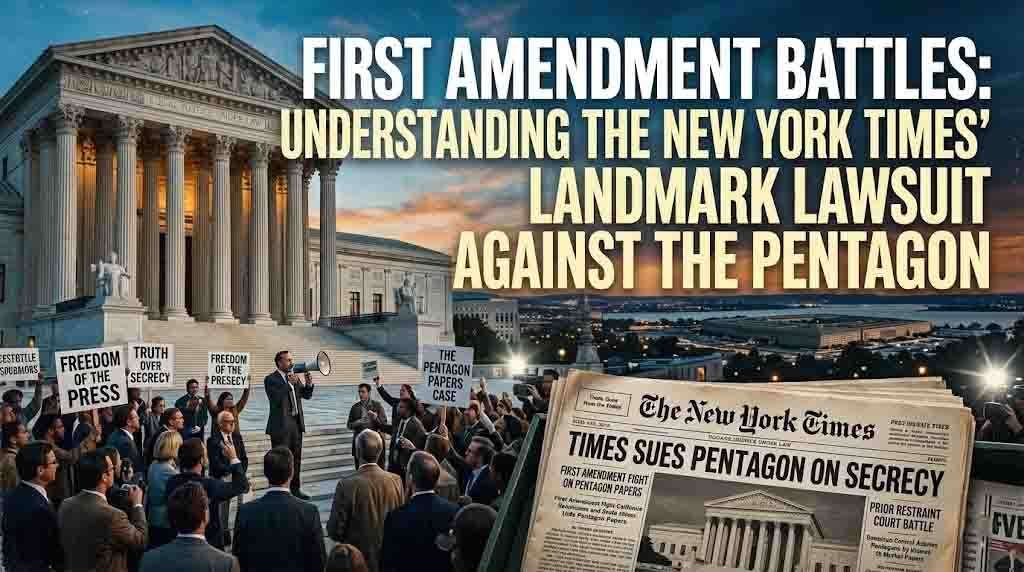
Fifty-four years after the most consequential press freedom case in American history, The New York Times is standing on the same ground — fighting the same government reflex to control what the public knows about its own military. The names have changed. The doctrine invoked has not.
On December 4, 2025, the Times filed suit in federal court in Washington, D.C., naming the Department of Defense, Secretary Pete Hegseth, and chief Pentagon spokesman Sean Parnell as defendants. The paper is seeking to overturn a Pentagon press policy that, in its current form, requires credentialed journalists to pledge they will not seek or report any information that defense officials have not explicitly authorized for public release — including unclassified material. Reporters who declined to sign that pledge surrendered their press credentials in October 2025. The Pentagon press room, once home to a bipartisan press corps including Fox News, CBS, CNN, and NBC correspondents, was subsequently repopulated with pro-administration media figures and content creators willing to accept the new terms.
The First Amendment says this cannot stand. The history of the American press says it has been tested before.
The Policy That Started the Fight
The escalation at the Pentagon did not happen overnight. Secretary Hegseth, a former Fox News host and Army veteran, moved incrementally through 2025 to reshape the conditions under which journalists could operate inside the building. In May, new escort requirements were introduced — a departure from decades of tradition under both Democratic and Republican administrations. By September, the new media policy arrived: news organizations would be required to formally acknowledge they would not report on, or even actively seek, any information that defense officials had not green-lit for release.
The policy gives Hegseth sole authority to determine which reporters retain access. The Times argued in its filings that this unchecked discretion — the ability to expel a journalist not for publishing classified material, but simply for working on a story the Secretary dislikes — creates a chilling effect on constitutionally protected newsgathering. “The policy is an attempt to exert control over reporting the government dislikes,” said Times spokesperson Charlie Stadtlander, “in violation of a free press’ right to seek information under their First and Fifth Amendment rights protected by the Constitution.”
The Reporters Committee for Freedom of the Press framed the constitutional concern plainly: the policy gives government officials unchecked power over who gets a credential and who does not — something the First Amendment has never tolerated.
1971: The Case That Built the Legal Foundation
To understand why the Times’ lawsuit carries such historical weight, you have to travel back to the summer of 1971. The Vietnam War was deep into its sixth year. Casualties were mounting. Public trust in the government’s official accounts was eroding. And a former Defense Department analyst named Daniel Ellsberg had photocopied more than 7,000 pages of a classified study commissioned in 1967 by then-Secretary of Defense Robert McNamara — a study that revealed, in systematic detail, that multiple presidential administrations had misled Congress and the American people about the scope, cost, and futility of American military involvement in Southeast Asia.
Ellsberg passed those documents to a Times reporter. On June 13, 1971, the Times began publishing. Three articles in, the Nixon administration secured a restraining order — the first time in American history that a federal court had successfully halted a newspaper’s publication on national security grounds. Ellsberg simultaneously handed the papers to the Washington Post, which began publishing as well. The government sought a second injunction. That one was refused.
The split between the circuits forced the matter to the Supreme Court. The entire legal process, from the original restraining order to the Supreme Court’s ruling, took fifteen days. In a 6-3 decision in New York Times Co. v. United States, 403 U.S. 713 (1971), the Court held that the government had not met the heavy burden of justification required to impose a prior restraint on the press. The papers could be published.
Justice Hugo Black, in his concurrence, was unambiguous: the government’s power to censor the press was abolished precisely to preserve the republic and protect the public’s right to know. Justice William Brennan added that only when publication would “inevitably, directly, and immediately” cause grave and irreparable harm could the government meet that bar. Publishing a decades-old history of Vietnam policy decisions did not meet it.
The ruling did not hand the press unlimited license. It established something more precise and durable: that the government faces an extraordinarily high — near-impossible — threshold when seeking to prevent publication in advance. The doctrine is called prior restraint, and it remains among the most disfavored forms of government censorship in constitutional law.
What’s Different in 2025 — and What Isn’t
Critics of the comparison might point out that the current dispute does not involve classified documents or prior restraint in the classic sense. No court has ordered the Times not to publish anything. The Pentagon’s mechanism is more surgical: rather than block publication after the fact, the new policy conditions access itself on a prior agreement not to independently gather information.
The Times’ legal theory is that this amounts to the same constitutional violation by a different mechanism. If a reporter must agree not to seek unauthorized information as a condition of receiving a press credential — and losing that credential restricts their ability to do their job — then the government has effectively created a prior restraint on newsgathering, not just on publication. The paper also argues that the policy’s due process violation is independent: press passes were revoked without notice, without stated cause, and without any avenue for appeal. Precedent from Trump’s first term is directly cited in the filings. In 2019, a federal court ordered the White House to restore CNN correspondent Jim Acosta’s press credential after it was revoked following a contentious briefing. The administration’s authority to determine access, the court found, was not unlimited.
What remains consistent across 1971 and 2025 is the underlying government rationale: national security. Pentagon officials have framed the new restrictions as “common sense” measures that protect military operations from unauthorized disclosures. Hegseth himself posted that “the ‘press’ does not run the Pentagon — the people do.” His press secretary, during a briefing exclusively for the newly installed press corps, stated that the legacy outlets would not be missed.
The Broader Ecosystem: Who Is Watching
The Times filed alone — deliberately, to move quickly. But it has not been isolated. The White House Correspondents’ Association called the suit “a necessary and vital step to ensure journalists can do their jobs.” CNN stated it would not surrender its journalistic principles in exchange for access. The Pentagon Press Association said the Defense Department’s attempt to limit how credentialed reporters gather news was “antithetical to a free and independent press and prohibited by the First Amendment.”
Notably, the original October walkout was bipartisan. Fox News correspondents participated. Newsmax correspondents participated. The objection to the policy’s constitutional overreach crossed the lines that otherwise divide the media landscape. That the Pentagon then constructed a replacement press corps from pro-administration influencers and commentators — granting them briefings while denying access to the outlets that declined to sign — only deepened the concern among press freedom advocates and First Amendment legal scholars.
Lawyers involved in the case have voiced a concern that extends beyond the Pentagon: if this policy survives legal challenge, similar restrictions could be installed at other federal agencies. The structure of the policy — pledge compliance or lose access — is legally portable.
What the Courts Will Have to Decide
Federal courts reviewing the Times’ suit will have to navigate several questions. Does the First Amendment protect not just publication, but the act of gathering information independently of government authorization? Does a credentialing system that gives a single official unchecked authority over press access violate the First Amendment’s prohibition on viewpoint-based discrimination? Does removing access without notice or appeal violate the Fifth Amendment’s due process clause?
The 1971 Pentagon Papers case does not answer these questions directly — it addressed prior restraint in its most classical form. But it established the philosophical premise upon which the Times’ current argument rests: that the government’s interest in controlling information about its own operations is not, by itself, sufficient to override press freedom. The Supreme Court majority in 1971 wrote that only a free and unrestrained press can effectively expose deception in government. That sentence reads differently — and more urgently — in 2025.
Why This Case Matters Beyond the Courtroom
Press access to the Pentagon is not a media industry concern. It is a civic one. The decisions made inside that building — about troop deployments, military strikes, defense spending, weapons systems, and international commitments — affect every American. The reporters who cover the Pentagon full-time are not adversaries of the military. They are, in the framework the Founders constructed, the mechanism by which the public remains informed about the exercise of executive power in its most consequential form.
The inspector general finding that Secretary Hegseth’s private Signal communications about pending U.S. airstrikes in Yemen may have placed American troops at risk — a story broken not by the new Pentagon press corps but by independent journalists — is the clearest evidence of why that mechanism matters. The stories being published by reporters who no longer hold credentials are the stories the Pentagon’s approved press corps is not covering.
A free press is not a courtesy the government extends to journalists it finds agreeable. It is a structural feature of democratic governance — one that American courts have defended, imperfectly but consistently, for more than two centuries. The Times’ lawsuit is an assertion of that structural principle. What the courts decide will determine whether the principle holds.
The outcome of New York Times Co. v. Department of Defense will be one of the most significant First Amendment rulings of the current era. Follow the case as it develops through the U.S. District Court for the District of Columbia.
Sources
- CNN Business. “New York Times sues Hegseth over Pentagon press crackdown.” December 4, 2025. https://www.cnn.com/2025/12/04/media/hegseth-new-york-times-pentagon-lawsuit-press
- NPR. “New York Times lawsuit creates a new headache for Pentagon chief Hegseth.” December 4, 2025. https://www.npr.org/2025/12/04/nx-s1-5631838/new-york-times-pentagon-defense-hegseth-lawsuit
- CNBC. “New York Times sues Defense Secretary Hegseth over media policy.” December 4, 2025. https://www.cnbc.com/2025/12/04/new-york-times-pentagon-pete-hegseth-lawsuit-media.html
- Military.com / Associated Press. “New York Times Suing Pentagon Over Defense Secretary Pete Hegseth’s New Press Rules.” December 4, 2025. https://www.military.com/daily-news/2025/12/04/new-york-times-suing-pentagon-over-defense-secretary-pete-hegseths-new-press-rules.html
- Justia U.S. Supreme Court. New York Times Co. v. United States, 403 U.S. 713 (1971). https://supreme.justia.com/cases/federal/us/403/713/
- Constitution Center. “New York Times Co. v. United States (The Pentagon Papers Case).” https://constitutioncenter.org/the-constitution/supreme-court-case-library/new-york-times-co-v-united-states-the-pentagon-papers-case
- FindLaw. “New York Times v. United States Case Study.” https://supreme.findlaw.com/supreme-court-insights/new-york-times-v-united-states-case-study.html
- First Amendment Encyclopedia (MTSU). “New York Times Co. v. United States (1971).” https://firstamendment.mtsu.edu/article/new-york-times-co-v-united-states/
- Bill of Rights Institute. “New York Times v. United States, 1971.” https://billofrightsinstitute.org/e-lessons/new-york-times-v-united-states-1971/