Thirty years ago, Pearl Jam tried to fight this battle and lost. In 1994, the band filed a formal antitrust complaint against Ticketmaster, triggering a federal investigation that ultimately went nowhere, left the company intact, and became, as one observer later noted, little more than a public-relations bruise. The machine kept running. The fees kept climbing. And the question of who actually owns the live music experience in America never got a real answer.
That question is finally before a jury.
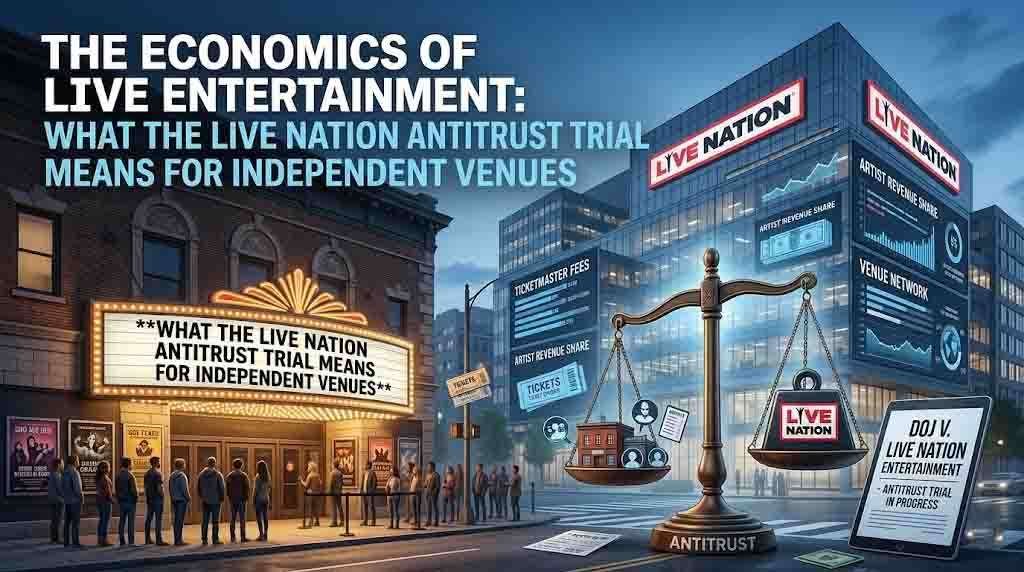
On March 2, 2026, the federal antitrust trial against Live Nation Entertainment and its subsidiary Ticketmaster began in Manhattan’s Southern District of New York — a case the DOJ filed in May 2024 alongside forty state attorneys general. The government’s argument is blunt: Live Nation has built an illegal monopoly over the live entertainment industry, controlling not just ticketing but concert promotion, venue ownership, and artist management simultaneously. The proposed remedy is equally blunt — break the company apart, separating Ticketmaster from Live Nation more than a decade after the two were allowed to merge in 2010.
What happens in that courtroom over the next six weeks matters far beyond the boardrooms of Beverly Hills. It matters in every mid-size city with a beloved music club that can’t turn a profit. It matters in every neighborhood where a developer with Live Nation backing just filed permits for a 3,300-seat theater nobody local asked for. And it matters to anyone who believes that culture, like food, is better when it comes from somewhere real.
How a Monopoly Gets Built
The mechanics of Live Nation’s dominance aren’t complicated once you see them laid out. The company controls the entire supply chain of a concert — it manages the artists, promotes the tours, owns or operates the venues, and processes the tickets through Ticketmaster. Each layer feeds the others. An artist signed to Live Nation management goes on tour promoted by Live Nation, plays in Live Nation venues, and sells tickets exclusively through Ticketmaster.
The DOJ’s complaint alleges that the company controls roughly 80% of major concert venue primary ticketing in the United States and holds exclusive arrangements with 265 concert venues. It directly manages more than 400 big-name artists. Live Nation has also, according to plaintiffs, retaliated against venues that dared to use competing ticketing services — a tactic corroborated in the original 2010 consent decree, which Live Nation promptly violated, forcing the DOJ to reopen it a decade later under the first Trump administration.
Live Nation’s attorney, David Marriott, pushed back in opening statements, calling his client a “fierce, lawful competitor” that brought 159 million people to 55,000 concerts in 2025 alone. The company argues competition in ticketing is fiercer than ever and that it does not hold monopoly power. It also pointed out, somewhat pointedly, that it did not promote Taylor Swift’s Eras Tour — though the DOJ wasted little time raising the infamous Ticketmaster site collapse during that onsale, citing internal company communications describing the system as held together by duct tape.
The jury will hear from Live Nation CEO Michael Rapino, musician Kid Rock, Roc Nation CEO Desiree Perez, Mumford & Sons keyboardist Ben Lovett, and Drake’s manager Adel Nur, among others. Twenty-five of the participating states are also seeking direct damages from consumers allegedly overcharged through Ticketmaster’s fee structures.
The Independent Venue Reality
While the legal arguments unfold in a Manhattan courtroom, the data from the ground has already told its story. According to the National Independent Venue Association’s first-ever comprehensive national economic impact study — The State of Live, released in June 2025 — 64% of independent venues, festivals, and promoters operated without profitability in 2024. In New York, that number climbs to 81%.
This is not a trivial or abstract statistic. NIVA’s study documented that the independent live sector generated $153.1 billion in total economic output in 2024, contributed $86.2 billion directly to U.S. GDP — more than the beer, gaming, and airline industries — and supported 908,000 jobs nationwide. These venues are not marginal operations existing on the fringes of the economy. They are the economy in countless American communities. And nearly two-thirds of them couldn’t turn a profit last year.
The structural pressure is multilayered. Staffing costs are rising. Artist fees are climbing. Insurance, rent, and mortgage payments eat into already thin margins. Meanwhile, industry observers note that Live Nation has pursued a strategy of subdividing its larger venues to compete for the mid-size shows that would otherwise have gone to smaller, independent spaces. Acquiring and, in some cases, closing competing venues is another tactic that independent venue representatives have flagged repeatedly in public testimony. When a local club operator loses a booking because the artist’s management sends them to a Live Nation-controlled room two miles away, the lost revenue can be the difference between a profitable quarter and a shuttered door.
The NIVA survey cited monopolies directly among the top operational challenges its members face — alongside rising insurance costs, scalpers, performing rights fees, and declining alcohol sales. That is not an industry complaining about market forces. That is an industry documenting a structural problem with a name.
The Vertical Integration Problem
What makes the Live Nation situation different from most corporate-consolidation stories is the depth of its vertical integration. Most monopoly concerns involve dominance in a single market. Live Nation has achieved simultaneous dominance across every market in its industry’s supply chain. An artist who signs with Live Nation management enters a system where their touring, their venues, and their ticketing are all controlled by the same entity. Saying no to any one part of the ecosystem means potentially losing access to all of it.
The DOJ’s complaint invokes the Sherman Antitrust Act — the same legislation used to break up AT&T in the 1980s. That parallel is instructive. AT&T controlled local telephone networks, long-distance service, and the manufacturing of telephones. Live Nation controls artist management, concert promotion, venue operation, and ticketing. The structural analogy is close enough that legal scholars have noted it. Whether Judge Arun Subramanian and the jury find the evidentiary case compelling is a separate question — but the architecture of dominance is not seriously in dispute.
The political dimensions add additional complexity. The case was filed under the Biden administration. Live Nation has since appointed Trump ally Ric Grenell to its board, and reporting from Bloomberg and Semafor indicates the company has spent months attempting to negotiate a settlement with DOJ officials outside the Antitrust Division. A group of Democratic senators, led by Amy Klobuchar, wrote to Attorney General Pam Bondi warning of exactly this scenario. The trial opened without a settlement — but the possibility hasn’t been ruled out, and political uncertainty over the DOJ’s ultimate resolve is, at this moment, real.
What a Breakup Could Mean
If the DOJ prevails and the court orders a structural remedy, the most likely outcome is the forced separation of Ticketmaster from Live Nation. This would not be without precedent. The AT&T breakup produced the “Baby Bells” and ultimately, over time, a more competitive telecommunications landscape. Whether a Ticketmaster spin-off would immediately produce meaningful competition in the ticketing space is harder to predict — the platform’s infrastructure is deeply embedded in venue contracts nationwide — but it would at minimum remove the self-reinforcing advantage Live Nation derives from owning both the promotion and the ticketing simultaneously.
For independent venues, the implications are practical. A separated Ticketmaster, competing on the merits of its technology and pricing rather than the leverage of its parent company’s venue portfolio, would create at least the theoretical possibility of independent venues negotiating ticketing arrangements without the implicit threat of losing access to tours and artists. That is not a small thing. The current system, as NIVA’s members have described it, leaves small venues with limited real choices when it comes to ticketing services — a characterization that tracks closely with the DOJ’s own language in its complaint.
The international picture is similarly pressured. In the UK, the Association of Independent Festivals documented that Live Nation controlled 66.4% of arena, stadium, and outdoor concert tickets in 2025 — well past the 40% threshold that defines a dominant market position under UK competition law. British festivals have been folding at an alarming rate, with two notable casualties in 2024 alone. The US trial, whatever its outcome, has already catalyzed renewed scrutiny by the UK Parliament’s Business and Trade Select Committee.
The Local Fight and What It Reveals
Perhaps the most telling indicator of how the Live Nation dynamic plays out in practice is what happened in Portland, Maine. In December 2024, word broke that Live Nation had quietly partnered with a developer to build a 3,300-seat venue in downtown Portland — a market already served by a vibrant network of independent music spaces. No community consultation. No public process. Just a press announcement.
The response was immediate. The Maine Music Alliance reactivated. More than 2,000 residents signed a petition. Around 150 musicians, venue owners, and fans packed city council chambers for a marathon eight-hour session. Six of the nine council members voted to put the project on ice. A corporation that had grown accustomed to moving without friction encountered something it apparently hadn’t fully prepared for: a community that understood exactly what was at stake and had the organizing infrastructure to push back.
That fight is a microcosm of what the antitrust trial is, at its core, about. Not just the mechanics of ticketing fees or venue booking percentages — but the question of who gets to decide what a local music scene looks like. Whether the answer is made in Beverly Hills by a publicly traded company optimizing for quarterly earnings, or by the people who actually live and work in a given city.
The Stakes Beyond Music
The Live Nation trial is worth watching even if live entertainment is not your primary concern, because the structural questions it raises apply across industries. What happens when a single company controls the infrastructure through which an entire sector operates? What obligations does antitrust law impose on vertically integrated corporations when that integration forecloses competition not through price-fixing or collusion, but through sheer positional dominance? These are not new questions in antitrust jurisprudence, but the Live Nation case poses them in an unusually visible and culturally legible way.
The concert hall is a cultural institution. Like the independent restaurant, the neighborhood bookstore, or the local hardware store, it does something that a corporate substitute cannot fully replicate — it is embedded in a community, responsive to local taste, financially vulnerable to the same economic pressures its customers face. When 64% of independent venues can’t turn a profit, and when the industry body representing them cites monopoly as one of its top operational headwinds, the problem is not that the market has spoken. The problem is that the market has been shaped, deliberately, by a company with the resources and the structural position to do so.
The jury in Manhattan will deliver its verdict on the legal merits. But the verdict on whether this kind of consolidation is good for the culture, good for artists, and good for communities has already been delivered by the numbers — and by the people who packed a city council chamber in Portland, Maine, for eight hours in the middle of a weeknight to fight for the right to keep their music scene their own.
Sources
- United States v. Live Nation Entertainment, Wikipedia, updated March 2026 — https://en.wikipedia.org/wiki/United_States_v._Live_Nation_Entertainment
- “Taylor Swift and Trump Loom Over Live Nation as Antitrust Trial Kicks Off,” The Hollywood Reporter, March 2026 — https://www.hollywoodreporter.com/business/business-news/taylor-swift-trump-live-nation-antitrust-trial-kicks-off-1236520803/
- “As Live Nation Antitrust Trial Begins, DOJ Tells Jury the Concert Industry Is ‘Broken’,” Music Business Worldwide, March 2026 — https://www.musicbusinessworldwide.com/as-live-nation-antitrust-trial-begins-doj-tells-jury-the-concert-industry-is-broken/
- “NIVA’s State of Live Survey,” Pollstar News, June 2025 — https://news.pollstar.com/2025/06/23/nivas-state-of-live-survey-finds-independent-venues-generated-153-1b-in-total-economic-output-across-u-s-in-2024-64-stages-struggling-with-unprofitability/
- “NIVA State of Live: How US Independent Venues Power Local Economies,” Hypebot, October 2025 — https://www.hypebot.com/hypebot/2025/10/niva-state-of-live-how-us-independent-venues-power-local-economies.html
- “Making Concerts Affordable Again: Live Nation-Ticketmaster Antitrust Lawsuits,” Cornell Journal of Law & Public Policy, November 2025 — https://publications.lawschool.cornell.edu/jlpp/2025/11/24/making-concerts-affordable-again-live-nation-ticketmaster-antitrust-lawsuits/
- “The Shifting Anti-Monopoly Landscape,” The American Prospect, September 2025 — https://prospect.org/2025/09/02/2025-09-02-shifting-anti-monopoly-landscape/
- “Musicians Against Live Nation–Ticketmaster,” Jacobin, October 2025 — https://jacobin.com/2025/10/live-nation-ticketmaster-music-industry
- “Canceling the Antitrust Show?” ProMarket, December 2025 — https://www.promarket.org/2025/12/11/canceling-the-antitrust-show-live-nation-ticketmasters-latest-attempt-to-keep-its-monopoly/
- “Live Nation 2024 Growth & Challenges for Indie Artists,” Link Media Partners, May 2025 — https://linkmediapartners.com/live-nation-2024-growth-challenges-for-indie-artists/