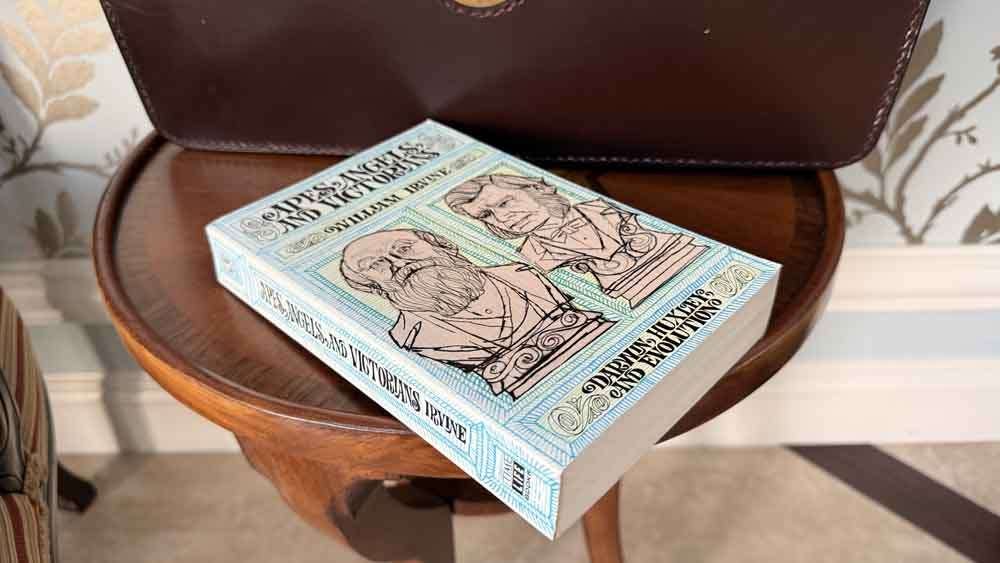
Few intellectual partnerships in history have been as lopsided in public glory and as quietly complicated in private as the one between Charles Darwin and Thomas Henry Huxley. Darwin supplied the idea; Huxley supplied the fight. Darwin retreated to Down House, cataloguing barnacles and nursing his chronic illness, while Huxley strode into lecture halls and debating chambers to defend a theory whose author could barely stand without his stomach seizing. William Irvine’s Apes, Angels and Victorians, first published in 1955, is the dual biography that chronicles this arrangement with biographical rigor and — when Irvine is at his best — prose sharp enough to cut through a century of hagiography.
The title itself is the whole drama in three words. Apes: the descent Darwin proposed. Angels: what the Victorians believed they were. Victorians: the world that had to reconcile the two, or break trying. Irvine, then a professor of English at Stanford, understood that the story of evolution’s acceptance was not primarily a story about evidence. It was a story about personality, timing, class, rhetoric, and the peculiar sociology of mid-nineteenth-century British intellectual life. He writes accordingly.
Two Men, One Theory, No Stage Big Enough for Both
What makes Irvine’s structure so interesting is that it refuses the easy narrative of seamless partnership. Darwin and Huxley were not two halves of the same man. They were, in almost every temperamental sense, opposites. Darwin was methodical, anxious, deeply reluctant to confront — a man who spent eight years studying barnacles after conceiving natural selection, not out of negligence but out of an almost pathological need to build an unassailable evidentiary foundation before anyone could look. Irvine captures him as the introverted genius who “assembled enormous masses of scientific data” with the patience of a man who knew that the idea he was carrying would rupture the world, and was in no hurry to light the fuse.
Huxley was a different animal entirely. Self-educated in his early years, possessed of a combativeness that was almost physical, he had none of Darwin’s private wealth or family comfort and none of his patience for diplomacy. When he read the Origin of Species in November 1859 — the day before its publication — he wrote Darwin a letter that stands as one of the most extraordinary pieces of intellectual loyalty in scientific history. He had finished the book, he said, and was ready, in his words, to “go to the stake” in support of it. He added a warning and a promise: that Darwin should expect “curs which will bark and yelp,” and that some of Darwin’s friends were “endowed with an amount of combativeness” that would stand him in good stead. The claws, Huxley promised, were already being sharpened.
That division of labor — Darwin thinking, Huxley fighting — was both the friendship’s greatest asset and its most quietly corrosive feature. Irvine doesn’t sentimentalize it. Darwin needed Huxley’s ferocity because he could not supply his own. Huxley needed Darwin’s theory because it gave his combativeness a worthy object. But what the arrangement cost Huxley — intellectually, personally, in terms of the original work he might have done — is a question Irvine leaves productively open.
Darwin in His Fortress
Irvine is at his most perceptive when describing Darwin’s working method, which was not passivity but a form of strategic withdrawal. The illness — which Irvine implies had a psychosomatic dimension, though writing in 1955 he wisely declines to diagnose it — kept Darwin largely immobile for significant stretches. What Irvine refuses to do is reduce Darwin to his infirmity. He shows instead a man of remarkable productivity whose correspondence alone constitutes one of the great intellectual archives of the century. Letters went out to naturalists on every continent. Seeds were soaked in seawater to test ocean dispersal. Darwin’s pigeon breeding shed behind Down House was as much a laboratory as anything in London, and the care with which he documented it was the same care that would eventually produce The Descent of Man, the Expression of the Emotions, the orchid studies, and the earthworm volume he was still writing at the end of his life.
The portrait that emerges is of a man who understood, at some deep level, that his ideas needed armor. Every piece of supporting evidence he gathered was a plate added to the theory’s hull. He was building something meant to survive centuries of criticism, and he knew it. The reluctance to publish was not cowardice; it was craftsmanship.
Huxley in the Arena
If Darwin was the architect, Huxley was the contractor who stood on the scaffolding in bad weather while the client stayed home. Irvine gives Huxley more than half the book, and the imbalance is justified. The arc of Huxley’s life is simply more dramatic — a broader range of activity, more public confrontations, more ideological evolution, and an eventual exhaustion that Irvine describes with the quiet sadness of watching a great engine run down.
The Wilberforce confrontation at Oxford in June 1860 is, of course, the set piece that every reader comes to. Irvine’s rendering of it helped cement the debate in the modern imagination, and it was Irvine’s account — along with Leonard Huxley’s version published in the Life and Letters — that eventually found its way into the Norton Anthology of English Literature, where it influenced generations of students. The famous exchange, in which Bishop Samuel Wilberforce supposedly asked whether Huxley traced his ape ancestry through his grandfather or his grandmother, and Huxley replied that he would sooner claim an ape than a man who used eloquence to obscure the truth — has since been complicated by historians who note that no contemporary press account recorded the exchange as it was later told. The debate’s most legendary lines appear to have crystallized in memory and retelling over the years rather than in any single transcript.
This is worth noting not to dismiss the encounter but to illuminate what Irvine was doing. He was writing literary biography as much as history, and he knew the power of a scene that captures something essentially true even if its specific words are disputed. What is not disputed is that Huxley stood his ground against the most formidable ecclesiastical orator in England, that the room was electric, and that Darwinism walked out of the Oxford University Museum with considerably more standing than it had walked in. The aftermath was real, whatever the exact words.
What Irvine traces with more sustained interest than the Oxford debate is Huxley’s long campaign to professionalize science in Britain — to wrest authority over natural questions from gentlemen amateurs, clerical reviewers, and aristocratic dilettantes, and hand it to men trained to ask those questions rigorously. This project, less dramatic than a single debate but ultimately more consequential, occupied decades of Huxley’s life. He sat on ten royal commissions. He helped build the system of technical education that would eventually reshape British industry. He coined the word “agnostic,” not as an act of atheism but as an act of intellectual honesty — a position that acknowledged the limits of what the human mind could know and refused to pretend otherwise. Late in life, he was still writing, still fighting, producing essays on ethics and the relationship between evolution and human civilization that showed a mind unwilling to settle for the simpler comforts of the theory it had spent a lifetime defending.
What the Friendship Cost
Irvine is too good a biographer to idealize the relationship. Darwin, for all his warmth in correspondence, remained at Down House while Huxley absorbed the public combat. The friendship was genuine — both men seem to have felt it as such — but it was also structurally unequal. Darwin’s reputation soared as natural selection became the organizing principle of biology. Huxley’s reputation, though substantial, was complicated by the very versatility that made him so useful. He was a scientist, an essayist, an educator, a public intellectual, a polemicist. In the Victorian taxonomy of achievement, that breadth was sometimes held against him. The specialist was becoming the gold standard, and Huxley, who was magnificent at everything, could be dismissed as a master of none.
There is a particular poignancy in Irvine’s account of Huxley’s later years — a man who had given the best of his intellectual energy to defending someone else’s idea, who spent his later decades complaining of age and infirmity, and who died at seventy looking, Irvine suggests, older than the life he had actually lived. The surprise is not that Huxley died young. The surprise is how much he accomplished and at what sustained personal cost.
Irvine the Writer
The book itself is a pleasure to read — partly because Irvine brings a literary critic’s ear to the prose of his subjects, quoting generously from the correspondence of both men, and partly because his own sentences have the kind of dry precision that biography at its best demands. He does not always resist what one Goodreads reviewer rightly called “flights of prose that are unnecessary,” and a reader today will occasionally feel the era in which the book was written pressing through the language. Published in 1955, Apes, Angels and Victorians predates the revisionist scholarship that has complicated the Oxford debate’s legendary status and has since been superseded by more specialized studies of Darwin and Huxley individually. But that is a criticism about encyclopedic completeness, not about literary or biographical quality. What Irvine set out to do — to render two extraordinary men and the civilization that shaped them and that they in turn reshaped — he does with skill and evident affection.
The book’s deeper argument, buried in the biographical detail but unmistakable once noticed, is about the price of intellectual courage in an age of institutionalized certainty. Darwin paid that price in anxiety and physical collapse, working alone on an idea that he knew would unsettle everything. Huxley paid it in combativeness — spending himself in public argument so that the idea could survive its earliest, most vulnerable years. Between the two of them, they moved a civilization. The question Irvine leaves quietly on the table is whether either of them got what they were owed for it.
Who Should Read This Book
Anyone who has ever been curious about the actual human texture of the Victorian period — not the costumes and the drawing rooms, but the intellectual pressure, the institutional friction, the slow and contested emergence of modern science as a profession — will find Apes, Angels and Victorians absorbing. It rewards readers who bring some familiarity with the period, as Irvine assumes a degree of background with figures like Herbert Spencer, Joseph Hooker, and Richard Owen. But it is not a specialist text. It is, at its heart, a book about two men who believed that the truth mattered enough to fight for, and who fought for it in the only ways their natures allowed — one in perfect, patient silence, and one in magnificent, exhausting noise.
A copy is easy to find — used paperback editions are available through AbeBooks and Amazon for a few dollars, which is a modest price for this much intellectual company.
If the evolution of ideas is the kind of territory you enjoy, my piece on Horizontal Gene Transfer: Why Darwin’s Tree of Life Is Actually a Tangled Web picks up some of the threads Irvine leaves behind — what happened to Darwin’s model after Darwin, and what science has done to complicate and deepen it.
You Might Also Like: Deserve’s Got Nothing to Do with It: Why Unforgiven Is the Greatest American Western Ever Made
Sources:
- Irvine, William. Apes, Angels, and Victorians: The Story of Darwin, Huxley, and Evolution. McGraw-Hill, 1955. Amazon
- Darwin Correspondence Project — British Association Meeting, 1860. darwinproject.ac.uk
- Oxford University Museum of Natural History — The Great Debate. oumnh.ox.ac.uk
- Smith, Jonathan. “The Huxley-Wilberforce ‘Debate’ on Evolution, 30 June 1860.” BRANCH: Britain, Representation and Nineteenth-Century History. branchcollective.org
- England, Richard. “Censoring Huxley and Wilberforce.” Notes and Records of the Royal Society, 2017. royalsocietypublishing.org
- Jensen, J. Vernon. “Return to the Wilberforce-Huxley Debate.” British Journal for the History of Science, 1988. filosoficas.unam.mx