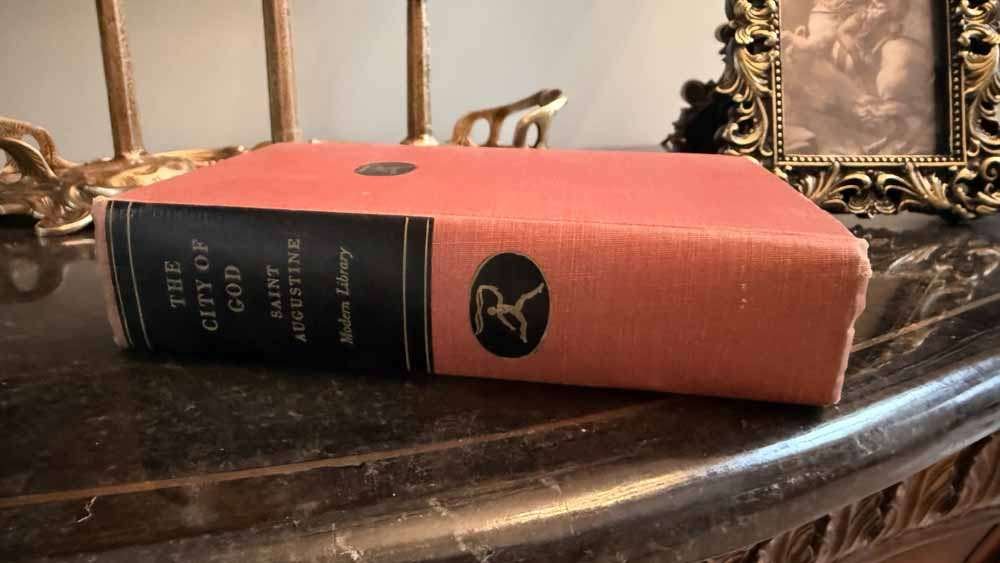
Few books in Western history have been composed under the pressure of genuine civilizational terror. Augustine began The City of God in 413 AD, three years after Alaric’s Visigoths sacked Rome — a city that had not fallen to a foreign enemy in eight hundred years. The psychological shock of that event rippled outward through the entire Roman world. Pagans blamed Christianity for weakening Rome’s ancient spiritual compact with its gods. Christians struggled to reconcile the fall of the city with their belief in a providential universe. Augustine, Bishop of Hippo in North Africa, sat down and wrote for the next thirteen years. What he produced was not a consolation pamphlet. It was nothing less than a complete philosophy of history, a metaphysics of the will, and the most consequential theological intervention since Paul’s letters — all of it in tense, restless conversation with Greek philosophy, most especially Plato.
The Debt to Plato
To read The City of God without understanding Augustine’s Platonic inheritance is to miss half the architecture of the argument. Augustine was, before his conversion, a devoted reader of Neoplatonist philosophy — particularly Plotinus and Porphyry — and his earlier encounter with Cicero’s Hortensius had already pointed him toward a life of philosophical inquiry rather than rhetorical ambition. By the time he writes The City of God, he carries Plato’s fingerprints on nearly every major category he deploys.
The most obvious inheritance is the distinction between the temporal and the eternal. Plato’s Republic posits a realm of ideal Forms — perfect, unchanging, and the true objects of real knowledge — against which the material world is shadow and imitation. Augustine translates this into theological terms: the City of God is eternal, its citizenship defined by love of the divine and contempt for earthly things; the City of Man is transient, built on the love of self to the exclusion of God. The structural move is Platonic. Two orders of reality, one permanent and one passing, with the soul’s orientation determining which city it inhabits.
Augustine also borrows Plato’s critique of the poets and the civic gods. Books one through five of The City of God constitute an extended demolition of Roman civic religion, an exercise in philosophical demythologization that Plato had pioneered in the Republic when he banished the poets for misrepresenting the divine. Augustine applies the same logic with greater ferocity: the Roman gods were morally deficient, demonstrably incapable of guaranteeing civic virtue, and their worship had not, in fact, protected Rome from disaster. The argument owes its sharpest edges to the Platonic tradition of holding the divine to a rigorous standard of goodness. A god who deceives, rages, or lusts — as the Olympians conspicuously did — cannot be the source of moral order.
And there is the matter of the soul. Augustine’s anthropology is shot through with Platonic assumptions about the soul’s dignity, its capacity for rational contemplation, and its restlessness in the material world. The famous opening of the Confessions — “our heart is restless, until it repose in Thee” — is not merely a devotional sentiment. It is a Platonic epistemological claim translated into Christian longing: the soul, by its nature, orients toward its true object and finds everything else insufficient.
Where He Parts Ways
The break, however, is sharp — and understanding it illuminates why Augustine was not merely a Christian Platonist but a genuinely new thinker.
For Plato, the soul ascends toward the divine by its own philosophical effort. The Republic, the Symposium, the Phaedrus all sketch a path of rational contemplation — rigorous, aristocratic, achievable by the philosophically disciplined mind. Salvation, to the extent the word applies, is an intellectual achievement. Augustine finds this intolerable, not because it demands too much of human reason, but because it demands nothing of grace. The Neoplatonists, he writes in The City of God, showed him the destination but gave him no road. They could describe the good, the true, and the beautiful from an intellectual distance; they could not cross the abyss between the contemplating mind and the living God.
This is where the Incarnation enters as a philosophical problem, not merely a theological one. Plato’s forms are approached asymptotically — the philosopher draws nearer through sustained intellectual effort, but the infinite qualitative gap between the finite mind and the ideal order remains. The Christian claim, as Augustine deploys it, is that the gap was closed from the other side. God became flesh. The mediation that Platonism was structurally unable to provide — a mediator who is simultaneously fully divine and fully human — is precisely what Augustine sees in Christ. He argues at length against the Neoplatonic demonology of Apuleius and Porphyry, who posited intermediary spirit beings as the appropriate objects of worship. These intermediaries, Augustine insists, cannot save because they are themselves caught between the mortal and the divine without being either fully. The only genuine mediator is one who is both, completely.
Equally significant is Augustine’s transformation of Plato’s account of the will. Plato, following Socrates, tended toward intellectualism: vice is ignorance, and to know the good is to pursue it. Augustine, drawing from his own biography with a specificity that still makes The Confessions feel shockingly modern, knew this to be false. He had known what was good and chosen against it, repeatedly, not from ignorance but from a divided will — what he calls the voluntas split against itself. The famous passage in Confessions about his prayer for chastity — “but not yet” — is the phenomenology of this experience. The City of God builds from this autobiographical insight into a full doctrine of the will and grace: human beings cannot reorient themselves toward the good by intellectual effort alone, because the will itself is disordered. Redemption requires not illumination but transformation — an act performed from outside the self.
This shift from intellect to will as the primary seat of the moral life is one of Augustine’s most consequential philosophical departures. It feeds directly into the debate between Pelagius and Augustine that would consume his later years: if human beings possess an unimpaired will capable of choosing good, grace is merely assistance and salvation is earned. If the will is structurally compromised by the Fall, grace is not assistance but rescue. Augustine hammered Pelagius with everything he had, and the Western church followed him. The consequences — theological, philosophical, and political — are still working themselves out.

What the Two Cities Actually Mean
The title metaphor of The City of God is frequently misread as a simple opposition between church and state, or between religion and secular politics. Augustine is considerably more subtle. The two cities are not institutional entities — they are not Rome and the Church as organizations. They are two kinds of love made social. The City of Man is constituted by amor sui — self-love, the orientation of will that treats the self, or the community, or the empire, as the ultimate good. The City of God is constituted by amor Dei — love of God above all, with love of neighbor following from it. These two cities are thoroughly mixed in the historical world. There are citizens of the City of God living within the Roman Empire; there are citizens of the City of Man within the institutional church.
This is philosophically important because it prevents the book from collapsing into mere theocracy. Augustine is not arguing that Christian Rome is the City of God made visible. He is arguing something harder to hear: that all earthly cities, including Christian ones, are built on a love that is at least partly disordered, and that the City of God cannot be identified with any human institution before the eschaton. The tension between temporal and eternal authority in Western political thought — the investiture controversy, the debates between popes and emperors, eventually the arguments of Locke and the theorists of secular government — runs directly through Augustine’s two-city framework. He set the terms even for those who would eventually argue against him.
The Unresolved Tensions
The City of God is not a resolved work. Augustine was too honest for that, and the problems he was wrestling with are genuinely hard.
The question of predestination and free will sits at the center of his thought like a fault line that never fully closes. If the will is disordered by sin and cannot reorient itself without grace, and if grace is not universally given, then the ultimate cause of damnation traces back, through a chain of causation, to God’s decision not to extend grace. Augustine knows this. He writes his way around it with the doctrine of original sin — we are justly condemned because Adam’s transgression corrupted the entire human family — but the asymmetry remains philosophically uncomfortable. Why is grace extended to some and withheld from others? Augustine’s answer is essentially that God’s judgments are inscrutable, which is theologically orthodox but philosophically unsatisfying, and Calvin would later draw out the implications of Augustinian predestinarianism with a rigor Augustine himself avoided.
There is also the question of history. The fall of Rome had convinced Augustine that history does not progress toward earthly perfection — the saeculum, the age between Christ’s resurrection and the last judgment, is not a period of continuous improvement but of mixed witness. And yet the sheer scale and ambition of The City of God implies a certain confidence in history’s intelligibility, a conviction that the pattern of two cities can be read in the historical record from Cain and Abel forward. Augustine is simultaneously skeptical about earthly progress and committed to historical meaning. That tension is productive philosophically, but it is not dissolved.
Those who have followed Augustine into the deep end of this debate — Hannah Arendt wrote her doctoral dissertation on his concept of love; Charles Taylor’s A Secular Age is unthinkable without him — find that his unresolved questions are more generative than most thinkers’ settled answers. The review of Darwin’s Origin of Species I wrote some time ago opened a similar vein: ideas powerful enough to reorganize entire fields of thought tend not to arrive fully tightened. They arrive with productive fractures built in.
Reading It Now
The City of God is 22 books long. It is demanding. The first ten books are primarily polemical — directed against Roman paganism and the Neoplatonists — and can feel slow to a modern reader unversed in the targets. Books eleven through twenty-two, where Augustine develops his positive theology of history, the soul, and the two cities, are where the real philosophy lives. A reader with limited time should at minimum read books eleven through fourteen, which contain his analysis of the will and the origins of the two cities, and books nineteen through twenty-two, which address peace, the end of history, and the vision of God.
The Henry Bettenson translation for Penguin Classics is readable and reliable. The R.W. Dyson translation for Cambridge University Press is more scholarly and better annotated.
What makes The City of God worth the effort in 2026 is not nostalgia for Christendom or any desire to relitigate medieval political theology. It is something more durable: Augustine is perhaps the most rigorous analyst in Western thought of what happens when a civilization’s foundational stories stop working. He watched Rome — the eternal city, the center of the known world, the referent by which everything else was measured — crack and fall. He did not flinch from the implications. He asked what it meant for the meaning of history, for the status of earthly institutions, for the nature of love and will and ultimate loyalty.
Those questions have not gone anywhere.
Sources
- Augustine. The City of God Against the Pagans. Trans. R.W. Dyson. Cambridge University Press, 1998. https://www.cambridge.org/us/universitypress/subjects/classical-studies/classical-studies-general/city-god-against-pagans
- Augustine. The City of God. Trans. Henry Bettenson. Penguin Classics, 2003. https://www.penguinrandomhouse.com/books/316783/city-of-god-by-augustine-of-hippo/
- Augustine. Confessions. Trans. Henry Chadwick. Oxford University Press, 2008. https://global.oup.com/academic/product/confessions-9780199537822
- Brown, Peter. Augustine of Hippo: A Biography. University of California Press, 2000. https://www.ucpress.edu/books/augustine-of-hippo/paper
- Taylor, Charles. A Secular Age. Harvard University Press, 2007. https://www.hup.harvard.edu/books/9780674026766
- Arendt, Hannah. Love and Saint Augustine. University of Chicago Press, 1996. https://press.uchicago.edu/ucp/books/book/chicago/L/bo3684003.html
- Chadwick, Henry. Augustine: A Very Short Introduction. Oxford University Press, 2001. https://global.oup.com/academic/product/augustine-a-very-short-introduction-9780192854520