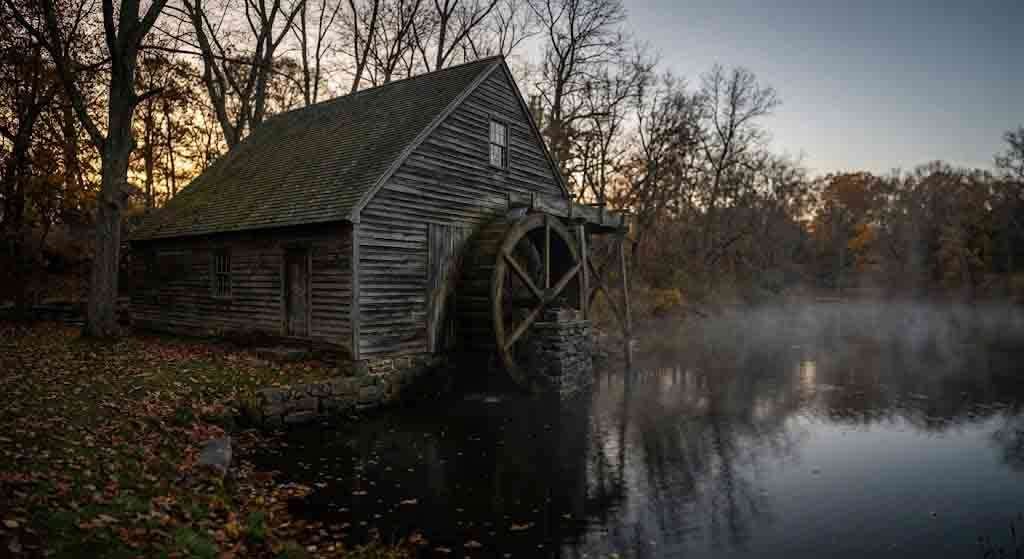
Every mill town on Long Island had its rhythm. Grain arrived by schooner and ox cart. The wheel turned. Flour left in barrels. Farmers waited, gossiped, settled debts. For over a century and a half, the Stony Brook Grist Mill held that rhythm together — grinding corn, wheat, and rye for families scattered across the Three Village area, functioning as the commercial and social center of a community that measured its calendar not by Sundays but by milling days. Then, in the autumn of 1871, a miller was found dead inside the works, the waterwheel jammed with debris, and the rhythm stopped.
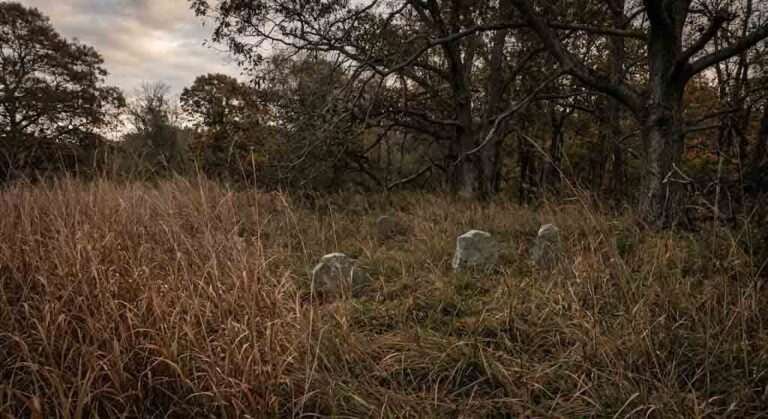
What happened that night has never been conclusively resolved. The coroner’s inquest returned a verdict of death by misadventure. The newspapers in Brooklyn and Riverhead printed conflicting accounts. The local families — Smiths, Davises, Bayleses, names carved into every headstone in the old burying ground — said nothing publicly and everything privately. The case folded in on itself like wet grain, and the man who died in that mill became a footnote in a story the North Shore decided it would rather not tell.
The Mill at the Center of Everything
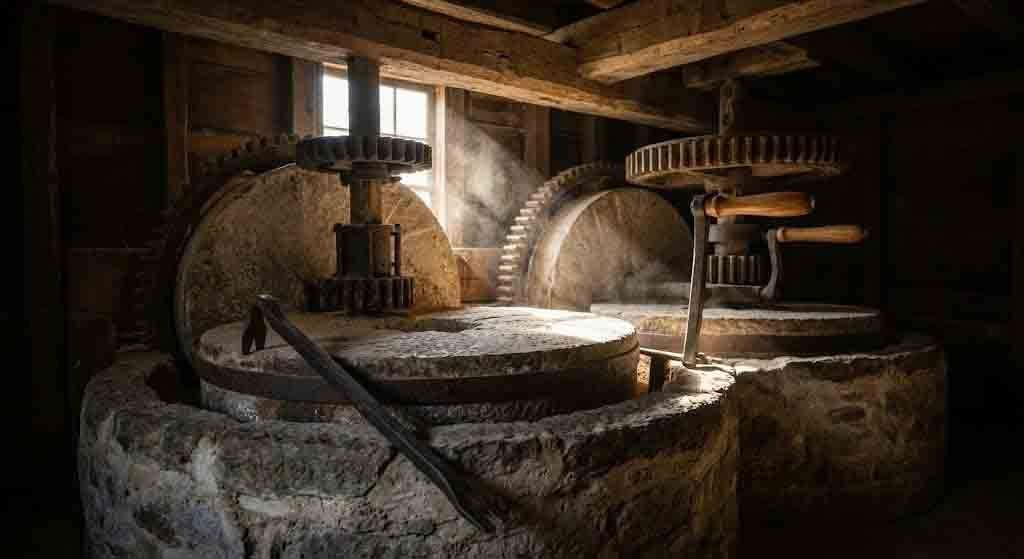
To understand the killing, you have to understand what a gristmill meant to a 19th-century Long Island village. The Stony Brook mill had been operating since 1699, when Adam Smith — son of Richard “Bull” Smith, the founder of Smithtown — was granted rights to the stream that the Setalcott people called Cutsgunsuck, meaning “brook laden with small stones.” Smith’s deal was straightforward: build and maintain the mill, and you collect a tenth of all wheat and an eighth of all corn and rye that passes through. That arrangement made the miller one of the most powerful men in the village. Not the wealthiest, necessarily, but the most necessary.
By the mid-1800s, the Stony Brook mill was handling enormous volume. Schooners carrying up to a hundred tons of grain were unloading directly at the mill site. The operation had expanded to include lumber sawing alongside the milling, and a tannery had established itself adjacent to the mill works, sharing the water power from the pond that straddled the Brookhaven-Smithtown boundary. The mill was no longer just a place where a farmer brought a bushel of corn. It was an industrial operation — small by Manhattan standards, but significant enough to attract outside capital and outside labor.
That combination — outside money meeting local tradition — is where the trouble started.
The Economic Fracture
The years following the Civil War brought rapid change to Suffolk County. The old agrarian order that had governed the North Shore since the colonial period was cracking. The families who had held land since the 1600s and 1700s — English and Dutch descendants who considered themselves the rightful inheritors of the soil — found themselves competing with a new class of entrepreneurs, many of them from Brooklyn and lower Manhattan, who saw opportunity in Long Island’s mills, quarries, and timber.
At the same time, the labor pool was shifting. The Great Famine had driven hundreds of thousands of Irish men and women to America between 1846 and 1851, and by the 1860s and 1870s, their children were the ones doing the heavy work on Long Island’s farms and in its workshops. The Irish had already figured prominently in Suffolk County’s most notorious crime: the Wickham axe murders of 1854, in which an Irish farmhand named Nicholas Behan butchered a wealthy Cutchogue farmer and his wife after being dismissed from employment. That case — which ended with Behan’s public hanging in Riverhead before a crowd of three thousand — cast a long shadow over labor relations on the Island for decades.
The arrangement at the Stony Brook mill in 1871 was typical of the era’s tensions. The mill had passed through several hands since the Revolution. The owner at the time was an outside investor with brewing interests in Brooklyn, and the day-to-day milling was handled by hired men — including, by several accounts, at least two Irish laborers who worked the heavy lifting of sacking flour, maintaining the millrace, and repairing the waterwheel mechanism. These men answered to the head miller, a local man from one of the established families, who answered to the absentee owner, who answered to nobody in Stony Brook at all.
The hierarchy was clear. The profits were not. Millers in this period were typically paid a percentage of the grain they processed, a holdover from the colonial toll system. But the absentee ownership model introduced cash wages for the laborers beneath the miller, and disputes over pay, hours, and working conditions were constant. The tannery workers, who used the same water supply, added another layer of friction. When the millrace ran low in dry months, the question of who got priority — the gristmill or the tannery — was not academic. It was existential.

The Night of the Killing
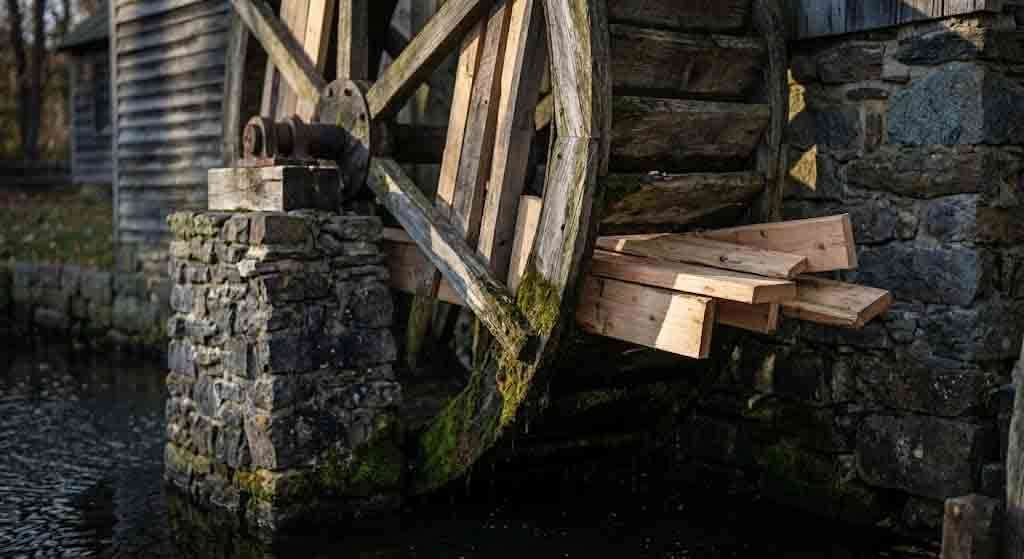
The details of what happened in the autumn of 1871 depend on which account you read. The Brooklyn Daily Eagle ran a brief item noting that a mill worker had been found dead “in circumstances suggesting foul play” at a gristmill in Suffolk County. The local press in Riverhead was more specific but more careful, reporting that the head miller had been discovered in the early morning hours by a laborer arriving for the day shift. The body was found near the main drive mechanism. The waterwheel had been jammed — not by natural debris, but by what appeared to be a deliberate obstruction. Planks from the adjacent lumber operation had been wedged into the wheel housing in a way that stopped the mechanism cold.
The miller’s injuries were consistent with blunt force trauma to the head and torso. The coroner noted bruising on both arms suggesting a defensive posture. A heavy iron pry bar, normally used for adjusting the millstones, was found nearby with what witnesses described as blood and hair. The millstones themselves had been disengaged — a detail that struck several observers as significant, because it suggested the killer understood the machinery well enough to shut it down before or after the attack.
No formal charges were ever filed. The coroner’s inquest, held within days, heard testimony from five witnesses — all local men, all from established families. The Irish laborers who worked at the mill were questioned but their testimony, if it was recorded, does not survive in the Suffolk County records. The verdict was death by misadventure, with a note suggesting the miller may have become entangled in the machinery during a nighttime inspection.
Nobody believed it.
The Silence of the Village
Small towns on 19th-century Long Island did not operate by the same rules as Brooklyn or Manhattan. There was no professional police force in the Three Village area. Law enforcement meant the county sheriff in Riverhead, twenty miles away, and whatever constables the townships appointed — men who were themselves embedded in the same families, the same churches, the same debts and alliances that governed every other aspect of village life.
When a crime occurred in a place like Stony Brook, the community had two options. It could pursue justice through the formal legal system, which meant outside scrutiny, newspaper attention, and the airing of disputes that everyone preferred to keep private. Or it could handle the matter internally — through social pressure, economic punishment, and the kind of enforced silence that functions as its own verdict.
The Wickham murders of 1854 had demonstrated the first path. The manhunt for Nicholas Behan had mobilized hundreds of armed men across the North Fork. The Long Island Rail Road ran a special train for the funeral. The trial in Riverhead brought the attorney general of New York State to prosecute. The hanging drew thousands. It was public, spectacular, and cathartic. But it was also deeply embarrassing for the old families, because it exposed the conditions under which they employed their labor — the isolation, the low pay, the casual cruelty of the class divide between English Protestant landowners and Irish Catholic field hands.
By 1871, the calculus had shifted. The established families of the Three Village area had no interest in another public spectacle. If the miller’s death involved a dispute over wages, or a confrontation with one of the Irish laborers, or — as some whispered — a conflict with the absentee owner over the mill’s finances, then bringing it to trial meant bringing all of it to light. The ownership arrangements. The labor conditions. The question of who was profiting from the mill and who was being ground down by it.
Better to call it an accident. Better to bury the man and fix the wheel and get back to milling. The village needed its flour more than it needed its justice.
The Fire That Erased the Evidence
In a detail that has never been adequately explained, a fire broke out at the mill complex not long after the miller’s death. The blaze destroyed portions of the gristmill structure and leveled the adjacent tannery entirely. Contemporary accounts attributed the fire to carelessness — a lamp left burning, or perhaps hot work from the tannery operation. But the timing was conspicuous enough that it lodged in local memory as something more than coincidence.
Fires at mills were not unusual. The combination of dry grain dust, wooden structures, open flames for heating and lighting, and the chemical processes of tanning made these buildings perpetually vulnerable. But a fire that destroyed the very building where a man had recently died under suspicious circumstances — that particular fire carried a different weight. It erased whatever physical evidence remained. It ended whatever informal investigation might have been underway. It gave the community its final excuse to close the book.
The mill was eventually rebuilt. The tannery was not. The ownership changed hands again. And by the time Edward Kane — the Brooklyn brewer who would plant Catawba grapes on the island in the Mill Pond and turn the gristmill into a winery — arrived in the late 1800s, the events of 1871 had been reduced to the kind of story that old men told at the general store. A story with no names, no charges, no resolution. Just a dead miller, a jammed wheel, and a fire that came along at exactly the right moment.
What the Records Don’t Say
The challenge of reconstructing this case in the present is that the primary sources are fragmentary and contradictory. The Suffolk County court records from this period are incomplete. Many documents were lost to fire, flood, and institutional neglect over the intervening century and a half. The newspaper coverage — what survives of it — is thin and hedged, reflecting the editorial caution of publishers who depended on the same local families for advertising revenue and social standing.
What the records do confirm is the broader pattern. Mid-to-late 19th-century Long Island was a place where economic transformation collided with entrenched social hierarchy, and the collision produced violence. The Wickham murders. The labor disputes at the quarries in Cold Spring Harbor. The tensions between established Anglo-Dutch families and the immigrant laborers — Irish, German, and later Italian — who did the work that made their estates profitable. The Stony Brook mill killing fits squarely within that pattern, even if the specific details have been sanded down by time and deliberate erasure.
The Stony Brook Grist Mill still stands today, restored and maintained by the Ward Melville Heritage Organization as a working museum and National Register landmark. Visitors watch the miller grind corn into flour using the same mechanisms that have operated on this site for over three hundred years. The wheel turns. The stones grind. The rhythm continues.
But if you visit on a quiet afternoon and listen past the mechanical rumble, past the schoolchildren and the gift shop chatter, you might catch something else in the air. The mill remembers what the village chose to forget. A man died here under circumstances that everyone understood and nobody would say out loud. The wheel was jammed. The fire came. The story ended before it was ever properly told.
That is how justice worked on the 19th-century North Shore. Not with a verdict, but with silence.
You Might Also Like:
- The Wickham Murders of 1854: Murder on Long Island — Geoffrey K. Fleming and Amy K. Folk’s definitive account of the Cutchogue axe murders
- The Stony Brook Grist Mill — Ward Melville Heritage Organization — Visit the mill, open Sundays April through October
Sources:
- Ward Melville Heritage Organization, “The Stony Brook Grist Mill,” wmho.org
- Wikipedia, “Stony Brook Grist Mill,” en.wikipedia.org
- Gothic Horror Stories, “Tales of Old Stony Brook I: The Haunting of the Stony Brook Grist Mill,” gothichorrorstories.com
- I Love NY, “Stony Brook Grist Mill,” iloveny.com
- Washington Spy Trail, “Stony Brook Grist Mill, c. 1751,” washingtonspytrail.com
- Southold Historical Society, Murder on Long Island: A Nineteenth-Century Tale of Tragedy & Revenge by Geoffrey K. Fleming and Amy K. Folk, The History Press, 2014
- Suffolk County Historical Society, Riverhead, NY — court records and newspaper archives
- Dan’s Papers, “Historic Axe Murders Re-Examined,” danspapers.com
- Kerriann Flanagan Brosky, Ghosts of Long Island II, 2006