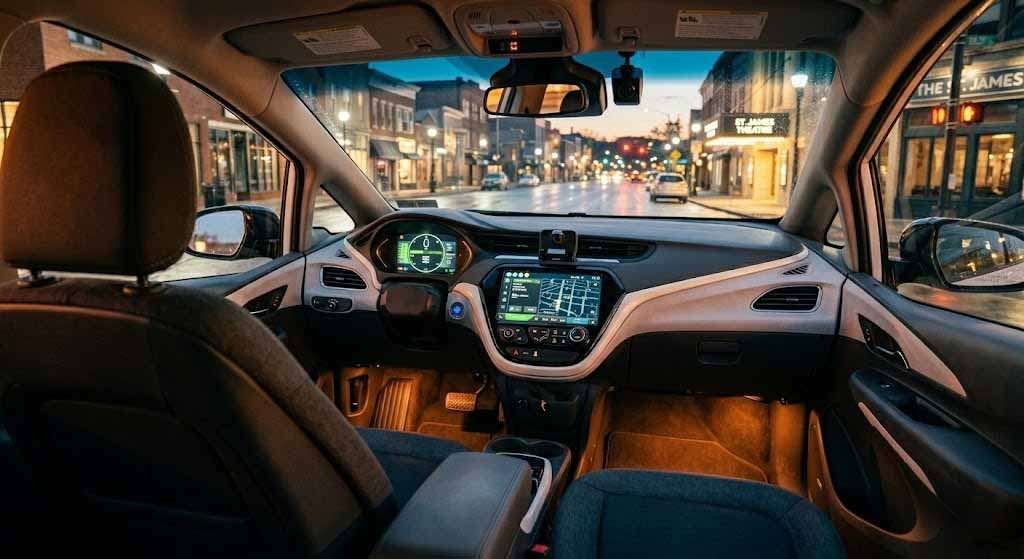
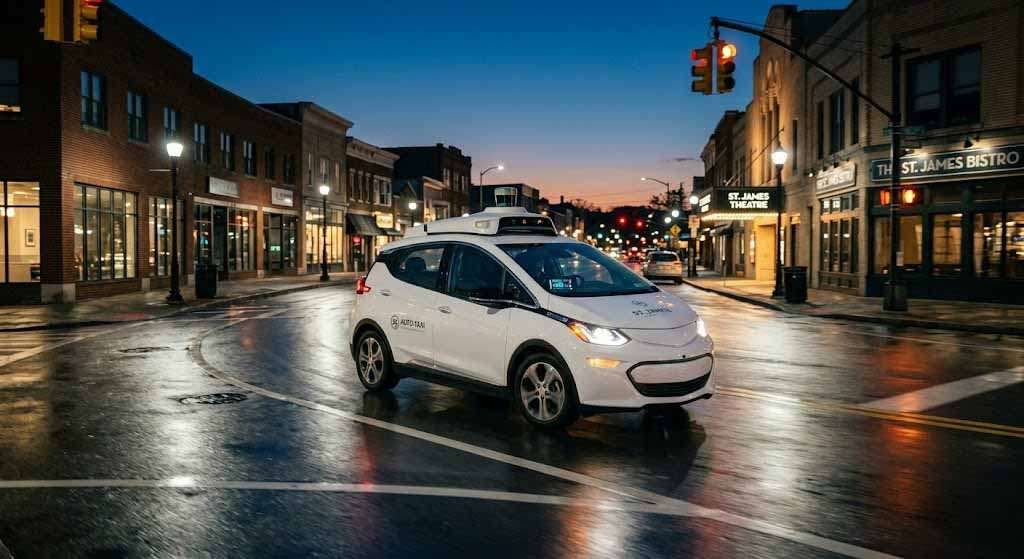
While Tesla has been promising Full Self-Driving “next year” for about a decade now, Waymo quietly crossed a threshold that most of the industry said was still years away. As of late 2025, the company is running over 450,000 fully driverless paid rides per week across San Francisco, Los Angeles, Phoenix, Austin, Atlanta, and Miami. No safety driver. No steering wheel grab. No one in the front seat at all. Just a Jaguar I-Pace rolling through city streets guided by sensors, neural networks, and a decade and a half of obsessive engineering. The number is expected to hit one million weekly rides by the end of 2026. That’s not a pilot program. That’s a commercial transportation business.
The headlines kept calling it a “tipping point” — but tipping points don’t usually feel like anything until you’re past them. This one is worth understanding in detail, because the technical and legal questions it raises aren’t going away. They’re coming for every city in America, including the ones on Long Island, whether we’re ready or not.
What Waymo Actually Is — and What It Isn’t
Waymo started as Google’s self-driving car project in January 2009. For nearly a decade it was a research operation. In 2018, it became a commercial service in Phoenix, pulling its safety driver from the vehicle and letting real passengers pay for real rides. Every milestone since has been earned the slow way: mapped city by mapped city, edge case by edge case, million miles by million miles.
By February 2026, Waymo had logged 200 million miles driven fully autonomously on public roads. That number matters because scale is the only honest test in this field. Anyone can make a prototype work in good conditions. Making it work in dense city traffic, in rain, at night, through school zones, next to erratic human drivers — that’s the actual problem. Waymo has been solving it for seventeen years.
What it is not is everywhere. Waymo operates at SAE Level 4 autonomy — fully driverless, but only inside a defined operational design domain. The vehicle has to be in a city that Waymo has extensively HD-mapped. Every street, every curb, every traffic signal has been catalogued with centimeter-level precision. Drop a Waymo outside its mapped zone and it won’t move. This is the key constraint that separates Waymo from what most people picture when they imagine autonomous cars: it is not a general-purpose robot driver. It is a highly specialized one, built for specific environments and operating brilliantly within them.
The Sensor Stack: Why This Technology Works the Way It Does
The debate at the center of the autonomous vehicle industry is a simple one with enormous consequences: how many ways does a car need to perceive the world in order to make life-and-death decisions reliably?
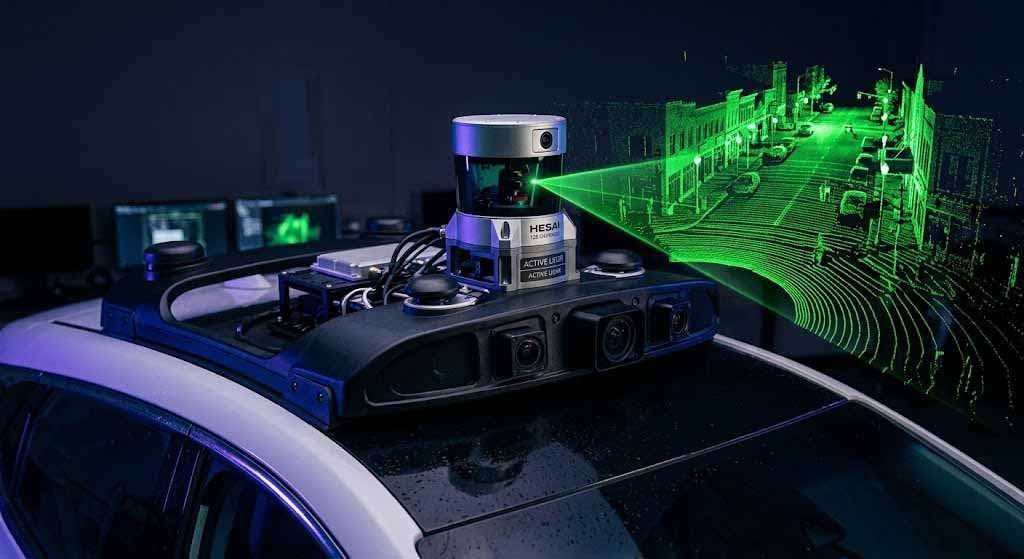
Waymo answers with redundancy. Its sixth-generation robotaxis carry 13 cameras, 4 LiDAR units, 6 radar sensors, and dedicated audio receivers. LiDAR — Light Detection and Ranging — fires laser pulses and measures how long they take to return, constructing a detailed 3D point cloud of everything within 300 meters. It sees depth, not just color. It works in the dark. It builds a real-time model of the physical world that no camera alone can replicate. Radar, meanwhile, detects moving objects behind other vehicles and through conditions that defeat optical sensors. The cameras handle color, lane markings, traffic signals, signage. All three systems run simultaneously, cross-checking each other through a sensor fusion architecture. When one sensor’s data is ambiguous, the others compensate. The result is a perception system with genuine redundancy — the same engineering philosophy that goes into commercial aviation.
Waymo initially used a $75,000 Velodyne LiDAR unit on its early test vehicles. By 2017, it had designed its own — cutting the cost by 90 percent. Today the full sensor suite runs approximately $12,700 per vehicle. That’s still significant, but it’s a fraction of where it started, and the trajectory is downward.
Tesla took the opposite bet. Elon Musk called LiDAR a “fool’s errand” in 2019. Tesla’s Full Self-Driving system uses eight cameras and an end-to-end neural network — the thesis being that since humans drive with vision alone, machines should be able to as well. The approach is cheaper to manufacture, works across any geography without pre-mapping, and has access to a massive training dataset from millions of Tesla vehicles collecting data every day. But it has a documented problem: camera-only systems struggle in conditions where visibility is compromised. Fog, heavy rain, snow, and certain edge cases have produced phantom braking, missed traffic signals, and failure to stop for school buses. Current Tesla FSD disengagement data shows approximately one human intervention required every 13 miles in real-world driving — a number that makes unsupervised robotaxi operation statistically impossible to defend at scale.
The argument is not settled. Tesla’s defenders point out that the training data advantage could eventually produce a camera-only system capable of matching multi-sensor performance — the way chess engines eventually crushed human players through sheer computational force rather than mimicking human strategy. The counterargument is that you can’t deploy that system commercially while you’re still building it. Waymo’s multi-sensor approach is operational now, at scale, with a safety record that NHTSA data consistently shows outperforming human drivers. Waymo reports a 90 percent reduction in serious injury crashes compared to human drivers across 127 million miles of fully autonomous operation. That’s not a simulation. That’s field data.
Where Waymo Stands in 2026
Backed by a $16 billion funding round that values the company at $126 billion, Waymo is moving fast. The round was led by Dragoneer Investment Group, DST Global, and Sequoia Capital, with Alphabet remaining the majority investor. Plans announced for 2026 include service launches in Nashville, Washington D.C., Detroit, Las Vegas, San Diego, Denver, and — in the company’s first international deployments — London and Tokyo. Waymo vehicles were spotted testing in Chicago in February 2026. The company has received permits to serve passengers at San Francisco International Airport and San Jose Mineta International Airport, and is operating employee shuttles at Miami International. Testing is now authorized across 26 of the top 30 U.S. metro areas.
The fleet as of late 2025 consists of roughly 2,500 robotaxis, primarily customized Jaguar I-Pace electric vehicles. Hyundai Ioniq 5 and Zeekr Ojai models are coming next, with a manufacturing facility in Mesa, Arizona being scaled up to eventually produce tens of thousands of vehicles annually. The sixth-generation platform is designed to reduce operating costs substantially, which matters because the current per-vehicle cost — sensor suite, software, monitoring infrastructure, and personnel — is the primary barrier to profitability at scale. Analysts estimate that robotaxi rides could eventually cost more than 60 percent less than human-driven rides. Human-driven rides currently average around $3.25 per mile. Eliminate the driver and you change the math of urban transportation entirely.
The expansion has not been without friction. In January 2026, both the NHTSA and the NTSB opened investigations into Waymo after a series of incidents in school zones — including a low-speed collision with a child in California who ran out from behind a parked vehicle. A power outage in San Francisco briefly immobilized Waymo’s entire fleet city-wide. These are legitimate concerns. They don’t cancel the safety data, but they do confirm what any honest assessment of the technology must acknowledge: Level 4 autonomy is not Level 5. Edge cases still exist. The system can encounter situations its training didn’t fully anticipate. And in a school zone at 3 PM, the margin for error is zero.
The Insurance and Liability Problem Nobody Has Solved Yet
Traditional auto insurance is built on a simple premise: the driver is the proximate cause of most accidents. The NHTSA estimates that over 90 percent of crashes involve driver error as the critical factor. Remove the driver, and you remove the foundation that the entire liability architecture was built on.
When a Waymo vehicle causes an accident, there is no driver to blame, no negligence to assign, no insured individual to pursue. Liability flows upward to the manufacturer and operator under product liability law — the same legal framework used when a defective appliance injures someone. If the system failed, the company that designed, deployed, and operated the system is responsible. This is the emerging consensus among legal scholars, and several states are beginning to codify it. California didn’t even allow law enforcement to issue basic noncompliance notices to driverless vehicles until 2026. The regulatory framework is, to put it charitably, a work in progress.
For fleet operators like Waymo, this means commercial liability policies rather than personal auto insurance — policies that don’t yet have decades of actuarial data behind them. The practical result is a complicated situation for accident victims: multiple parties potentially at fault (manufacturer, software developer, fleet operator), “black box” data that requires expert analysis to interpret, and legal frameworks that vary state by state. In Texas and Florida, laws were written when the primary question was whether a human driver had been negligent. Those laws don’t translate cleanly to a situation where the vehicle made every decision autonomously. A Florida jury already awarded $243 million in a case against Tesla after a fatal Autopilot accident in 2025, with the case hinging on whether the company had misrepresented the system’s safety capabilities. Courts are moving faster than legislatures.
Waymo itself carries commercial liability coverage and has publicly committed to accepting responsibility for accidents that occur during autonomous operation. That’s a meaningful position — and more than can be said of some competitors. But the legal infrastructure surrounding it is still being assembled in real time, often in response to specific incidents rather than coherent policy. In February 2026, Waymo testified before the U.S. Senate Committee on Commerce, Science, and Transportation, arguing for uniform national standards for autonomous vehicle deployment. Without them, they warned, U.S. companies risk losing the global AV market to Chinese firms that operate under a more permissive regulatory regime. It’s a legitimate concern.
When Does Long Island See Autonomous Ride-Sharing?
Not soon. The honest answer requires understanding why Waymo is operating in San Francisco and Phoenix rather than here: density, weather, regulatory environment, and mapping investment all have to align. Long Island’s suburban geography — arterial roads, strip malls, school zones, sporadic pedestrian behavior, genuine winter weather — creates a different problem set than the gridded streets of a dense urban core. The infrastructure investment required to HD-map Nassau and Suffolk counties at the resolution Waymo requires would be enormous. And the regulatory framework in New York State for autonomous commercial vehicle operation is still developing.
The more likely path is incremental. Highway autonomous driving — where vehicles handle long stretches of controlled-access road — is an easier technical problem and one where several manufacturers are already operating. The Long Island Expressway at 2 AM is a fundamentally more tractable environment than the intersection of Route 25A and a school dismissal. From there, geofenced suburban service areas — specific towns or corridors with full HD mapping — could follow, probably not before the early 2030s for a market like Long Island. The infrastructure changes coming to the Island, including the ongoing debates about transit, commuter rail, and road capacity, are happening in parallel to a technology that could eventually alter the conversation about car ownership entirely. It’s worth keeping both in view. I’ve written before about how New York City’s tech expansion is reshaping the region, and autonomous transportation is part of that same picture — it will arrive from the city outward.
For anyone interested in how AI systems are making complex real-world decisions at scale, the rise of autonomous vehicles connects directly to the broader story of agentic AI systems — machines that don’t just respond to prompts but perceive environments and act within them continuously. The Waymo stack is one of the most sophisticated deployed examples of that architecture in existence. And for a deeper look at how AI is quietly moving from server farms into the physical world, this piece on local AI traces some of that same trajectory.
The Real Question Behind the Number
Four hundred and fifty thousand paid driverless rides per week is not just a metric. It is a proof of concept that has crossed into proof of operation. The arguments against autonomous vehicles — that they can’t handle complexity, that the liability is too murky, that the technology isn’t ready — are no longer theoretical. They are empirical questions being answered in real time, in real cities, with real people in the back seat.
Waymo is not perfect. The school zone incidents are serious. The power outage that froze an entire city fleet is a systems design problem that hasn’t been fully solved. The legal framework governing liability is a patchwork that will require years of legislative work to sort out. None of that changes the fundamental data point: Waymo is operating a profitable commercial robotaxi service, without drivers, at a scale that makes it impossible to dismiss.
Tesla will keep promising Full Self-Driving next year. Waymo will keep running rides this week. The tipping point already came. Most people just didn’t notice.
Sources
- Waymo, 2025 Year in Review, December 2025
- Bloomberg, Waymo Co-CEO Outlines Path to 1 Million Weekly Trips in 2026, February 2026
- TechCrunch, Waymo Raises $16 Billion to Scale Robotaxi Fleet Internationally, February 2026
- Automotive World, Waymo’s Metric for 2026 Success: One Million Weekly Rides, February 2026
- Fortune, Waymo Executive on LiDAR and Radar Safety, August 2025
- Drivetech 360, Sensor Wars: Waymo vs. Tesla in the Robotaxi Revolution
- Brookings Institution, Setting the Standard of Liability for Self-Driving Cars, August 2025
- Technology.org, How Vehicle Technology Is Changing Car Accident Liability in 2026, March 2026
- Wikipedia, Waymo, accessed March 2026
- GF GuruFocus, Waymo Expands Robotaxi Footprint as 2026 Becomes a Crucial Test, December 2025