
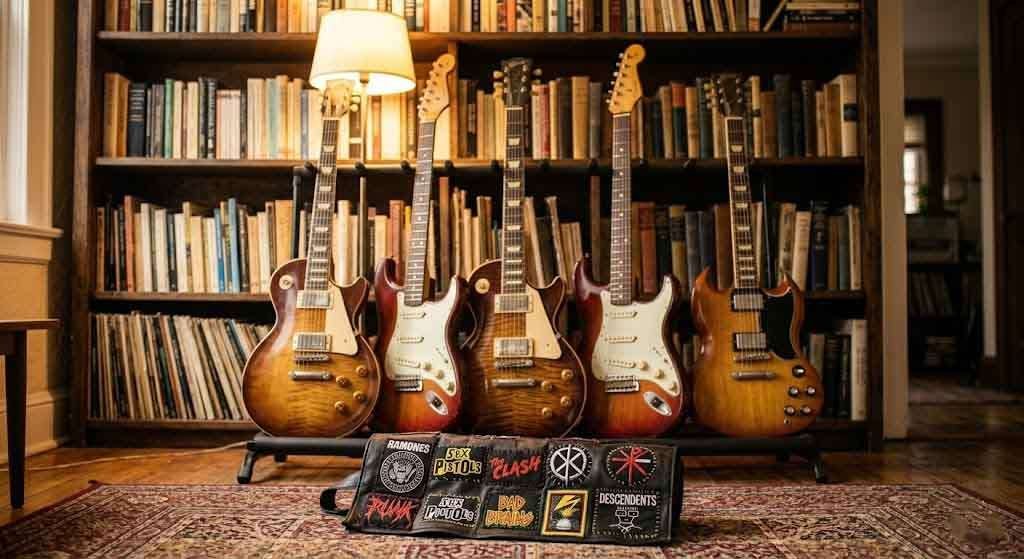
It starts with two companies in postwar America arriving at the same problem from opposite directions. The problem was this: guitarists needed more volume, more presence, more authority in a world that had just discovered amplification and didn’t know what to do with it. Leo Fender was a radio repairman from Fullerton, California. He thought about the guitar the way a machinist thinks about a lathe — what does it need to do, and how do I build something that does it efficiently? Ted McCarty at Gibson thought about it the way a furniture maker thinks about a dining room table — it needs to be beautiful, it needs to be substantial, and it needs to last.
Both approaches worked. Both are still working seventy years later. And the argument between them has never been settled because it was never really about the guitars.
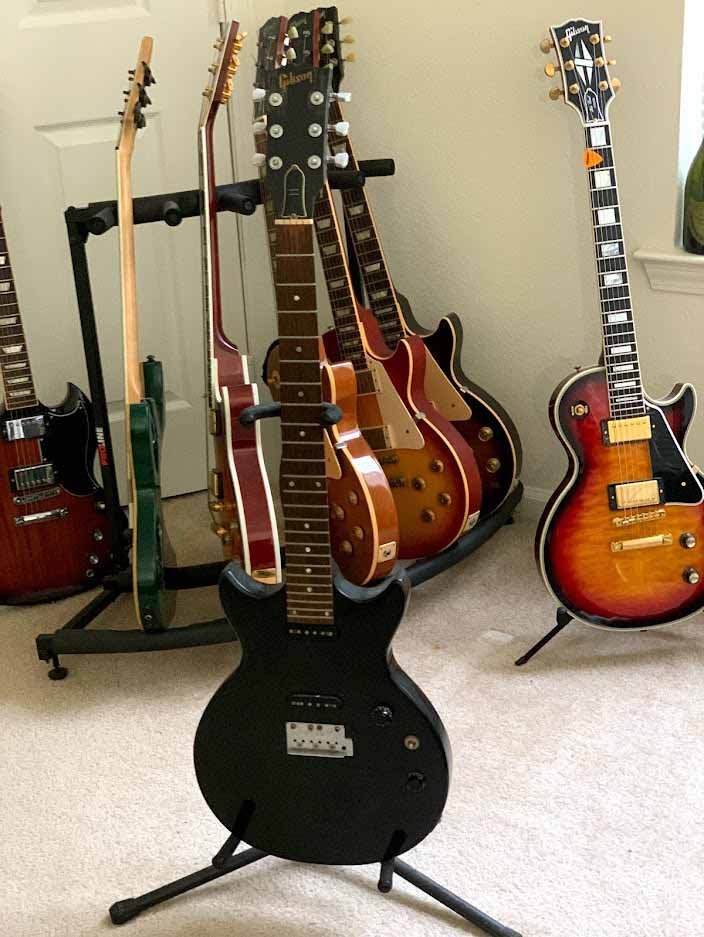
I’ve been on both sides of this argument my whole life, because I collect both. I have Strats. I have Gibsons. I have a Les Paul I hold up with both hands when I play it standing because the thing weighs a small fortune in wood. And I have my first Gibson — a black Les Paul Junior-style body from the nineties, no strings, no finish to speak of — that I probably picked up used for under fifty dollars back when fifty dollars was a real decision. I haven’t sold it. I’m not going to.
The Architecture of the Thing
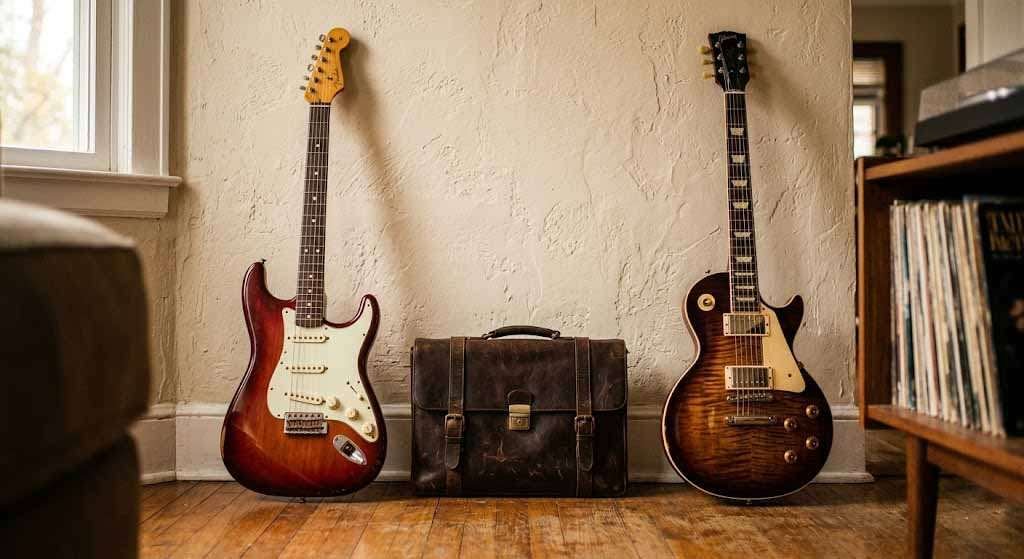
The Fender Stratocaster, introduced in 1954, is a bolt-on instrument. The neck is not glued into the body — it’s bolted. Three screws. Four screws. You can remove it with a screwdriver. To a lot of guitarists, this sounds like cost-cutting, and sometimes it was. But it also means the neck can be swapped, replaced, adjusted. It means the guitar is modular, fixable, democratic. The alder body is contoured so it sits against you naturally — Fender actually carved comfort into the design. The three single-coil pickups produce a sound that is bright, articulate, almost bell-like at the upper register. Notes separate. You can hear every attack, every ghost note, every mistake. The whole thing weighs about eight pounds.
This is why the Strat is the easier guitar to play. The neck is thin. Your fingers glide. You can move around a room with it and not feel like you’re hauling lumber. It rewards spontaneity. The instrument is built for motion — physically and musically.
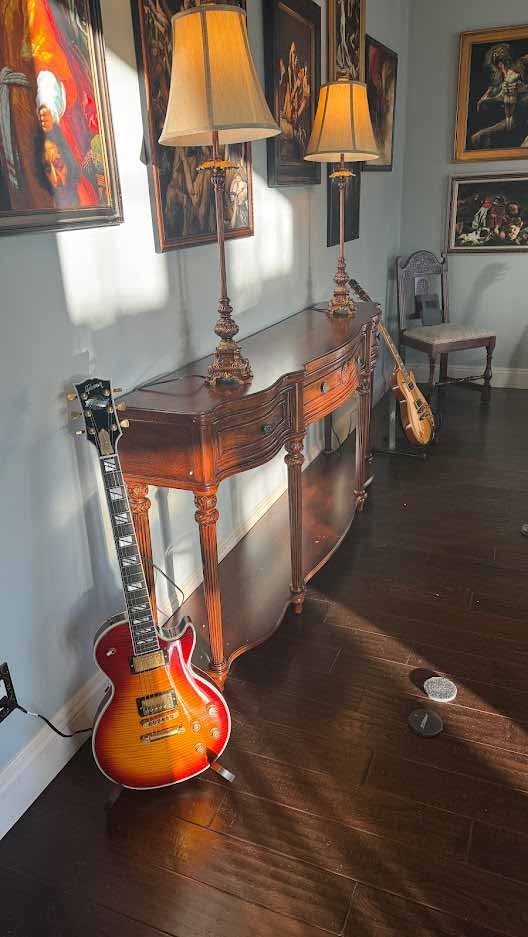
The Gibson Les Paul, first produced in 1952 and then revised into what most people recognize by 1959, is a different animal entirely. The neck is glued to the mahogany body with a mortise and tenon joint. You cannot remove it without destroying the guitar. The body is carved maple over solid mahogany — dense, heavy, resonant in a way that you feel in your chest before you hear in your ears. The humbucking pickups, added in 1957 to eliminate the 60-cycle hum that plagued single coils, produce a thicker, warmer, more compressed signal. Notes bloom after you strike them. The sustain on a good Les Paul is almost obscene — hit an open G and walk to the other side of the room. It’s still ringing when you get there. The whole thing weighs about eleven pounds. Sometimes twelve.
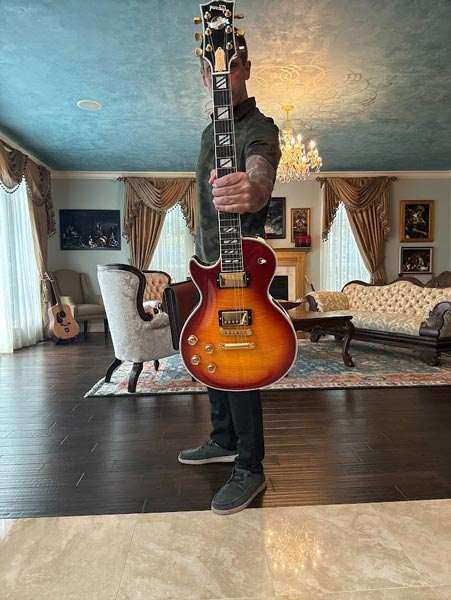
The neck on a Les Paul is thicker, rounder, more substantial in your hand. If the Strat neck is a fast road, the Les Paul neck is a bridge. You feel the wood. It pushes back. And playing standing up, moving around — you feel that weight in your shoulder inside of twenty minutes. But pick it up and look at it and the thing is genuinely beautiful. The quilted maple top catches light in a way no Strat body ever has. There’s a reason players who have never touched a guitar can identify a Les Paul on sight.
These are not subtle differences.
What Sustain Actually Means
Here’s where the argument gets philosophical. On a bolt-on neck, when you hit a string, some of the vibration transfers into the joint, into the hardware, and dissipates. What you lose is sustain — the time a note takes to decay. On a set-neck, that energy has nowhere to go. It stays in the wood. It feeds back into the string. It sustains.
This sounds like a technical footnote until you understand what it means musically. Sustain is time. It’s the space between your attack and your next decision. A guitarist playing a Les Paul can hit a note and let it sing while they choose — bend it, vibrate it, hold it until it becomes something else. A guitarist playing a Strat has to keep moving. The note is already leaving. You have to fill the space with more notes, more articulation, more presence of mind. The two guitars reward different playing styles not just aesthetically but structurally. The architecture tells you how to play.
This is why the argument is really an argument about how you think sound should be built — whether music is a conversation you sustain or a conversation you keep restarting.
Hendrix, Page, and the Proof
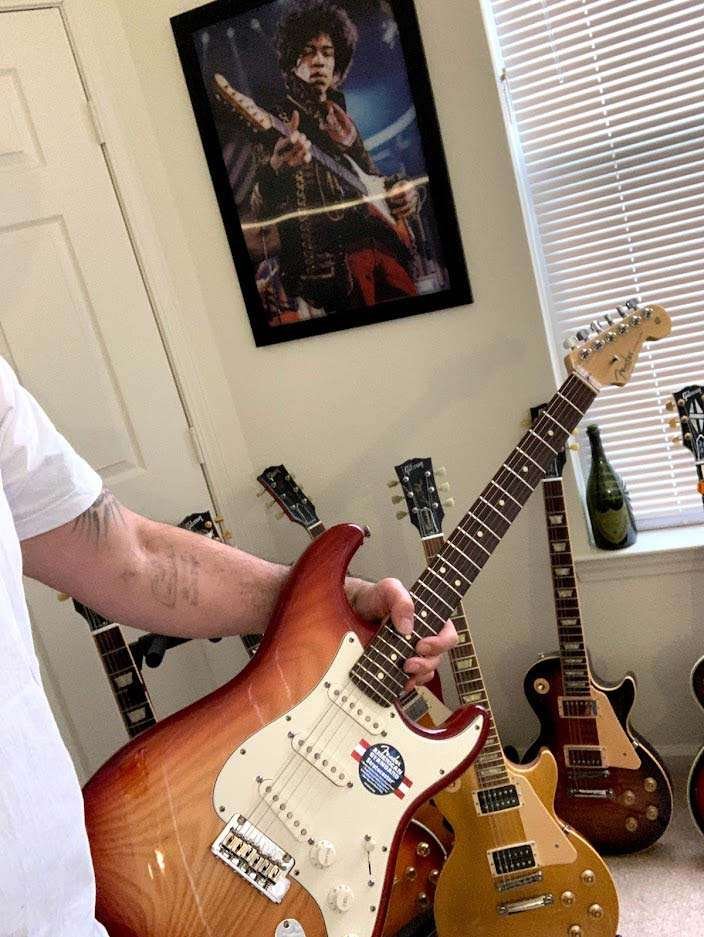
Jimi Hendrix played a Stratocaster upside-down — he was left-handed, strung the guitar in reverse, and produced sounds that nobody had imagined. The Strat’s bright, responsive pickups became, in his hands, a full orchestra of feedback, whammy-bar manipulation, and harmonic complexity. “The Wind Cries Mary” is a Stratocaster song — tender, articulate, every note distinct and chosen. “Voodoo Chile (Slight Return)” is a Stratocaster song too, but pushed into something ferocious, the guitar acting as both rhythm and lead simultaneously, as both hammer and scalpel. Hendrix understood the Strat’s transparency and used it completely, including its capacity to expose everything you’re doing. There’s no hiding on a Strat.
Jimmy Page played a 1959 Les Paul Standard — the Sunburst, the one guitar players lose sleep over — and on that instrument recorded Led Zeppelin’s entire catalog of riffs that feel less like they were played than summoned. “Whole Lotta Love.” “Heartbreaker.” “Stairway to Heaven.” The sustain is doing work on every one of those songs. Page bends into notes and holds them there, lets them rise, uses the guitar’s inherent compression to blur the line between attack and sustain until the note becomes something geological. You can also hear the weight of the thing — a Les Paul has physical gravity and it shows in the playing. You don’t noodle on a Les Paul. You commit.
Neither man could have made what he made on the other guitar. That’s not an insult to either — it’s the point.
The People Who Switched
Some of the most interesting data in this argument comes from players who crossed the line. Eric Clapton, who played a Les Paul with John Mayall and a Les Paul derivative (the ES-335) early on, eventually became so associated with the Stratocaster that Fender named a signature model after him. His reasoning, stated in various interviews over the years, was essentially about clarity — he wanted to hear exactly what he was doing. The Strat gave him that. David Gilmour is the same story: a Stratocaster player whose sound is all about the space between notes, the sustain achieved through effects and amp settings rather than through wood. He forced the Strat to do Les Paul things without becoming a Les Paul player.
Conversely, Billy Gibbons of ZZ Top started on a Strat, moved to Gibson, and eventually built his signature sound around a 1959 Les Paul Standard he bought from a young Texan. The guitar remade the player. The sustain changed his phrasing. The weight changed his relationship to the beat.
Switching guitars is not decoration. It is a philosophical commitment.
What the Collection Tells You
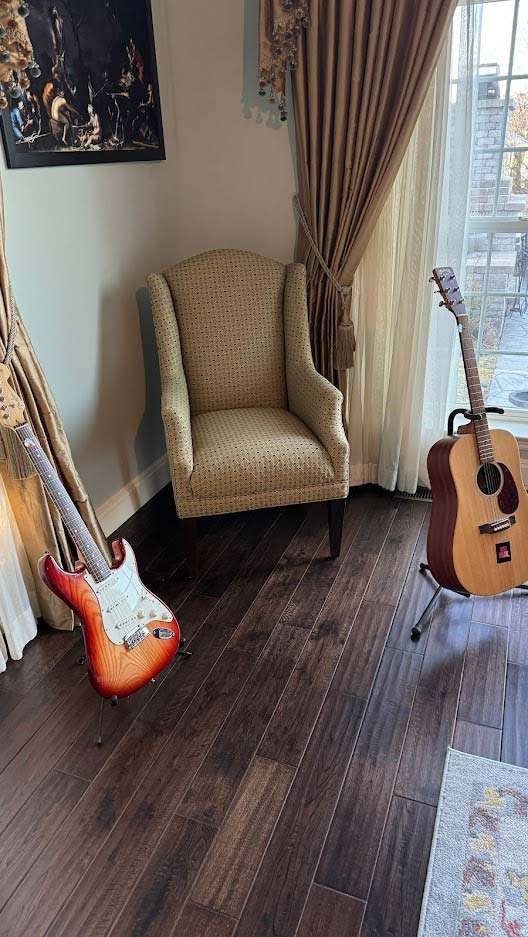
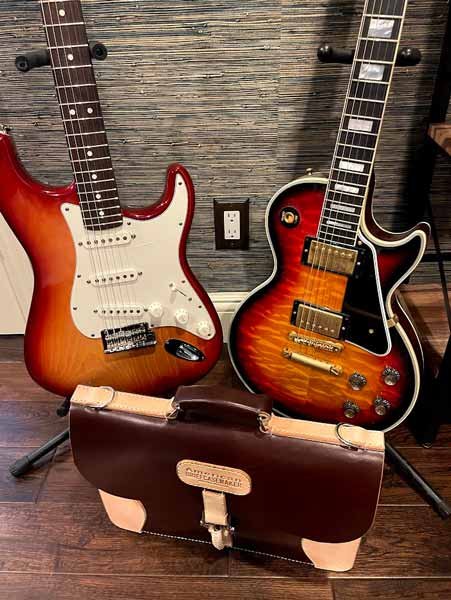
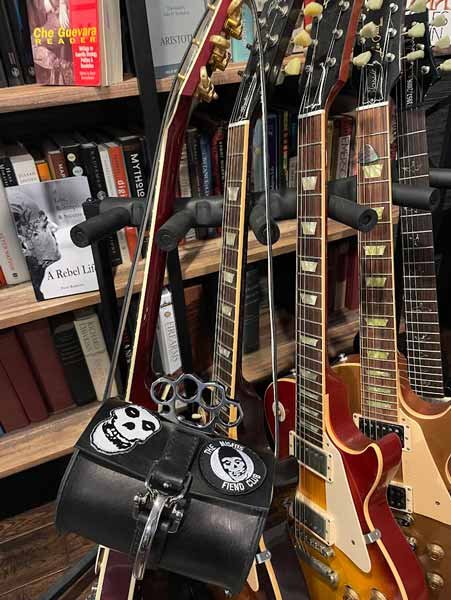
Most players land on one side eventually. I didn’t. My bookshelf has Aristotle next to A Rebel Life and Dawkins next to a Che Guevara Reader, so maybe it shouldn’t be a surprise that my guitar rack doesn’t have a single allegiance either. I have the cherry Strat — thin neck, easy action, the one I reach for when I want to think out loud on strings. And I have the Les Paul, that big quilted top, the humbuckers that turn a chord into an event. Neither one is the right guitar. Both are the right guitar depending on the night.
But that first black Gibson — no strings, stripped down, bought used for almost nothing in the nineties — that one sits in the rack and doesn’t have to do anything anymore. I bought it when I had no money and less sense, and I’ve kept it through every version of my life since. It doesn’t play. It just stands there being the reason I started.
There’s something honest about that. A guitar that cost next to nothing that you’d never sell. It’s the same logic as the instrument itself — the Les Paul Junior, stripped of the carved top and the fancy hardware, is just mahogany and a pickup and a prayer. No ornamentation. All character. If you want to understand what a Gibson actually is underneath everything, play one of those. It tells you the truth the same way the expensive ones do, just louder about it.
The Answer That Isn’t an Answer
Here’s what nobody who actually plays guitar will tell you: the best-sounding guitar in any room is usually the one the best player in the room is holding. A great guitarist makes a Stratocaster sound warm. A great guitarist makes a Les Paul sound articulate. The wood and the pickups and the neck joint matter, but they matter less than what happens between a player’s hands and the instrument over the course of ten or twenty years.
The argument persists because it isn’t really about the object. It’s about the approach. It’s about whether you think sound is something you catch or something you construct, whether music is an act of transparency or an act of mass. Fender and Gibson — like most lasting debates — gave us two correct answers to a question with no correct answer.
I wrote a while back about what happens when a song gets recorded on the instrument it was built for — about how Metallica’s “Ride the Lightning” sounds the way it does precisely because of the tools in the room. Black Sabbath’s Tony Iommi had the same relationship with Gibson that built heavy metal from the string up. The instrument is never neutral. It argues back.
Pick one. Or pick both. Learn them the way they want to be learned. Then argue about it for the rest of your life. That’s the tradition.

You Might Also Like
- Ride the Lightning: Metallica, Fade Away
- Jello Biafra and the Dead Kennedys: Political Philosophy in Three-Minute Bursts
- Black Sabbath — ‘Paranoid’ (1970): The Riff That Built Heavy Metal
Sources
- Fender Musical Instruments Corporation — fender.com
- Gibson Guitar Corporation — gibson.com
- Tony Bacon, 50 Years of the Gibson Les Paul (Backbeat Books, 2002)
- André Millard, The Electric Guitar: A History of an American Icon (Johns Hopkins University Press, 2004)
- Guitar Player Magazine archives — guitarplayer.com
- Tom Wheeler, The Stratocaster Chronicles (Hal Leonard, 2004)