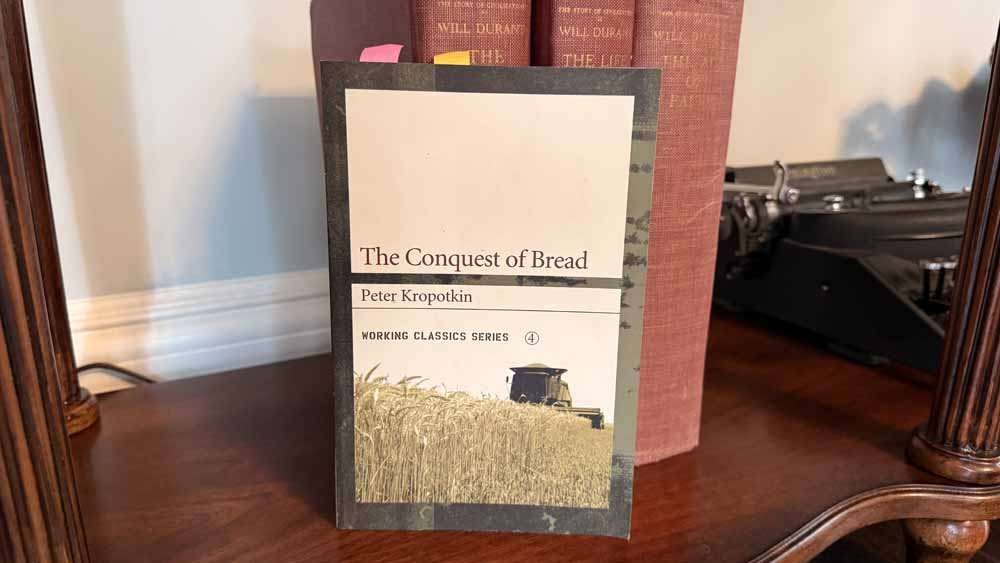
Kropotkin was not a crank. That’s the first thing you have to get straight. He was a Russian prince who gave up his title, a geographer who mapped Siberia on foot, a scientist who corresponded with Darwin’s circle, a man who went to prison in three countries for what he believed. When he sat down to write The Conquest of Bread in 1892, he was not some pamphleteer with a grudge. He was a rigorous thinker who had watched industrialism grind people into the floor and decided he had to answer it with something better.
The book he wrote is genuinely beautiful. And it doesn’t work. Both of those things are true at once.
What Kropotkin Actually Argues
The premise of The Conquest of Bread is straightforward: everything civilization has built — the bread, the houses, the roads, the machines — was built by collective human labor across centuries. No individual owns those centuries. Therefore, the wealth produced by that labor belongs to everyone. Not to the state. Not to a party. To everyone, distributed freely according to need, organized through voluntary cooperation rather than coercion.
This is anarcho-communism, and Kropotkin lays it out with a clarity that most ideological writing never achieves. He goes chapter by chapter through the practical questions. How do you feed a city? How do you house people? Who does the dirty work that nobody wants to do? He has answers for all of it. His answer to food supply is essentially: apply the same collective intelligence that built the railroad to agriculture, and you can feed the world in a few hours of daily labor per person. His answer to housing is: stop treating empty buildings as property and start treating them as shelter. His answer to undesirable work is: distribute it evenly, rotate it, make it a shared burden rather than a class destiny.
It is a serious attempt at a serious problem. And the problem it’s responding to was real. Industrial England and France in the late nineteenth century were genuinely brutal. Children in mines. Ten-hour factory days. Wages that kept workers at the edge of starvation while the people who owned the machines got rich. Kropotkin looked at that and said: this is not the natural order. This is a choice. And we can make a different one.
He was right about that. Where the trouble starts is in the mechanism he proposes to change it.
The Part He Can’t Get Past
Every time Kropotkin describes the transition to his free commune, he does something interesting: he rushes through it.
The revolution happens. The old system collapses. And then — free people, organizing freely, produce for the common good without coercion, without the state, without the slow accumulation of advantage that always seems to produce hierarchy. He believes this so completely that he doesn’t feel the need to explain how you get from the first day after the revolution to the tenth year, when someone has started keeping better records of who’s doing what, when the most productive farms start attracting more labor because they’re better run, when the guy who was an excellent engineer before the revolution is still making better decisions about where to route the water than the guy who wasn’t. Kropotkin would say that’s fine, voluntary coordination will handle it. What he can’t say is what happens when voluntary coordination produces outcomes that look a lot like the hierarchy it replaced.
This is not a small objection. It’s the entire history of the twentieth century.
Every serious attempt to build something like Kropotkin’s commune — the Russian soviets before the Bolsheviks absorbed them, the Spanish anarchist collectives in Catalonia, the Israeli kibbutz movement, the various commune experiments of the 1960s and 1970s — followed a recognizable arc. Initial energy. Real communal solidarity. Then the emergence of informal hierarchies. Then either the collapse of the experiment or the formalization of those hierarchies into something that looked, functionally, like the structure that was supposed to have been abolished.
The Spanish Civil War anarchist collectives are the closest real-world test of Kropotkin’s ideas, and they are genuinely instructive. Some of them worked remarkably well for two to three years, particularly in agriculture. But even in the best cases, coordination across collectives required something — a committee, a delegate, a mechanism for resolving disputes — that began to look like a governing body. Once you need a governing body, you need a mechanism for choosing who sits on it. Once you have that, you have politics. Once you have politics, you have power. Once you have power, you have the problem Kropotkin was trying to solve in the first place.
This is the dead end. Not because people are evil. Because coordination at scale requires structures, and structures accumulate advantages for the people who run them. Kropotkin understood this in capitalism. He did not account for it in his own model.
Why He Keeps Getting the Darwin Part Wrong
The Conquest of Bread was preceded by Kropotkin’s Mutual Aid: A Factor of Evolution, published in 1902, which matters for understanding the full argument. In that book, he went after Social Darwinism directly, and he wasn’t wrong to. The Gilded Age reading of Darwin — that capitalism was natural selection in action, that the wealthy were the fittest, that poverty was biological destiny — was a grotesque distortion of what Darwin actually showed. I’ve written about this in my review of The Selfish Gene by Richard Dawkins and in my reading of On the Origin of Species itself — Darwin was describing mechanism, not morality. The robber barons who invoked him were cherry-picking.
Kropotkin’s counter-argument was that cooperation was equally fundamental to evolution. Ants build colonies. Wolves hunt in packs. Humans build cities. Mutual aid is everywhere in nature, and it’s at least as powerful as competition. This is correct. Evolutionary biology has vindicated large parts of it — kin selection, reciprocal altruism, group selection debates all confirm that cooperation is a genuine adaptive strategy.
But here’s where Kropotkin’s argument overreaches. He goes from “cooperation is natural and adaptive” to “therefore, a fully cooperative society without hierarchy is achievable.” The second does not follow from the first. Cooperation in nature is not egalitarian. The ant colony cooperates, but it also has a queen. The wolf pack cooperates, but it has an alpha. The primate troop cooperates, but it has a dominance hierarchy that every animal in it is constantly working to improve its position in. Cooperation and hierarchy are not opposites. They tend to co-evolve.
Kropotkin was fighting the right battle against Social Darwinism. But he needed Darwin to support an optimism that Darwin’s actual data doesn’t fully justify. The biology was more complicated than either side wanted it to be.
The Problem With the Transition
The specific mechanism Kropotkin proposes for getting to his commune is revolution — the seizure and redistribution of wealth, the dismantling of the state, the reorganization of society from below. He is careful to distinguish his revolution from the Marxist version, which he despised. He did not want a vanguard party. He did not want a dictatorship of the proletariat. He wanted decentralized, spontaneous, self-organizing communities.
The problem is that revolutions are not spontaneous or self-organizing. They require coordination. Coordination requires leaders. Leaders acquire power during the chaos of transition. And people with power in chaotic situations tend to keep it. This is not speculation — it is the documented pattern of every major revolution in recorded history, including the ones that started with the most sincere intentions.
Kropotkin watched the early Russian Revolution with horror. He had theorized a free commune for forty years, and what emerged was the Bolshevik state. He wrote Lenin a letter in 1920, from Dmitrov, expressing his disillusionment. He died the following year, in 1921, and by all accounts he died believing the revolution had been betrayed. From his perspective, it had been. From a structural perspective, it had followed the logic of every revolution that came before it.
The anarchist answer to this is that the Russian Revolution failed because Lenin hijacked it, and that a genuinely anarchist revolution, without a vanguard party, would produce different results. That may be true. But the Spanish Civil War, the closest real test, ended with the anarchists losing to the Nationalists partly because the anarchists’ refusal to build a coordinated military command made them organizationally weaker than their enemies. The very thing that made them anarchists made them lose.
Thomas More wrote Utopia four centuries before Kropotkin, and the structural problem is recognizable across both books: the ideal society requires ideal citizens, and ideal citizens are not what you get to work with. What you get is people — competitive, cooperative, brilliant, petty, generous, status-seeking, exhausted, occasionally heroic, and mostly just trying to get through the week.
What the Book Still Gets Right
None of this means The Conquest of Bread is worth dismissing. It’s worth reading for the same reason you should read No Gods No Masters by Daniel Guérin — not as a workable blueprint, but as a critique that still lands. Kropotkin’s argument that concentrated wealth is not a natural outcome but a political one — enforced by law, protected by state violence, maintained by the fiction that property rights are inherent rather than constructed — is difficult to refute. His observation that the work that builds civilization is never the work that gets compensated for building it is as accurate now as it was in 1892. His insistence that the dignity of labor is not a sentiment but a structural claim about who actually produces value is one that every serious economics has had to grapple with.
The critique is better than the prescription. That’s not unusual. Most books that identify what’s wrong with the world are sharper than the ones that describe how to fix it. Diagnosis is hard. Treatment is harder. The doctor who tells you exactly what the disease is doing to you is not necessarily the one who has the cure.
Kropotkin had the disease right. The treatment he offered keeps running into the same contraindication: it works on people who have already solved the problem it’s trying to solve.
The Verdict
Read it. Argue with it. Let it make you uncomfortable about things that are worth being uncomfortable about. The pages where Kropotkin describes the absurdity of a world where food rots in warehouses while people go hungry in the same city — those pages are still live. The mechanism he proposes for ending that absurdity is where the book runs aground.
He was a serious man who took a serious problem seriously. That puts him ahead of most of the people who have ignored the problem entirely. What he couldn’t figure out — what nobody has fully figured out — is how to build a structure that produces collective outcomes without concentrating power in the people who run the structure.
That’s still the question. We’re still not answering it.
Sources
- Kropotkin, Peter. The Conquest of Bread. London: Chapman and Hall, 1906. Available via Project Gutenberg
- Kropotkin, Peter. Mutual Aid: A Factor of Evolution. London: Heinemann, 1902. Available via Project Gutenberg
- Apter, David E. and James Joll, eds. Anarchism Today. London: Macmillan, 1971
- Graham, Robert, ed. Anarchism: A Documentary History of Libertarian Ideas. Montreal: Black Rose Books, 2005
- Bookchin, Murray. The Spanish Anarchists: The Heroic Years 1868–1936. New York: Free Life Editions, 1977
- Goldman, Emma. My Disillusionment in Russia. Garden City: Doubleday, 1923. Available via Project Gutenberg
- Avrich, Paul. The Russian Anarchists. Princeton: Princeton University Press, 1967