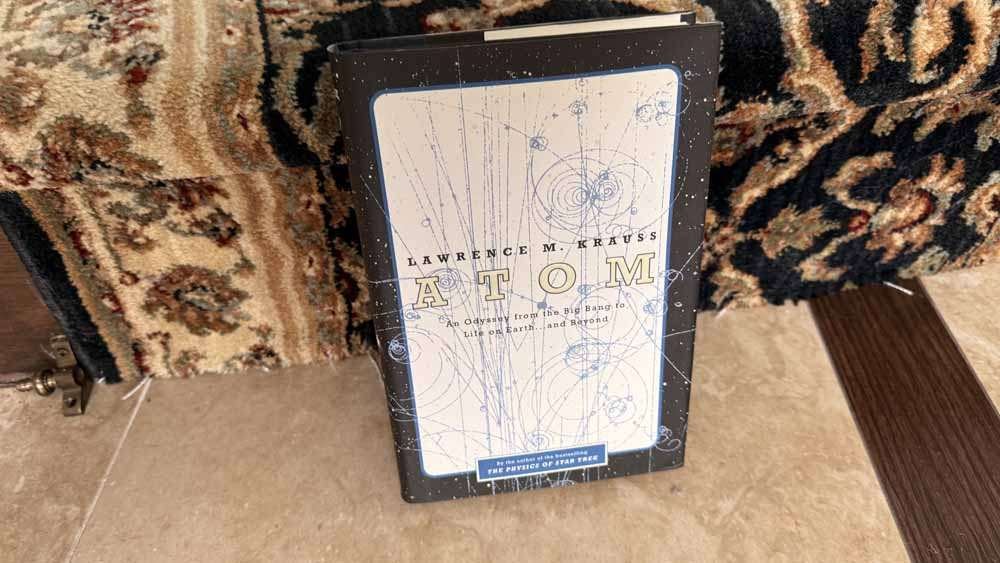
Every few years I come across a book that doesn’t just give me information — it repositions me. Not a dramatic conversion. More like a small, irreversible shift in the way I hold things. Atom: An Odyssey from the Big Bang to Life on Earth…and Beyond by Lawrence M. Krauss did that. Published in 2001, it won the Science Writing Award in 2002, and it reads, decades later, with the same cold clarity it must have had the day it came out. Some books age out. This one doesn’t, because the universe it’s describing hasn’t changed, and neither has the question underneath it.
Krauss takes a single oxygen atom — the kind that might be in a glass of water you drank this morning — and follows it from the first seconds after the Big Bang to the death of the solar system and beyond. That’s the conceit. What he actually does is tell you the complete story of the universe using one tiny piece of matter as the witness. The atom is a character. It doesn’t speak. It doesn’t think. But it was there for all of it — nucleosynthesis in stellar cores, supernova explosions, the formation of Earth, the first oceans, the first cells, and eventually, the respiratory cycle of something that walks upright and asks questions.
The book is structured in five sections: Time, Space, Matter, Life, and Consciousness. The progression isn’t accidental. Krauss is building a case, and you don’t fully see what case he’s making until you’re deep inside the last section.
The Biography of Everything
What makes Atom unusual as science writing is the choice of narrator. Not the scientist, not the reader, not an omniscient third party — but the matter itself. Krauss follows this oxygen atom through scenarios that require him to learn geology, biochemistry, paleontology, and astrophysics at a level of depth that he openly admits was new to him. He says in the book’s author essay that writing Atom “dramatically changed the way I think about the world.” I believe him. You can feel it in the prose — a scientist who is genuinely astonished at what he’s uncovering, not just reporting it.
The early chapters are about scale and physics. The atom begins as protons and neutrons formed in the dense plasma of the first seconds of the universe. Before stars existed, before anything existed that could be called a place, the raw ingredients of our atom were assembling under conditions we’ll never recreate. The temperature of the early universe was on the order of billions of degrees. The laws of physics were the only thing running. No God needed. No intention. Just the math, burning.
Then the first stars form, and the atom ends up inside one. It rides out a stellar lifetime — hundreds of millions of years — before the star explodes as a supernova, scattering the atom into interstellar space. This happens more than once. Krauss’s atom cycles through stellar births and deaths before it finds itself in the cloud of gas and dust that collapses to form our solar system. It ends up on Earth. Eventually, it ends up inside you.
This is not metaphor. This is what happened.
Carl Sagan famously said, “We are all star stuff.” Krauss shows you the receipts. He walks you through the nuclear physics of stellar fusion, the specific processes that created oxygen from lighter elements, and the supernova dynamics that scattered those elements into the interstellar medium. The poetry is real because the science is real. Krauss uses the fictional life of an oxygen atom to explain how we all came to be made from star-stuff — how we came to be here. And he does it without dumbing it down enough to insult you.
Scientific American called the result something that “reads as compellingly as a good novel,” tracing the atom from the earliest moments of the universe through its role in life on Earth and beyond. They weren’t wrong.
The Physics of Nothing and the Debates I Watched on YouTube
Here is where I have to be honest about how I came to Krauss before I read him.
I used to watch his debates on YouTube the way some people watch sports. His most famous lecture — A Universe from Nothing — delivered at the Atheist Alliance International conference in 2009 and released by the Richard Dawkins Foundation, has been viewed millions of times. The foundational lecture explored how quantum mechanics and general relativity allow for the emergence of the universe from an apparent vacuum state. If you haven’t seen it, stop reading and watch it first. It’s 53 minutes. It will rearrange things.
What I loved about Krauss in those videos was his refusal to dress science up in false humility when confronting religious claims. He wasn’t rude. He was precise. He had the data, and he pointed at it. His line — “The lack of understanding of something is not evidence for God. It’s evidence of a lack of understanding” — is the cleanest dismantling of the God-of-the-gaps argument I’ve ever heard, and he delivered it like a man reading a grocery list.
He debated William Lane Craig at North Carolina State University in 2011. The topic was whether there is evidence for God. Krauss opened by saying he didn’t come to disprove the existence of God — he considered that a “futile and useless activity,” something he wouldn’t waste his time on. He came to talk about evidence. That distinction mattered. Craig came with syllogisms. Krauss came with cosmology. They were barely having the same conversation, which told you everything about how far apart the two frameworks actually sit.
He also toured the world with Dawkins, a collaboration documented in the 2013 film The Unbelievers. They traveled the world speaking publicly about the importance of science and reason as opposed to religion and superstition. I watched parts of that film on YouTube too. What struck me was how relaxed they both were. Not combative. Not angry. Just two men who had arrived at a position through evidence and were willing to say so in public, which still takes a kind of nerve that most people, even smart ones, don’t have.
Atom is the scientific foundation beneath all of that. The debates are the application. Read the book first.
Consciousness and the Hardest Chapter
The section I keep returning to is the last one. Consciousness.
Krauss doesn’t pretend to solve it. Nobody has. But he does something more useful — he frames the question honestly. Our atom, having passed through stars, comets, oceans, and cells, has ended up inside a brain. That brain is aware of itself. It is asking where it came from. The atom that was forged in a supernova billions of years ago is now, somehow, part of a system that can contemplate supernovae.
Krauss writes: “The most poetic thing I know about physics is that we are all stardust.” What he means is not a bumper sticker. He means that the iron in your blood was made in a star that died before our sun was born. He means that every heavy element in your body has a stellar address. He means that the universe did not create you — the universe became you, through billions of years of blind, indifferent, magnificent process.
In his author essay, Krauss says the process of writing Atom dramatically changed the way he thinks about the world, and he hoped it would do the same for its readers. It did for me. Not because it gave me new information — some of this I knew in pieces — but because the narrative structure forces you to hold the entire arc at once. From nothing to proton, from proton to star, from star to planet, from planet to organism, from organism to thought. All of it, continuous. All of it, matter behaving according to laws.
What Krauss Gets Right That Others Miss
Most popular science writing goes one of two ways. Either it oversimplifies to the point of uselessness, or it gets so deep in the weeds that you lose the thread entirely. Krauss walks the line. Physics Today noted that the “standard of writing in Atom is perhaps even higher” than in his earlier bestseller The Physics of Star Trek, and that he had mastered both geology and biology — subjects he had to learn from scratch — finding “lyrical ways of explaining ideas in both fields.”
The Physics Today review also offered an honest critique: that the atom itself is sometimes a pretext rather than a true protagonist, that the story of universal evolution is so vast and interesting that the atom occasionally gets lost in it. The reviewer found the atom’s participation in events “somewhat artificially contrived” and the events themselves more interesting than the framing device. That’s a fair read. But I’d argue the conceit still works, because it does what Krauss intends — it keeps the story personal. The atom could be you. In fact, some version of it is.
Martin Rees, cosmologist and author of Just Six Numbers, called Krauss “a superb expositor” and Atom “his best book — an eloquent and panoramic survey of the links between cosmos and microworld.”
I’d go further. It’s one of the best science books I’ve read, period, alongside Dawkins’ The Selfish Gene and Darwin’s On the Origin of Species. All three books do the same thing: they take a question that religion claims to own and they answer it. Precisely. With evidence. Without apology.
The Argument Underneath the Science
I grew up Greek Orthodox. My mother had priests at the house. I went to church. I put the robe on. I know that world from the inside, and I also know what it felt like the first time I read Nietzsche at fifteen and realized the entire apparatus was invented to manage people who were afraid of dying. That realization came slow and then all at once, the way most real ones do.
What Krauss does — in this book and in every debate I watched him in — is not destroy religion. He does something harder. He makes it unnecessary. He doesn’t need to argue against a creator because the science has already told the story without one. The universe from nothing. Life from chemistry. Consciousness from neurons. Each of these, verified. Each of these, more astonishing than any theology I was handed as a kid.
His line from the 2009 AAI lecture has stayed with me: “Forget Jesus. The stars died so that you could be here today.”
That is not nihilism. That is the opposite of nihilism. If the matter that makes you was forged in stellar explosions billions of years before Earth existed — if you are not an accident in the dismissive sense but a consequence, an outcome of cosmological processes that had to go exactly right — then you are something remarkable. Not because a god decided so. Because physics did.
The diner I’ve been running for twenty-five years sits on a road on the North Shore of Long Island. Every morning, the flat-top comes on at 5:30. Eggs crack, bacon hits, coffee pulls through. A hundred small things happen before the first customer walks in. None of it requires a metaphysical explanation. It requires skill, work, and the laws of chemistry doing what they do. That is not a lesser thing. That’s the whole thing.
Atom is available on Amazon in hardcover and Kindle. If you’ve been meaning to read Krauss, start here — then go to the 2009 YouTube lecture, then read The God Delusion by Dawkins, which covers the philosophical and evolutionary ground Krauss leaves for another book. You won’t come out the other side with all the answers. But you’ll come out with better questions.
You might also like:
– The Boltzmann Brain Paradox: When Statistical Physics Predicts You Shouldn’t Exist
– The Fermi Paradox and the Great Filter
– The Selfish Gene by Richard Dawkins — The Book That Unlocked Darwin for Me
Sources
- Krauss, Lawrence M. Atom: An Odyssey from the Big Bang to Life on Earth…and Beyond. Little, Brown, 2001. Amazon
- Lavers, Chris. Review of Atom. The Guardian. (via Wikipedia) Wikipedia
- Rees, Martin. Blurb for Atom. Barnes & Noble
- Physics Today review of Atom. Physics Today
- Scientific American review excerpt, via Snowmass 2001 press release. Fermilab News
- Krauss, Lawrence M. “A Universe from Nothing.” AAI lecture, 2009. YouTube
- Craig-Krauss Debate, NC State, March 30, 2011. Reasonable Faith
- Krauss, Lawrence M. Quotes on religion. AZ Quotes
- The Unbelievers (documentary, 2013). Krauss and Dawkins public tour.
- Rausch, Andrew J. “Three Questions with Lawrence Krauss.” SecularByNature. Link
- ASU News, “Book explores how universe could have come from nothing.” ASU News