Erich Fromm opens The Anatomy of Human Destructiveness not with a declaration but with a problem: why does the human animal — the one capable of building cathedrals and composing symphonies and loving another person to the point of self-erasure — also go out of its way to destroy? Not in self-defense, not to eat, not to survive. For the sheer satisfaction of it. No other creature on earth does this. The chimpanzee fights over territory. The wolf kills to eat. Fromm’s central insight is that if humans were endowed only with the biologically adaptive aggression we share with animal ancestors, we would be relatively peaceful beings. The malignant kind — the kind that produces Hitler, that produces gulags, that produces ordinary men who do terrible things on an ordinary Tuesday — that’s something else entirely. That belongs to us alone.
The book was published in 1973, and it still reads like it was written last week. Which is either a compliment to Fromm’s vision or a verdict on how far we haven’t come.
Freud’s Student, Freud’s Critic
Fromm was trained in psychoanalysis. He came up through the Frankfurt School, studied at the Berlin Psychoanalytic Institute, spent years immersed in Freud, and then — with considerable intellectual courage — started pulling the whole thing apart. Not to destroy it. To fix it.
Freud’s theory of the death instinct, Thanatos, gave human destructiveness a biological foundation. We’re wired for it, Freud said. It’s baked in, written into the nervous system, as natural as the drive toward pleasure. Fromm respected Freud enough to take the theory seriously and disagree with it openly. He presents a critical revision of Freud’s theory of a “death instinct,” arguing instead that malignant aggression — destructiveness and cruelty — is not instinctive, not phylogenetically programmed, not biologically adaptive. It serves no biological or survival purpose. It is one of the passions, like ambition or greed.
That distinction matters more than it sounds. If destructiveness is instinct, we’re off the hook. Evolution made us this way; what are you going to do? But if it’s character — if it’s formed by experience, by social conditions, by the specific kind of society that shapes a specific kind of human — then we have both a problem and a responsibility. Fromm always preferred the harder answer.
Those who’ve spent time with Civilization and Its Discontents will recognize the conversation Fromm is entering. Freud got the diagnosis right — modern civilization produces suffering — but Fromm thought he assigned the wrong cause.
The Escape We Never Talk About
One of the threads running through Fromm’s entire body of work, from Escape from Freedom to this book, is what he calls automaton conformity. The idea is straightforward and devastating. Most people, when confronted with the weight of genuine freedom — the terrifying responsibility of actually being yourself, choosing your values, living by them in a world that actively discourages it — don’t rise to it. They don’t rebel. They don’t despair. They disappear into the crowd.
Since conformity makes a person look like a million other people, he no longer feels alone. He isn’t alone, perhaps, but he’s not himself either. The automaton conformist experiences a split between his genuine feelings and the colors he shows the world. Fromm saw this as a form of psychological violence — not inflicted from outside, but chosen. We do it to ourselves. We hollow ourselves out and call it getting along.
What the book makes clear is that this escape doesn’t actually release the pressure. The energy that belonged to genuine selfhood has to go somewhere. Unexpressed freedom turns into something uglier. If a person’s desire to destroy is blocked by circumstances, he or she may redirect it inward — self-destructiveness, drug addiction, alcoholism, or the joys of passive entertainment. The man who has never really lived invests deeply in watching other things burn.
What Fromm Means by Love
This is where the book becomes something more than a clinical study. Fromm was a humanist in the old, serious sense of the word — not the bumper-sticker variety, but the kind who believed that the fully realized human life was both possible and worth fighting for. And central to that life, irreducible, was love. Not the sentimental kind. The demanding kind.
“The unity achieved in productive work is not interpersonal; the unity achieved in orgiastic fusion is transitory; the unity achieved by conformity is only pseudo-unity. Hence, they are only partial answers to the problem of existence. The full answer lies in the achievement of interpersonal union, of fusion with another person, in love. This desire for interpersonal fusion is the most powerful striving in man. It is the most fundamental passion, it is the force which keeps the human race together.”
What makes that passage land — and what distinguishes Fromm from more optimistic thinkers — is the sentence that follows: failure to achieve this means insanity or destruction. He’s not selling love as a nice idea. He’s arguing that love is structural, that without it the human psyche starts looking for other outlets, and those outlets are rarely benign.
This sits in sharp contrast to the consumer society he’s diagnosing throughout the book, a society organized around having rather than being, around acquisition rather than connection. “We live in a world of things, and our only connection with them is that we know how to manipulate or to consume them.” That’s the world that produces the necrophilic character. Not a monster. A person who never learned to love anything that couldn’t be owned.
The Courage Clause
Here’s what separates Fromm from the cultural critics who spend six hundred pages describing the problem without ever putting their neck out. He believes something. He believes human beings can choose differently. He believes character is formed, not fixed, and that insight — real insight, not the therapy-speak kind — can change it.
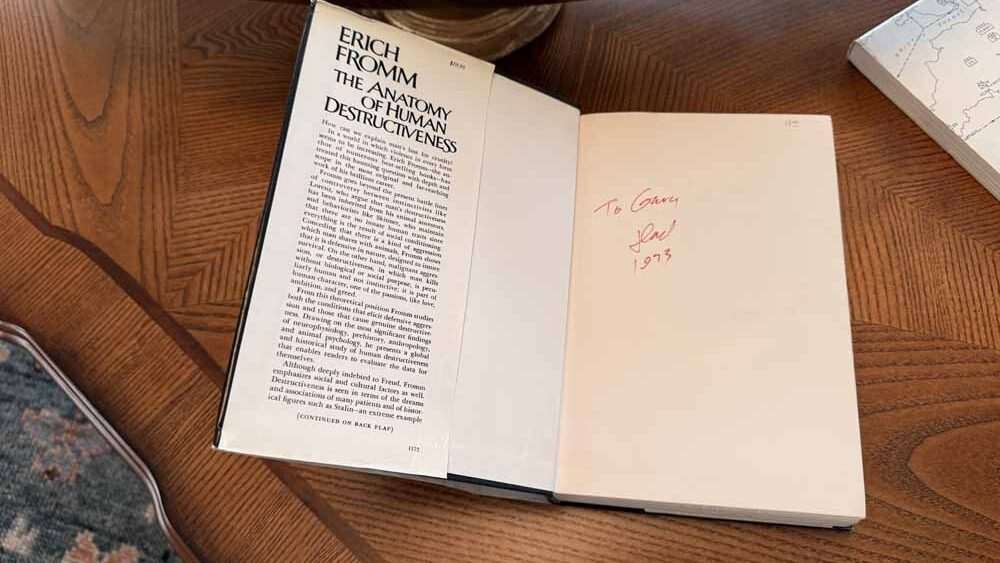
But he’s not naive about the cost. The passage that opens one edition of this book — preserved in marginalia and reader responses ever since — stops you cold:
“If other people do not understand our behavior — so what? Their request that we must only do what they understand is an attempt to dictate to us. If this is being ‘asocial’ or ‘irrational’ in their eyes, so be it. Mostly they resent our freedom and our courage to be ourselves. We owe nobody an explanation or an accounting, as long as our acts do not hurt or infringe on them… a free person owes an explanation only to himself — to his reason and his conscience — and to the few who may have a justified claim for explanation.”
There’s something almost subversive in that, written by a man who spent his career inside academic institutions, publishing houses, professional associations. He’s telling you that the social demand for conformity — the ambient pressure to be explicable, manageable, legible to the group — is itself a form of control. The price of fitting in is a piece of yourself. Most people pay it without noticing they’re paying anything at all.
I’ve spent enough time around people who run on their own terms — in craftsmanship, in building things from scratch, in refusing to outsource their values to consensus — to know what Fromm is describing. The ones who never quite explain themselves, and never quite apologize for it. They tend to be the ones who haven’t gone hollow.
Critical and Radical Thought
The book is not without its tensions. Herbert Marcuse, Fromm’s Frankfurt School peer, accused him of reviving time-honored idealistic values — love, responsibility, care — as if no one had ever demonstrated their conformist features, as if self-realization in a society of total alienation were actually possible without a structural transformation of that society. It’s a serious critique. Fromm answers it, partially, by grounding his humanism in character change rather than political utopia — but the gap between individual transformation and systemic change is one the book never fully closes.
Still. “Critical and radical thought will only bear fruit when it is blended with the most precious quality man is endowed with — the love of life.” That’s not a retreat from politics. It’s an insistence that the political is downstream of the psychological. You can’t build a free society out of people who have never practiced being free.
Fromm also draws on a striking range of evidence — neurophysiology, anthropology, the psychobiographies of Hitler and Stalin, observations of primates in captivity. Some of the empirical material has dated. The intellectual architecture has not. The Atlantic Monthly called his analysis of the causes of destructiveness “unique” and praised his “enviable skill in the lucid presentation of intricate material.” Ashley Montagu, the anthropologist, called it simply “by far the best book I have ever read on the subject.”
Those who’ve read Thus Spoke Zarathustra will hear echoes here — the contempt for the herd, the insistence that genuine selfhood is possible and costs something — though Fromm arrives at his conclusions through a very different emotional register than Nietzsche. Where Nietzsche is volcanic, Fromm is clinical and then, unexpectedly, warm. He believes in people. He just wants them to stop running away from themselves.
The same conversation appears in a different key in No Exit by Jean-Paul Sartre: the hell of other people’s gaze, the trap of defining yourself through how others see you. Fromm hands you the diagnosis and then, unlike Sartre, offers something that looks like a way out — not a guaranteed exit, but a direction.
What This Book Actually Asks of You
The Anatomy of Human Destructiveness is five hundred dense pages. It asks you to think about human nature without flinching. It asks you to look at the psychological cost of a society organized around consumption and conformity and take it seriously, not as abstraction but as a description of your life.
Fromm believed the fundamental alternative for man is the choice between “life” and “death” — between creativity and destructive violence; between reality and illusions; between brotherhood and dominance-submission. He’s not being melodramatic. He’s describing a daily decision, most of which we make without realizing we’re making it. Every time we hollow out a little more to fit in, every time we reach for what deadens rather than what nourishes, every time we mistake the absence of conflict for the presence of peace — that’s the necrophilic pull. Small, ambient, cumulative.
The biophilic alternative isn’t heroic. It doesn’t require a manifesto or a revolution. It requires something harder: the consistent, unglamorous decision to stay alive inside your own life. To love with intention. To refuse the various forms of disappearance the world offers.
Fromm thought that was possible. He spent fifty years writing to that possibility. I find that — not the darkness this book contains, but the fact that a man who understood that darkness this well still believed the other thing was possible — genuinely remarkable.
You Might Also Like:
Civilization and Its Discontents by Sigmund Freud — The Book That Saw the Twentieth Century Coming
Thus Spoke Zarathustra by Friedrich Nietzsche — The Book That Rewired My Understanding of Everything
A Kierkegaard Anthology — The Thinker Who Refused to Let Me Go
Sources:
Fromm, Erich. The Anatomy of Human Destructiveness. Holt, Rinehart and Winston, 1973. Amazon
Fromm, Erich. Escape from Freedom. Farrar & Rinehart, 1941.
Fromm, Erich. The Art of Loving. Harper & Row, 1956.
Marcuse, Herbert. Eros and Civilization. Beacon Press, 1955.
Critical blurbs via Amazon listing
Erich Fromm biography: Spartacus Educational
Fromm quotes archive: Wikiquote