
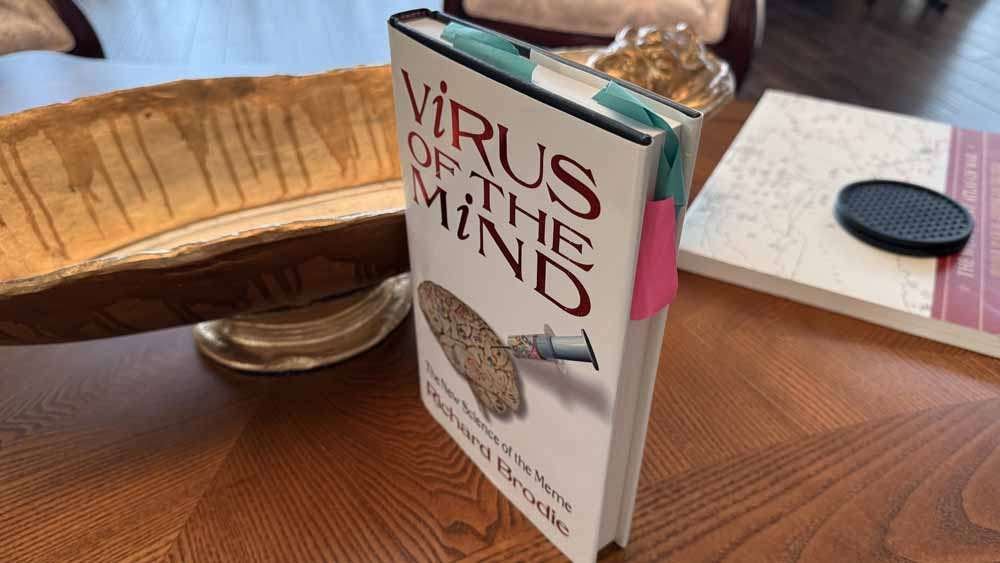
Richard Dawkins invented the meme as a thought experiment — a word to fill a conceptual gap, a placeholder for the cultural equivalent of a gene. He gave it one chapter near the end of The Selfish Gene, planted the seed, and moved on. Richard Brodie, a former Harvard dropout who wrote the first version of Microsoft Word and later became Bill Gates’s personal technical assistant, decided that one chapter wasn’t enough. Virus of the Mind: The New Science of the Meme, first published in 1996, is what happens when a programmer-turned-entrepreneur gets hold of a biologist’s metaphor and runs it straight through the machine of everyday life — advertising, religion, cults, sex, and the covert architecture of how we come to believe what we believe.
The result is a book that is, in equal parts, genuinely illuminating, occasionally infuriating, and impossible to dismiss. Which, if you’ve absorbed any of its argument, is exactly what a well-engineered meme is supposed to be.
What Dawkins Actually Said — and What Brodie Heard
To understand where Brodie goes, you need to know what he was working from. Dawkins defined the meme in 1976 as a unit of cultural transmission — an idea, behavior, or style that spreads from brain to brain the way a gene spreads from body to body. He named it by analogy: genes replicate through biology; memes replicate through imitation, language, and media. The concept was elegant but deliberately loose. Dawkins wasn’t proposing a new science. He was pointing at something and saying: look, there’s a pattern here that nobody has named.
Brodie heard something more urgent than that. In Virus of the Mind, he writes that “memes are to the human mind what viruses are to the world of cellular biology — fragmentary gewgaws whose sole ‘purpose’ is to hijack their host and use it to churn out copies of themselves.” He pulls this further than Dawkins ever pushed it: memes aren’t just a clever parallel to genetics. They are, in Brodie’s framing, the actual engine of human behavior — the invisible code running in the background while you think you’re making conscious decisions. The scary part of his argument is that it’s not entirely wrong.
What Brodie got right — and what Dawkins, always the careful empiricist, left deliberately underdeveloped — is the weaponization angle. A gene either replicates or it doesn’t. It has no PR department. A meme, operating through human psychology, can be deliberately designed for maximum penetration. Religions that have survived millennia, Brodie argues, didn’t do so by accident. They evolved — or were engineered — to include self-defense mechanisms (heresy as a concept, for example), reproduction strategies (evangelism, childhood indoctrination), and crisis triggers (the threat of hell, the promise of salvation) that make them extraordinarily resistant to competing ideas. If you’ve read the The God Delusion and wondered why Dawkins’ arguments, however logically airtight, bounce off true believers without leaving a mark — Brodie’s framework gives you the mechanism. You’re not failing to reason with them. You’re failing to out-compete a meme that was engineered over centuries to defeat exactly your kind of argument.
The Three Types of Memes — and Why They Matter
Brodie organizes his meme taxonomy around three core types: distinction memes, strategy memes, and association memes. The first teaches you to draw a line between two things — this is sacred, that is profane; this person is in, that person is out. The second programs behavior — if X happens, do Y. The third links an emotion or a value to an object or idea — the American flag paired with pride, a luxury car paired with success, a political opponent paired with fear.
This last category is where his argument connects most viscerally to the world we actually live in. Anyone who has watched a political ad, scrolled a social media feed, or sat through a pharmaceutical commercial is watching association memes being deployed with surgical precision. The drug company doesn’t tell you their product works. They show you a gray-haired man throwing a Frisbee with his grandkids while a voice lists side effects over gentle piano music. The association — this drug equals this feeling equals this life — does the work that evidence alone could never do. Brodie saw this coming in 1996, long before the algorithmic amplification that turned these techniques into an industrial process.
The chapter on advertising is, in some ways, the most practical in the book. Not practical in the sense of how to run a better campaign, but practical in the sense of how to recognize when your own buttons are being pushed. Brodie’s core argument is that you cannot defend yourself against meme infection without first understanding that you are susceptible to it — that the brain did not evolve to seek truth; it evolved to survive and reproduce, which are overlapping but not identical goals. A meme that hijacks your survival anxiety or your reproductive instincts doesn’t have to be true to spread. It just has to connect.
Where Brodie Overshoots Dawkins — and the Field
Here is where a fair reading has to acknowledge the book’s limitations, which are real.
Dawkins coined the meme as an analogy, not a scientific unit. He was explicit about this. A gene has a physical substrate — a stretch of DNA that can be sequenced, measured, and traced across generations. A meme does not. There is no memetic equivalent of a genome. You cannot point to the exact neural structure that carries “the Christianity meme” across a population the way you can sequence a gene across species. This is not a minor problem. The philosopher Daniel Dennett, one of the thinkers Brodie cites approvingly, spent years building a more rigorous philosophical scaffolding around the concept in Darwin’s Dangerous Idea (1995), and even his version drew sustained criticism from biologists who felt the analogy was being asked to carry more weight than it could bear.
Brodie is not Dennett. He is not trying to build a rigorous philosophy of mind. He’s writing for a general audience, and he writes well for that audience — with humor, accessible examples, and a genuine gift for making the abstract concrete. But the looseness of his central concept does real work in allowing him to categorize almost anything as a “mind virus.” Youth gangs? Mind virus. Welfare dependency? Mind virus. Government bureaucracy? Mind virus. At a certain point the concept becomes so elastic that it risks explaining everything by explaining nothing. If every persistent social pattern is a virus, the metaphor stops doing analytical work and starts functioning as a rhetorical convenience.
The critics noticed. The editors at The New York Times Magazine in January 1995 — as Brodie himself quotes in the book — wondered skeptically what “the notion of a meme adds to the paradigm of cultural evolution. Perhaps there is nothing new under the sun.” Brodie’s response, essentially, is: wait. The waiting has been interesting. In the three decades since Virus of the Mind appeared, the concept of the meme went from fringe academic metaphor to the central vocabulary of internet culture, digital marketing, and political messaging — though almost entirely stripped of the biological precision Dawkins intended and deployed instead as a synonym for “shareable content.”
Whether that validates Brodie or vindicates his critics is a question worth sitting with. He predicted the spread of mind viruses through mass media and digital networks with more accuracy than almost anyone writing in 1996. But the version of memetics that actually spread into the culture is the shallow one — the viral video, the shareable outrage post — rather than the analytical framework he was hoping to build.
The Designer Virus Problem
The most disturbing chapter in the book is the one on designer viruses — a practical taxonomy of how to engineer ideas for maximum spread and resistance to counter-argument. It reads, in 2026, like a manual someone actually followed. The chapter covers how to create crisis and urgency, how to attach a meme to existing drives, how to build in self-replication mechanisms that cause the host to spread the idea without being instructed to. Brodie is explicit that he’s describing these techniques to vaccinate readers against them, not to arm the unscrupulous.
That distinction matters morally. It matters less practically. The techniques work whether or not you know their name. And as Douglas Rushkoff — whose own Media Virus! arrived around the same time — wrote in his endorsement of the book: “The ideas in Brodie’s book are double-edged swords. They can vaccinate against the effects of cognitive viruses, but could also be used by those seeking power to gain it even more effectively.” The arms-race problem is baked in. Understanding memetics makes you harder to infect and better at infecting others, simultaneously. There is no asymmetric defense.
This is the deepest tension in the book, and Brodie doesn’t fully resolve it. His final section on “disinfection” — how to inoculate yourself against harmful memes — is the weakest part of the argument. The prescription amounts to: become conscious of your memes, choose the ones that serve your goals, and design your belief system intentionally. Which is good advice, as far as it goes. But it assumes a degree of meta-cognitive access to your own programming that the rest of the book argues is much harder to achieve than we imagine. If the whole point is that memes operate below the threshold of conscious awareness, telling people to consciously choose their memes is like warning someone that their water is contaminated after they’ve already been drinking it for years. The awareness helps. It doesn’t undo the exposure.
What This Book Still Gets Right
For all its limitations, Virus of the Mind earns its place on the shelf — particularly now. The core insight, which Brodie shares with Dawkins and sharpens in his own direction, is this: ideas compete for mental real estate using evolutionary logic. The ideas that survive are not necessarily the truest or the most useful. They are the most contagious. Understanding that distinction — really sitting with it, letting it reconfigure how you watch the news or scroll your phone or raise your kids — is genuinely useful. It is not comfortable, but it is useful.
The book pairs well with The Extended Phenotype, Dawkins’ own expansion of the gene-as-replicator idea into the structures organisms build in the world. Where Dawkins extends the genetic argument outward into beaver dams and cuckoo behavior, Brodie extends the memetic argument into the architecture of human culture. The two books together form something like a complete picture: replicators don’t stop at the organism’s edge. They build.
Elan Moritz, director of the Institute for Memetic Research, wrote that Virus of the Mind “can do for memetics what Carl Sagan has done for astronomy and astrophysics with Cosmos.” That’s a generous comparison, but it captures what Brodie was attempting: translation. Not original research, but a genuine effort to bring a rigorous biological concept into the public’s hands before it was too late to matter. The argument can be made that he succeeded — just not quite in the way he intended, and not quite in time.
Virus of the Mind: The New Science of the Meme by Richard Brodie is available at Amazon and Barnes & Noble.
You Might Also Like
- The Selfish Gene by Richard Dawkins — The Book That Unlocked Darwin for Me
- The Extended Phenotype: How Your Genes Build Structures Beyond Your Body
- The God Delusion by Richard Dawkins — A Review
Sources
- Brodie, Richard. *Virus of the Mind: The New Science of the Meme*. Hay House, 1996. Amazon
- Dawkins, Richard. *The Selfish Gene*. Oxford University Press, 1976.
- Dennett, Daniel C. *Darwin’s Dangerous Idea: Evolution and the Meanings of Life*. Simon & Schuster, 1995.
- Rushkoff, Douglas. *Media Virus! Hidden Agendas in Popular Culture*. Ballantine Books, 1994.
- Moritz, Elan. Blurb/endorsement. Institute for Memetic Research. Reprinted in Brodie (1996).
- *The New York Times Magazine*, January 1995. Editors’ note on meme concept. Cited in Brodie (1996).
- Barnes & Noble product listing. barnesandnoble.com