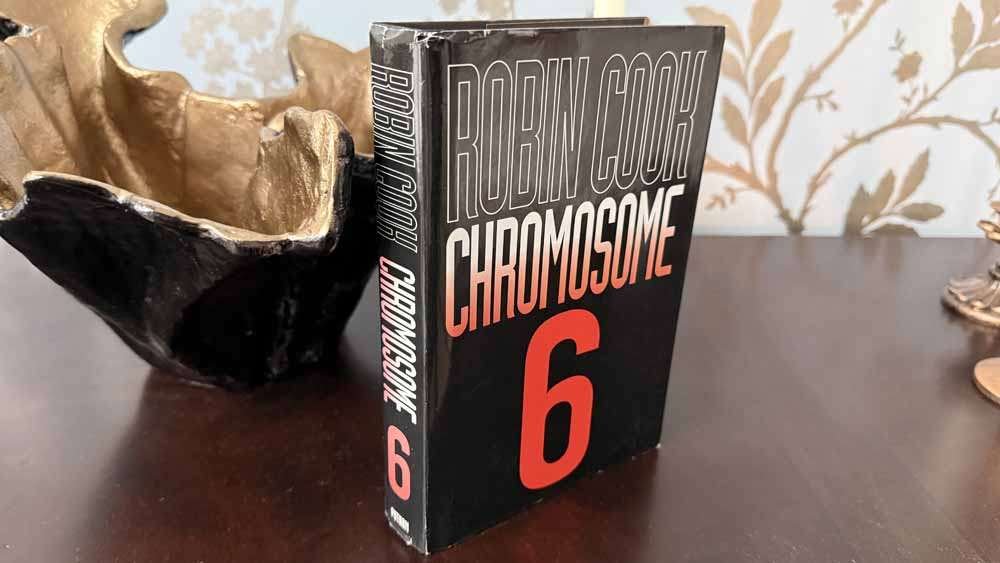
Robin Cook has a trick he’s been running since 1977, and it works every time. He hands you a thriller — fast, kinetic, somebody’s dead on an autopsy table — and while you’re turning pages to find out what happened, he performs surgery on an institution you trusted. In Coma, the hospital itself is the killer. In Chromosome 6, published in 1997, the target is the machinery of corporate medicine: the research firm, the offshore lab, the billable body, the executive who prefers not to know the details. Cook called his own stated purpose bluntly in interviews — he wanted to decry the intrusion of business into medicine. What he built to carry that argument was one of the more unsettling thrillers of the decade.
The setup is split-screen. In New York City, forensic pathologist Dr. Jack Stapleton catches a strange case: a murdered mob boss, Carlo Franconi, whose body vanishes from the medical examiner’s office before autopsy. When a mutilated floater turns up days later — no head, no hands, no feet — Stapleton’s interest sharpens. The missing liver is what gets him. Not the missing head. The liver. A detail only a doctor would notice, and Cook makes you feel the clinical weight of that noticing. Something happened to this man’s liver that someone did not want examined.
Meanwhile, in the jungle of Equatorial Guinea, a molecular biologist named Kevin Marshall is losing sleep. He works for GenSys, a biotechnology giant operating an animal research compound in the remote African interior, on an island called Isla Francesca where bonobos are kept isolated from the world. The work is elegant in theory: insert the short arm of human chromosome 6 — the region that governs immune compatibility — into a bonobo, and the resulting animal becomes, immunologically speaking, a near-perfect organ donor for the patient whose genetic sequence was used. No rejection. No anti-rejection medication. A custom liver, grown in an ape, shipped in a cold case, surgically installed without a paper trail. The operation serves wealthy clients who can afford to skip the transplant waiting list and the paperwork entirely.
Cook’s scientific architecture is not loose speculation. Chromosome 6 contains the major histocompatibility complex — the real genetic region that determines whether a transplanted organ is accepted or destroyed by the body’s immune system. The premise is exaggerated, but it is not invented from nothing, and that gap between implausible and impossible is where Cook does his most effective work. The Anniston Star noted in its review that the novel was “only a step ahead of the fast-moving marvels of the real-life laboratory.” A molecular biologist writing on LibraryThing called the genetic science “thrillingly believable” while noting only the bonobos’ accelerated cognitive development pushed against plausibility. Cook earns his fear by keeping the science close to its leash.
The Corporation as Villain
What gives the book its staying power is not the chase — though there is one — but the portrait of GenSys as an institutional organism. The company is not cartoonishly evil. Its executives in New York are polished and distant. Its managers in Africa are pragmatic and territorial. The scientists doing the work, including Kevin Marshall, are largely idealistic researchers who made a series of small compromises that aggregated into something they can no longer name without discomfort. Cook understood, as he always has, that institutional wrongdoing rarely requires villains. It requires incentive structures, information gaps, and the quiet suppression of the people in the middle who start asking the wrong questions.
Kevin Marshall is that person. He raises concerns. He is told, in various polished registers, to focus on the work. When the bonobos on Isla Francesca begin exhibiting behaviors that cannot be explained — fire, primitive tool use, what appears to be language — Marshall understands before anyone else that the genetic modification has crossed a line that nobody in GenSys’s boardroom defined because they preferred not to. The company’s on-site managers respond not with scientific curiosity but with a threat assessment. What happens if this gets out? How much does it cost to contain? Those are not scientific questions. They are quarterly-report questions.
This is Cook at his most pointed. The thriller machinery — the mob connection in New York, the jungle pursuit in Africa, the converging investigations — exists to move you through a critique of what happens when medicine becomes a product line and patients become revenue events. The Mafia client is almost a detail. What matters is that the system GenSys built is structurally indistinguishable from any high-end concierge medical service: it exists because wealthy people do not want to wait, do not want to interact with institutional processes designed for everyone, and will pay whatever the market will bear to avoid both. Cook does not need to editorialize about this. The plot demonstrates it.
The Tradition He Built
It helps to read Chromosome 6 as one installment in a longer project. Cook’s career-long theme, across dozens of novels, is the same institutional critique in different rooms. Coma (1977) put it inside a hospital. Fatal Cure put it inside managed care. Chromosome 6 moves the location to a biotech firm operating in a country with no regulatory infrastructure, which is precisely the point — GenSys went to Equatorial Guinea because it could, because the absence of oversight is a feature, not a problem. The geography of the novel is the argument. When regulation and transparency disappear, what fills the space is exactly what fills it here.
Cook told interviewers that beyond entertainment, his goal was to get the public interested in medical issues they didn’t know they should be thinking about — because, as he put it, it is the public that ultimately should decide which way we ought to go on something as ethically charged as genetic research. Chromosome 6 is a delivery mechanism for that project. The thriller is the wrapper. The content is: someone is already doing this math, and nobody elected them to do it.
What the Book Gets Right That Matters
The organ transplant crisis in the United States is not fictional backdrop in Chromosome 6. It is the engine. In 1997, the year the novel was published, over 55,000 people were on the national transplant waiting list. The gap between need and supply was not closing. Cook identified that gap as the pressure point a GenSys would exploit — not with malice as its first motive, but with the same logic a pharmaceutical company uses when it moves a clinical trial to a country with looser informed-consent rules. The system is not broken. It is working exactly as designed, for the people who designed it.
What Chromosome 6 does, at its most effective, is make that abstraction physical. The bonobo in a cage on Isla Francesca is not a philosophical thought experiment — it is a living organism that someone altered, confined, and is waiting to cut open. The mob boss who received the liver did not know where it came from. The doctor who transplanted it looked the other way. The GenSys executive in New York knew enough to not want to know more. Cook distributes the moral weight across an entire chain, which is how real institutional harm actually works.
The Limits of the Novel
Chromosome 6 is not a perfect book. Cook’s detractors have always had a point: his characters are functional rather than fully inhabited. Jack Stapleton is a vehicle for investigation. Kevin Marshall is a vehicle for conscience. The women in both storylines are underdeveloped in ways that reflect 1990s genre conventions rather than intentional craft. The ending resolves the plot while leaving the institutional question deliberately open — a choice that will frustrate readers who want closure and ring true to readers who understand that GenSys doesn’t end when the book does.
The pacing occasionally stalls when Cook front-loads the genetics. He is a doctor who loves his subject matter, and there are passages where the science is explained at a length that the thriller format doesn’t entirely support. But this is the tax you pay to read a writer who actually knows what he’s describing, and on balance, the precision earns its cost.
Why It Still Reads
Twenty-seven years after publication, the specific technology Cook imagined has not arrived. But the institutional logic has. The offshore research compound, the wealthy clients who pay to bypass the queue, the scientists asked to not look too hard at the downstream consequences of their work — all of this is recognizable in the landscape of modern pharmaceutical research, clinical tourism, and for-profit genomics. When a company today builds a proprietary genetic database and the business model depends on people not asking exactly who benefits from their DNA, Chromosome 6 is not dated. It is early.
Cook was always writing a diagnosis. The thriller was the bedside manner. What I keep coming back to, long after the plot details fade, is the image of Kevin Marshall on that island, watching a bonobo make fire, understanding what it means, and knowing with absolute certainty that his company does not want to hear it. That is not a scene from a thriller. That is a scene from an ethics course that hasn’t been taught yet.
You Might Also Like
- The Selfish Gene by Richard Dawkins — The Book That Unlocked Darwin for Me
- Horizontal Gene Transfer: Why Darwin’s Tree of Life Is Actually a Tangled Web
- The Extended Phenotype: How Your Genes Build Structures Beyond Your Body
Sources
- Cook, Robin. Chromosome 6. G.P. Putnam’s Sons, 1997.
- Reactor Magazine. “Forgotten Bestsellers: Coma by Robin Cook.” https://reactormag.com/forgotten-bestsellers-coma-by-robin-cook/
- Wikipedia. “Robin Cook (American novelist).” https://en.wikipedia.org/wiki/Robin_Cook_(American_novelist)
- Penguin Random House. Chromosome 6 product page. https://www.penguinrandomhouse.com/books/353364/chromosome-6-by-robin-cook/
- LibraryThing reader reviews. Chromosome 6. https://www.librarything.com/work/8971391/t/Chromosome-6
- Goodreads reader reviews. Chromosome 6. https://www.goodreads.com/book/show/66470.Chromosome_6