Yaphank, New York is not a place most people think about. It sits in the middle of Suffolk County, surrounded by the Long Island Pine Barrens, forty miles east of Manhattan and a long way from the Hamptons or the North Shore’s waterfront villages. The name itself comes from the Unkechaug people who were here before anyone else. For most of the twentieth century, the 5,265 acres at its center have been owned by the federal government — first as an army training camp, then as a nuclear research facility. The people who live around it go about their lives. The land keeps accumulating history.
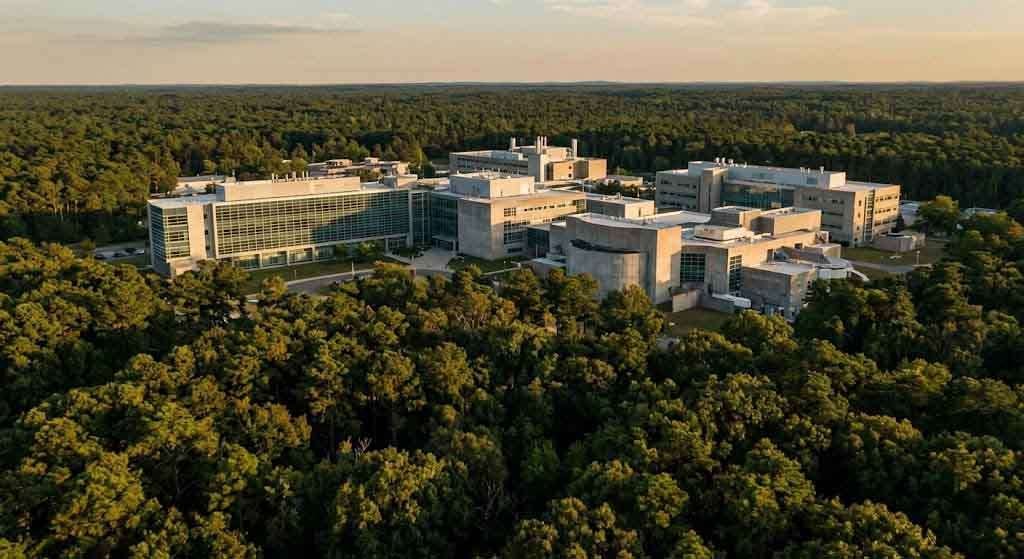
That land is now Brookhaven National Laboratory, one of the most significant scientific research institutions in the world, home to multiple Nobel Prize-winning discoveries and a series of particle accelerators that have been at the frontier of physics for more than seventy years. Before it was any of that, it was a place where young men from New York City learned to dig trenches.
The First Use: Camp Upton, 1917
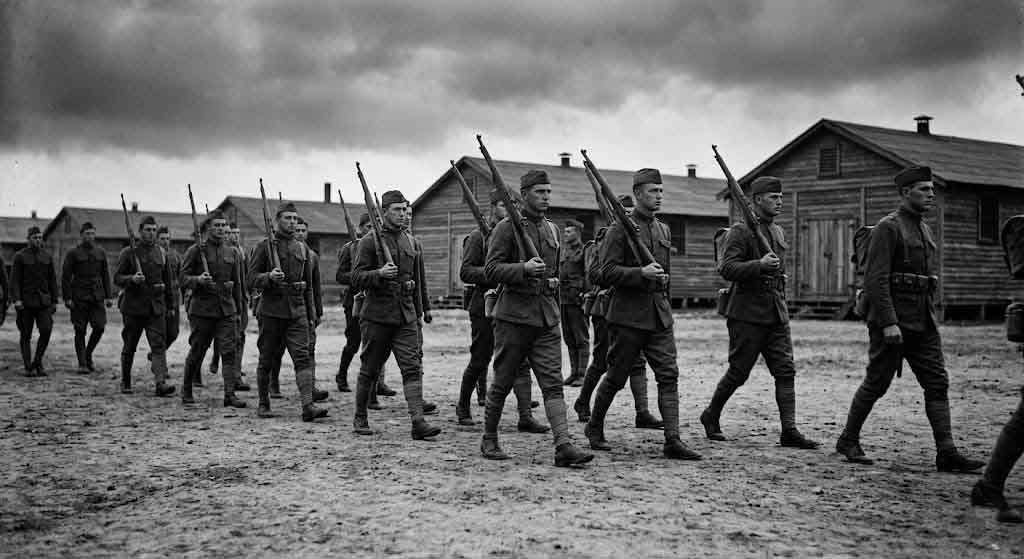
When the United States entered World War I in April 1917, it had almost no standing army. The decision to build one fast produced sixteen training cantonments across the country, one of which was assigned to the New York metropolitan area. The site selected was Yaphank — centrally located in Suffolk County, already thinly populated, accessible by the Long Island Rail Road, and available. The Army acquired the land and began construction almost immediately.
Camp Upton was named after Major General Emory Upton, a Union general from the Civil War. It was built to hold 37,000 men. The first 20,000 recruits arrived in September 1917 while the camp was still being finished around them — barracks going up on one side, men drilling on the other. Training included marching, weapons handling, and the particular specialty of that war: trench warfare. Men from the New York area who had been grocers, factory workers, and clerks six months earlier were learning to live in interconnected ditches filled with mud and rats and wait for the order to go over the top.
More than 300,000 men trained at Camp Upton over the course of the war, many of them members of the 77th Infantry Division — the “Liberty Division,” made up largely of immigrants and second-generation New Yorkers from the city’s working-class neighborhoods. Among them was a draftee named Irving Berlin, already famous as a songwriter before the war, who wrote “Yip, Yip, Yaphank” while stationed there, a musical revue based on camp life that was performed on Broadway with his fellow soldiers filling the cast. The show produced one of Berlin’s most durable songs: “Oh, How I Hate to Get Up in the Morning.” The bugle was not popular at Camp Upton.
When the war ended in November 1918, the camp demobilized quickly. The Army decided it no longer needed the site, and by 1920 Camp Upton was deactivated. For the next two decades, the land reverted to Upton National Forest. The pine barrens grew back over the parade grounds.
The Second Use: Camp Upton Reactivated, 1940
The world began threatening itself again in the late 1930s, and the Army returned to Yaphank. Since the land was still federally owned, the decision to rebuild Camp Upton was straightforward. New barracks, new parade grounds, new facilities — the same site, the same purpose. When the United States entered World War II after Pearl Harbor, the camp filled again with men and machinery.
This time the use evolved as the war did. After the induction center function was transferred to Fort Dix in New Jersey, Camp Upton became a convalescent and rehabilitation hospital for wounded veterans returning from the Pacific. Bowling alleys, swimming pools, and tennis courts were added — recreational therapy for men who had been broken by combat and were being put back together. In May 1945, five hundred German prisoners of war were transferred to the camp. By 1946, with the war over, the Army again deemed the site unnecessary.
The question this time was what to do with it.
The Third Use: Brookhaven National Laboratory, 1947
Several proposals circulated after the war for the future of the Camp Upton land. One suggested using it as a vocational school for Long Island youth. The proposal that won was more consequential: convert the former military installation into a civilian research facility dedicated to the peaceful applications of atomic energy. The United States had just demonstrated what atomic energy could do in war. The scientific community — and the federal government — was invested in demonstrating what it could do in peace.
On March 21, 1947, the site was formally transferred from the U.S. War Department to the new U.S. Atomic Energy Commission. Brookhaven National Laboratory was born. The old barracks were repurposed to house scientific equipment. The parade grounds became campus lawns. The same Pine Barrens that had surrounded men learning trench warfare now surrounded men and women building particle accelerators.
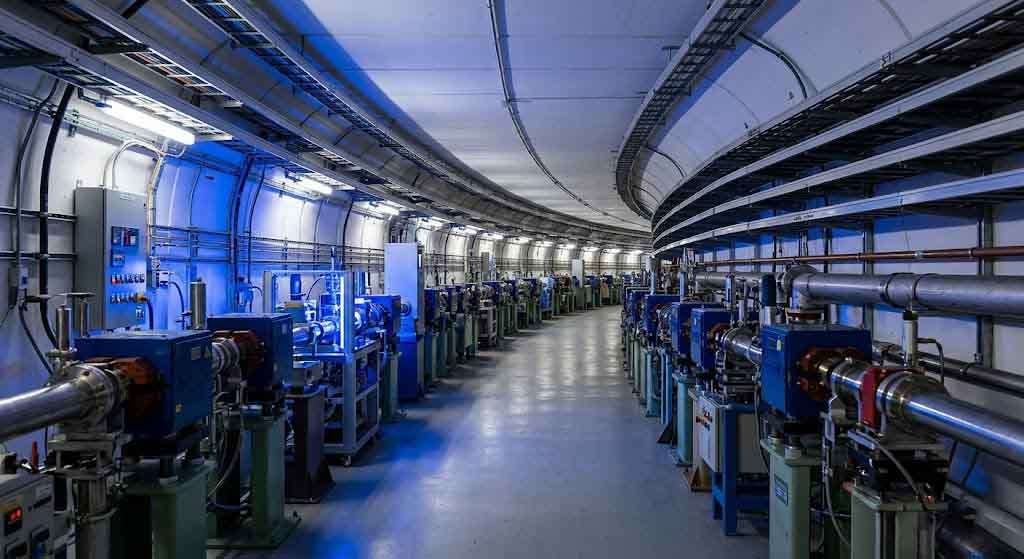
The laboratory’s early work centered on nuclear science, but its scope expanded rapidly into high-energy physics, biology, medicine, and environmental science. Over the following decades, Brookhaven would become home to research that produced seven Nobel Prizes in Physics and Chemistry, including work on particle physics and neuroscience. The Relativistic Heavy Ion Collider, completed in 2000, remains one of the most powerful accelerators for studying the conditions of the early universe.
The physical campus retains traces of its military origin. The Brookhaven Center, a structure from the Camp Upton era, still stands on the site and is used for conferences and events. The Brookhaven site history tour documents the remaining evidence of the camp — barracks foundations, the old clock tower framework, the patterns of original roads. The land holds its history in layers, and the laboratory has preserved enough of the physical record to make that layering visible.
What the Land Tells You
The three uses of this land — training ground, hospital, research facility — trace a particular arc of American policy in the twentieth century. Each use was determined not by the market but by the federal government, which owned the land and assigned it a purpose according to the national priorities of the moment. The men who drilled there in 1917 didn’t choose the location. The scientists who set up their instruments there in 1947 didn’t either. The land was assigned its purpose from above, by institutional decision, and the communities around it adapted.
This is a different model of land use than most of what happens on Long Island. The private real estate market that has shaped the island’s residential landscape from Port Jefferson to Montauk operates through individual transactions, price signals, and zoning codes negotiated at the town level. The federal government, when it owns land, doesn’t negotiate. It designates. It transfers. When a military installation becomes available, it becomes whatever Washington decides it should become — a research lab, a national seashore, a veterans hospital, a wildlife refuge.
Paola Pawli Meyer, who works closely with buyers navigating the North Shore and broader Suffolk County market, notes that federal land ownership shapes surrounding real estate values in ways buyers sometimes don’t track closely enough. Properties near Brookhaven benefit from proximity to one of the largest employers in Suffolk County — the laboratory has roughly 2,750 employees and hosts thousands of visiting researchers annually. The Pine Barrens that surround the site, protected by the Long Island Pine Barrens Protection Act of 1993, ensure that the adjacent land will not be developed, which has its own effect on the character and long-term value of nearby communities.
The Rum Row and the Freeport Bootleggers post captures a different layer of Long Island history — the unofficial, improvised, illegal kind. The Camp Upton story is the opposite: official, planned, federally decreed. Both shaped the island. Neither shows up clearly in a real estate listing.
A Century in the Same Dirt
What strikes me about the Camp Upton to Brookhaven story is the compression of American ambition in a single piece of geography. In 1917, men were learning to survive artillery barrages in that dirt. In 1947, scientists were learning to split atoms in the same dirt. In 2026, those scientists’ successors are colliding heavy ions at energies that approximate conditions one microsecond after the Big Bang, in a facility built on a site where Irving Berlin once complained about the bugle.
The land doesn’t know any of this, of course. The pine barrens grow back when you let them. The parade grounds became research quads. The barracks became laboratories. But the physical continuity is real: the same 5,265 acres, the same federal ownership, the same location in the middle of Long Island’s geographic center, pressed into entirely different service as the nation’s needs changed.
That is what federal land can do. It can absorb a century’s worth of institutional purpose without being sold, subdivided, or developed. It is the inverse of the private real estate market — patient, institutional, indifferent to individual valuation. When the Army decided in 1946 that Camp Upton had no further military value, the land did not go on the market. It was simply re-designated, and the scientists moved in.
For the communities around Yaphank, the effect over seventy-five years has been stabilizing. The federal presence has prevented sprawl into the Pine Barrens. It has provided a major employer. It has anchored a research culture that includes Stony Brook University, Cold Spring Harbor Laboratory, and other scientific institutions that make the central spine of Long Island more economically diverse than its residential geography would suggest.
The draftees from 1917 who dug practice trenches in the Yaphank dirt couldn’t have imagined what the land would become. Neither could the scientists who set up their first instruments in repurposed barracks in 1947. That kind of transformation — one landscape, one century, from trench warfare to particle physics — is not the kind of story real estate markets are built to record. But it is exactly the kind of story that explains why a place is what it is.
The pine barrens are still there. The atoms are still being split. The soldiers are long gone.
You Might Also Like
- Rum Row and the Freeport Bootleggers: Long Island’s Clandestine War on the Water
- The Ride Down 25A: A Historic Motorcycle Journey Along Long Island’s North Shore
- What Never Hits Zillow: The Hidden Inventory Problem on Long Island’s North Shore
Sources
- Brookhaven National Laboratory — History: Camp Upton
- Brookhaven National Laboratory — 75th Anniversary: Camp Upton
- Brookhaven National Laboratory — Site History Tour Pamphlet
- Wikipedia — Camp Upton
- William G. Pomeroy Foundation — Camp Upton Historical Marker
- Long Island Genealogy — Camp Upton
- HMDB — Camp Upton Historical Marker Entry
- The East Hampton Star — Camp Upton’s World War I Recruits
- U.S. Department of Energy — Brookhaven National Laboratory