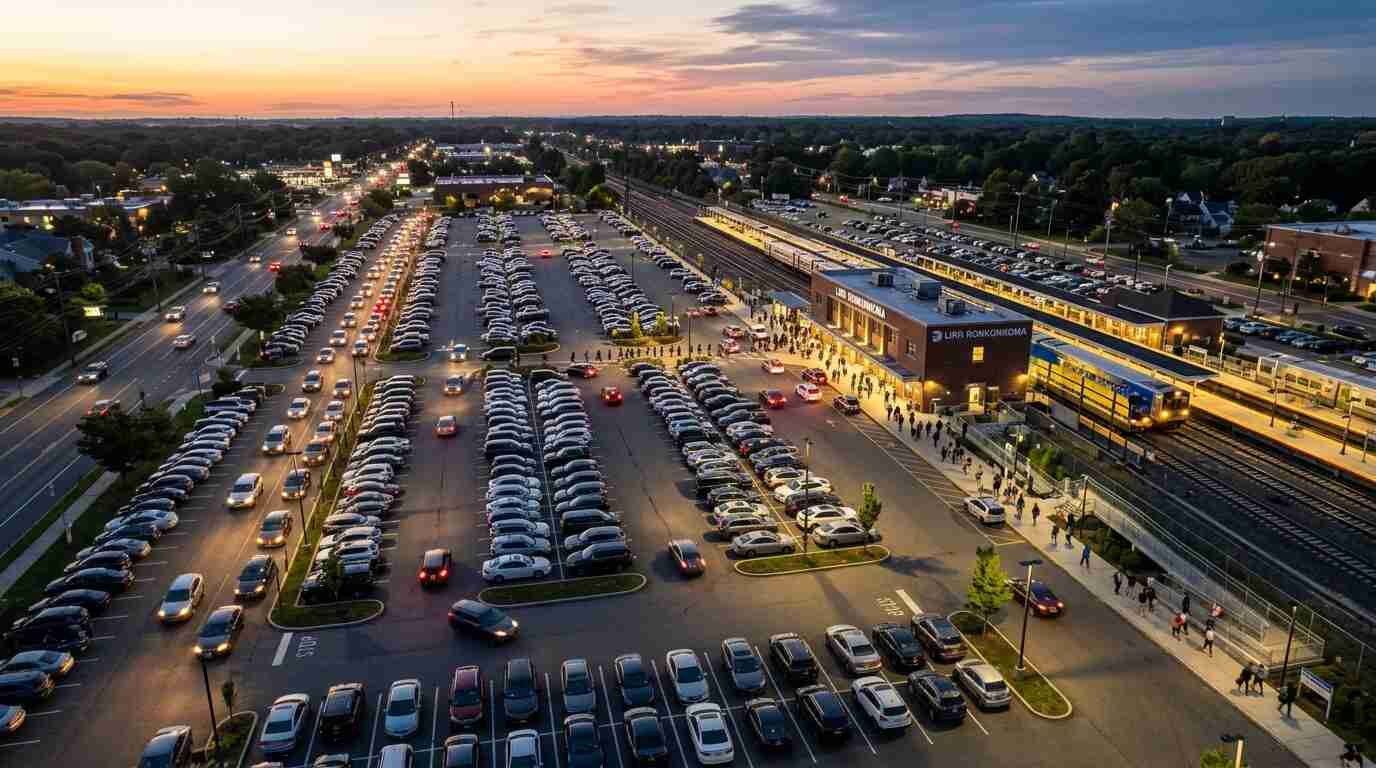
Somewhere around 5:45 on a weekday morning, Ronkonkoma Station begins its first quiet surge. Coffee thermoses have already been filled. Commuters park their cars in one of the station’s 5,400 spaces — some free, some not — and make their way toward the platform. Trains to Penn Station and Grand Central Madison. The 6:02 express. The 6:17 local. The brief window between them, warm and habitual, belongs to the diners.
That window built a food economy that Denny’s never figured out. IHOP couldn’t crack it either.
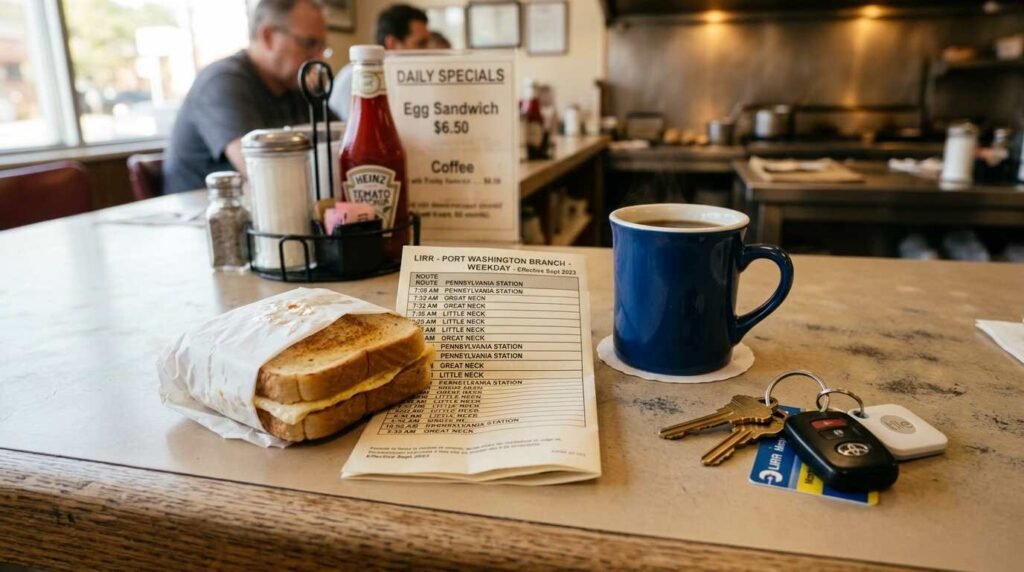
The Second Busiest Station on Long Island
Ronkonkoma is not the flashiest stop on the Long Island Rail Road. There’s no ferry landing, no village square, no boutique hotel with a rooftop bar. What it has is volume and position. According to ridership data, it is the second busiest station on Long Island by daily boardings and the fifth busiest on the entire LIRR system — handling upwards of 15,000 daily passengers pre-pandemic, and over 4 million rides per year in peak years.
What makes Ronkonkoma operationally distinct is what happens at the eastern edge of electrification. The LIRR’s Main Line is electrified from Penn Station to Ronkonkoma — and then, east of that, service transitions to diesel “scoots” running toward the North Fork. Passengers coming from Greenport, Riverhead, and points east of Yaphank must transfer at Ronkonkoma to continue west into the city. The station isn’t just a terminus. It’s a collection point — a place where commuters funnel in from a sprawling catchment that extends well past the station’s immediate ZIP code.
Studies of LIRR Origin and Destination data show that only about a third of Ronkonkoma’s riders actually come from the surrounding area. The other two-thirds have driven past their closest station — on the Montauk Branch, the diesel North Fork lines, from the Brentwood and Islandia areas — specifically because Ronkonkoma offers faster, more frequent electric service into the city. You don’t stumble into Ronkonkoma Station by accident. You choose it.
That choice creates something rare in the suburban breakfast economy: a reliable, predictable customer base that arrives in distinct waves tied to departure times.
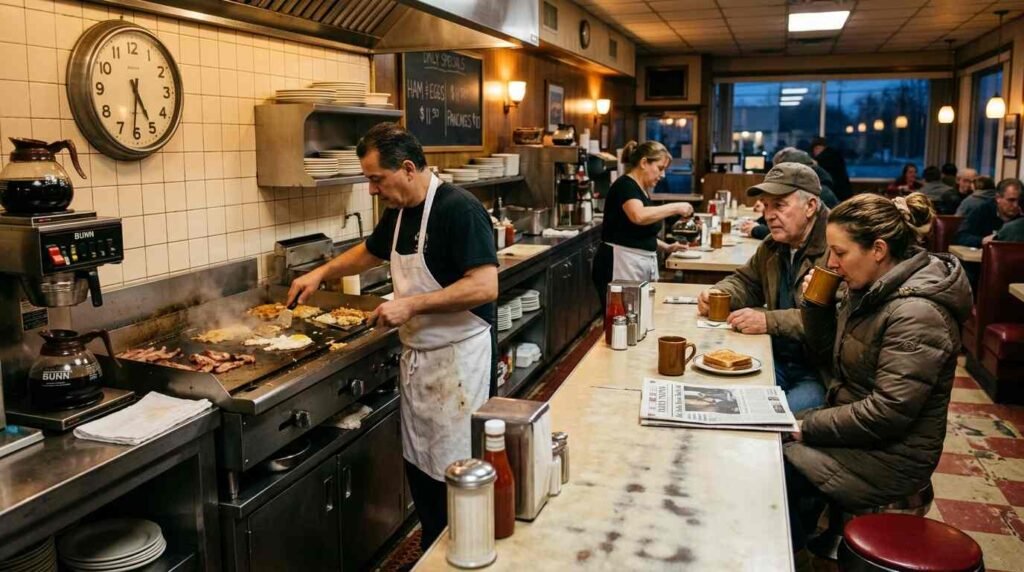
What the Chain Breakfast Model Optimizes For
A national breakfast chain — your IHOP, your Denny’s, your Perkins — optimizes for the highway-adjacent family with time to spare. The model assumes dwell time. Tables filled for 45 minutes. A server cycling through the Grand Slam order. Children requiring high chairs. Four people sharing a check with two separate payment methods.
That model is built for Route 110 strip malls and exit-ramp real estate. It works in Hauppauge. It works off the LIE service road. What it does not work for is a platform filling up at 5:58, clearing by 6:04, and filling again at 6:14.
The Ronkonkoma commuter does not want a laminated menu. He wants coffee in hand before he gets to the fare machine. He wants the egg sandwich the counter guy already knows. He wants to pay cash, get change, and be walking toward the platform in under four minutes. The national chains, with their POS systems and portion-controlled cook lines and mandated greeting scripts, cannot execute that transaction at the speed the commuter requires.
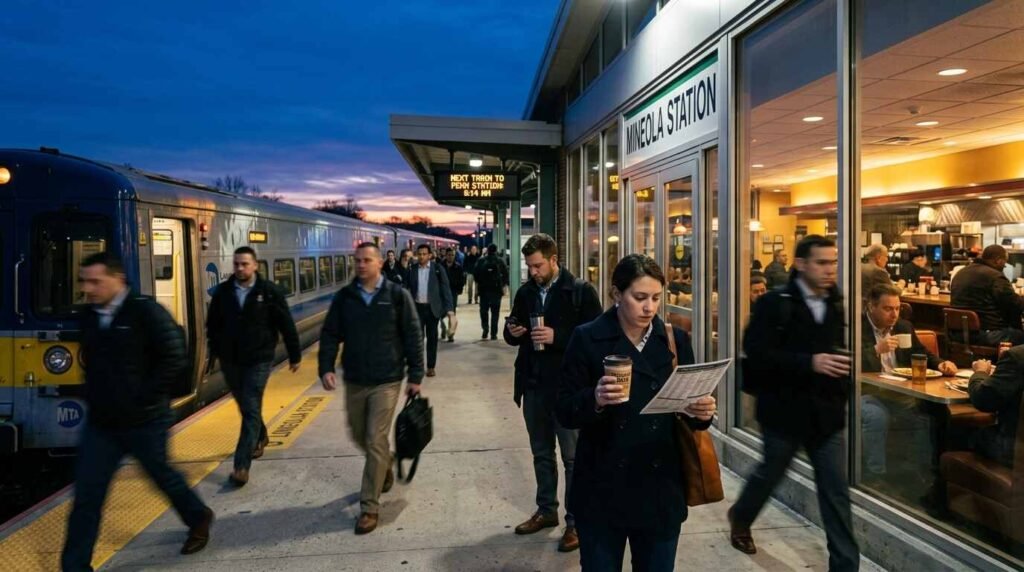
What Local Diners Adapted To Do
The diners that survived around the Ronkonkoma corridor learned something that no focus group can teach: the schedule is the boss.
The 5:47, the 6:02, the 6:17 — these are not suggestions. They are the architecture of the morning. A diner that figures out when those trains leave, and reverse-engineers its prep, staffing, and service flow from those departure times, has a structural advantage no amount of national marketing can overcome. The counter seats closest to the door get used three times between 5:30 and 7:00. The late-morning tables are a different economy entirely — retirees, work-from-home types, the occasional shift worker coming off nights.
That bifurcated customer flow is deeply uncomfortable for a franchise model. You cannot write a corporate operations manual that efficiently handles both the 5:58 train rush and the 10:30 omelet crowd without ending up with a counter that does neither particularly well.
Why This Matters for Anyone Buying Near a Transit Hub
Here’s the real estate layer to this story, and it’s one that buyers consistently undervalue.
Properties near Ronkonkoma Station sit at the intersection of two Long Island demand curves: commuter accessibility and service-economy proximity. When you buy near an LIRR hub with this kind of volume, you’re not just buying a commute — you’re buying into a neighborhood ecology that includes functional, independently operated food and service businesses. That ecology has proved remarkably durable against national competition precisely because the local operators understand the rhythm of the place.
Contrast that with the Route 110 strip in Huntington Station or the interchange retail along the LIE service road, where national chains cycle through leases on a ten-year rhythm and vacancy is the norm. Near Ronkonkoma Station, the guy who knows your order has been behind the same counter for nineteen years. That kind of institutional memory is an amenity. It shows up in the character of the neighborhood even when it doesn’t show up in the listing price.
Buyers looking at Ronkonkoma, Lake Ronkonkoma, and the surrounding Lake Grove corridor often focus on commute time and school district. Fair. But the walkable food economy around a high-functioning transit hub — the ability to stop somewhere real before your train — is a quality-of-life factor that doesn’t have a Zillow field.
The Chain Graveyard
The evidence is available to anyone willing to pull business license records from the Suffolk County Department of Economic Development. National breakfast concepts have tried the Ronkonkoma-adjacent market. They have not lasted. The throughput model built for suburban families doesn’t survive when the morning peak arrives in a four-minute window and expects to leave in three.
The diners that are still there — the ones with the coffee urns, the counter with the worn edge, the specials written on a whiteboard because the laminated menu hasn’t been reprinted since 2011 — those operations understood the schedule before they understood anything else. They built their businesses around the LIRR timetable the way harbor fishermen build their day around the tide. You don’t fight it. You read it and move accordingly.
That’s not a lesson the national chains ever had the flexibility to learn.
What to Consider If You’re Buying in the Ronkonkoma Corridor
The near-station market around Ronkonkoma has seen consistent demand from NYC commuters, particularly in the aftermath of remote work policies shifting back toward hybrid schedules. The ability to get to Penn Station or Grand Central Madison in under 70 minutes without paying the full freight of North Shore waterfront pricing has made communities like Lake Ronkonkoma, Centereach, and Nesconset increasingly attractive to buyers who want commuter access without the Smithtown or Stony Brook price premium.
If you’re evaluating property in this corridor, the train schedule isn’t just a commute consideration — it’s a neighborhood character document. Towns that organized themselves around transit hubs decades ago have a different grain than the developments that assumed everyone would drive to the LIE. The former has walking-distance infrastructure. The latter has parking.
The diner that built its prep list around the 5:47 is still there. The Denny’s that opened near the exit ramp is not.
For anyone exploring what that kind of commuter-accessible Long Island living looks like in practice, Maison Pawli a Boutique Modern Realty works with buyers across the North Shore and central Suffolk County corridor who are navigating exactly this kind of decision.
This post is for informational purposes only — consult a licensed attorney or financial advisor for your specific situation.
Sources
- MTA Long Island Rail Road: 2024 Annual Ridership Report
- The LIRR Today: Where Ronkonkoma Riders Come From
- The LIRR Today: The Long Wait for Ronkonkoma Branch Half-Hourly Service
- Wikipedia: Ronkonkoma Branch
- Suffolk County Department of Economic Development: Business license records (public archive)