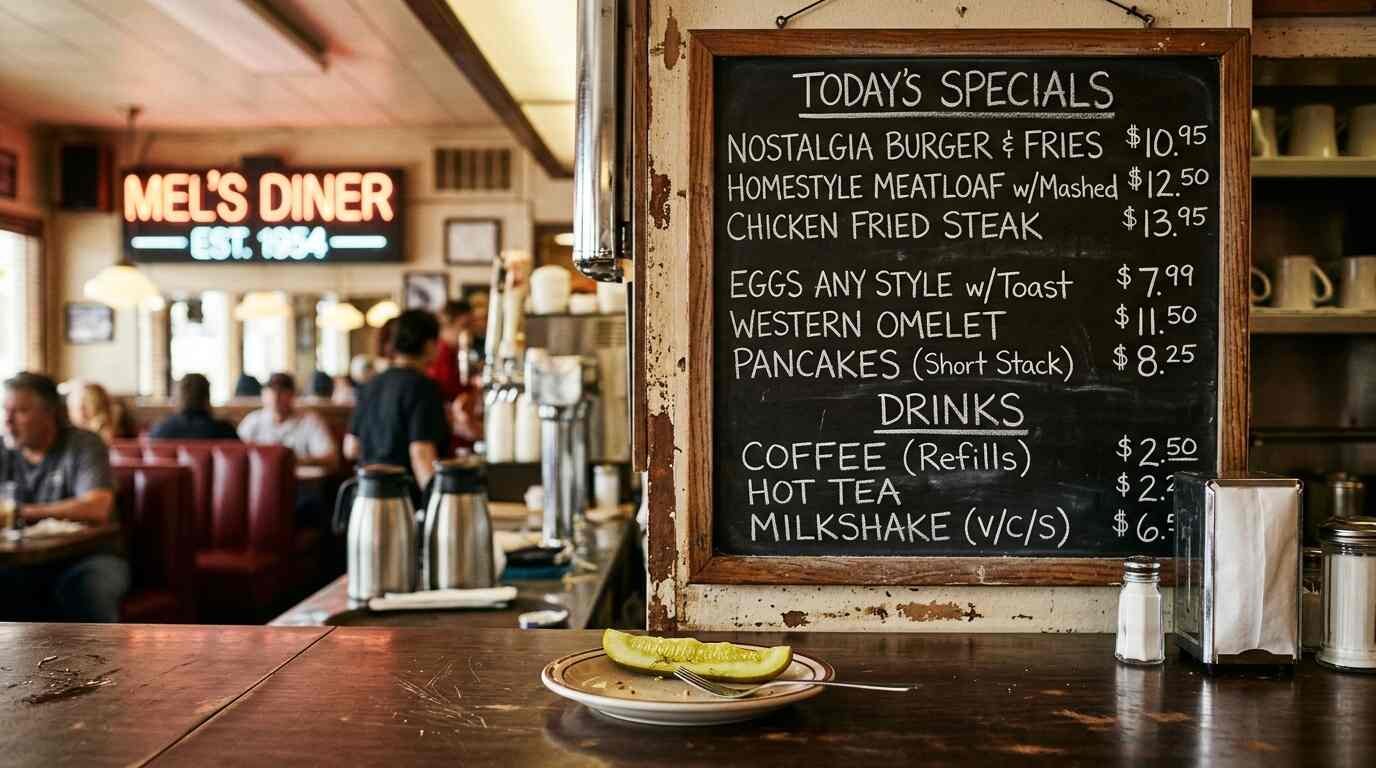
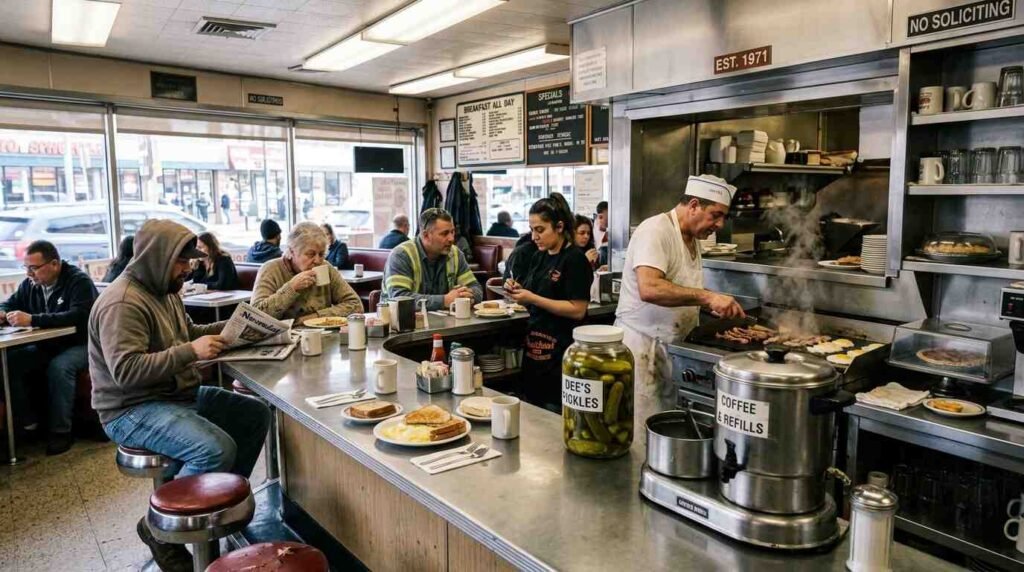
The pickle is still $0.50. This is not nostalgia or marketing. It is a data point.
In a Nassau County that has lost nearly every working-class diner corridor to redevelopment, conversion, or the slow attrition of a customer base that can no longer afford to live nearby, Farmingdale’s Route 110 stretch has held. The evidence is in the menus, the booths, the laminate that hasn’t been replaced, and the shift workers who fill the counter seats at 6:30 AM. To understand why this strip survived when virtually nothing analogous survived anywhere else in Nassau County, you have to stop reading it as a food story and start reading it as a zoning story.
The Airport That Built the Lunch Counter
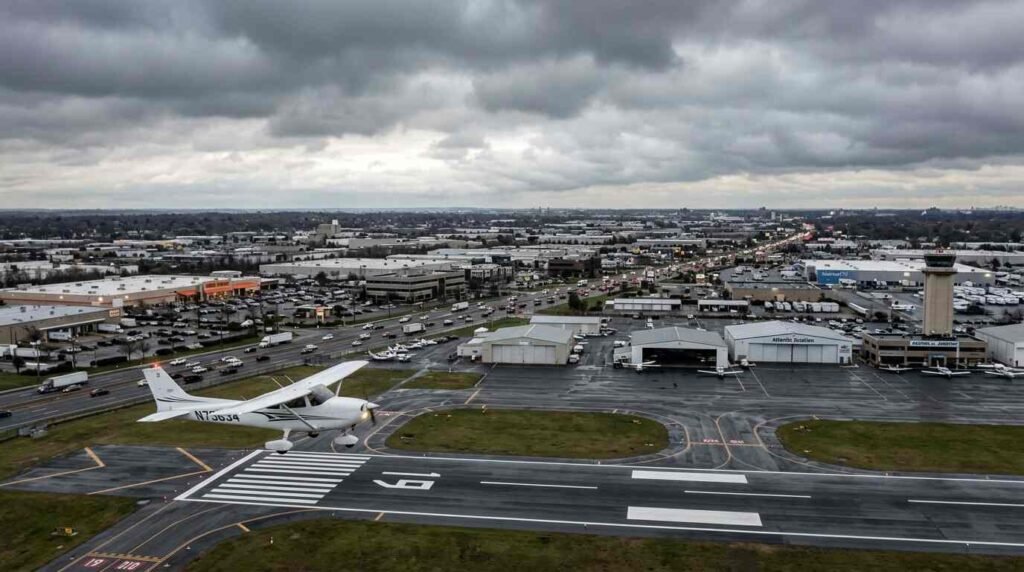
Republic Airport — officially Long Island MacArthur’s western neighbor, located in East Farmingdale between Route 110 and the Southern State Parkway — has been a continuous operational presence on Long Island since it opened as Farmingdale Airport in 1928. FAA Airport Data and Information Portal records document its ongoing role as a general aviation hub serving corporate, charter, and flight training operations.
An airport at that scale, running operations through multiple daily shifts, does not generate passenger traffic in the way a commercial airport does. What it generates is workforce traffic: maintenance crews, line technicians, fuel handlers, avionics specialists, administrative staff, charter crews — people who work shifts, eat early, eat again at midnight, and have neither the time nor the inclination for a table-service experience. The lunch counter is not a preference for these workers. It is a functional requirement.
The Route 110 diner corridor oriented itself toward that workforce before the concept of a “target market” existed in the food service industry. The cook was behind the flat-top because that’s where you need a cook when someone needs eggs and toast at 5:45 AM and has a preflight walkthrough at 6:00. The counter existed because you cannot fit a booth worth of food service into the time between parking and wheels up.
Northrop Grumman and the Shift-Worker Economy
Republic Airport’s workforce is one layer. The Northrop Grumman employment base — centered at Bethpage but with facilities and operational footprint distributed across Nassau and western Suffolk — is another.
Northrop Grumman’s Long Island presence, documented in public SEC filings and regional economic reports, represents decades of stable, concentrated aerospace and defense employment. At the height of Grumman’s Long Island operations in the Cold War period, the company employed tens of thousands of workers across its Island facilities. Those employment numbers have contracted significantly since the early 1990s, but the company’s Bethpage campus and associated operations have maintained a continuous presence.
The workers who commuted to Bethpage and related facilities along the Route 110 corridor, and the defense subcontractors and suppliers who clustered in the light industrial parks flanking Route 110 through Farmingdale and Bethpage, generated a lunch counter economy that proved resilient because it was never discretionary. You do not choose whether to eat before a nine-hour shift. You choose where. And if you’ve been eating at the same counter for fifteen years, you stop choosing.
That kind of habituated customer base is extraordinarily valuable for low-margin food operations. It removes the acquisition cost. The customer comes back tomorrow because he came back yesterday, and because the coffee tastes the way he expects coffee to taste.
The Zoning Buffer That Saved the Strip
Here is the structural explanation for why Route 110 in Farmingdale held while comparable corridors in Garden City, Mineola, and Great Neck did not.
Nassau County Planning records and publicly available zoning maps document a consistent pattern along the Route 110 commercial strip through Farmingdale: light industrial and commercial zoning flanking the highway, with residential zoning set back at a distance sufficient to limit the “highest and best use” pressure that has driven redevelopment across Nassau County’s more desirable corridors.
In Garden City, the pressure to redevelop comes from the residential premium directly adjacent to the commercial strip — developers can acquire a diner site and build condominiums that appeal to a buyer pool willing to pay for the Garden City zip code. The gap between diner income and residential land value is wide enough to make the transaction attractive.
In Farmingdale, that gap is narrower. The residential interior behind the Route 110 strip is not premium. It is working-class and lower-middle-income housing — functional, stable, not generating the kind of land value appreciation that makes a diner acquisition compelling to a residential developer. The light industrial parcels flanking Route 110 have their own zoning buffers, limiting the upzoning that would be necessary to make mixed-use or residential redevelopment pencil out.
The diner survives, in other words, partly because the land it sits on is not worth enough to someone else to justify ending what’s already there.
What Nassau Has Lost and Farmingdale Still Has
The inventory of working diner corridors in Nassau County has declined dramatically since the 1980s. The commercial strips in Hempstead, the Sunrise Highway corridor in Valley Stream, the Jericho Turnpike stretch in Westbury — these have been transformed by redevelopment pressure, corporate chain displacement, or demographic shifts that changed the composition of the lunch counter clientele. The result is a county where the full-service diner experience is increasingly concentrated in a handful of locations, and the blue-collar lunch counter — the eggs-and-coffee-and-a-pickle operation that doesn’t take reservations — is nearly extinct.
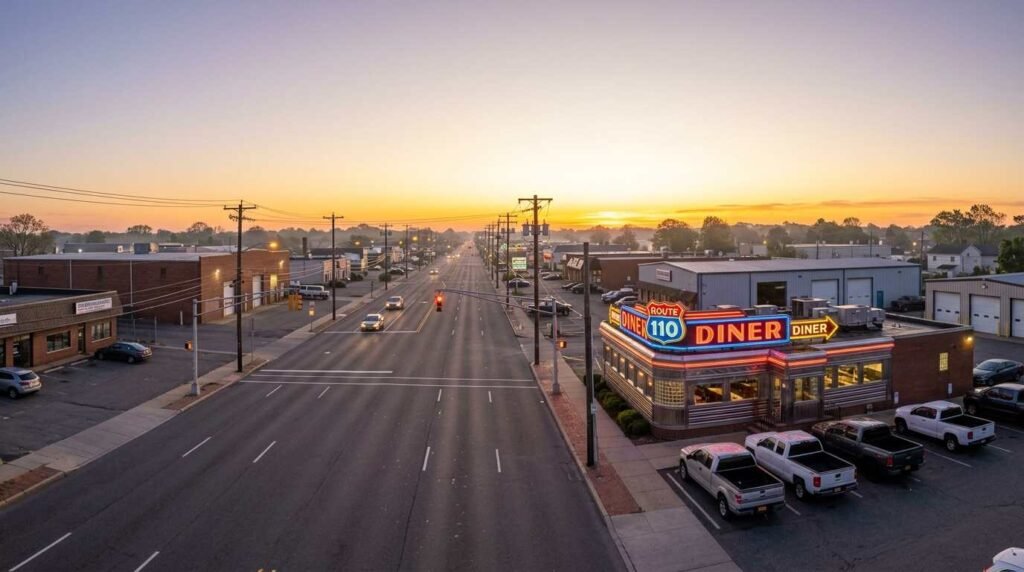
Farmingdale’s Route 110 is the outlier. The physical corridor retains a density of independent food operations oriented toward the shift-worker customer that has been erased almost everywhere else at this price point in Nassau County. The businesses are not distinguished by their food — they are distinguished by their consistency, their hours, and their indifference to trend. That indifference is the product. When the aerospace industry decides to start the work day at 5:30 AM, the counter opens at 5:30.
The Real Estate Argument for Farmingdale
Buyers who look at Farmingdale often encounter it at the end of a price search — it shows up when Garden City is over budget, when Bethpage is moving too fast, when the Massapequa waterfront becomes irrelevant. That positioning as a fallback town obscures what Farmingdale actually offers on its own terms.
Farmingdale Village — the incorporated village center, separate from the broader hamlet — has a functioning downtown, a train station on the LIRR Ronkonkoma Branch, and a residential stock that ranges from genuine Victorian and Craftsman-era housing to mid-century colonials on reasonable lots. The school district is Farmingdale Union Free, with consistent performance metrics publicly available through the New York State Education Department.
What Farmingdale does not have, and will not have anytime soon, is the premium zip code pressure that drives prices in the western Nassau communities. That’s a trade-off, not a deficiency. For the buyer who wants a functioning community, LIRR access, a neighborhood with actual commercial services, and a price that doesn’t require extraordinary income to carry — Farmingdale is a more honest argument than the marketing on Zillow suggests.
The Route 110 corridor, with its surviving lunch counters and shift-worker economics, is not a liability for that buyer. It’s evidence that the town has a real population with real needs, and that those needs are being met by real businesses. That’s more than can be said for a lot of Nassau County’s redeveloped corridors, where the chain coffee shop that replaced the diner is now in its second lease cycle and showing signs of struggle.
Pawli at Maison Pawli a Boutique Modern Realty regularly works with buyers evaluating exactly this kind of Nassau County trade-off — established communities where the price hasn’t caught up with the fundamentals. Farmingdale keeps coming up in those conversations for reasons that the corridor’s lunch counters make visible, if you know how to read them.
This post is for informational purposes only — consult a licensed attorney or financial advisor for your specific situation.
Sources
- FAA Airport Data and Information Portal: Republic Airport (FRG)
- Northrop Grumman corporate history and Long Island employment — public SEC filings and regional economic reports
- Nassau County Department of Planning: Zoning maps and records
- Nassau County Clerk: Business entity records (public record)
- New York State Education Department: Farmingdale UFSD performance data
- Newsday digital archives — accessible via public library digital collections