There is a particular torment reserved for the man who spends his life insisting on the existence of something no one else can see. He is not quite a madman, and that is his curse. A madman has the comfort of his certainty. The believer in the unseen — the physicist who calculates the ripples in a fabric that cannot be touched, measured, felt, or in any ordinary sense known — he must live between two unbearable conditions simultaneously: the certainty that he is right and the terror that he cannot prove it. Kip Thorne lived inside that torment for decades. And then, on a September morning in 2015, the universe confessed.
It confessed with a chirp. A sound lasting a fifth of a second. An oscillation in the arms of two enormous interferometers — one in Livingston, Louisiana, one in Hanford, Washington — so minute that it represented a distortion of spacetime smaller than one ten-thousandth the diameter of a proton. The LIGO instruments detected the gravitational waves produced by two black holes, each some thirty times the mass of the sun, spiraling into each other 1.3 billion light-years away. That collision had happened when the most complex life on Earth was a single cell dividing in shallow water. The wave it produced had been traveling toward us ever since, across an emptiness so absolute it makes the word emptiness seem generous — and then it arrived, passed through us, passed through the planet, and was recorded.
The paper was published in Physical Review Letters on February 11, 2016. The event was designated GW150914. The designation is clinical, anesthetic. It does not suggest what it actually was: the moment that Einstein’s general theory of relativity — a century-old mathematical structure, beautiful and abstract and, many physicists suspected, ultimately unprovable at its outermost reaches — became something else entirely. Became testimony.
The Underground Men of Physics
There is a type that Dostoevsky knew well: the man who has seen something true and cannot make the world agree with him. He retreats not out of weakness but out of a kind of wounded pride — the pride of the unacknowledged prophet. Kip Thorne was not quite this figure, but he touched its edges. The LIGO project — the Laser Interferometer Gravitational-Wave Observatory — was proposed in the late 1970s and early 1980s. It was expensive. It was, in the estimation of many serious physicists, foolhardy. The National Science Foundation was asked to fund instruments capable of detecting distortions in spacetime at sensitivities no instrument in history had approached. The justification rested on a theoretical prediction that had, at the time, zero direct experimental confirmation.
The objections were not made by fools. They were made by men who understood physics and who understood the limits of instrumentation. The sensitivity required was, as critics pointed out, staggering: to measure the effect of a gravitational wave passing through the solar system, you would need to detect a change in distance equivalent to one-thousandth the diameter of an atomic nucleus across a baseline of four kilometers. This is not a number that invites confidence. This is a number that sounds like a category error, a physicist’s fever dream mistaken for an engineering specification.
And yet. Thorne pushed. Rainer Weiss had already begun thinking seriously about interferometric detection in the 1970s. Barry Barish, who would later transform the project from a promising idea into an actual operating observatory, joined later. The three men would eventually share the 2017 Nobel Prize in Physics. But in the years before the detection, the project had detractors inside the scientific community, inside the funding bodies, inside the very institutions that would ultimately claim credit for its success. LIGO cost roughly $1.1 billion over its lifetime of development. There were those who argued, not unreasonably, that the money could have purchased more certain returns elsewhere.
What sustained the believers? Not faith in the mystical sense — these were mathematical men, men of equations and instruments. Something harder than faith. A conviction that the equations meant something, that a structure so elegant and so internally coherent as general relativity could not be pointing at an empty sky. Dostoevsky’s underground man rages against the wall of reason, against the despotism of the twice-two-makes-four. Thorne’s conviction was the opposite: he believed in the wall absolutely, and that belief required him to insist that the wall was there even when no one else could see it.
The Question They Could Not Ask Out Loud
Here is the confession within the confession, and it is the most human thing about the story.
On the morning of September 14, 2015 — before any announcement, before any verification, in the hours immediately after the signal was recorded — the LIGO team faced a question so uncomfortable they could barely speak it directly: was this real?
Not because the instruments had malfunctioned. Not because the mathematics was unclear. But because LIGO had a protocol, inherited from years of operating in a scientific environment where false confidence could destroy careers and credibility, of conducting what were called “blind injections” — deliberate, secretly inserted fake signals designed to test whether the analysis teams could detect a genuine event. The injection was a kind of institutional anxiety made procedural. We cannot trust our own excitement. We must assume, until proven otherwise, that our greatest discovery is a test.
For months after GW150914 was recorded, a small group of LIGO insiders held the possibility in suspension: that this signal, this chirp, this extraordinary convergence of theory and measurement, might be a blind injection. That the universe had not confessed at all — only the institution’s own self-doubt had spoken.
It was not an injection. The signal was real. The verification took months. The announcement came in February 2016. But consider what those months required of the scientists involved: to have heard, potentially, the most significant observational result in the history of physics — and to sit with the knowledge that they were not certain whether it was real. The underground man in Dostoevsky cannot act because he thinks too much, circles too obsessively, undermines himself with his own intelligence. The LIGO scientists were required, by intellectual honesty and institutional protocol, to do the same: to think, and to wait, and to resist the temptation of premature certainty, even certainty about something that sounded, to trained ears, exactly like what it was.
What Einstein Actually Said
The detection confirmed something specific, and the specificity matters. Einstein’s general theory of relativity, published in 1915, described gravity not as a force in the Newtonian sense but as a curvature of spacetime caused by mass and energy. The theory predicted, as a consequence, that accelerating masses would produce ripples in this curvature — gravitational waves propagating outward at the speed of light, carrying energy away from the system that produced them. Einstein himself was uncertain, at various points in his life, whether gravitational waves were physically real or mathematical artifacts of the coordinate system used in the equations. He published papers in 1936 arguing, incorrectly, that they could not exist — a paper that was rejected by Physical Review and revised before publication. The greatest physicist of the modern era doubted his own prediction.
This is not a discrediting anecdote. It is the correct thing to notice. The theory was so complex, so conceptually radical, that even its author could not always see clearly what it implied. And here is where the underground quality enters the story again: general relativity is one of those theories whose implications exceed the grasp of any single intelligence. It is a structure large enough that serious, trained minds have repeatedly misjudged what it contained.
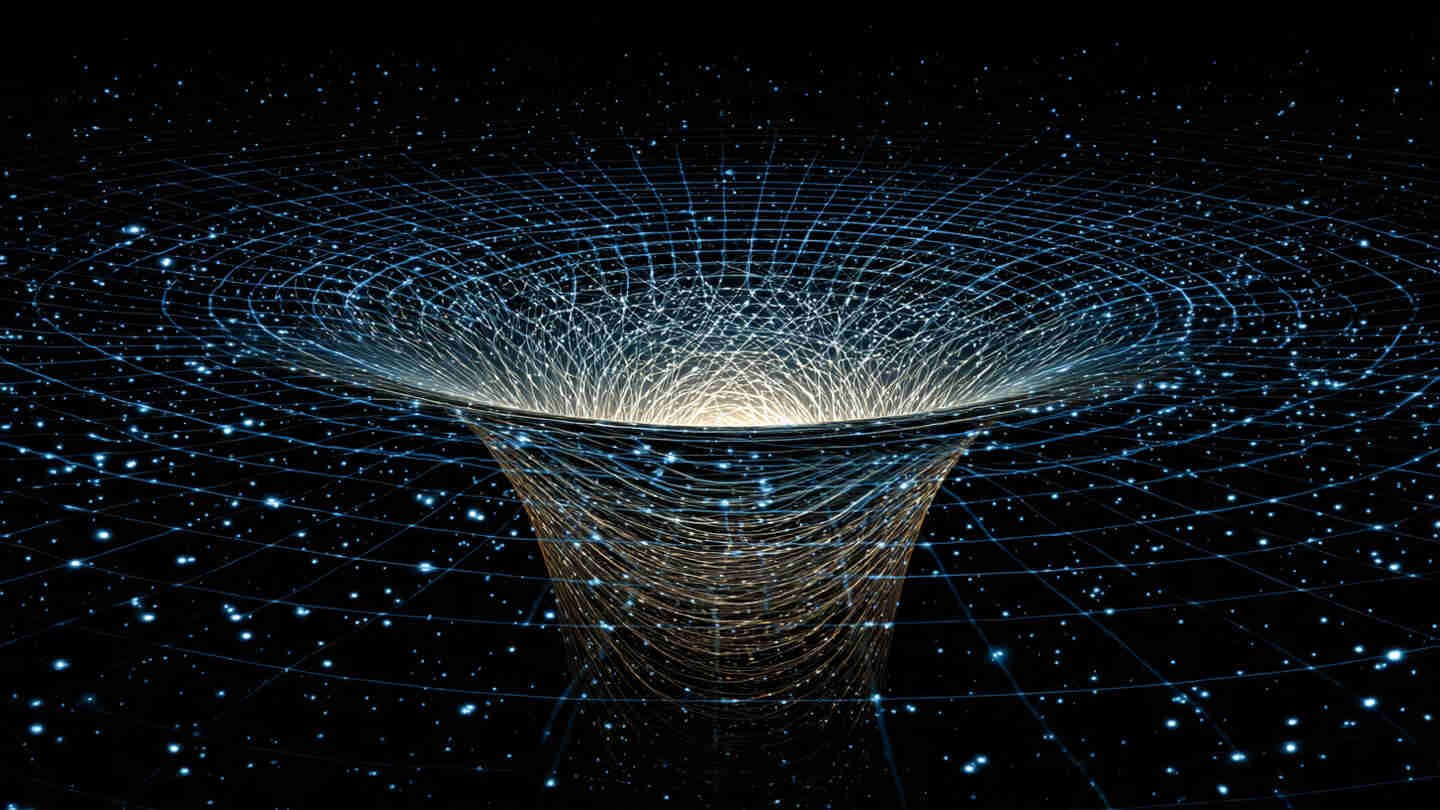
What GW150914 confirmed is that spacetime is not a passive backdrop against which events occur. It is a physical medium. It flexes. It rings. It carries information. When two black holes of thirty solar masses each spiral into each other and merge over the last several hundred milliseconds of their orbital life, they radiate more power — momentarily — than all the stars in the observable universe combined. That power goes somewhere. It goes into spacetime itself, propagating outward as a wave, diminishing with distance, stretching and compressing everything it passes through. The LIGO arms stretched and compressed by less than the diameter of a proton. That compression was the universe’s testimony.
We have, for the first time in history, a way of listening to the cosmos in a register that light cannot reach. Black holes do not shine. The mergers of black holes, neutron stars, the catastrophic collapses of massive stars — these events are invisible to telescopes. They are, however, loud in gravitational terms. We have built ears for a frequency we could not previously hear, and the universe has immediately begun speaking.
The Ecstasy and Its Aftermath
The press conference on February 11, 2016 was one of those rare moments when science produces something that even non-scientists can feel. David Reitze, the executive director of LIGO, announced: “We have detected gravitational waves. We did it.” The brevity was right. The room understood. Decades of effort, a billion dollars, the lifetimes of careers — and the confirmation could be stated in six words.
What followed the announcement has received less attention than the detection itself, but it is where the real philosophical weight accumulates. The confirmation of gravitational waves opened a new field — gravitational wave astronomy — almost instantaneously. LIGO’s sensitivity was improved. A partner detector, Virgo, came online in Europe. In August 2017, LIGO and Virgo together detected the merger of two neutron stars — GW170817 — and for the first time, a gravitational wave event was observed simultaneously in gravitational waves and in light. Gamma-ray telescopes, optical telescopes, radio telescopes all captured the same event from different angles in different wavelengths. The era of multi-messenger astronomy had begun.
But the opening of a new field is always also the opening of new uncertainty. The detection of gravitational waves has made the so-called “Hubble tension” more visible, not less. The Hubble constant — the rate at which the universe is expanding — can now be measured in a new, independent way using gravitational wave events. And the measurements disagree. The value derived from gravitational waves does not precisely match the value derived from the cosmic microwave background. They are close. They are not the same. Physics does not yet know what this means.
The underground man discovers that his long-sought certainty has produced not peace but new contradiction. This is always the shape of honest inquiry. Confirmation is not resolution — it is escalation. The universe confessed, and having confessed, revealed that it had more to confess.
What It Costs to Listen
Kip Thorne, in his long career, wrote with remarkable candor about the psychological dimensions of theoretical physics — about the loneliness of sustained commitment to an unprovable idea, the particular discipline required to maintain confidence across decades without experimental confirmation. His work on Interstellar, the 2014 film for which he served as scientific advisor and which grew out of his collaboration with Carl Sagan, reflected this sensibility: a belief that the universe’s strangeness was not a scandal but an invitation, that the right response to the incomprehensible was not retreat but rigorous, patient attention.
Rainer Weiss, the other Nobel co-laureate, built his first experimental prototype of an interferometer in the 1970s — a tabletop device — as a teaching exercise, to show students why it wouldn’t work at scale. The exercise convinced him, instead, that it could. He spent the next forty years making the case that it should. That kind of conviction — sustained, methodical, occasionally mocked, never abandoned — is something Dostoevsky would have recognized, even if he would have had little use for the physics.
The underground man suffers because he cannot reconcile his consciousness with a universe that does not care about his consciousness. He is intelligent enough to see his own futility and proud enough to resent it. The scientists of LIGO represent a different response to the same confrontation: the recognition that the universe does not care, and the decision to listen anyway, carefully, with instruments of extraordinary precision, until it speaks. That is not the underground man’s solution. But it is, perhaps, the only solution that works.
On September 14, 2015, the universe spoke. A chirp. One-fifth of a second. The arms of the detector moved by less than a proton’s width, and two men who would share the Nobel Prize heard it, and spent months unable to celebrate, unable to announce, unable to do anything except wait and verify and resist the seduction of certainty. This is what it looks like when science operates with integrity: not triumph, but patience. Not confession, but the slow extraction of testimony. And when the testimony finally came — it was worth every year of the waiting.
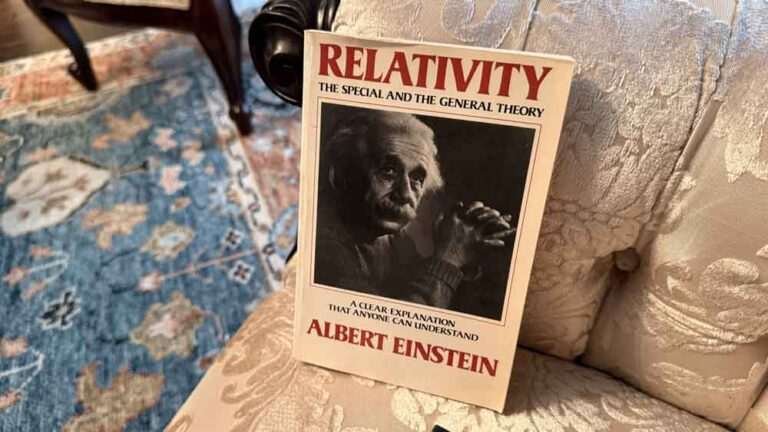
You can read more about the philosophical weight of physics on this blog in the review of Just Six Numbers by Martin Rees, and in the review of Einstein’s Relativity: The Special and the General Theory, where the man himself, at the height of his powers, explains in plain language what GW150914 would one day confirm.
You Might Also Like
- The Fabric of Reality by David Deutsch — Knowledge Has No Ceiling, and That Should Change Everything
- Just Six Numbers by Martin Rees — A Review
Sources
- Abbott, B.P. et al. (LIGO Scientific Collaboration and Virgo Collaboration). “Observation of Gravitational Waves from a Binary Black Hole Merger.” Physical Review Letters 116, 061102, February 11, 2016. https://journals.aps.org/prl/abstract/10.1103/PhysRevLett.116.061102
- Nobel Prize Committee. “The Nobel Prize in Physics 2017.” Awarded to Rainer Weiss, Barry C. Barish, and Kip S. Thorne. https://www.nobelprize.org/prizes/physics/2017/summary/
- Thorne, Kip S. The Science of Interstellar. W.W. Norton & Company, 2014.
- LIGO Scientific Collaboration. Mission documentation and instrument overview. https://www.ligo.caltech.edu/
- Overbye, Dennis. “Gravitational Waves Detected, Confirming Einstein’s Theory.” The New York Times, February 11, 2016.
- Castelvecchi, Davide and Witze, Alexandra. “Einstein’s gravitational waves found at last.” Nature, February 11, 2016. https://www.nature.com/articles/nature.2016.19361