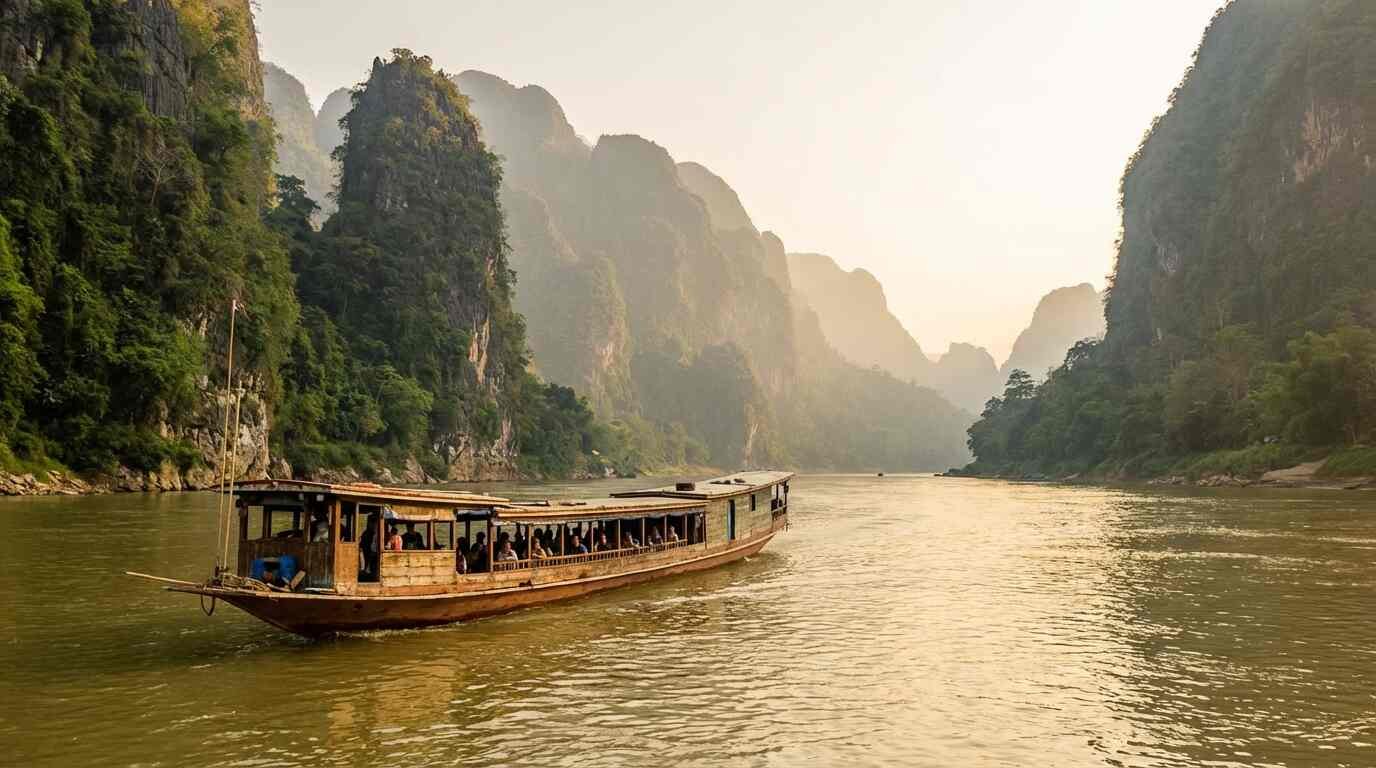
The slow boat takes two days. There is no Wi-Fi. The river decides the speed. This is the condition, and the condition is the point.
That sentence reads more cleanly in retrospect than it felt on the morning the boat pushed off from Huay Xai, the small border town on the Thailand-Laos crossing, and began its descent of the Mekong toward Luang Prabang. On the morning itself, the main sensation was the absence of things to do, which is a different experience than rest.
What the Route Is and Isn’t
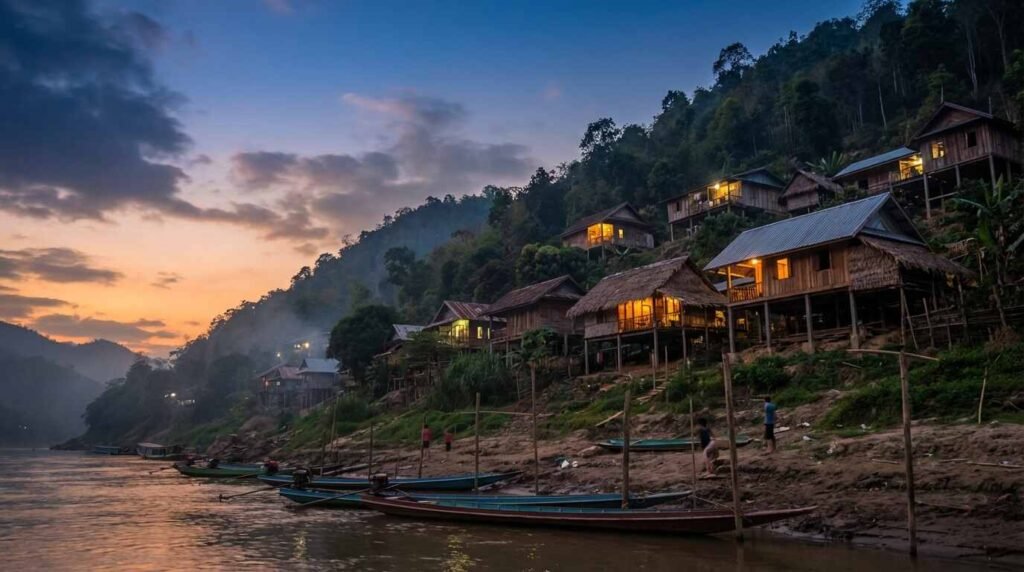
The slow boat between Huay Xai and Luang Prabang follows the upper Mekong through northwestern Laos — a stretch of the river documented extensively by the Mekong River Commission, which coordinates water management across the six countries the river passes through. The journey covers roughly 300 kilometers over two days, with an overnight stop at the village of Pak Beng. The boat is a long wooden vessel, low in the water, carrying perhaps sixty passengers — independent travelers mostly, a few local families with crates and bags stacked in the bow.
Luang Prabang, the destination, is a UNESCO World Heritage City — a remarkably preserved royal capital of the Kingdom of Laos, where French colonial architecture sits alongside temple complexes and the monks’ alms procession still moves through the streets at dawn. Getting there by slow boat is not the efficient route. It is emphatically not the efficient route. It is the route that requires you to sit with a river for forty hours and have whatever thoughts arrive.
This is its specific value, and its specific difficulty.
The Compulsion to Document
By hour three of day one, I had taken approximately two hundred photographs. The river bends. The limestone karsts rise from the green water. The villages appear on the bank — children waving from stilted houses, a water buffalo knee-deep at the edge, a woman washing fabric in the shallows. Each of these things is genuinely beautiful. Each of these things I photographed as though the photograph were the point of the beauty rather than a response to it.
Marcus Aurelius, writing his private philosophical notebooks in the second century AD, had no camera. He had something harder to manage: a mind. Never esteem anything as of advantage to you that will make you break your word or lose your self-respect. The Meditations are, among other things, a sustained campaign against the mind’s tendency to drift — toward distraction, toward vanity, toward the performance of virtue rather than its practice.
The camera is a contemporary version of that drift. It converts experience into content in real time, which is a way of staying at a safe distance from the experience itself. I am not the first person to observe this, and the observation has not stopped anyone, including me, from continuing to take photographs. But the Mekong made the problem unavoidable, because by the second hour of day two, the battery was dead and the river was still there.
Pak Beng, and What Arrives in the Absence of a Plan
Pak Beng sits on a steep hillside above the river, halfway between the two endpoints. The overnight stop is mandatory — darkness on the Mekong is navigational territory the boatmen wisely refuse. The village has guesthouses, restaurants serving Lao beer and sticky rice and whatever was fresh that day, and a single street that climbs the hill in the dark.
There is not much to do in Pak Beng in the evening. This is also the point.
What arrives, in the absence of a plan, is the actual content of the day you just had. The river, reviewed without the buffer of the camera’s viewfinder, turns out to have been extraordinary. A fishing boat at dusk, the fisherman standing at the stern with a cast net, the net catching the last light as it opened over the water. A submerged sandbar visible in an emerald shallowing. The slow passage of cloud shadow across a limestone face the height of a twenty-story building.
None of these images were made better by being photographed. They were images already. They were simply available to whoever was willing to be present for them.
The happiness of your life depends upon the quality of your thoughts. Marcus wrote that too, in a different passage, and it is both more and less helpful than it sounds. More, because it is true. Less, because knowing it is true and enacting it are separated by the full distance of human psychology.
What the Body Learns When the Scenery Stops Performing
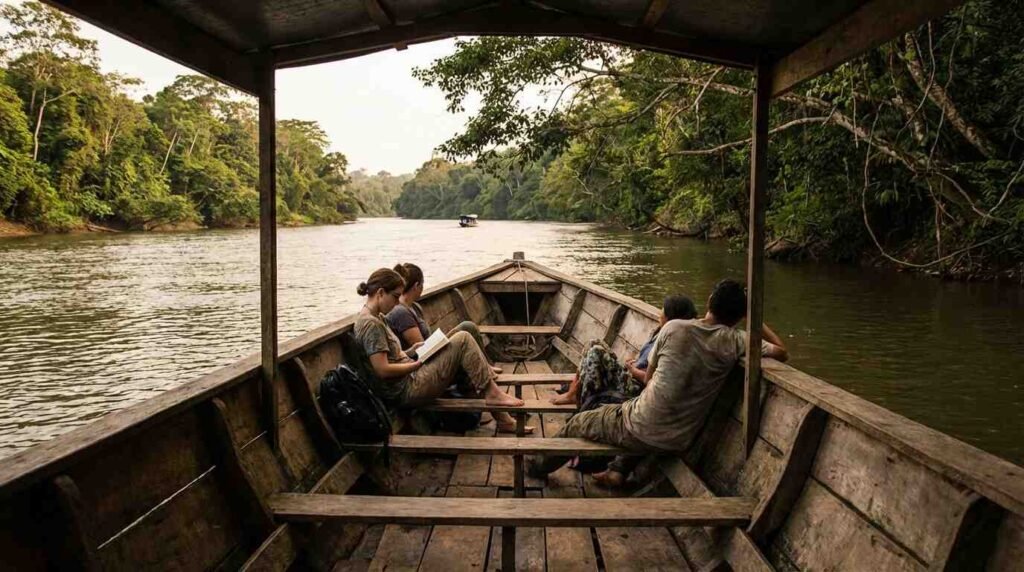
By day two, somewhere past a tributary with no English name on the maps, the scenery stopped performing. This happens on long river journeys — the dramatic limestone gave way to lower, greener banks, the villages grew less visually distinct, and the river settled into a grey-green repetition that offered nothing for the eye to catch on.
This is, arguably, when the journey began.
Without visual novelty to consume, what remained was the quality of attention itself. The sound of the engine — a low, constant throb, not unpleasant. The way the current against the hull created a small wash pattern on the left side that had its own rhythm. The conversation at the back of the boat between two French travelers that rose and fell without my catching the words. The monk, traveling alone in saffron robes, reading a text I could not see, indifferent to the river and the boat and the passengers in a way that, over several hours, began to seem like its own form of instruction.
The Stoics held that equanimity was not the absence of perception but its purification. You do not feel less; you feel more accurately. The river, stripped of its dramatic peaks, did not become less interesting. It became differently interesting — you had to look more carefully, with less reward promised, to find what was actually there.
What was actually there: a working river. Not a scenic attraction. A river that people fish from and travel on and wash in and irrigate from, that has supported the communities along its banks for millennia. The Mekong River Commission documents annual sediment flows, fish migration patterns, the effects of upstream dam construction on downstream communities. The river has politics. The river has an ecology. The river does not care about the tourist experience, and this is, it turns out, exactly why it is worth traveling.
On Enforced Stillness and What It Proves
Pico Iyer, who has written more usefully than almost anyone on the subject of slow travel and enforced stillness, argues that the self you carry on a journey is the same self you carry everywhere, and that speed is partly a mechanism for not confronting it. The fast route — the flight from Chiang Rai to Luang Prabang, which takes one hour — delivers you to Luang Prabang intact, unchanged, refreshed perhaps, but not metabolized.
The slow boat metabolizes you. Over forty hours and three hundred kilometers of river, the ordinary mental noise — the planning, the retrospection, the ambient low-grade anxiety about things that are happening elsewhere — runs out of material. There is nothing to plan. There is no elsewhere that matters. There is only the river and the bench seat and the person sitting across from you who you have now observed for long enough that you know whether they take their coffee with sugar.
Marcus Aurelius, commanding the Roman frontier on the Danube, was not practicing stillness. He was practicing the discipline of maintaining interior calm under continuous external pressure. The slow boat offers a different version of the same practice: maintaining interior presence under continuous external sameness. Both require you to locate the source of your quality of life inside yourself rather than outside it.
This is difficult. It is also, on the second day of a river journey when the battery is dead and the river is grey-green and wide and entirely indifferent to your preferences, genuinely available in a way it is not when you have a schedule and a signal.
Luang Prabang, Arrived At
The UNESCO World Heritage listing for Luang Prabang describes the city as “an outstanding example of the fusion of traditional architecture and Lao urban structures with those built by the European colonial authorities in the 19th and 20th centuries.” This is accurate and entirely misses the quality of arriving there by river.
When the boat rounds the last bend and the landing comes into view — the town visible on the peninsula where the Nam Khan meets the Mekong, the temples rising through the trees — the arrival has been built across two days of river. You know the river now. You have traveled its length at its own pace. The city that the river brings you to carries the weight of that journey in a way that an hour’s flight cannot produce.
This is not mystical. It is logistical. Duration creates context. Context creates meaning. The Nabataeans knew this — they built a city accessible only by canyon. The monks of Luang Prabang know it; the alms procession at dawn is not efficient, and that is exactly why it has continued for centuries. Some things require time in order to be what they are.
The ferryman who navigated the upper Mekong did not ask where you were going. He already knew. He had known since Huay Xai. The only open question was what you would do with the river in between.
You Might Also Like:
- The Montreal–Maine–Maritime Loop: A 1,200-Mile Fall Foliage Circuit You Can Drive in Five Days
- Salt That Knew Its Place: The Stoic Doctrine of Natural Hierarchy and Why Every Diner Salt Shaker Is a Small Philosophical Argument About the Cosmos
Sources:
- Mekong River Commission: mrcmekong.org
- UNESCO World Heritage — Luang Prabang: whc.unesco.org/en/list/479
- Laos National Tourism Administration: tourismlaos.org
- Pico Iyer, The Art of Stillness: Adventures in Going Nowhere (TED Books / Simon & Schuster, 2014)
- Marcus Aurelius, Meditations, trans. Gregory Hays (Modern Library, 2002)