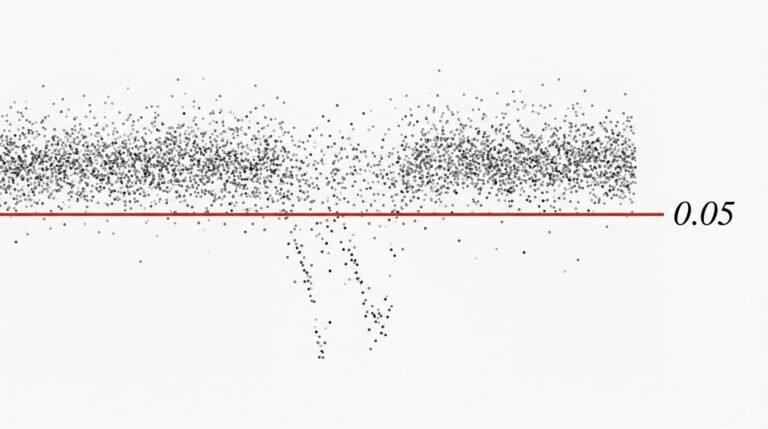
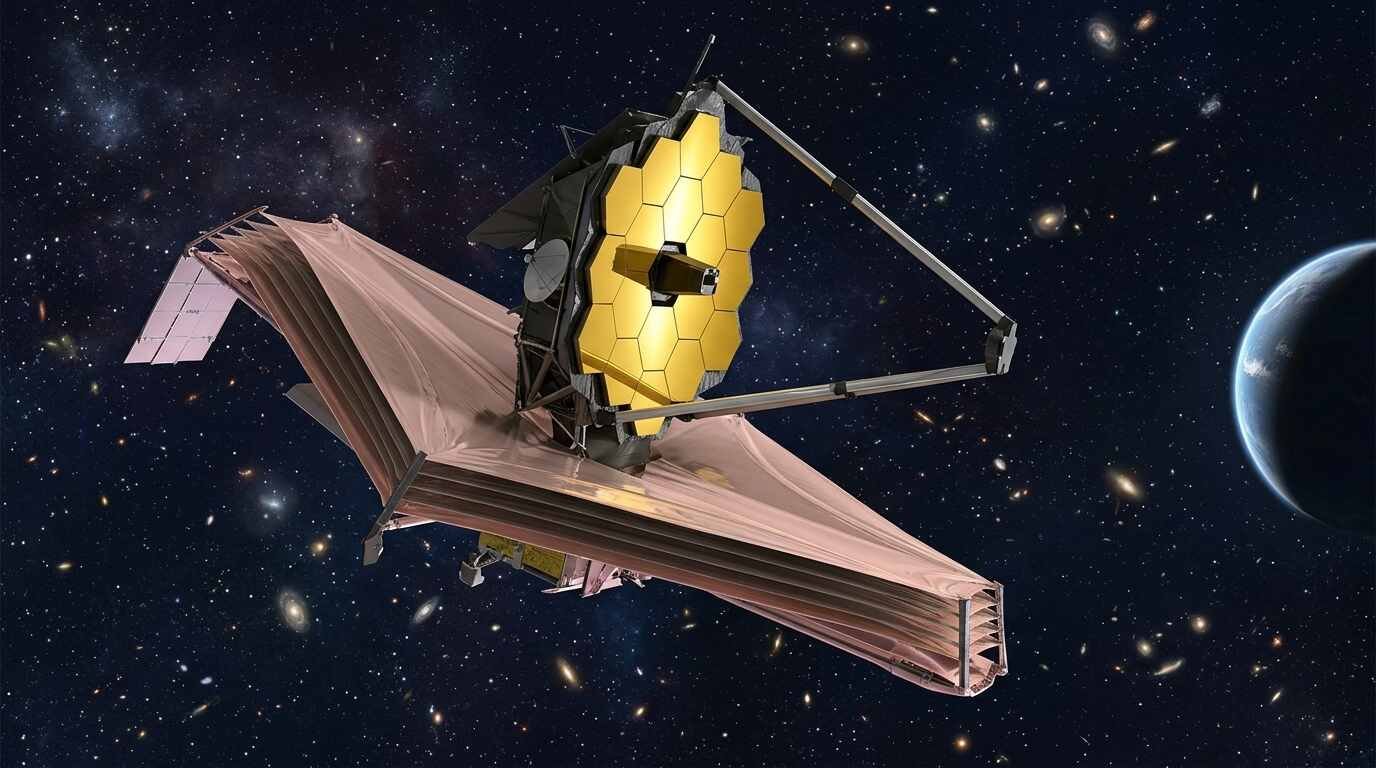
The James Webb Space Telescope launched on December 25, 2021 — and within its first year of science operations, it was reading the chemical composition of planetary atmospheres orbiting stars 40 to 120 light-years from Earth. The instrument had been designed primarily to observe the first galaxies that formed after the Big Bang, to push observational astronomy back toward the cosmological horizon. That it is now functioning as a chemical spectroscope for worlds that may or may not host life is a demonstration of the telescope’s capability that surprised even many of the astronomers who built it.
The results from 2022 through 2024 have ranged from the expected to the genuinely surprising. What they mean for the search for life depends entirely on understanding what the telescope is measuring, what the measurements can and cannot distinguish, and where the scientific community has set the threshold for what counts as evidence of biology.
Transmission Spectroscopy: How JWST Reads Atmospheres
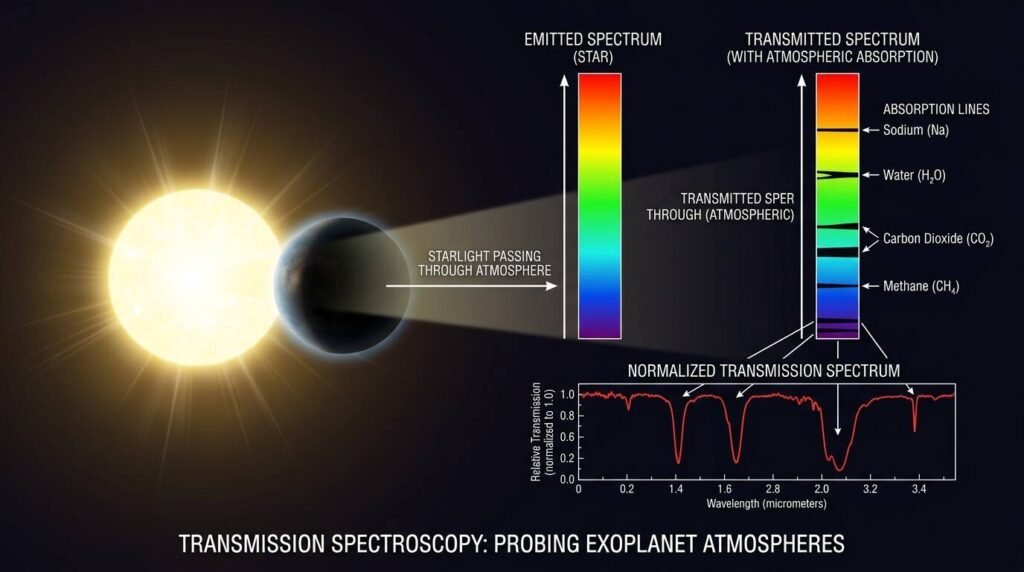
When an exoplanet transits its host star — passes between the star and the telescope — a small fraction of the starlight passes through the planet’s atmosphere before reaching JWST’s instruments. Different molecules absorb starlight at characteristic wavelengths. Carbon dioxide absorbs at 4.3 microns. Water absorbs across multiple infrared bands. Methane, ammonia, dimethyl sulfide, and thousands of other compounds each leave a distinct spectral fingerprint.
JWST’s NIRSpec and MIRI instruments cover a wavelength range from 0.6 to 28 microns with spectral resolution sufficient to distinguish many of these molecular signatures — a capability far exceeding the Hubble Space Telescope’s atmospheric characterization tools. The technique is called transmission spectroscopy, and JWST’s application of it to exoplanet atmospheres represents one of the most consequential advances in observational astronomy of the past two decades.
TRAPPIST-1b: What Was Found (and What Wasn’t)
The TRAPPIST-1 system — seven Earth-sized planets orbiting an ultracool red dwarf 40 light-years away — has been a primary target since the system’s discovery was announced in 2017. Three of the planets orbit within the conventional habitable zone. TRAPPIST-1b, the innermost planet, was the first to receive JWST thermal emission measurements.
A 2023 Nature paper by Greene and colleagues reported the thermal emission spectrum of TRAPPIST-1b. The findings were notable for a negative result: the data showed no evidence of a thick carbon dioxide atmosphere and was consistent with either a bare rock surface or a very thin atmosphere. For a planet this close to its star — receiving about four times Earth’s solar flux — the absence of a detectable thick atmosphere has significant implications for the habitability of the inner TRAPPIST-1 planets.
The TRAPPIST-1 results are ongoing. Transmission spectra for TRAPPIST-1c have similarly shown no strong evidence of a dense atmosphere, while measurements for the potentially habitable-zone planets TRAPPIST-1e, f, and g require additional observation time that JWST has allocated through its approved programs.
K2-18b and the Dimethyl Sulfide Question
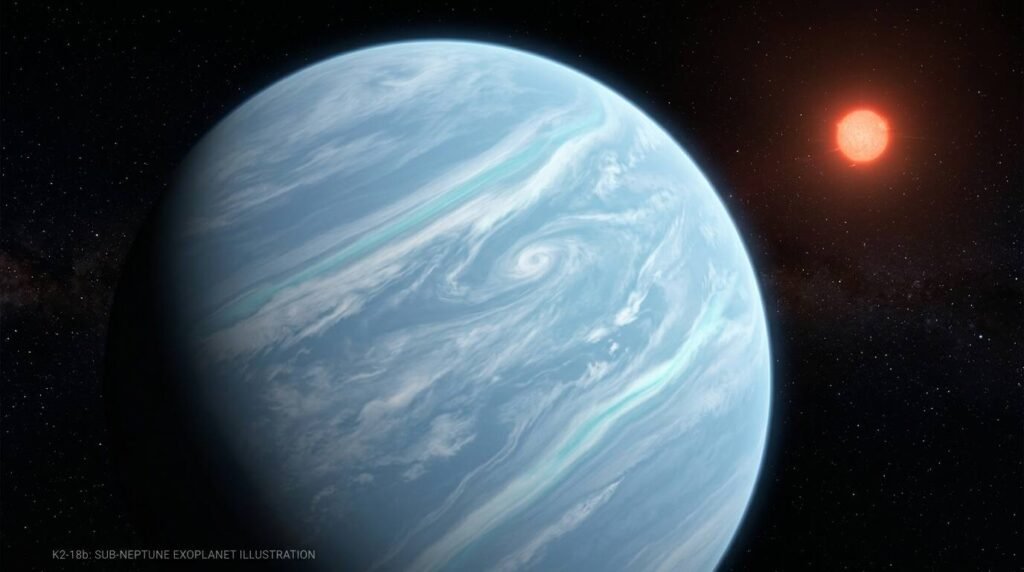
The most discussed — and most contested — JWST exoplanet result to date involves K2-18b, a sub-Neptune world orbiting a red dwarf 120 light-years away. K2-18b orbits within the habitable zone and, based on its mass and radius, is theorized to be a “Hycean world” — a class of planets proposed to have hydrogen-rich atmospheres over liquid water oceans.
A 2023 paper by Madhusudhan and colleagues, published in Astrophysical Journal Letters, reported JWST transmission spectroscopy findings for K2-18b. The team identified spectral features consistent with carbon dioxide and methane — molecules expected in a Hycean world scenario. They also reported a tentative detection of dimethyl sulfide (DMS), a compound produced on Earth almost exclusively by marine phytoplankton. On Earth, DMS has no known significant abiotic source in the quantities the atmospheric model requires.
The scientific community responded with significant caution. The DMS detection was described by Madhusudhan’s team themselves as tentative — the spectral feature overlaps with other molecules, the signal-to-noise was insufficient for confident attribution, and alternative non-biological production mechanisms at the scale required have not been fully characterized for hydrogen-dominated atmospheres. Subsequent commentary in Nature and Astrophysical Journal Letters emphasized that the detection required confirmation across multiple transits with higher signal confidence before it could be considered robust.
This is where the biosignature threshold question becomes critical.
Where the Biosignature Threshold Sits
A biosignature is not simply a molecule that life produces. It is a molecule — or combination of molecules — whose presence in the observed concentration and atmospheric context cannot be plausibly explained by known abiotic chemistry. Carbon dioxide alone is not a biosignature; it has abundant abiotic sources. Oxygen paired with methane in a planetary atmosphere is a stronger biosignature candidate because the two molecules react and destroy each other — their simultaneous presence at significant concentrations implies continuous replenishment, which life does efficiently.
DMS in isolation, even if the K2-18b detection is confirmed, falls short of that threshold by current scientific standards. The NASA JWST mission science page describes the biosignature search as requiring a “network of biosignatures” — a combination of molecules, atmospheric disequilibrium conditions, and contextual planetary factors that together exceed the plausible abiotic envelope. A single molecule, however suggestive, does not constitute that network.
This is not a pessimistic conclusion about what JWST may eventually find. It is an honest description of where the evidentiary standard sits, and why it sits there. The history of astrobiology has multiple examples of findings initially interpreted as biosignature candidates that were later explained abiotically — from the Martian meteorite ALH84001 to the Venus phosphine detection of 2020. Rigor at the detection stage protects the field from false positives that would undermine its credibility.
What the First Generation of Results Has Established
Across its first two years of exoplanet science, JWST has demonstrated several things clearly. It can characterize the atmosphere composition of small, rocky planets — a capability that did not exist before. It has detected carbon dioxide in exoplanet atmospheres with confidence, including in WASP-39b, where the detection was announced in 2022 as the first unambiguous carbon dioxide detection in an exoplanet atmosphere. It has characterized the diversity of sub-Neptune and super-Earth atmospheres with a resolution that will form the baseline for the next generation of comparative planetology.
What it has not yet done is deliver a confirmed biosignature. That may happen within the telescope’s operational lifetime — or it may not. The probability depends on how common life is, how common Hycean worlds are, and whether the chemistry of biology leaves marks distinctive enough to read across 100 light-years with an 18-meter mirror.
You Might Also Like: Decoding the Next Generation of Exoplanets | The Boltzmann Brain Paradox