The still looks like something from a steampunk novel. It costs a fortune to build and maintain. There is a reason every serious distillery still uses one.
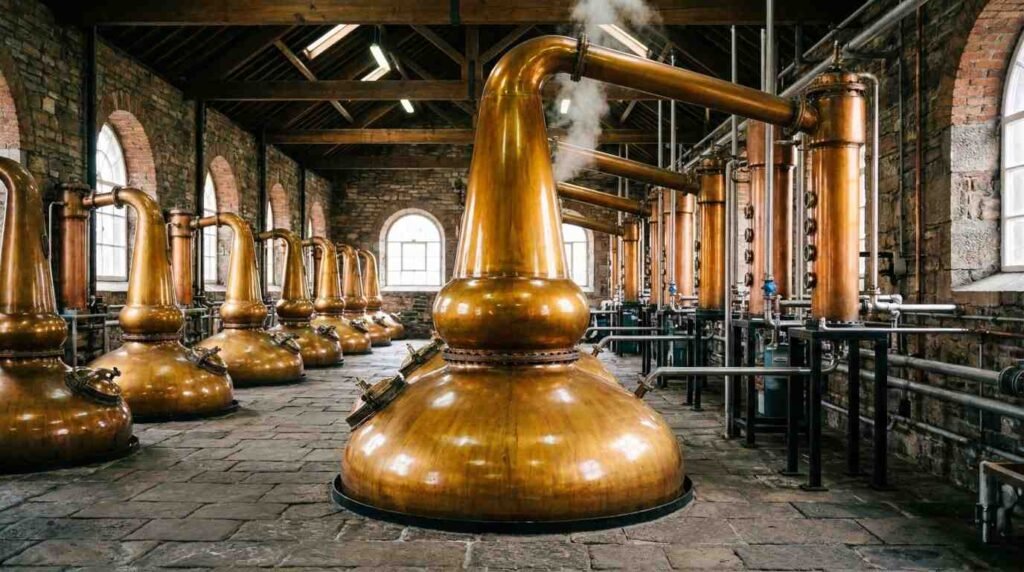
Walk into a working Scotch whisky distillery and the still room is the most striking thing in the building. Enormous copper vessels, onion-shaped or lantern-shaped or swan-necked depending on the house, rising from the floor to the ceiling, warm and gleaming, venting steam at the top. They look ancient. They look ceremonial. They cost half a million to eight hundred thousand dollars each, require constant maintenance, and will be replaced at great expense when they wear through. Distillers keep using them anyway.
This is not nostalgia. This is chemistry.
The copper pot still does something to whiskey that no other material can replicate, and the science of why is documented well enough now that the romanticism can be set aside. The Scotch Whisky Research Institute has published peer-reviewed research on it. What they found is what distillers had known empirically for centuries: copper removes sulfur compounds from the spirit in ways that aluminum, stainless steel, and every modern alternative cannot. And those sulfur compounds, unremoved, are the difference between a whiskey that tastes like something worth aging and one that doesn’t.
Sulfur Compounds and Why Copper Removes Them
During fermentation, yeast produces sulfur compounds as metabolic byproducts. The most significant of these for whiskey quality is dimethyl trisulfide — DMTS. It has a perception threshold of roughly 0.1 micrograms per liter. Whiskey that hasn’t had its sulfur adequately addressed during distillation can carry concentrations of one to six micrograms per liter — well above that threshold. What DMTS smells like is rubbery, meaty, eggy. Not what you want in your glass.
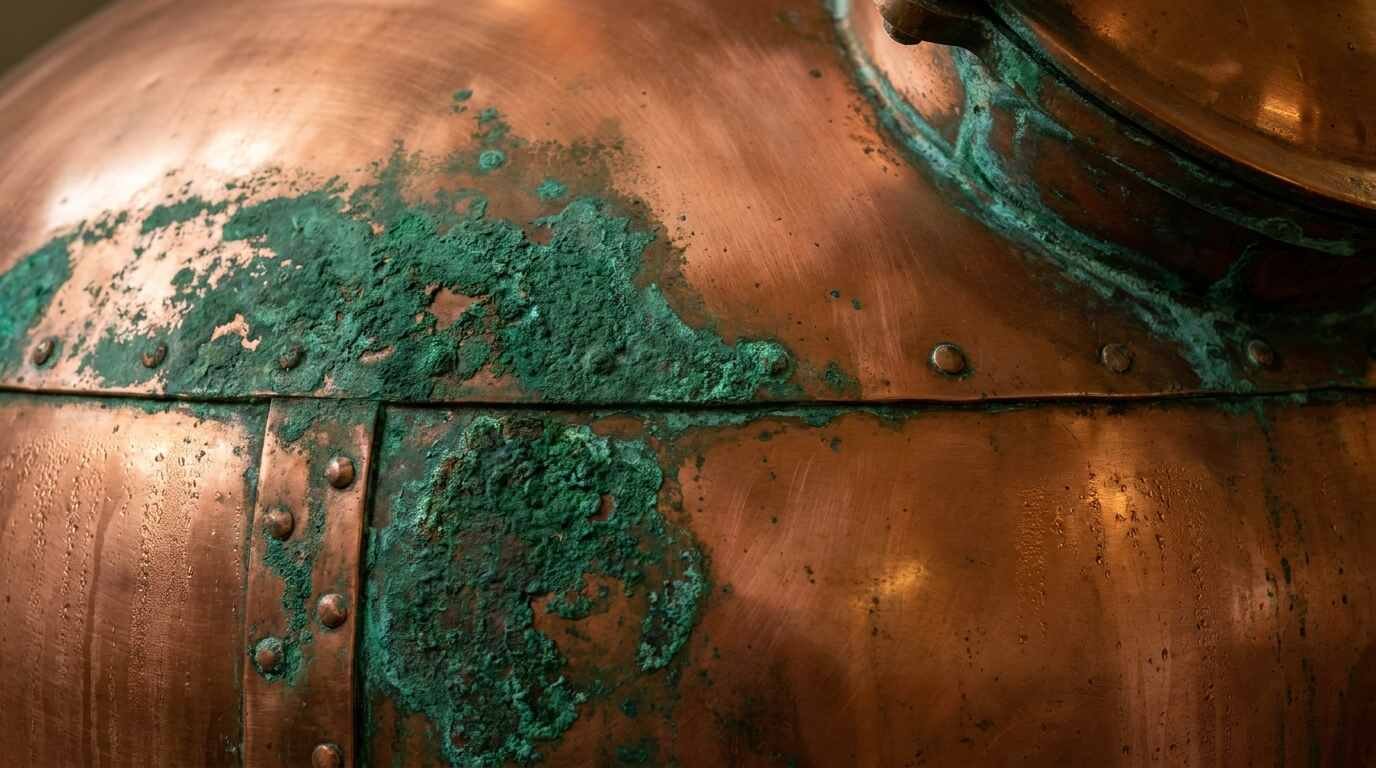
Copper eliminates this problem through direct chemical interaction. The copper surfaces of the still react with sulfur compounds as the vapor passes through, bonding with them and pulling them out of the spirit. The process is catalytic — the copper isn’t consumed in the reaction, but it mediates a transformation that happens nowhere else in the production chain. You can see the evidence on old stills: the green patina that forms on copper surfaces where sulfur has reacted with the metal is copper sulfate, the physical byproduct of that chemistry.
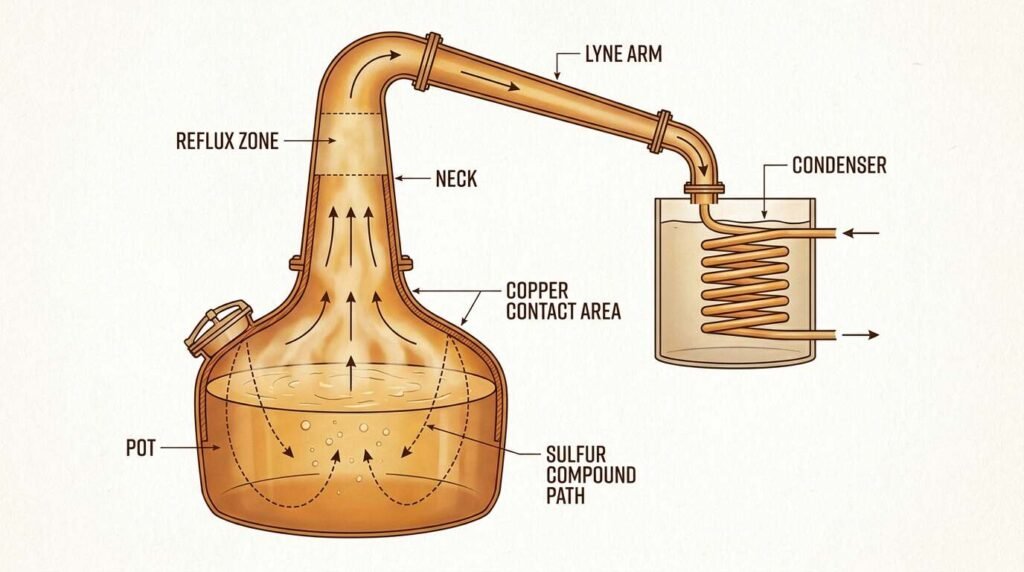
Research published in the Journal of the Institute of Brewing by Harrison et al. at the Scotch Whisky Research Institute found that copper’s effectiveness varies depending on where it’s located in the still — the neck, the lyne arm, the condenser. Copper contact in some sections is more effective than in others for removing specific compounds. This is why distillery engineers care deeply about which parts of their stills are replaced with copper versus lined with other materials, and why the decisions about still geometry have downstream consequences for what ends up in the bottle.
Stainless steel costs 60 to 70 percent less than copper and lasts two to three times as long. It cannot perform the chemical transformation that copper enables. That is the full equation. Every distillery running copper stills has done this math and decided the flavor justification exceeds the capital cost.
Pot Still vs. Column Still: What Each One Actually Does to the Spirit
The distinction between pot still and column still is not primarily about copper. It is about what kind of spirit each produces and at what efficiency.
A pot still distills in batches. You load the wash, you heat it, you run it through, and you get a relatively small amount of spirit at a relatively low proof — typically in the 60 to 70 percent alcohol range for a first distillation. The resulting spirit retains a significant amount of the congeners — the flavor compounds derived from the grain and fermentation — that make malt whisky taste like something specific. Most Scotch single malts are double-distilled in pot stills; some triple-distill.
A column still — also called a patent still or Coffey still, after Aeneas Coffey who patented his design in 1831 — distills continuously. Wash flows in at the top, steam flows up from the bottom, and the apparatus separates alcohol from the wash across a series of plates in a continuous operation. It is dramatically more efficient and produces spirit at much higher proof, often 94 to 96 percent alcohol. At that proof, very few congeners survive. The result is a relatively neutral spirit — the base of most grain whisky, blended Scotch, and American bourbon’s column-still component.
American bourbon actually uses both. The grain mash is distilled in a column still to around 65 to 70 percent alcohol, then run through a pot still — called a doubler or thumper — for a second distillation that adds copper contact and refines the spirit without stripping out the congeners that make bourbon taste like bourbon. The copper pot element is built into the American process even when the first pass is column-distilled.
Irish distillers, particularly Midleton where much of the Jameson family is produced, have historically used a combination of pot still and column distillation in a way that creates a distinctive style. The large copper pot stills at Midleton are among the biggest in the world.
Why the Shape of the Still Changes What Goes in the Bottle
This is where it gets specific, and where the vocabulary of distillery design becomes relevant.
The shape of the still determines how much copper contact the spirit vapor gets and what kind of reflux happens before the vapor exits. Reflux is the process by which heavier, less volatile compounds condense and fall back into the still before they can make it into the spirit safe. More reflux equals lighter, cleaner spirit. Less reflux equals heavier, oilier, more complex spirit.
A tall still with a long neck creates more reflux — the vapor has to travel farther, more of the heavier compounds fall back, the spirit is lighter. A short, squat still creates less reflux, and a heavier, fuller-bodied spirit. The angle of the lyne arm — the pipe that carries vapor from the neck of the still to the condenser — also matters. A lyne arm that angles upward further encourages reflux and lightness; one that angles downward allows more congeners to pass through.
Glenfiddich’s stills are relatively tall and produce the clean, approachable house character associated with that brand. Springbank’s stills are small and use a partial triple-distillation system that produces the famously oily, complex house style. The shape decisions are not arbitrary. They encode a flavor philosophy, and they are extraordinarily expensive to change.
Which Distilleries Are Known for Specific Still Shapes and Why
Forsyths of Rothes in Scotland is the dominant copper still manufacturer. When a distillery orders new stills — whether to replace worn equipment or for a new operation — Forsyths is usually building them. They work from specifications provided by the distillery, which are typically designed to replicate the existing still’s shape as precisely as possible when replacing worn equipment.
Why replicate rather than improve? Because the house character is embedded in those dimensions. Glenmorangie famously has Scotland’s tallest pot stills at five and a half meters. The height produces the light, floral, approachable spirit that defines the brand. When they replaced aging stills, they specified the same height, the same angle, the same everything. The same chemistry.
Talisker on the Isle of Skye has unusual T-shaped stills with purifiers — additional copper contact points before the lyne arm — that contribute to its characteristic peaty, spicy, full-bodied character. Dalmore uses broad, flat-topped stills that encourage heavier reflux through the wider base and produce the rich, sherried house style. These are not accidents. They are the accumulated decisions of distillers who learned what their equipment did to their spirit and then locked those decisions in copper.
American craft distillers choosing between alembic pot stills and hybrid configurations are making the same fundamental choices: how much copper contact, what shape of vessel, how much reflux. The operations I’ve written about in New York — Hillrock Estate in Ancram and Tuthilltown in Gardiner — are small enough that their still choices are visible in their spirit character in a way that’s almost direct.
What a Distiller Sacrifices When They Switch to More Efficient Equipment
The efficiency argument for stainless steel or hybrid systems is real. Copper requires constant attention. It corrodes. The sections most actively engaged in sulfur removal wear fastest. A condenser in a high-volume operation may need replacement within a decade or two. Copper maintenance is a significant ongoing capital commitment.
Some distilleries have experimented with stainless steel vessels fitted with copper mesh or copper coils to get the catalytic benefit without the full capital cost of all-copper construction. Research confirms that copper contact in the condenser section — where the vapor cools and becomes liquid — is particularly important for sulfur removal. A stainless still with a copper condenser captures some but not all of the benefit of full copper construction.
What a distillery sacrifices with full transition to more efficient equipment is, ultimately, control. The copper still gives the distiller specific, documented, reproducible influence over the spirit’s character. The still shape is a precision instrument for flavor. Strip that out, and you’re working with a more efficient tool that does less.
The best analogy I know is the difference between a machine-sewn briefcase and one made by hand. The machine is more efficient. The output is consistent. What you lose is the ability to make the specific decisions at each seam that produce a different result. Working with leather at Marcellino NY long enough taught me that some materials reward the slowness. They require it. The copper still and the hand-stitched hide are different problems with the same answer: the material does something that the shortcut can’t replicate, and knowing that is what separates the serious practitioners from the merely efficient ones.
The next time you’re drinking a Scotch that tastes like smoke and salt and something that took years to become itself, that copper vessel that shaped it was doing chemistry the whole time. It just didn’t look like a laboratory.
You Might Also Like:
- The Finger Lakes Distillery Trail: A Three-Day Tasting Route Through Upstate New York’s Craft Spirits Boom
- Hillrock Estate Distillery — 408 Pooles Hill Road, Ancram, NY 12502
- WhistlePig PiggyBack 6 Year Old Rye: Vermont’s Most Democratizing Drop
Sources:
- Harrison, B. et al. “The Impact of Copper in Different Parts of Malt Whisky Pot Stills on New Make Spirit Composition and Aroma.” Journal of the Institute of Brewing, 2011, 117(1): 106–112. Wiley Online Library
- Scotch Whisky Research Institute, Riccarton, Edinburgh — copper catalysis research
- Annandale Distillery — Technical Notes: Copper
- Dramandglen.com — Copper Still Engineering Economics
- Whisky Science — Copper
- Forsyths of Rothes — distillery equipment documentation
- Buxton, Ian and Hughes, Paul. The Science and Commerce of Whisky. RSC Publishing.