
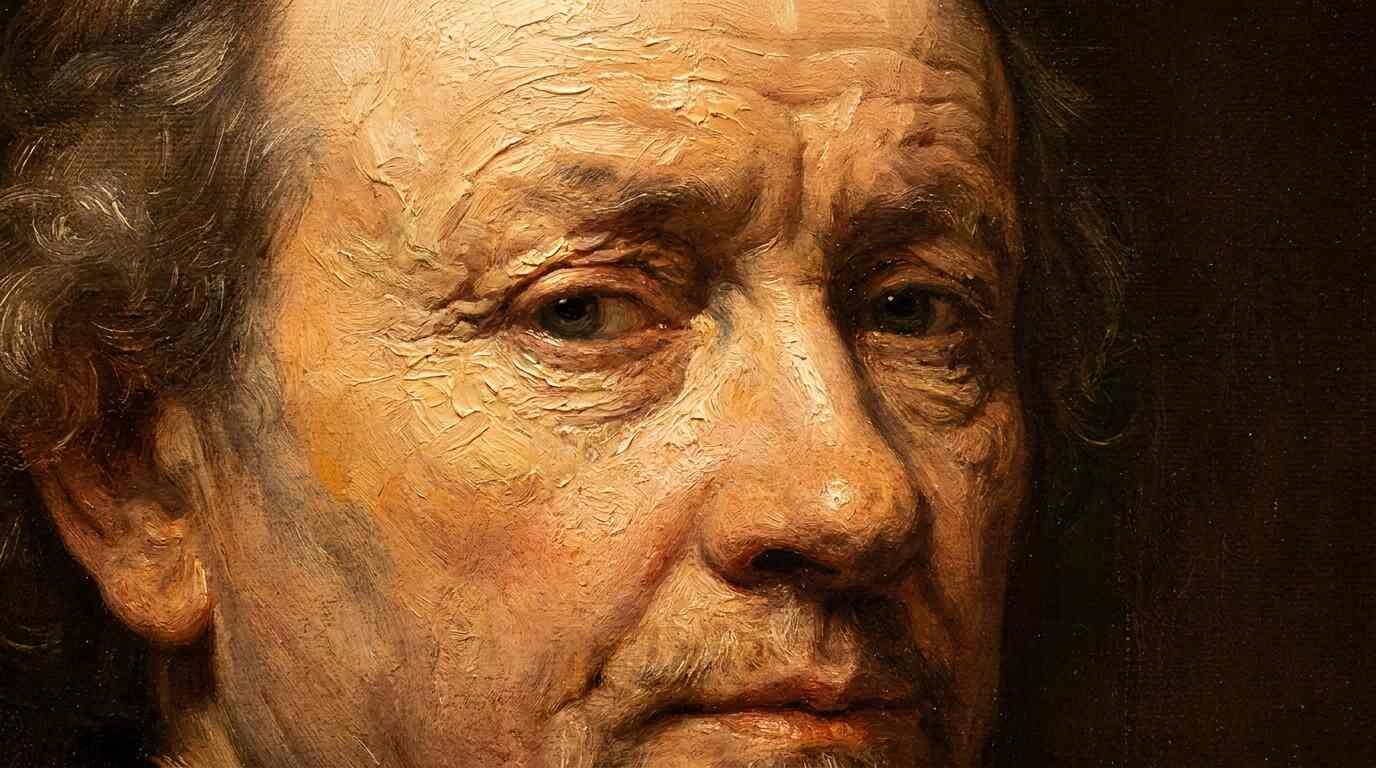
Rembrandt painted himself over forty years, from confident young master to bankrupt old man. Most painters would have stopped. He kept going — and the late work is better.
That’s not a provocative take. The late self-portraits — roughly 1652 onward, from the Self-Portrait at 46 in Vienna through the final paintings of 1669, the year he died — are technically unlike anything he produced in his prosperity years. They’re also unlike anything anyone else was producing. The financial ruin, the auctioned possessions, the son who predeceased him — none of it shows up as tragedy in the paintings. What shows up is a man looking at himself without flattery and without flinching, and doing it with brushwork that no one in the seventeenth century fully understood how to imitate.
The Span of the Self-Portraits: What Changes and What Doesn’t
Rembrandt produced somewhere around eighty self-portraits across his career — paintings, etchings, drawings — making it one of the most extensive self-documented bodies of work in the history of Western art. The early ones are performances. He dresses up, tries on attitudes, experiments with expression. The 1630s works show him in expensive clothes, fur-trimmed coats, the trappings of Amsterdam’s prosperous merchant class. He had arrived. He wanted you to know.
The middle period is more settled, more composed. A man who knows his position.
Then, after a gap of nearly seven years when he largely stepped away from self-portraiture, the late series begins. What’s gone: the gold chains, the velvet, the look of someone showing off. What remains: a face. His face. Getting older in real time.
By the final years, the sitters in his commissioned portraits and the man in his self-portraits are occupying the same canvas differently — the commissioned work still shows his mastery of surface, his ability to produce what a patron wanted, while the self-portraits have abandoned the performance entirely. The Self-Portrait at the Age of 63 (1669, National Gallery, London), painted months before his death, shows a man who has taken off everything that wasn’t himself. Red coat, fur collar, a plain beret. He looks out with what can only be called self-possession. Not dignity in the performative sense — something quieter and more durable than that.
How He Painted Skin That Actually Looks Lived In
This is the technical problem that the late self-portraits solve in ways the early ones barely attempted: how do you paint a face so it reads as inhabited rather than illustrated?
Most portrait painters of the period approached the human face the way you’d approach fine furniture — smooth finish, clean lines, the physical evidence of careful craft. Beautiful work, often. But faces in the Dutch Golden Age tradition tend to read as objects. Well-made objects, but objects.
Rembrandt understood something different. A face isn’t finished. It’s always in the process of having been through things. The lines don’t arrive at once — they accumulate, layer by layer, each one the record of something. To paint that in the conventional way, with smooth blended tones and even surfaces, is to miss what the face is actually doing. It’s to paint the face as it appears in controlled light rather than as it has been shaped by time.
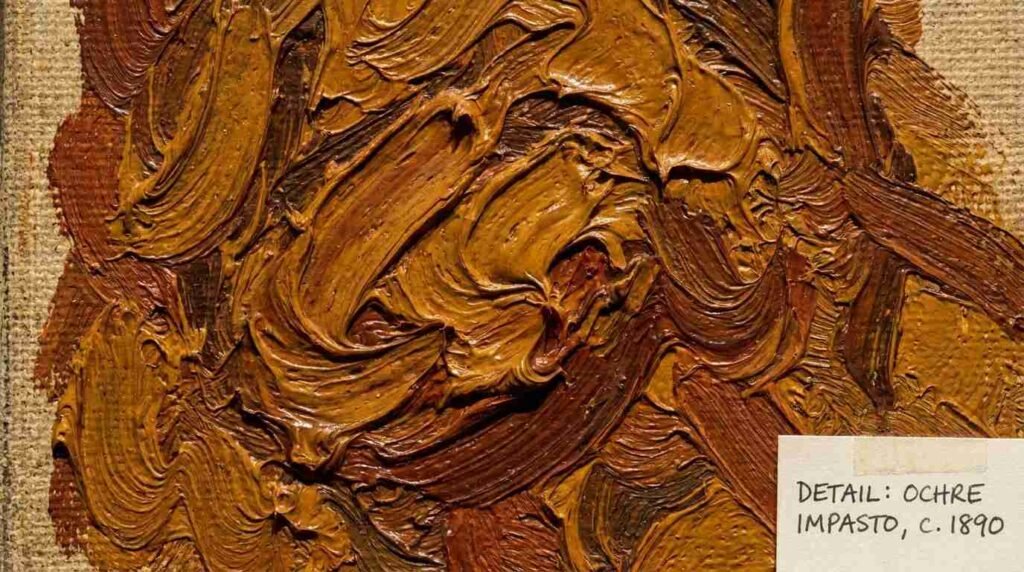
What he did instead was build the skin through the paint itself — thick applications over thin ones, each layer carrying information, the surface of the canvas becoming an analogue for the surface of aging flesh. The National Gallery’s conservation notes on the Self-Portrait at the Age of 63 confirm what the naked eye senses: thick impasto on the cheek areas, lead white tinted with ochres, the paint itself creating the textural impression of skin that has lived in it.
The Impasto Technique and Why It Works at Human Scale
Impasto — from the Italian for “dough” or “paste” — refers to paint applied so thickly that it stands up from the surface, catching its own light and casting its own shadow. It’s a physical intervention in the canvas. You’re not just applying color; you’re building topography.
In Rembrandt’s early work, impasto appears selectively — highlights on jewelry, the sheen of fabric, the catchlight in an eye. It’s a trick, judiciously applied. In the late self-portraits, it becomes the primary descriptive language for flesh itself.
The Dutch biographer Arnold Houbraken — not a fan — complained that Rembrandt’s technique looked bad up close. That Rembrandt reportedly told people not to stand too near his paintings because “the smell of colour will bother you.” Whether this was a joke or a deflection, Houbraken read it as defensiveness about rough execution. He was wrong about what it meant. The roughness isn’t a defect in the late work — it’s the argument. Stand close to the Self-Portrait with Two Circles (c. 1665–1669, Kenwood House, London) and the paint surface is almost aggressive. It has the texture of a face that has spent decades making decisions, absorbing consequence, losing sleep. Stand back and the flesh resolves into something that reads as more humanly precise than any smooth-finish portrait of the period.
This is the counterintuitive discovery of the late work: that imprecision at the micro level produces precision at the human level. The paint doesn’t try to look like skin — it tries to feel like what skin has been through.
What Younger Painters Got Wrong When They Tried to Imitate Him
They imitated the appearance of his technique and missed its purpose.
The problem is that impasto applied without the same tonal understanding produces texture that reads as texture — surfaces that look worked, not surfaces that look inhabited. A thick brushstroke on a young face creates material chaos. On an aging face, rendered with Rembrandt’s control of the underlying tonal structure, the same stroke reads as a year lived. The difference is everything.
What’s also inimitable is the tonal matrix beneath the surface work. Rembrandt built his paintings in layers — thin washes establishing the underlying value structure, mid-layers developing the form, the impasto arriving last on top of a foundation that made it legible. The texture works because the groundwork is solid. Remove the foundation and you just have thick paint.
As the art blogger at That’s How The Light Gets In wrote of the late self-portraits in a close reading of the Kenwood picture: the eyes are “a moment of clarity in the artist’s rough, bearded face furrowed with lines” — a description that captures exactly the paradox the technique produces, where roughness surrounds clarity, and the clarity is more intense for it. You can reproduce the roughness. You can’t reproduce what it’s surrounding unless you understand why it’s there.
Why Looking at the Late Works Feels Different From Looking at the Early Ones
It’s not sentiment. It’s not the biographical pathos of a man who fell from success. Those things might get you into the room, but they’re not what holds you in front of the painting.
The late works feel different because they’ve removed everything you can look at instead of the face. The early self-portraits give you distractions — costume, props, theatrical attitude — and the face is one element among several. In the late works, the face is everything. There’s nowhere else to look.
And the face Rembrandt gives you in these late paintings is not performing anything. It’s not asking for sympathy. It’s not asking you to admire his resilience in the face of hardship. It’s just watching you watch it, with the kind of attention that comes from having spent decades studying what a face can hold.
His 1669 self-portrait holds its face with that attention. The Self Portrait with Two Circles holds it. The late self-portraits as a group constitute something unusual in the history of Western art: a systematic, decades-long effort to paint the thing that portraiture typically avoids — not what someone looks like, but what they look like knowing what they know.
The technique made it possible. The impasto gave the paint the ability to carry what smooth surfaces can’t. But the technique is in service of something larger: an insistence that old age, decline, and loss, rendered honestly, are not lesser subjects than triumph. They might be the more interesting ones.
I wrote earlier about Rembrandt’s Aristotle with a Bust of Homer — a commissioned work that explores a different kind of Rembrandt entirely, the one who thought about the minds behind the faces he painted. Worth reading alongside this one.
Sources
– Self-Portrait at the Age of 63 (1669) — National Gallery, London: nationalgallery.org.uk – Self-Portrait with Two Circles (c. 1665–1669) — Kenwood House, London: english-heritage.org.uk – ColourLex: Rembrandt Self-Portrait at the Age of 63: colourlex.com – That’s How The Light Gets In — Rembrandt: The Late Works at the National Gallery: gerryco23.wordpress.com – Arnold Houbraken, De groote schouburgh der Nederlantsche konstschilders en schilderessen (1718) — primary historical source on Rembrandt’s technique – E. Van De Wetering, A Corpus of Rembrandt Paintings: The Self-Portraits, Springer 2005 (Rembrandt Research Project) – Wikipedia: Self-Portrait at the Age of 63: en.wikipedia.org