Las Meninas is the most analyzed painting in Western art. It’s also the most misread. People see a court scene. Velázquez painted a trap — and put the king inside it.
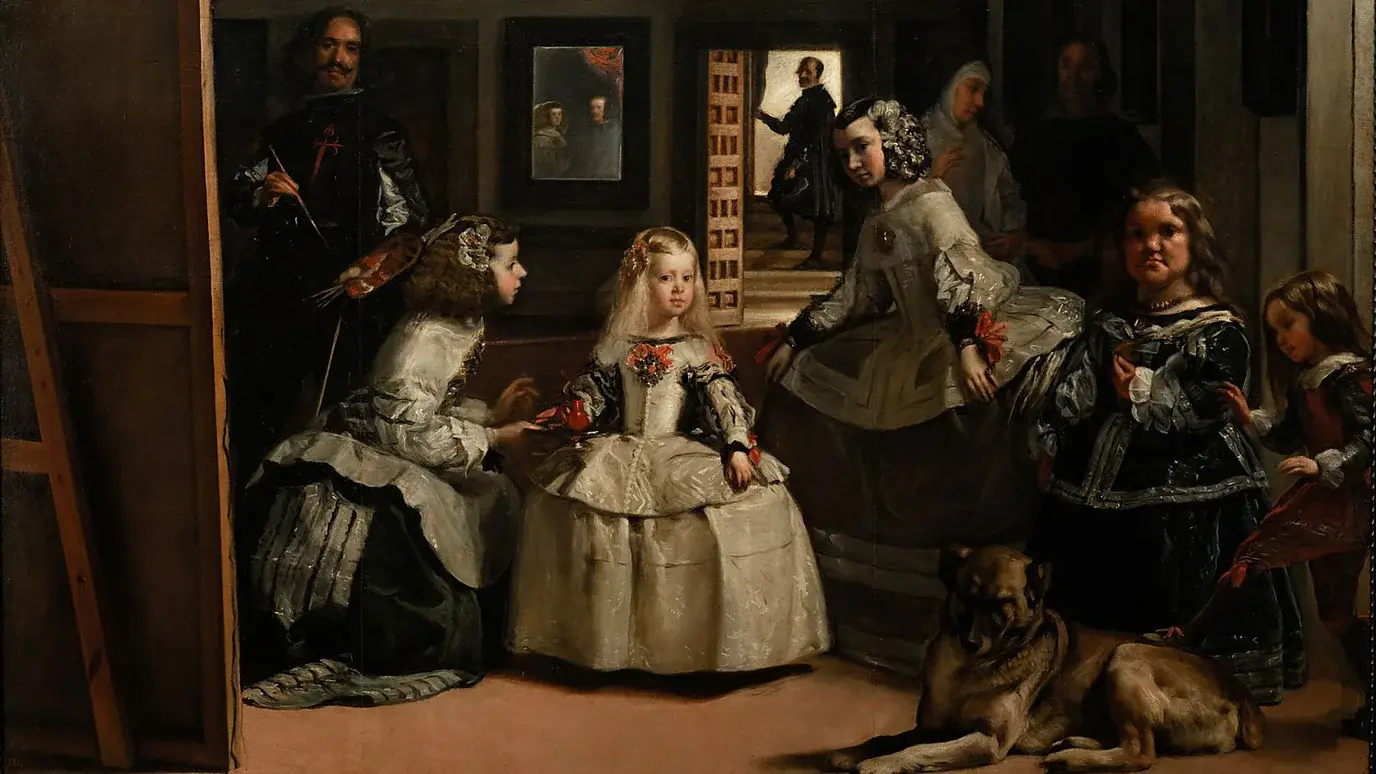
The painting hangs in the Museo del Prado in Madrid, where it has been since 1819. It measures roughly ten and a half by nine feet — nearly life-size, which matters. You don’t look at it from a comfortable remove. It pulls you in at the scale of the room it depicts, and that’s not an accident. Everything about this painting is an argument, and the scale is the first argument. You are in this room. You are part of this scene. What happens to you next is the painting’s subject.
What’s Actually Happening in Las Meninas
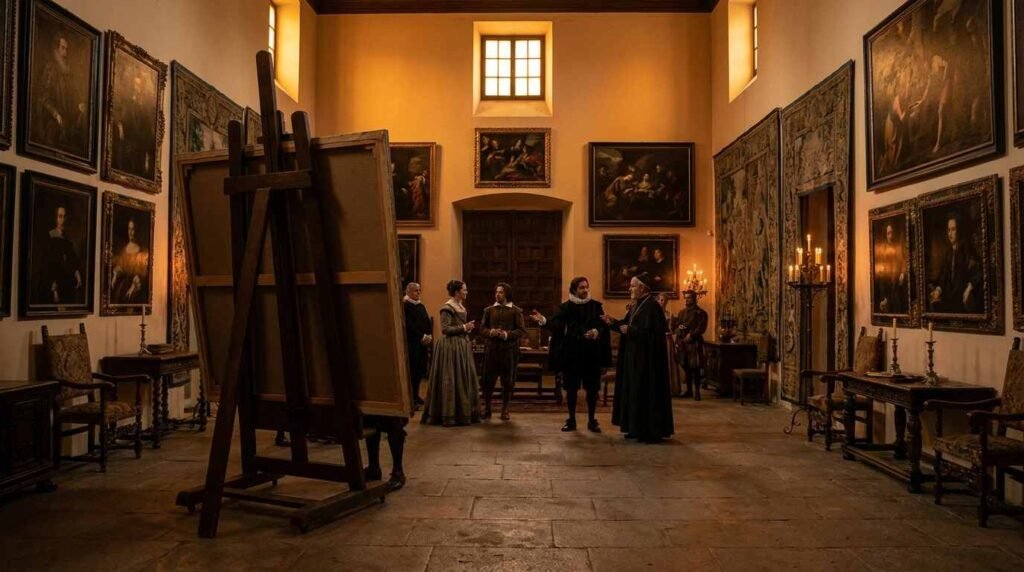
The year is 1656. Felipe IV is King of Spain. Diego Velázquez, court painter, is at work in a room in the Royal Alcázar in Madrid. He has arranged — or recorded — a scene of peculiar complexity.
At center-left stands the Infanta Margarita Teresa, five years old, attended by her ladies-in-waiting (las meninas, from the Portuguese for young noblewomen). Two dwarfs occupy the right foreground — Mari Bárbola and Nicolás Pertusato, Nicolás nudging the sleeping dog with his foot. Behind the Infanta are two courtiers, and further back, half in shadow, the housekeeper Marcela de Ulloa and a bodyguard.
Velázquez himself stands at the far left, brush in hand, palette raised, looking outward. Not at the Infanta. At you.
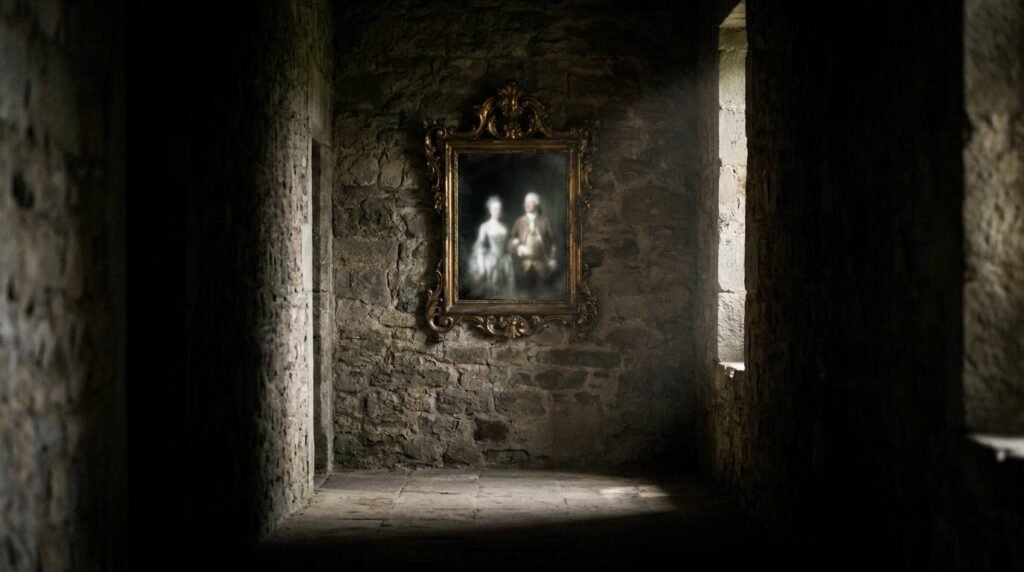
Behind this assembly, at the far end of the room, a man pauses in a doorway — José Nieto Velázquez, the court’s chief chamberlain, silhouetted against light from outside. And between him and the foreground, mounted on the back wall, hangs a mirror. In that mirror: the blurred, luminous reflections of Philip IV and his queen, Mariana.
The king and queen are not in the painting. They are in the mirror. Which means they are standing where you are standing.
The Mirror Problem: Who Is the Painting Really About?
This is the question that has occupied art historians for nearly four centuries: what, exactly, does the mirror reflect?
The straightforward reading is that Philip and Mariana are posing for the large canvas Velázquez is depicted painting — the canvas whose back faces us — and the mirror catches their reflection as they stand before him. The scene would then be: Velázquez at work on a royal portrait, the Infanta having wandered in with her attendants, the whole casual machinery of court life present in the room.
The art historian Joel Snyder challenged this in 1985, arguing from perspective analysis that the mirror’s position makes a direct optical reflection of the king and queen geometrically impossible — that what we see in the mirror is not a reflection but a painting of the royal couple on the far wall. The debate hasn’t fully resolved. But it hasn’t diminished the painting’s central effect, which operates regardless of which interpretation you hold.
Because either way, you — the viewer — are standing in the space the royals occupy. Velázquez is painting you.
As the WordPress art blog Art Mirrors Art noted in a close reading of this dynamic: Foucault “argued that Velázquez was the first to employ this clever technique, putting the viewers in front of the painting so that they inevitably understand themselves as occupying the king and queen’s place. In other words, we are not simply looking at the scene — we are the royal couple inside it.” That’s the trap. The king, in this painting, is whoever is standing in front of it.
How Velázquez Used Space to Redistribute Power in the Frame
Spatial logic in a royal portrait had an established grammar by 1656. The monarch is central, elevated, surrounded by symbols of power. The painter, if present at all, is marginal — a functionary, signing his work in a corner.
Velázquez ignored this entirely.
He placed himself at the compositional left, prominent, large, holding the tools of his trade with the ease of a man who belongs in this space. He put the Infanta at center, which is conventional enough for a princess, but the Infanta is five years old and her face holds no particular authority. The courtiers fall into shadow. The king and queen — the nominal subjects of any royal portrait — exist only as a smudge of reflected light at the back of the room.
The painter, by contrast, is watching everything. He is the most compositionally active figure in the image. He is at work. He is in control of the frame you’re looking at, because he built the frame you’re looking at.
Svetlana Alpers, in her analysis of the painting, argues that Velázquez was making a claim about the status of painting itself — that by placing himself in the company of royalty and in command of the scene’s composition, he was arguing that painting is a liberal art, not a mechanical trade. This mattered practically: the rules of the Order of Santiago, which Velázquez eventually received in 1659, excluded those whose work was classified as mechanical. The painting preceded and may have supported that claim. Power dressed up as humility.
The Painter as Subject: What It Meant to Put Himself In
Self-portraiture within a commissioned work is not unprecedented — Jan van Eyck did it in the Arnolfini Portrait, among others. But Las Meninas is different in kind.
Van Eyck’s self-inclusion in the mirror reflection is a signature, a witness mark, a maker’s stamp. It says: I was here, I made this. Velázquez’s self-inclusion is something structurally more aggressive. He is not signing the work — he is in the work as a primary subject, with his own gaze, his own authority, his own act of looking outward that every other element of the composition ultimately defers to.
Consider the sight lines. The Infanta looks at us — or at her parents, where we stand. Several of the attendants look at us. The chamberlain in the doorway looks at us. Velázquez looks at us. Every gaze in this painting converges on the viewer’s position. And the painter’s gaze is the most direct, the most level, the one that reads as most knowing.
He is the man who understands how this room works. The painting says so, in the grammar of composition. The king is a reflection.
Why This Painting Still Unsettles Philosophers and Art Historians
Michel Foucault opened The Order of Things (1966) with an extended analysis of Las Meninas because he saw in it something that interested him more than art history: an illustration of the fundamental instability of classical representation. The painting, he argued, enacts the impossibility of seeing oneself seeing. The painter in the canvas is looking at us, but we cannot see what he sees — the canvas he’s painting faces away. The royals are present only as reflection. The viewer occupies the position of the represented subject without being able to represent themselves. The whole structure of looking, representing, and being seen turns back on itself.
Art historians have since complicated Foucault’s reading. His analysis, some have pointed out, overstates the centrality of the mirror and understates the specific historical conditions — the social politics of the Spanish court, Velázquez’s campaign for noble status, the particular conventions of royal portraiture he was both working within and subverting. A purely philosophical reading of Las Meninas can miss what a painting made in a specific court for a specific king actually meant to do in the world.
But the philosophical reading and the historical reading don’t cancel each other. A painting can be simultaneously a social maneuver and a meditation on representation. Las Meninas is both. The maneuver succeeds precisely because the meditation is so sophisticated — because the painting does something so structurally unusual that it becomes hard to argue against the status of the man who made it.
Velázquez earned the Order of Santiago. According to tradition — and this is legend, not documentation — Philip IV himself picked up a brush after the painting was complete and added the red cross of the order to Velázquez’s chest. Whether true or not, the story says something about what the painting accomplished. The painter put himself in the frame, made the king a reflection, gave the viewer the royal position, and walked away with a title.
For context on another painter who used composition to argue about power and perception, the earlier post on Goya’s Saturn Devouring His Son examines how Spanish painting returns, a century later, to the question of what darkness can hold. And the piece on Jacques-Louis David’s The Death of Socrates takes up the relationship between painting and philosophical argument directly.
Sources
– Las Meninas (1656) — Museo del Prado, Madrid: museodelprado.es – Michel Foucault, The Order of Things (1966) — Chapter 1: Las Meninas – Svetlana Alpers, The Vexations of Art: Velázquez and Others (2005) — Yale University Press – Joel Snyder, “Las Meninas and the Mirror of the Prince,” Critical Inquiry 11:4 (1985) – John R. Searle, “Las Meninas and the Paradoxes of Pictorial Representation,” Critical Inquiry 6:3 (1980) – Wikipedia: Las Meninas: en.wikipedia.org/wiki/Las_Meninas – Art Mirrors Art: Las Meninas and the Other Mirrors of Diego Velázquez: artmirrorsart.wordpress.com