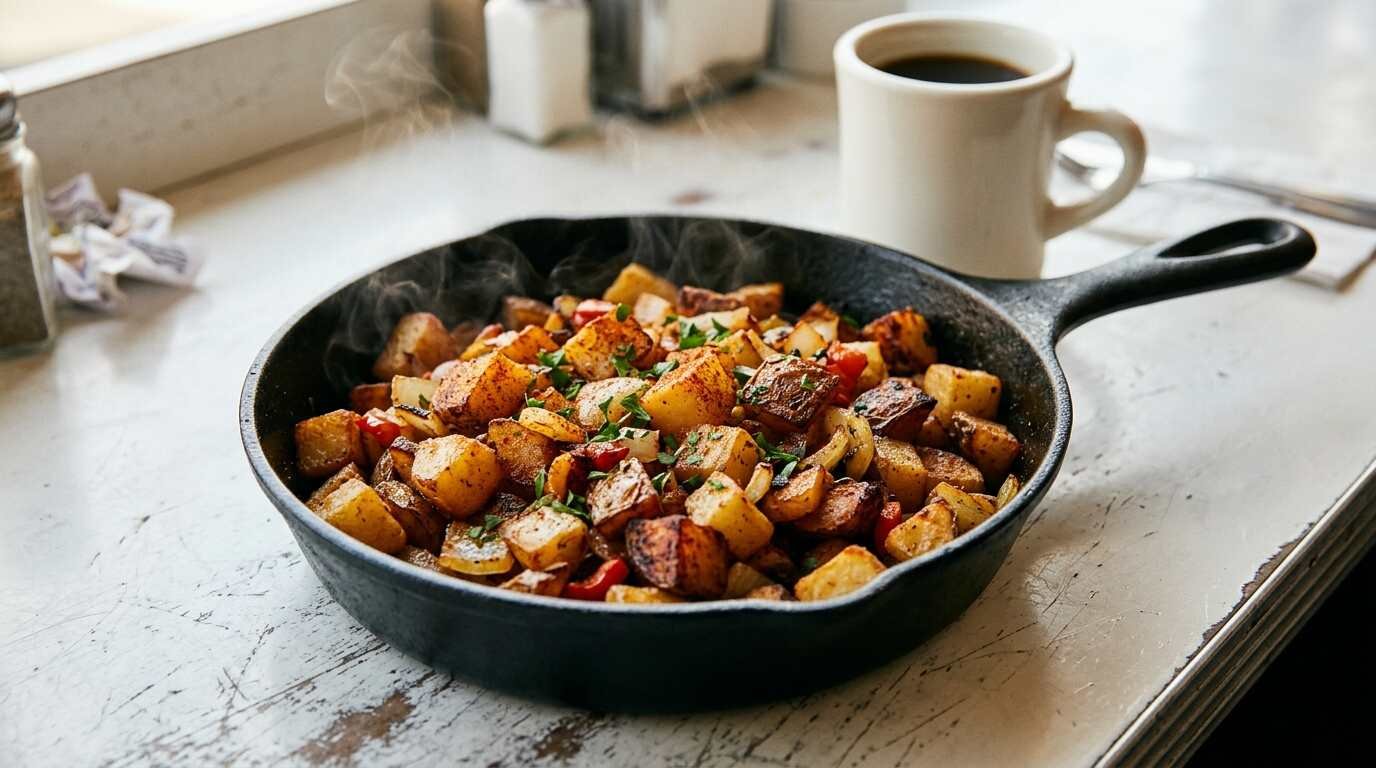
Chef John of Food Wishes spent about seven minutes in April 2017 telling viewers to cool their potatoes before frying them, and YouTube now lists that video at 2.4 million views. The advice sounds backward until starch enters the picture, and starch is the entire story of crispy home fries.
The video earns its audience on the pan work, but the written post behind it carries the reasoning. Home fries made in a house kitchen, Chef John notes, usually look great but rarely get the crisp crust that the local greasy spoon manages every morning. The gap, in his telling, opens well before the skillet gets hot.
Why the Pan Wants Cold Potatoes
Frying a hot, wet potato is a bit like trying to sear a sponge. The surface steams instead of browning, and the crust never forms.
Food Wishes lays out what a diner kitchen does instead: the potatoes are steamed or boiled ahead of time, cooled, cut, and held chilled until service. Then comes the line that gives this post its title.
“When you pan fry a cold starch, it gets a beautifully crispy surface”
Chef John, Food Wishes
America’s Test Kitchen approaches the same problem from the other side. In an article about a sheet-pan dinner, its cooks describe a parboil with baking soda, because the alkalinity breaks down the potatoes’ exteriors. Stirring the drained cubes with salt then roughs up that softened surface and releases starch that forms a paste, which gives the pan more area to brown. Drying the parboiled potatoes on the stovetop drives off surface moisture, so the oil does the browning instead of the steam.
“Parboiling potatoes with baking soda is one of our favorite cooking tricks.”
America’s Test Kitchen
Two kitchens, two routes, one shared rule: cook the interior first, dry the outside, and only then fry.
Two Ways to Par-Cook
Published home fries recipes split into two camps. One steams the potatoes (Chef John uses a microwave) and chills them. The other boils briefly in baking-soda water and dries them in the hot pot. The table below lines up three recipes. It comes from the published instructions, not from a side-by-side cook-off, so read it as a map and not a verdict.
| Recipe | Par-cook | Dry or cool | Pan stage |
|---|---|---|---|
| Food Wishes (Chef John) | Peeled, quartered russets microwaved a few minutes until barely tender (no exact time given) | Cool fully before frying | Olive oil plus butter |
| Jessica Gavin | ¾-inch russet cubes, skin on, boiled 5 to 6 minutes in 5 cups of water with ¼ teaspoon baking soda and 1 teaspoon salt | Shaken dry in the pot over low heat for about 2 minutes, then tossed with butter and salt for a starchy paste | Medium heat, 4 to 5 minutes per side, 11 to 15 minutes total |
| Savory Experiments | ½-inch russet cubes boiled in water with 1 teaspoon baking soda, 1 to 2 minutes after the boil | Steam-dried 1 to 2 minutes in a colander | Medium-high heat, 2 to 4 minutes per side, in batches |
The recipes disagree in useful ways. Gavin’s boil runs five to six minutes with a quarter teaspoon of baking soda, while Savory Experiments uses a full teaspoon and a boil of one to two minutes (its own method text says “until tender,” so the clock is a guide, not a rule). The practical lesson is to treat the boil as a window and test with a fork: the surface should soften while the center stays firm, and a cube that collapses has gone too far.
Which fork to take? The microwave route skips the pot of boiling water and the baking soda entirely, and Chef John prefers steam because boiling can waterlog potatoes. The boil route buys the starchy paste that Test Kitchen cooks credit for extra browning. Either way, dry potatoes and a patient pan do most of the work.
The Pan Work Is Mostly Patience
Once the potatoes are cooked and dry, the job turns into restraint.
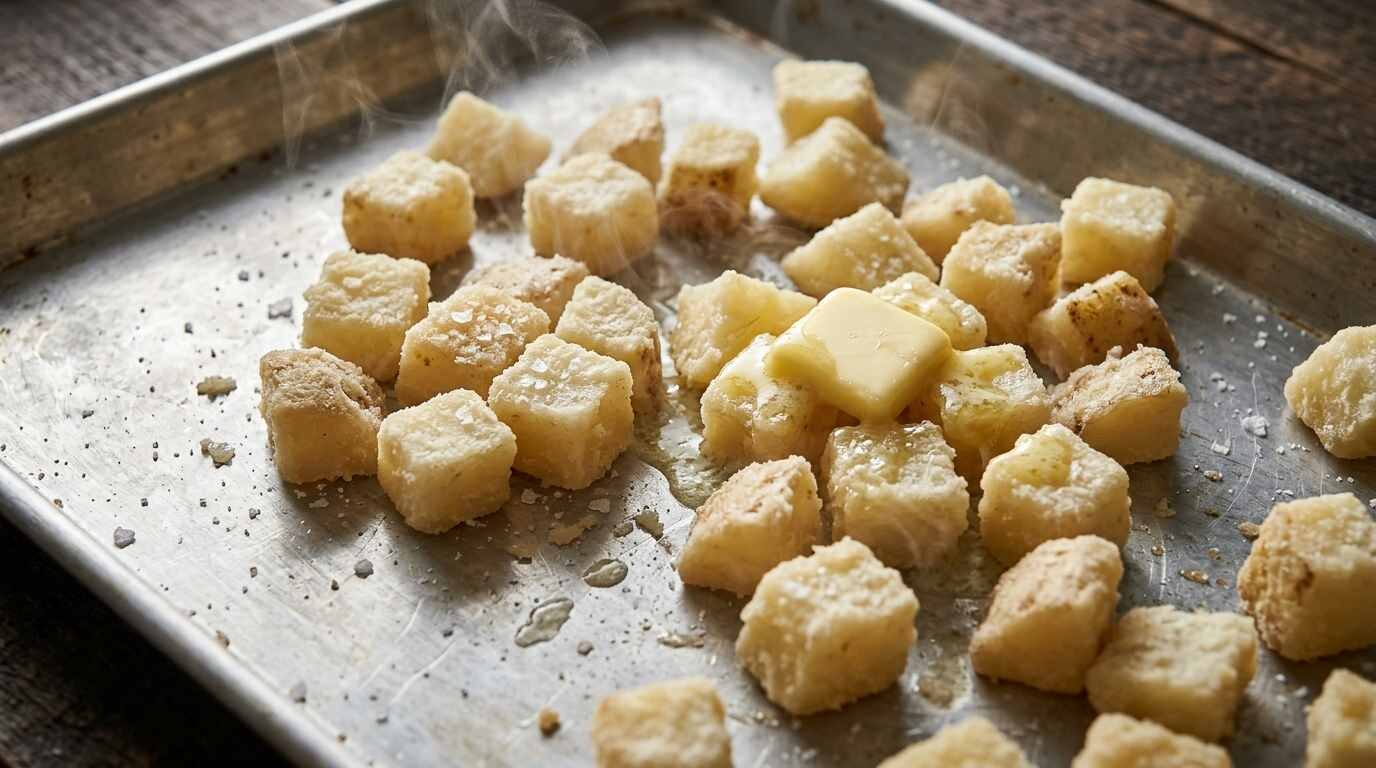
Spread the cubes in a single layer and leave them alone. Gavin’s recipe asks for 4 to 5 minutes before the first flip, and Savory Experiments suggests 2 to 4 minutes per side at higher heat; both warn against crowding, and Savory Experiments cooks in batches when the pan fills. A 12-inch cast iron skillet is the pan that recipe recommends. The skillet comparison covers where cast iron, carbon steel, and stainless each earn their place, and the guide to seasoning cast iron keeps that crust from sticking.
Fat timing matters too. Savory Experiments starts with oil and adds butter after the potatoes hit the pan, which lowers the risk of burnt butter; Chef John uses two tablespoons of olive oil and one of butter. Spices come last. Gavin’s recipe takes the pan off the heat before the paprika and garlic powder go in, since paprika scorches easily.
Onions get their own pan time. Both Gavin and Savory Experiments soften the onions first (Gavin adds diced red bell pepper for a minute) and set them aside, then fold them back in at the end so they warm through without burning. Finish the plate with a properly cooked egg using the flat-top fried egg guide, or turn leftovers into crispy corned beef hash. The sheet-pan route has its own walkthrough in Diner Breakfast at Home.
Crispy Diner-Style Home Fries, Start to Finish
Adapted from the published recipes by Jessica Gavin and Savory Experiments. Quantities are theirs, blended, so scale the water to cover your potatoes.
Ingredients
- 2 to 3 large russet potatoes, scrubbed and cut into ¾-inch cubes
- Water to cover, with ¼ teaspoon baking soda and 1 teaspoon salt for every 5 cups
- 1 tablespoon butter and ¾ teaspoon salt, for the starchy coating
- 1 tablespoon olive oil, 1 cup diced yellow onion, and ¼ teaspoon salt
- ½ cup diced red bell pepper
- 1 tablespoon butter and 1 tablespoon olive oil, for the skillet
- ½ teaspoon paprika, ¼ teaspoon garlic powder, and ¼ teaspoon black pepper
- Chopped parsley, optional
Method
- Bring the salted baking-soda water to a rolling boil, add the potatoes, and cook 5 to 6 minutes, until the surfaces soften and the centers stay firm.
- Drain, shake off the water, and return the potatoes to the dry pot over low heat for about 2 minutes to evaporate the surface moisture.
- Off the heat, stir in 1 tablespoon of butter and ¾ teaspoon of salt for about 30 seconds, until a thick starchy paste coats the cubes.
- In a 12-inch skillet over medium heat, cook the onion in 1 tablespoon of olive oil with ¼ teaspoon of salt for 4 to 5 minutes. Add the bell pepper for about 1 minute, then move everything to a bowl.
- Add the remaining butter and oil to the skillet over medium heat. When the butter melts, spread the potatoes in a single layer and leave them for 4 to 5 minutes.
- Flip and repeat, adjusting for even browning. Expect 11 to 15 minutes total.
- Turn off the heat, stir in the paprika, garlic powder, and pepper, return the onions and peppers for about a minute, and serve hot with parsley.
The microwave version: skip steps 1 and 2. Microwave peeled, quartered russets until just barely tender (Food Wishes gives no exact time, so check with a knife), cool them completely, cut them, and pick up at step 3 or go straight to the hot skillet.
What Diners Are Serving Right Now
The topic sits in the news this fall. On September 17, 2026, Eat This published a list of five restaurant chains with the best home fries, according to diners: First Watch, Silver Diner, Black Bear Diner, The Original Pancake House, and Bob Evans. The ranking rests on informal sources (Reddit posts, a TripAdvisor review, and Facebook comments), not on a formal survey, so it reads as a snapshot of opinion and not a measurement.
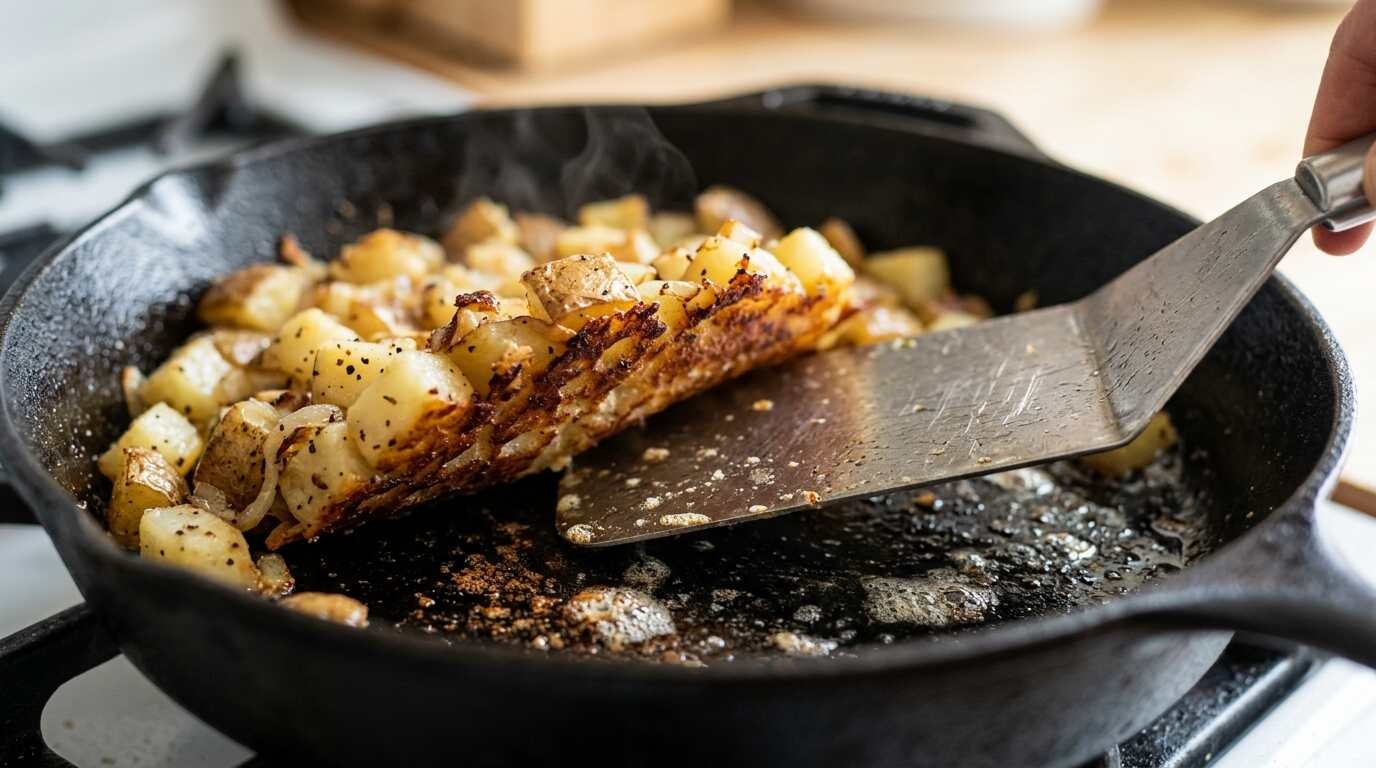
One detail lines up neatly with the methods above. The Original Pancake House, per the article, parboils and pan-fries russet potatoes, which come out crispy outside and creamy inside. That is the same two-stage logic every recipe here uses. Black Bear Diner’s country potatoes and Bob Evans’s chunks are red-skinned, a reminder that the potato itself varies by kitchen, even though the recipes above all call for russets.
Gear Worth Having
A few tools make the technique easier. Each link below goes to a product page on Amazon.
- Lodge Pre-Seasoned Cast Iron Skillet, PFAS-Free, 12 Inches: a 12-inch cast iron skillet gives a single layer of cubes the floor space they need. See it on Amazon (affiliate link)
- OXO Good Grips Restaurant Turner, Stainless Steel Metal Spatula: a stiff stainless turner slides under a browned crust instead of tearing it off. See it on Amazon (affiliate link)
- Nordic Ware Naturals Half Sheet, 2-Pack: a half sheet pan lets par-cooked cubes spread out and cool in a single layer before frying (this listing is a 2-pack). See it on Amazon (affiliate link)
- Diamond Crystal Kosher Salt, 3 Pound: a kosher salt that is easy to pinch for seasoning the warm cubes, and the Diamond Crystal versus Morton conversion explains how to swap brands. See it on Amazon (affiliate link)
- Arm & Hammer Pure Baking Soda 1 lb. Box: the baking soda for the parboil, which softens the potato surface before it gets roughed up. See it on Amazon (affiliate link)
As an Amazon Associate I earn from qualifying purchases. A commission may be earned if you buy through this link, at no extra cost to you.
Questions People Ask
Why are my home fries soft instead of crispy?
Surface moisture and crowding are the usual causes. Both baking-soda recipes stress drying the parboiled potatoes and keeping them in a single layer, and Chef John’s method chills them before frying.
Do I need baking soda?
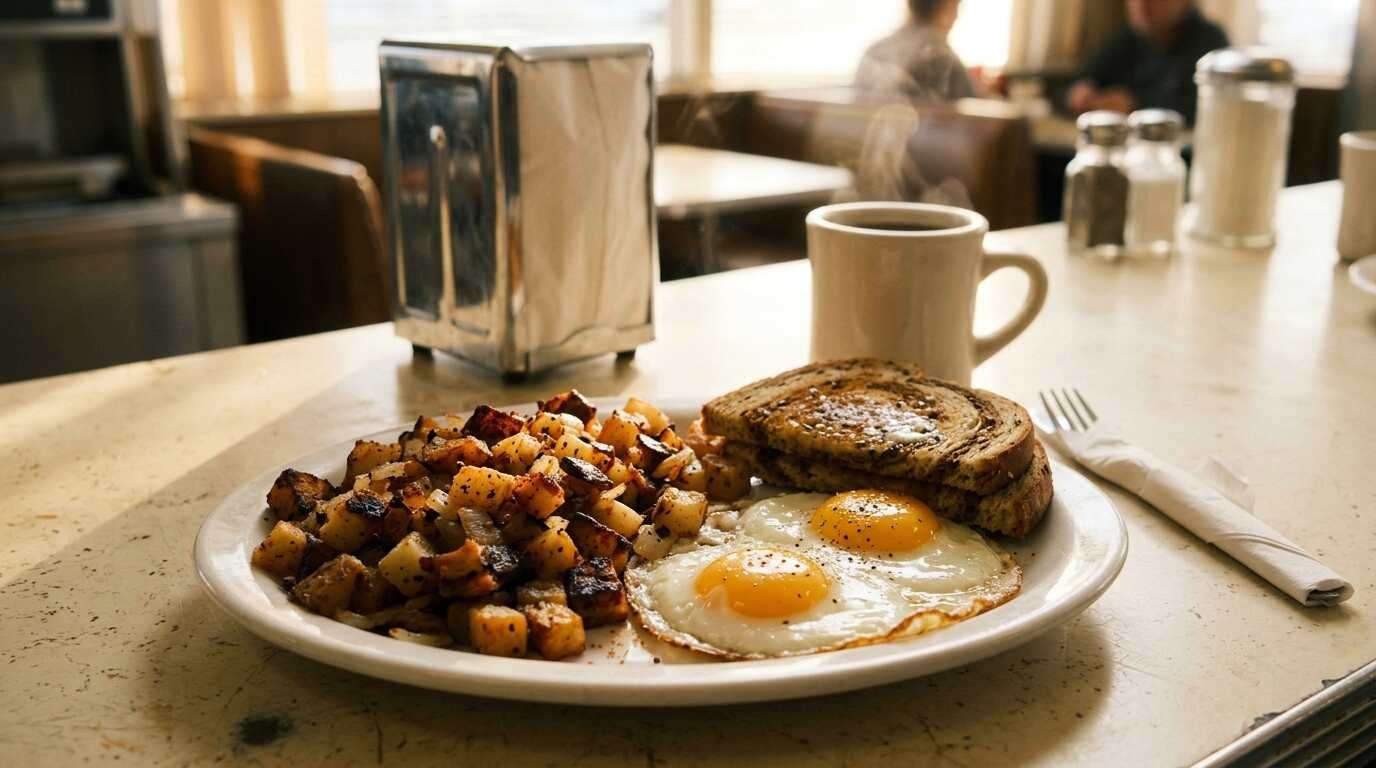
Not for the microwave method, which skips it. America’s Test Kitchen credits baking soda with breaking down the surface so the potatoes brown more deeply.
Can I use leftover baked potatoes?
Savory Experiments says leftover baked potatoes can skip the parboil.
Why add paprika at the end?
Jessica Gavin’s recipe stirs it in off the heat so it does not burn.
Should I use russets or red potatoes?
Every recipe cited here calls for russets. Eat This notes that some chains serve red-skinned potatoes, and none of these sources tests one against the other.
Sources
- Food Wishes, Quick & Crispy Home Fries (April 28, 2017)
- YouTube, Food Wishes: Quick & Crispy Home Fries
- Jessica Gavin, Home Fries
- Savory Experiments, Crispy Home Fries
- America’s Test Kitchen, Your New Go-To Sheet-Pan Dinner
- Eat This, 5 Restaurant Chains With the Best Home Fries, According to Diners (September 17, 2026)