 275 Route 25A, Mt Sinai, NY 11766


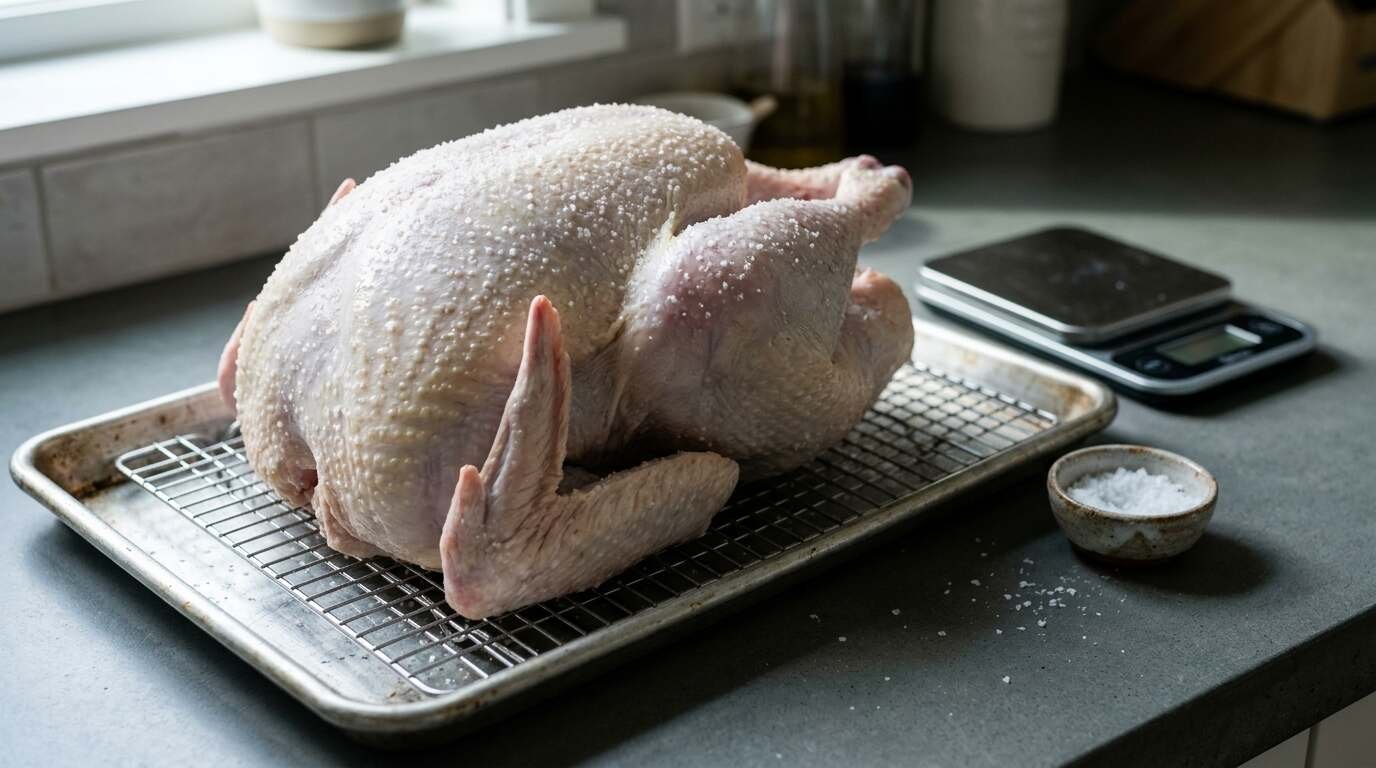
A fresh whole turkey from Butterball carries a line of fine print that most shoppers never read before they haul a cooler into the garage and start dissolving salt by the cupful. The ingredient statement on the company’s fresh whole turkey page reads: “Contains up to 4% of a solution of Water, Salt, and Spices to enhance tenderness and juiciness.” The same page says every fresh bird is pre-brined before it is packaged. Somebody already did the job. The bucket in the garage is a second coat of paint over a wall that was primed at the factory.
@@YOUTUBE@@ That is the practical end of the brining argument, and it is worth getting to the label before the science, because the science only matters for a turkey that has not been salted yet. For that bird, the choice comes down to three roads: soak it in salt water, rub it with dry salt and wait, or roast it as it came. Each one does something different to the muscle, and the differences are physical, not mystical.
Salt and the lattice inside a turkey breast
The muscle is a set of tight springs. Salt loosens the coils.
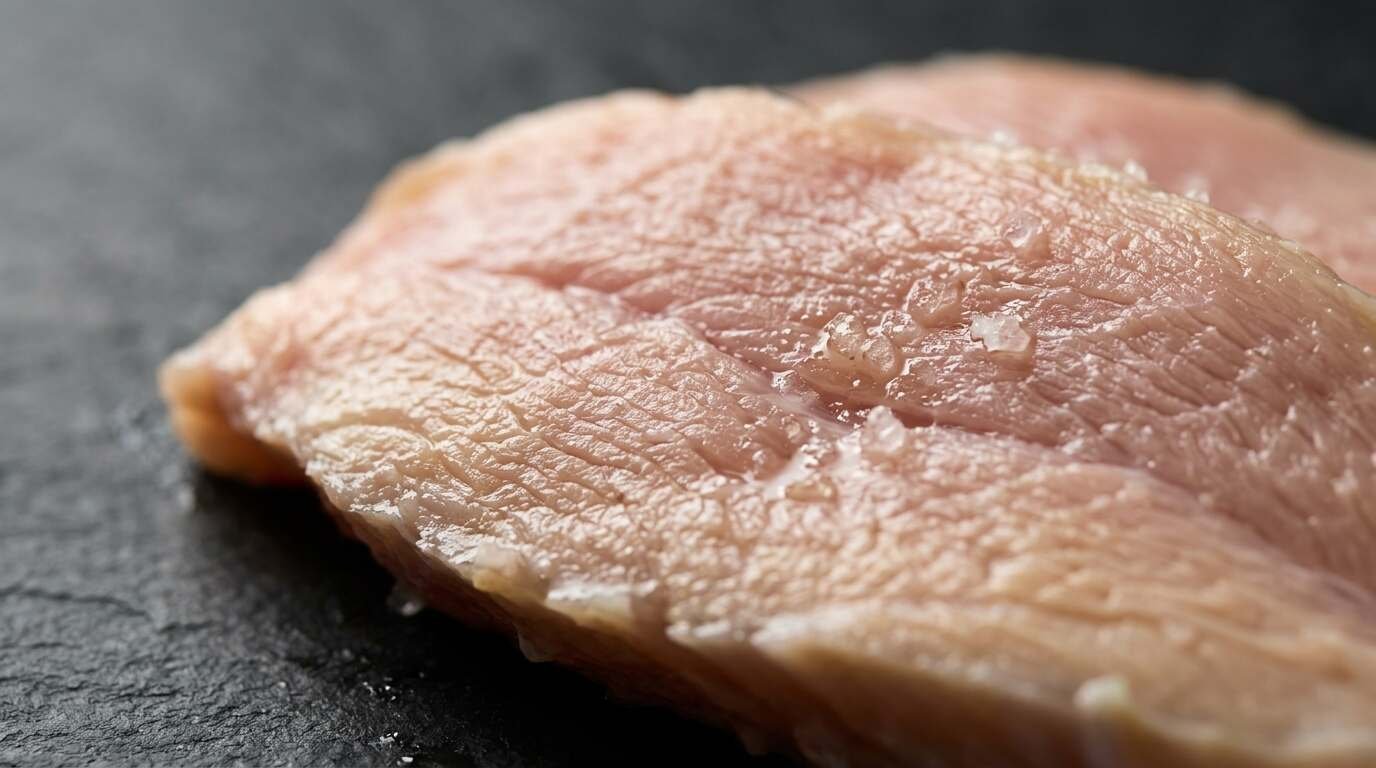
Turkey breast is mostly myofibrils, long bundles of protein filaments packed in a lattice like rebar inside poured concrete. How much water meat can hold depends on how far that lattice can open. The classic paper on the subject, Gerald Offer and John Trinick’s “On the mechanism of water holding in meat: The swelling and shrinking of myofibrils”, published in Meat Science in 1983, put the question in exactly those structural terms: meat holds water when the filament lattice swells and loses it when the lattice shrinks.
Salt pushes the lattice open. A 2009 review in the Italian Journal of Animal Science by Maurizio Bianchi, Massimiliano Petracci and Claudio Cavani, “The use of marination to improve poultry meat quality,” describes how sodium chloride “causes transverse expansion of the myofibrils due to the electrostatic repulsion.” Charged protein surfaces push away from one another, the filaments spread apart, and the gaps between them fill with water. The same review credits a partial solubilization of proteins with helping the meat take that water up.
The USDA’s own explanation is plainer. Archie Magoulas, a technical information specialist with the Food Safety and Inspection Service, wrote in a brining guide reprinted by UW–Madison Extension in Dunn County that “the salt in the brine dissolves a bit of the protein in the muscle fibers,” which lets the meat absorb brine and hold moisture during cooking.
That word “during” carries the weight. Heat makes muscle proteins contract and wring out juice the way a fist wrings a rag. Salted muscle still contracts, but some of the protein has been loosened or dissolved into a sticky gel, so less liquid gets squeezed into the roasting pan. A University of Minnesota animal scientist, Ryan Cox, told Mental Floss that this rearrangement makes more space between the muscle fibers.
Phosphates push the same lever harder. Youling Xiong’s 2005 study in Food Research International, “Role of myofibrillar proteins in water-binding in brine-enhanced meats,” found that phosphate brines expanded myofibrils sideways and pulled myosin from the ends of the A-band, swelling the fibers and raising water uptake. That study worked on chicken and pork, not turkey, but the principle is the same one: the right chemistry opens the lattice wider than salt alone. A home kitchen stocks salt and sugar, and that is usually where the chemistry ends.
A bucket of salt water
The wet brine adds weight. Some of that weight is just water.
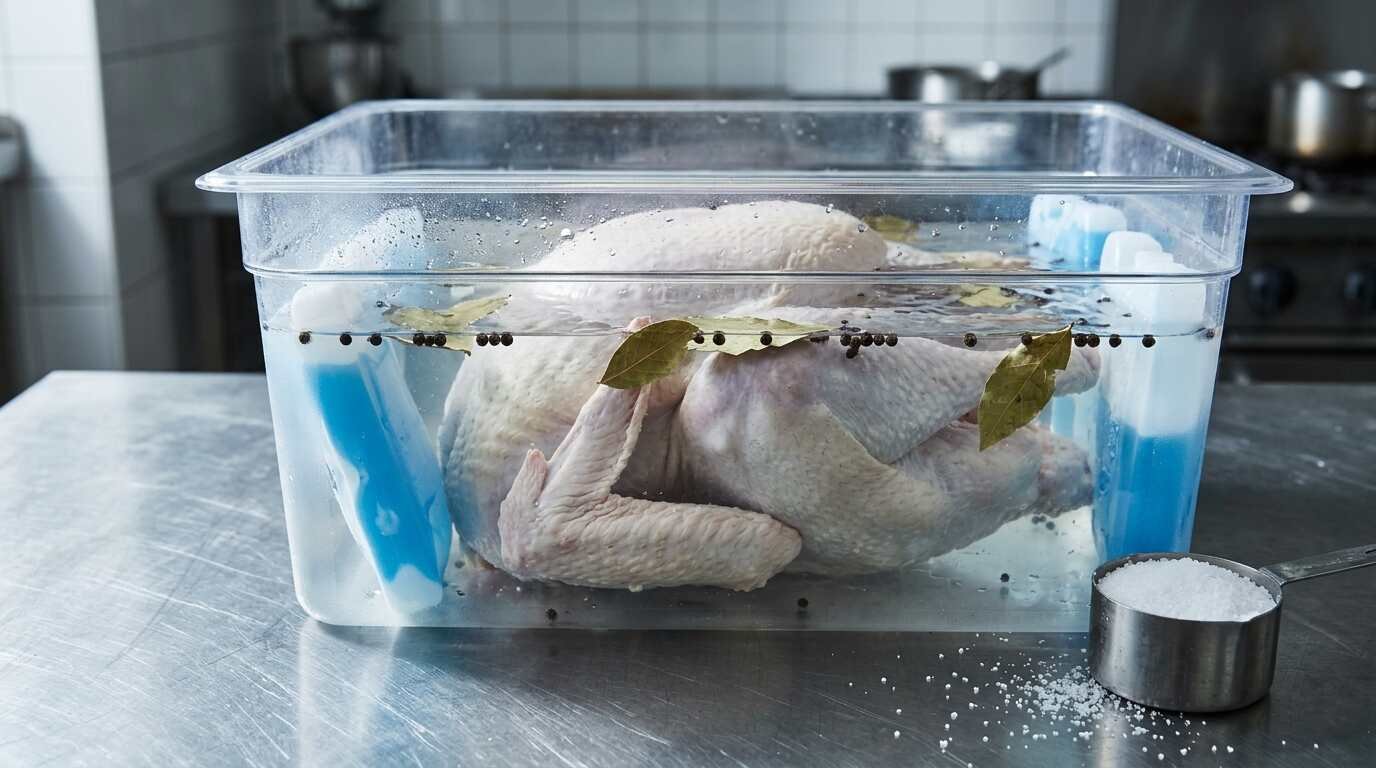
A wet brine works by diffusion: salt moves from the concentrated bath into the less salty meat, and the loosened proteins grab water along the way. University of Illinois Extension’s brine method calls for dissolving “4 cups kosher salt or 2 cups table salt in 2 gallons cold water,” adding a cup of sugar, and chilling the bird for 6 to 8 hours, with the salt and sugar cut in half for an overnight soak. America’s Test Kitchen’s roasted brined turkey runs on similar math: 1 cup of salt per gallon for a 4- to 6-hour brine, half that for 12 to 14 hours.
Notice that Illinois needs twice as much kosher salt as table salt to reach the same strength. A cup is a measure of space, and coarse flakes leave more air between them than fine grains do. Brands differ too, as the Diamond Crystal and Morton conversion on this site lays out in teaspoons. The chef and food scientist Chris Young, quoted by KQED, put the problem bluntly: “As a chef, I would never use volumetric measurements because they’re too unreliable.” KQED’s piece suggests weighing the salt at 1.5 percent of the turkey’s weight.
Safety rules sit on top of the chemistry. The FSIS guidance in the Dunn County handout says not to brine longer than two days, to keep the turkey and brine at 40°F or below the whole time, and to cook to a minimum internal temperature of 165°F. A cooler full of ice packs is a refrigerator only for as long as the ice lasts.
Rubbing salt on dry skin
Dry brining asks for patience instead of plumbing.
A dry brine skips the water. Salt goes straight onto the bird, and the bird sits uncovered or loosely covered in the refrigerator for a day or more. Mental Floss, drawing on Cook’s Science from the editors of Cook’s Illustrated, notes that salt also dissolves some proteins into “a gel that can hold onto even more water.” The mechanism is the same lattice-loosening chemistry. The delivery is slower.
How slow is the honest question. Cox told the magazine that salt moves into meat at a rate of about an inch per week. A turkey breast is thicker than an inch at its crown, so a two- or three-day dry brine seasons the outer layer far more than the center. Cooking does some of the rest: as the meat heats, the contracting proteins push liquid toward the surface, where it mixes with salt and gets pulled back in, according to the same article.
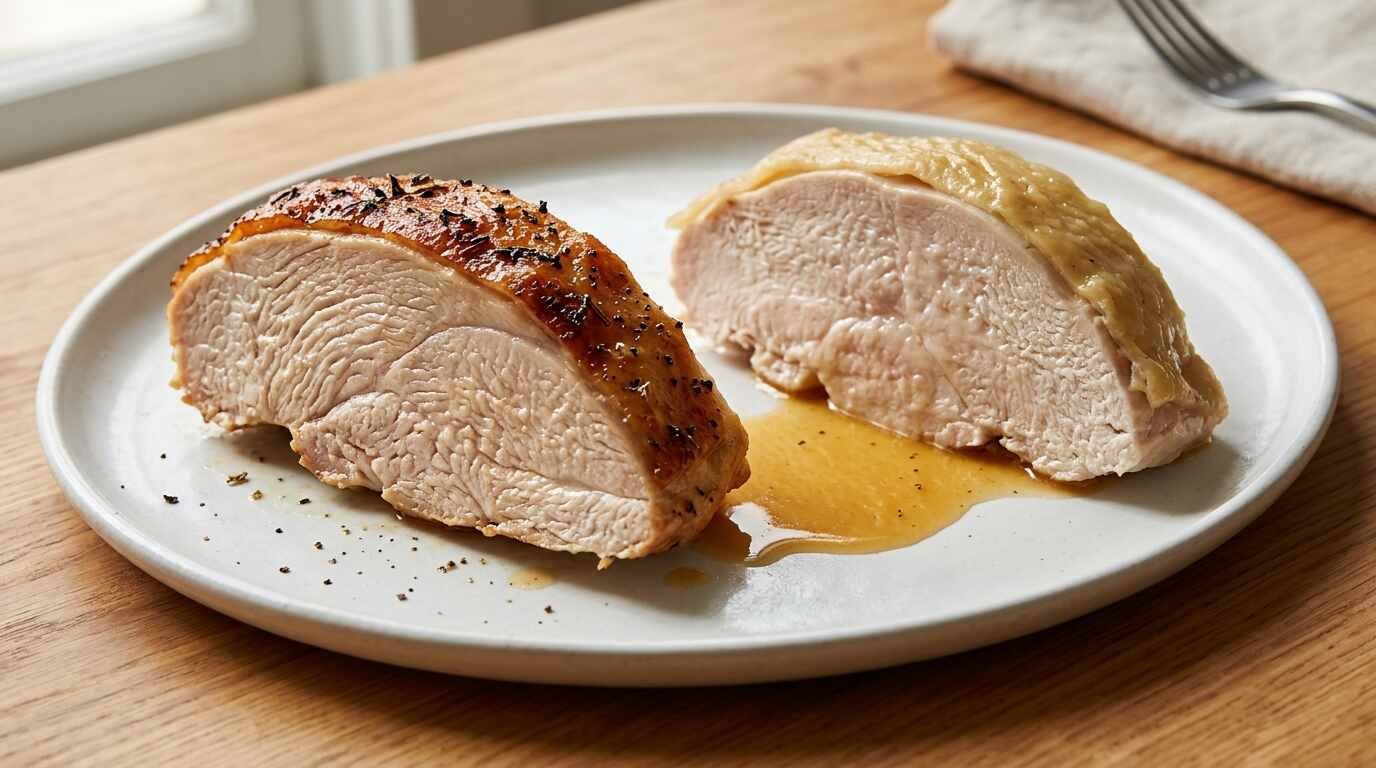
What the dry method gives up in reach it pays back at the surface. Without a soak, the skin is not waterlogged going into the oven. Amy Traverso, writing for New England Today, advises removing the plastic wrap while the salted turkey sits in the refrigerator for extra-crisp skin, and argues that because the breast absorbs less water than it would in a wet solution, it never turns spongy.
The KQED piece offers a middle path for cooks without a scale, attributed to Young: coat the turkey heavily in salt, wait an hour, rinse off the excess, then season and refrigerate. It is a rough method that trades precision for a guaranteed ceiling on saltiness. Rough methods have a place in a kitchen running four ovens on one Thursday.
The case against the bucket
Juicier is not the same word as tastier.
The wet brine’s biggest defenders and its sharpest critics agree on one thing: the meat comes out heavier. They split over what that extra weight is worth. J. Kenji López-Alt, the cook and food writer, told Quartz that in a wet brine “Water goes in and flavor compounds go out.” The same Quartz article reported on a BuzzFeed taste test in which brined turkey came across as moist but flavorless, and argued that the skin on a soaked bird does not crisp.
Texture is the quieter complaint. Traverso’s New England Today piece, which still defends wet brining as a way to add flavor, concedes that the soak can leave the breast meat a little spongy. That sponginess is the lattice science pushed past its sweet spot. Open the filaments a little and the meat holds its juice. Open them a lot and fill the gaps with plain water, and the bite goes soft and wet in a way that no amount of gravy disguises.
The research literature hints at a ceiling too. The Bianchi review notes that higher solution-to-meat ratios raised marinade uptake and also raised cooking loss. More liquid went in, and more came out in the pan. A bird that weighs more raw does not automatically weigh more on the platter, and the gravy boat is the only one that profits. For the drippings, that is fine news; the lump-free gravy roux timeline is built for exactly that pan. For the slices, it is a wash at best.
None of this makes a wet brine a mistake. It makes it a tool with a known side effect, the way a pipe wrench will turn a fitting and also scar it.
Kosher turkeys and the salt they already carry
A kosher bird has been salted by rule, not by recipe.
Koshering is its own salt treatment. Chabad’s introduction to the koshering process describes meat soaked in water for at least half an hour, covered in coarse salt and left for a minimum of one hour, then rinsed three times. The salt’s job in that ritual is to draw out blood, which is why the instructions call for coarse crystals rather than fine table salt that would dissolve into the flesh.
Grow & Behold, a kosher meat company, says on its guide to kosher pastured turkey that all kosher meat is soaked and salted, and that its bird doesn’t require any further brining. America’s Test Kitchen is firmer. Its recipe page warns that “you should never brine a kosher or a self-basting bird because it will become too salty,” and advises cooks roasting either kind to skip the brine because it already holds a good amount of sodium.
Reading a pre-brined label
The label tells the truth. It just whispers.
Federal rules cover what goes on the package. The USDA FSIS fact sheet “Turkey from Farm to Table,” revised in August 2010 and hosted by University of Tennessee Extension, says bone-in poultry injected or marinated with a solution of butter or other fat, broth, stock or water plus spices and flavor enhancers must be labeled “basted” or “self-basted.” Kansas State University’s guide to turkey labels adds that those ingredients must be listed on the label.
A broader rule arrived later. FSIS’s final rule on raw meat and poultry containing added solutions, effective January 1, 2016, requires the percentage of solution and its ingredients to appear as part of the product name, written as a number with a percent sign, so a label reads along the lines of containing 15% added solution of water and salt. The rule states that “the word ‘enhanced’ is not allowed in the product name.” Its reasoning was blunt: products with added solution had carried the same name as products without it. FSIS estimated that about 60 percent of all raw meat and poultry sold contains added solutions, and cited survey findings that only 40 percent of consumers knew it.
That 60 percent figure covers all raw meat and poultry, not turkeys alone, so it cannot say how many whole birds in a given freezer case are pre-salted. The label on the specific bird can. The words to look for are a percentage followed by “solution,” along with “basted,” “self-basted,” “pre-brined” or “kosher.” Any of them means the salt is already in the meat, and a home brine stacks a second dose on the first.
A turkey with none of those words is a blank wall, and the salt choice belongs to the cook. A turkey that has them can go straight from the wrapper to the roasting pan, then later to the Thanksgiving timeline for a small kitchen, and eventually between two slices of bread under gravy as a hot turkey sandwich. The meat does not remember which road it took. The tongue does.
So the open question goes to the people who have roasted both: on a bird that came home already carrying 4 percent of somebody else’s solution, has anyone actually tasted the difference a second brine made, or only weighed it?
You Might Also Like
- Green Bean Casserole History: Dorcas Reilly’s 1955 Recipe and How It Became a Thanksgiving Fixture
- Pecan Pie History: The Karo Syrup Claim and the Recipes That Came Before It
- After the Bird: Eight Ways to Use Leftover Turkey
Sources
- Butterball, Fresh Whole Turkey product page: https://prod-www.butterball.com/products/whole-turkey/fresh
- PBS NewsHour, “The science of cooking the perfect Thanksgiving turkey” (YouTube): https://www.youtube.com/watch?v=7v-bshg-yOI
- Offer, G., and Trinick, J. (1983), “On the mechanism of water holding in meat: The swelling and shrinking of myofibrils,” Meat Science 8(4), 245–281, Scilit record: https://www.scilit.com/publications/87d94685330c494952141e857ead9674
- Bianchi, M., Petracci, M., and Cavani, C. (2009), “The use of marination to improve poultry meat quality,” Italian Journal of Animal Science 8(Suppl. 2): https://cris.unibo.it/retrieve/handle/11585/76383/e1dcb335-76e8-7715-e053-1705fe0a6cc9/The%20use%20of%20marination%20to%20improve%20poultry%20meat%20quality.pdf
- UW–Madison Extension, Dunn County, “Brining Tips” (Archie Magoulas, USDA FSIS): https://dunn.extension.wisc.edu/files/2020/11/Brining-Tips.pdf
- Mental Floss, “The Science Behind Brining Your Thanksgiving Turkey”: https://www.mentalfloss.com/article/516267/brine-time-science-behind-salting-your-thanksgiving-turkey
- Xiong, Y. L. (2005), “Role of myofibrillar proteins in water-binding in brine-enhanced meats,” Food Research International 38(3), 281–287: https://scholars.uky.edu/en/publications/role-of-myofibrillar-proteins-in-water-binding-in-brine-enhanced-/
- University of Illinois Extension, “Brine Method”: https://extension.illinois.edu/turkey/brine-method
- America’s Test Kitchen, “Roasted Brined Turkey”: https://www.americastestkitchen.com/recipes/1713-roasted-brined-turkey
- KQED Science, “Step Aside, Julia Child: For the Perfect Thanksgiving Turkey, Turn to Science”: https://www.kqed.org/science/1951073/video-step-aside-julia-child-for-the-perfect-thanksgiving-turkey-turn-to-science
- New England Today, “Should You Brine or Dry-Cure Your Turkey?” (Amy Traverso): https://newengland.com/food/cooking-advice/should-you-brine-or-dry-cure-your-turkey/
- Quartz, “Brining turkey is the worst, according to science”: https://qz.com/554914/brining-turkey-is-the-worst-according-to-science
- Chabad.org, “Introduction to the Koshering (Salting) Process”: https://www.chabad.org/library/article_cdo/aid/82678/jewish/Koshering-Meat.htm
- Grow & Behold, “What to Know About Kosher Pastured Turkey”: https://blog.growandbehold.com/what-to-know-about-kosher-pastured-turkey/
- USDA FSIS, “Turkey from Farm to Table” (rev. August 2010), hosted by University of Tennessee Extension: https://rhea.tennessee.edu/wp-content/uploads/sites/145/2020/12/Turkey_from_Farm_to_Table.pdf
- Kansas State University, “What’s on a Turkey Label?”: https://www.k-state.edu/news/you-asked-it/articles/2021/11/whats-on-a-turkey-label.html
- Federal Register, “Descriptive Designation for Raw Meat and Poultry Products Containing Added Solutions” (FSIS final rule, Dec. 31, 2014): https://www.federalregister.gov/documents/2014/12/31/2014-30472/descriptive-designation-for-raw-meat-and-poultry-products-containing-added-solutions
Suggested category: Food & Cooking
Leave a Reply