
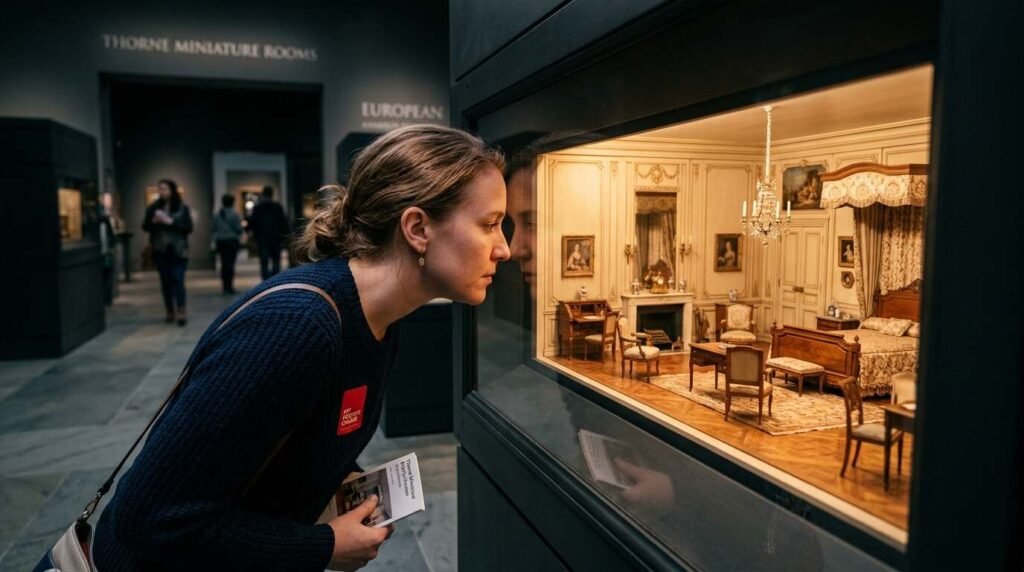
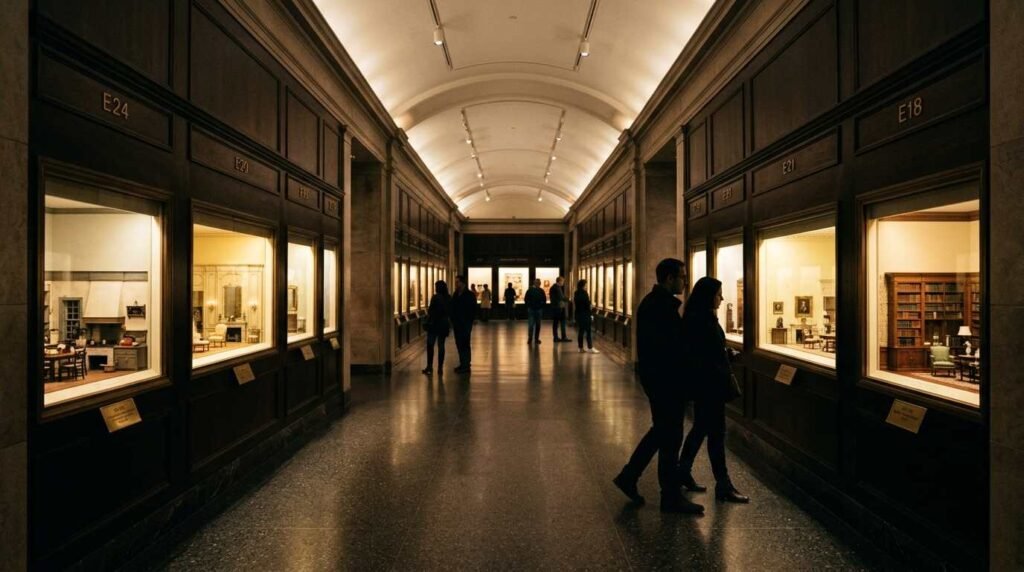
The Thorne Miniature Rooms occupy a lower-level gallery at the Art Institute of Chicago, set into the wall in a long corridor of illuminated boxes. You press your face to the glass and look through a window into a room — a seventeenth-century Dutch interior with specific tiles on the floor, a particular lace pattern on the tablecloth, a fireplace surround that corresponds to a documented regional style. The scale is 1:12. One inch equals one foot. Everything is as it would appear from a height of approximately six inches, which is to say: from the perspective of no living creature.
That perspectival strangeness is part of what makes the rooms compelling. You are not looking at a decoration or a toy. You are looking at the result of approximately fifteen years of systematic historical research — primary source documentation of how people arranged and furnished interior spaces across six centuries of Western domestic life, compressed into a corridor you can walk in under five minutes.
Who Narcissa Thorne Was
Narcissa Niblack Thorne was born in 1882 into the Illinois social elite and married James Ward Thorne, heir to Montgomery Ward’s retail fortune. She had resources, a capacious intellect, and what appears to have been an almost scholarly disposition toward the material culture of domestic life. She began collecting antique miniature furniture in the 1920s and quickly found that existing miniature antiques were insufficient for her purposes — too stylistically inconsistent, too casually sourced.
She began commissioning rooms. The process was methodical. For each room, Thorne and her collaborators researched the specific period and regional style — consulting museum collections, architectural pattern books, and surviving documented interiors. She then engaged master craftsmen in Chicago and later in California to execute the rooms to exacting standards: cabinetmakers, silk weavers, silversmiths, glassblowers, and painters all contributed to specific rooms.
By the time the rooms were exhibited publicly — first at the 1933 Century of Progress International Exposition in Chicago — there were 30. The final collection, donated to the Art Institute of Chicago in 1954, numbered 68 rooms: 37 European rooms spanning from the late thirteenth century to the 1930s, and 31 rooms of American interior design from the early colonial period through the early twentieth century.
The Research Process Behind the Rooms
What distinguishes the Thorne Rooms from decorative arts miniatures generally is the documented research infrastructure behind each one. The Art Institute’s curatorial records and the Thorne archive — portions of which have been made accessible to researchers — show correspondence with museum curators, architects, and textile historians conducted in preparation for specific rooms. Thorne visited institutions including the Victoria and Albert Museum in London and consulted with period furniture scholars at multiple American museums.
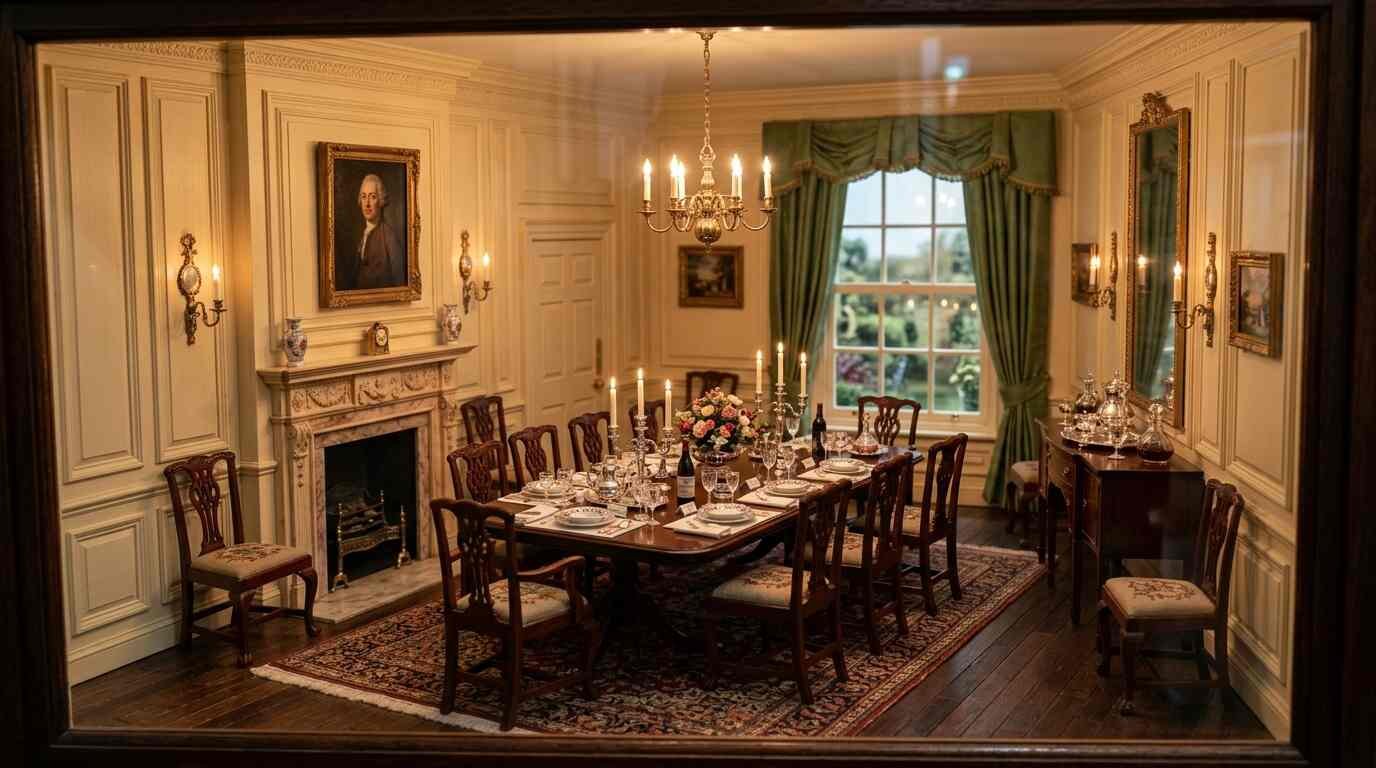
Each room was designed to represent a specific period, region, and socioeconomic context rather than a generic “historical style.” The distinction matters. The English Dining Room of the Early Georgian Period (1720–1760) is not simply “Georgian” — it reflects the specific furniture forms, color palette, lighting technology, and surface treatment associated with a defined two-generation window in English domestic culture. The paneling corresponds to documented regional woodworking traditions. The plasterwork ceiling reflects patterns from surviving interiors of the period.
Fannia Weingartner’s catalog documentation, produced in collaboration with the Art Institute in the decades following the donation, recorded the source materials and research decisions behind individual rooms. The catalog functions as a primary source reference for the rooms themselves — a documentation of the documentation.
How Conservators and Researchers Use the Rooms
The conservation research function of the Thorne Rooms has been noted in museum literature but is not well known outside professional circles. Interior conservators — specialists who work on the preservation of historically significant domestic interiors — have used the rooms as reference material for period-specific detail that is difficult to access through other means.
The problem the Thorne Rooms solve is one of scale and access. Surviving historic interiors are relatively rare, usually inaccessible to close physical examination, and frequently have been altered, restored, or modified over time. Photographic records of historic interiors exist but do not always capture the three-dimensional relationships between objects, the treatment of surfaces under specific lighting conditions, or the spatial arrangement of furniture within a room at a specific moment in its history.
The Thorne Rooms, because they were constructed at 1:12 scale with documented reference materials, offer a different kind of access. A conservator working on a restoration of an eighteenth-century New England parlor can examine the corresponding Thorne Room to observe how wall treatment, furniture arrangement, textile color, and floor covering relate spatially in an informed reconstruction — without requiring access to a surviving original. The rooms have been cited in museum conservation literature as reference material for exactly this kind of comparative work.
The Rooms as Evidence of a Particular Kind of Mind
There is something intellectually interesting about the Thorne Rooms that goes beyond their documentary value. Narcissa Thorne, working in the 1930s and 1940s, was constructing what might now be called a knowledge visualization project — translating archival and material research into a physically navigable form that communicates relationships between objects more effectively than a written catalog or a flat photograph.
The rooms work because they think spatially. A curator can describe in words that a Dutch seventeenth-century interior typically placed the table at the center of the room with chairs arranged formally around it, that specific tile patterns were associated with specific regional production centers, that light entered from a particular angle through a specific type of window. The Thorne version of the same room shows all of that simultaneously, in relationship, at a scale that allows the eye to move through the space the way a body would move through the original.
That spatial intelligence is what makes the rooms something more than very well-researched miniatures. It is the same quality that makes a good architectural model more useful than a floor plan for most observers — the cognitive difference between reading a description of a space and being inside it, even at 1:12.
The Thorne Miniature Rooms at the Art Institute of Chicago are open to the public as part of the general admission collection. The Art Institute’s website at artic.edu provides gallery information and exhibition details.
You Might Also Like: Basquiat’s Crown Symbol: What the Three-Point Mark Actually Meant | Rodin’s The Thinker