 275 Route 25A, Mt Sinai, NY 11766

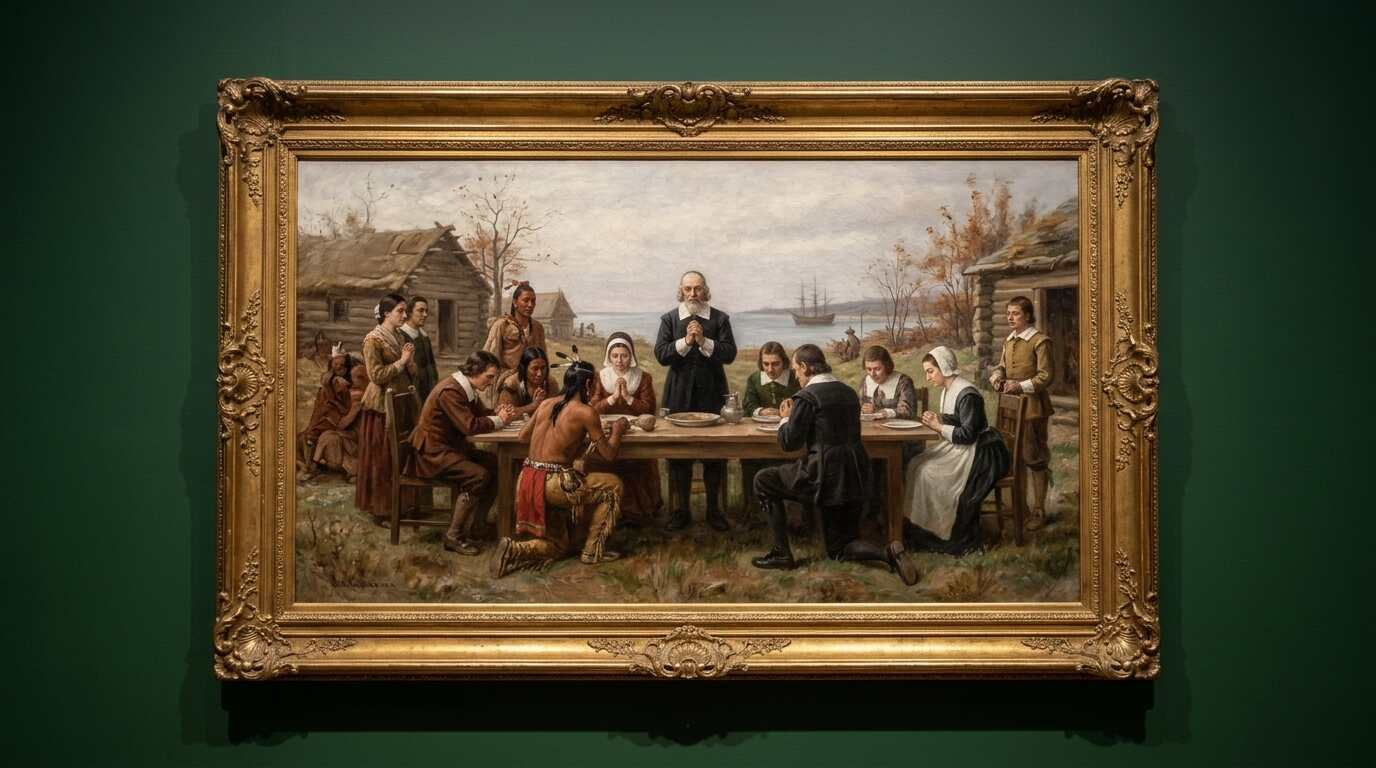
A feather headdress from the western plains sits on a guest at a harvest meal in coastal Massachusetts, far from the people who wore that style, and nobody in the picture seems to mind. Jennie Augusta Brownscombe painted it in oil in 1914, in either Honesdale, Pennsylvania, or New York, according to the Pilgrim Hall Museum’s history-paintings page, which also lists a log cabin among the details that do not belong in 1621. The canvas is called The First Thanksgiving at Plymouth, and it is probably the closest thing the holiday has to an official portrait.
@@YOUTUBE@@ The museum does not pretend otherwise. Its entry says Brownscombe’s interpretation “has become a symbol of the holiday for many Americans”, and that the picture reached a wide audience and shaped the national understanding once it was printed in Life magazine. A painting that is wrong on its face became the template anyway. That is a stranger fact than any single error in it, and it is the reason the picture is worth standing in front of a little longer than a greeting card allows.
What the canvas asks the eye to accept
Every element is built to calm the viewer down.
Pilgrim Hall’s entry names the work’s three registers: religious solemnity, feasting and community. In the museum’s reading, Brownscombe clearly conveys a peaceful meeting between the English settlers and the Native Americans, and the entire image still carries strong emotional appeal while showing a Thanksgiving that early twentieth-century Americans would find comfortable (Pilgrim Hall Museum). That last idea is the hinge. Comfort is the product. The picture works the way a well-seasoned flat-top works: it has been used so long that nothing sticks to it, including the facts.
A viewer who knows the period goes looking for the seams, and two of them sit in plain sight. The headdress is Sioux, a Plains nation, not Wampanoag. The log cabin is the other, and the museum describes both as details Brownscombe picked, inconsistent with history, to symbolize early America while painting in the Colonial Revival period (Pilgrim Hall Museum). Both errors are doing a job. They are shorthand, the way a cartoon chef always wears a toque.
There is a long visual habit behind that shorthand. A reading assigned with the picture by Oklahoma Ag in the Classroom, drawn from Nathaniel Philbrick’s Mayflower, notes that Victorian-era engravings tended to show a long table under a white cloth with people praying, and disputes that picture of the 1621 gathering. Brownscombe did not invent the costume drama. She perfected the version people would buy.
Jennie Brownscombe, from Honesdale to the calendar rack
She trained like a fine artist and sold like a printer.
Brownscombe was born on December 10, 1850, near Irving Cliff in Honesdale, Pennsylvania, and died on August 5, 1936, in Bayside, New York, according to her Wikipedia biography. Bayside sits in Queens, on the western end of the same island that holds Mount Sinai, which gives the most famous Thanksgiving painting in the country a quiet Long Island footnote.
Her training was serious. The same biography records that she graduated from the Cooper Institute School of Design for Women in New York in 1872, studied at the National Academy of Design until 1881 under Lemuel Wilmarth, won the Elliott Medal and the Suydam Medal there, and studied in Paris in 1882 under Henry Mosler. She was also a founding member of the Art Students League of New York, where she taught to help cover her own tuition (Wikipedia).
Then came the commercial work, which explains a lot about the 1914 canvas. Brownscombe drew for Harper’s Weekly and Scribner, and she sold reproduction rights to more than 100 of her paintings, which turned up on prints, calendars and greeting cards (Wikipedia). In 1899 the New York World called her “one of America’s best artists,” per the same page. A painter whose income depends on a picture hanging over thousands of kitchen tables learns what those kitchens want to look at. Accuracy is rarely first on the list.
The National Museum of Women in the Arts puts the appeal in historical terms: her Colonial American scenes spoke to contemporaries looking for a nostalgic escape from modern change.
The letter Edward Winslow sent home
One eyewitness, one letter, and no turkey by name.
Almost everything known about the 1621 meal comes from a single letter. Edward Winslow wrote it to a friend in England in December 1621, and it was printed in London in 1622 in the book now called Mourt’s Relation. Plimoth Patuxet Museums describes it as “the only eye-witness record of the celebration that survives”. The Pilgrim Hall Museum dates the letter to December 11, 1621.
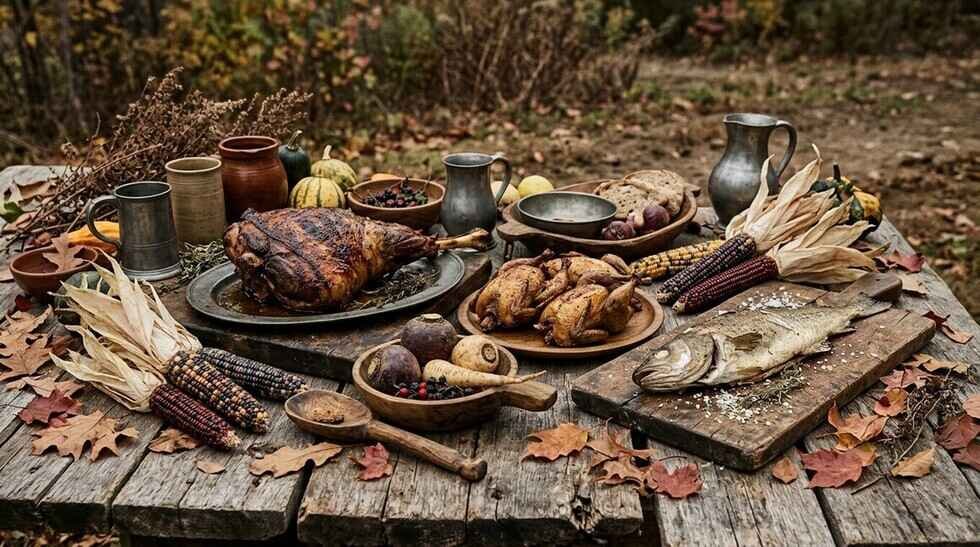
The account is plain and short. The harvest came in, and the governor sent four men out hunting birds, “that so we might after a speciall manner rejoyce” together. The English fired their guns as part of the recreation. Massasoit, the Wampanoag leader, arrived with about ninety men, and the English hosted and fed them for three days, while the Wampanoag went out and “killed five Deere, which they brought to the Plantation”, as the museum’s transcription reads.
That is the meal. Birds of an unnamed kind, five deer, and a crowd the Pilgrim Hall Museum estimates at about 150 people, most of it likely cooked by the English women and older girls. William Bradford’s later history of the colony mentions cod, bass, waterfowl, wild turkeys, venison and Indian corn among that season’s food, according to the same page, but Winslow’s letter about the feast itself does not single out the bird that now anchors the holiday. Darius Coombs, quoted by Smithsonian magazine, put it flatly: “They never ever mention turkey at that feast.”
The modern menu grew in later centuries, including side dishes like the green bean casserole, a 1955 recipe, and pies whose origin stories are contested in their own right. None of that appears in Winslow’s letter.
Who sat down, and why they came
The guest list was a diplomatic event, not a dinner party.
What the painting smooths over, Smithsonian fills in. The Wampanoag had lived for about 10,000 years at the coastal place they called Patuxet, where Plymouth was built. Between 1616 and 1619, diseases brought by Europeans killed up to 90 percent of New England’s Native population in what is called the Great Dying (Smithsonian).
In April 1621, the English and the Wampanoag agreed to a treaty pledging mutual aid if either side was attacked. Donna Curtin describes the autumn gathering as a way to strengthen that fresh alliance, the magazine reports, and the Wampanoag had their own reasons, including pressure from the Narragansett. Massasoit, also called Ousamequin, came from Pokanoket, about 40 miles away in present-day Rhode Island, and represented roughly 70 Wampanoag communities. Tisquantum, remembered as Squanto, was one of the few people present who could translate (Smithsonian).
Historians still debate whether the meeting was accidental; the same article reports that argument and Coombs’s position that they had to be invited. The Smithsonian’s National Museum of the American Indian frames the whole relationship as diplomacy and political alliance built after nearly a century of contact with European explorers, traders and enslavers, and notes that the cooperation and peace were short-lived.
Winslow’s letter had been in print since 1622. What the 1914 market lacked was any appetite for the rest of the story.
Two paintings, two museums and an argument over feathers
Even the experts cannot agree on what the second version shows.
Brownscombe returned to the subject. A later canvas, Thanksgiving at Plymouth, dated 1925, oil on canvas, 30 by 39 1/8 inches, belongs to the National Museum of Women in the Arts in Washington, a gift of Wallace and Wilhelmina Holladay. The museum’s catalog entry says that “Patrons and critics of the day viewed her version of the first Thanksgiving as true to life,” and that she worked from portraits and documents in pursuit of accuracy. The same entry then says the gathering would not have looked like her portrayal, partly because she included anachronistic log cabins and Sioux headdresses.
Here the record splits. Brownscombe’s Wikipedia biography states that the 1925 canvas recreated the scene without the Plains headdresses, and art writer Christopher Volpe, writing for Streamline Publishing in November 2022, says the same, adding that the two works are often mistaken for each other. The museum that owns the 1925 picture describes Sioux headdresses in it. A reader without the canvas in front of them cannot settle this from text alone, which is a fitting problem for a painting about a meal almost nobody wrote down.
Where the 1914 original hangs is its own small mess. The Pilgrim Hall Museum in Plymouth includes it on its history-paintings page, and Wikipedia lists the museum as its holder. Volpe’s article and the Art History Project place it at Museum De Lakenhal in Leiden, in the Netherlands. Anyone planning a trip to see it in person should ask the museum before booking the hotel.
The case for a wrong picture
Errors this durable are not accidents. They are load-bearing.
An easy reading says Brownscombe got it wrong and Americans should know better. That reading misses what the painting was for. The National Museum of the American Indian dates the friendly-harvest myth to the mid-1800s, when English accounts of 1621 resurfaced, and says romanticized paintings and stereotyped images helped spread a story the museum calls “incomplete and inaccurate.” Brownscombe’s picture arrived after that story had already set, like a beam dropped into concrete that was poured decades before.
Smithsonian traces the same timeline: support for a national holiday grew after the Civil War, William Bradford’s manuscript history was recovered in 1855, and Longfellow’s The Courtship of Miles Standish appeared in 1858. Paul Chaat Smith, a curator at the National Museum of the American Indian, called the 1621 meal a “nonevent”, and noted the colonists did not repeat it the next year. A footnote does not make a holiday. A picture does.
So the headdress is not a slip of the brush. It reads as a translation into the Native image a 1914 audience was most likely to recognize, a Plains bonnet standing in for people who never wore one. The cabin works the same way, a building that says “beginning” to anyone raised on the frontier story. Brownscombe was fluent in the visual language her customers spoke, and the Pilgrim Hall entry more or less says so when it calls the details symbols of early America.
Translation has a price, though, and the people being translated never agreed to pay it. The NMAI’s classroom guidance discourages schools from bringing imitation Native costumes or crafts into the classroom and asks for accurate, tribally specific portrayals instead (NMAI). The same page counts school curriculums, holiday marketing, literature and memorials among the things that kept the myth alive, and a picture reprinted as often as this one sits squarely in that machinery. The image did not just misdescribe 1621. It erased the specific people who were there and replaced them with a generic one who was easier to print.
Since 1970, some Native people have observed Thanksgiving as a day of mourning, with ceremonies in Plymouth, and Linda Coombs attends its ceremonies there, according to Smithsonian. If the 1914 canvas does hang at Pilgrim Hall, then every November the painting and the mourning ceremonies share one small town, two accounts of one autumn that cannot both be the comfortable one.
When the picture of the first Thanksgiving comes to mind, whose clothes are the guests wearing?
You Might Also Like
- Kara Walker Makes Silhouettes That Cut Like a Blade
- Hot Turkey Sandwich
- Before the Drive-Thru, There Was a Wall of Little Glass Doors
Sources
- Pilgrim Hall Museum, History Paintings: https://mail.pilgrimhall.org/ce_history_paintings.htm
- Pilgrim Hall Museum, The “First Thanksgiving”: https://www.pilgrimhall.org/?p=1053
- Pilgrim Hall Museum, The “First Thanksgiving” at Plymouth: https://pilgrimhall.org/ap_first_thanksgiving.htm
- Plimoth Patuxet Museums, Eye-Witness Account of the 1621 Harvest Celebration: https://plimoth.org/yath/unit-4/eye-witness-account-of-the-1621-harvest-celebration
- Smithsonian Magazine, What Really Happened at the First Thanksgiving: https://www.smithsonianmag.com/history/what-really-happened-at-the-first-thanksgiving-180979108/
- Smithsonian Magazine, How an Unremarkable “Brunch in the Forest” Turned Into the Thanksgiving We Know: https://www.smithsonianmag.com/smithsonian-institution/how-unremarkable-brunch-forest-turned-thanksgiving-we-know-180970811/
- National Museum of the American Indian, Rethinking Thanksgiving: https://b.asp.si.edu/nk360/informational/rethinking-thanksgiving
- National Museum of Women in the Arts, Thanksgiving at Plymouth: https://nmwa.org/art/collection/thanksgiving-plymouth/
- Wikipedia, Jennie Augusta Brownscombe: https://en.wikipedia.org/wiki/Jennie_Augusta_Brownscombe
- Christopher Volpe, Streamline Publishing, Not Necessarily the First Thanksgiving Painting: https://streamlinepublishing.com/inside-art/not-necessarily-the-first-thanksgiving-painting/
- Art History Project, The First Thanksgiving at Plymouth (1914): https://www.arthistoryproject.com/artists/jennie-augusta-brownscombe/the-first-thanksgiving-at-plymouth-1914/
- Oklahoma Ag in the Classroom, Brownscombe: https://oklahoma.agclassroom.org/resources_classroom/art/brownscombe
Suggested category: Fine Art
Leave a Reply