Vienna gave the egg its own holiday in 1996, and the thirtieth edition landed on Friday, October 9, 2026. The World Egg Organisation hung this year’s celebration on the theme “Protein that Powers and Protects,” leaning on a fact nutritionists have repeated for decades: an egg is a complete protein, carrying all nine essential amino acids. The campaign tag, #30YearsWorldEggDay, ran across the organisation’s accounts on X and Instagram.
A holiday does its real work in the kitchen, though. A birthday for the egg is a fine excuse to learn the preparation that separates people who cook breakfast from people who merely heat it: the over-easy egg. It gets fried on one side, turned for a few seconds, and served with a set white and a yolk that is still liquid. Nothing hides a mistake. Scrambled eggs forgive a distracted minute; an over-easy egg does not.
The method below is stitched together from published instruction by Alton Brown, Geoffrey Zakarian and Bobby Flay, and it is written for a home stove. It is not a record of what any particular diner’s griddle cook does. For the commercial side, the flat-top temperatures that make a short-order cook’s morning so unforgiving are laid out in the sunny-side-up science post, and the rest of the plate gets its turn in Diner Breakfast at Home.
Gear That Earns Its Counter Space
Three inexpensive tools carry most of the work.
- OXO Good Grips Pro 8-inch non-stick frying pan: The size matches the pan Alton Brown specifies, small enough to keep two eggs compact and slick enough to let them slide. See it on Amazon (affiliate link)
- OXO Good Grips silicone flexible turner: A thin, flexible edge slips under a delicate white without tearing it, which counts for a lot if you turn eggs with a spatula instead of a flick of the wrist. See it on Amazon (affiliate link)
- Pyrex 6-ounce glass custard cups: Cracking each egg into a small cup first is the habit Brown and Flay both recommend, and a custard cup is the cheapest tool for it. See it on Amazon (affiliate link)
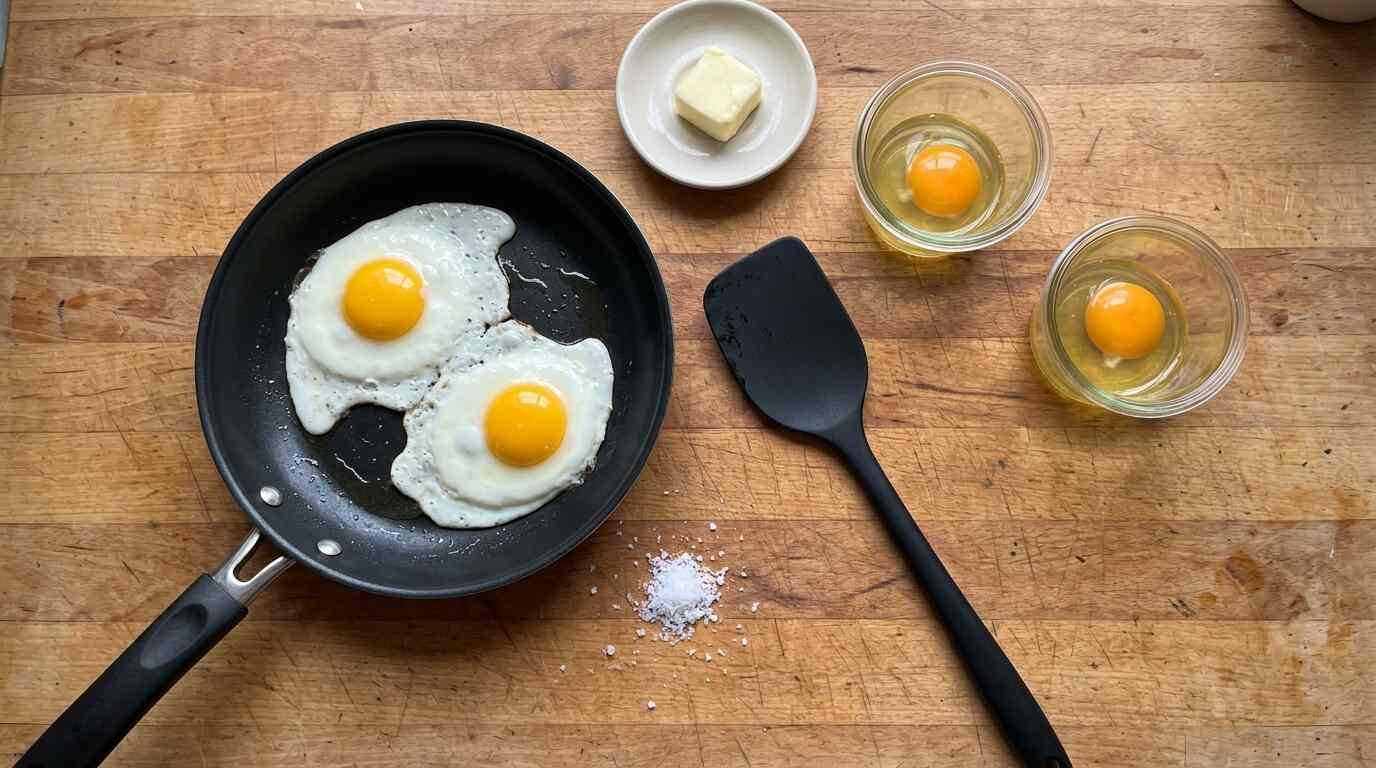
Add the freshest eggs you can find (Brown’s recipe asks for exactly that), a tablespoon of unsalted butter, and a pinch of salt and pepper.
The Method, Start to Plate
Two eggs, one tablespoon of butter, roughly five minutes. Brown’s Food Network recipe lists precisely that, and the sequence is short enough to memorize.
- Crack first, cook second. Break each egg into a small cup or ramekin. Flay puts the logic bluntly: “I don’t break it in the pan. I break it in the ramekin.” A yolk that bursts in the cup costs one egg; a yolk that bursts in a hot pan costs the plate.
- Melt the butter over low heat. Use a full tablespoon in the 8-inch pan. On the butter, Brown’s own site says “don’t you dare skimp.” Low is the setting for the whole cook. Zakarian calls a pan that is too hot the most common mistake, and Tasting Table’s write-up of Brown’s method explains the damage: a hot pan browns the bottoms before the tops have set.
- Wait for the foam to settle. When the butter stops foaming, tip the eggs in from about an inch above the surface, one at a time, gathering them on the far side of the pan.
- Tilt the pan. Lift the handle about an inch so the eggs pool in the far corner, and hold it there for roughly 30 seconds, until the whites begin to set. The tilt keeps a thin white from sprawling across the pan.
- Level it and season. Lower the handle, jiggle the pan gently to confirm nothing is sticking, and add salt and pepper. Zakarian salts early because the salt seasons the underside of the egg as it cooks.
- Cook until the whites turn opaque. Stay on low. No clear, jellied white should remain around the yolk.
- Loosen everything. One more gentle jiggle should send the eggs sliding freely. If they hold on, wait a few seconds and try again.
- Turn the eggs. Spatula or pan snap, covered in the next section.
- Count and finish. In Brown’s Food Network version, if the yolks survive the turn, count slowly to ten, flip the eggs back, and slide them onto a plate. His own site has the eggs return to the heat briefly before plating. Either way, the second side gets seconds, not minutes.
- Rescue a broken yolk. If one breaks, Brown’s advice is to fry it another minute and serve it anyway. It has simply become an over-hard egg.
Two Ways to Turn an Egg
The turn is where the technique gets interesting, and the sources split into two camps.
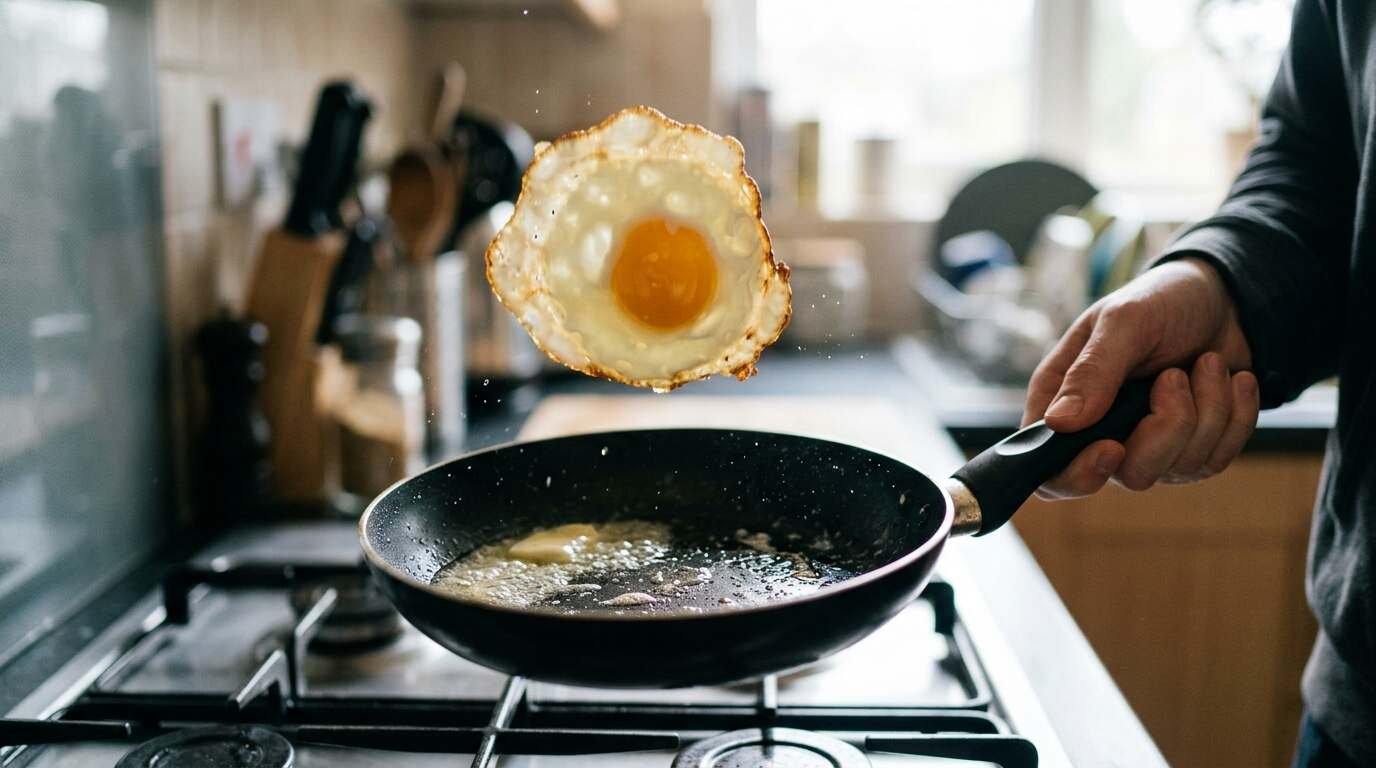
Zakarian’s approach, shown in a short Food Network video, is the gentle one: when the egg is nearly set, slide a spatula underneath and flip it, or tilt the pan and let the weight of the yolk help roll the egg over. Brown’s approach is the showman’s. Lift the pan about a foot above the burner, push it away from you while snapping it upward, then raise it to meet the eggs so the yolks land softly.
A beginner should start with the spatula. Anyone who wants the pan flip should rehearse the motion over the sink with an empty pan before trusting it with breakfast.
Two videos on YouTube show the turn in motion. This first one, from MOMables, demonstrates how to fry an over-easy egg and flip it without a spatula.
The second, from the channel What Am I Cooking Tonight, is titled “How To Flip an Egg Without Breaking the Yolk,” and it is a useful companion for the spatula method.
Why the Heat Stays Low
A commercial flat-top runs between 350 and 400 degrees Fahrenheit during a breakfast rush, and most operators set theirs near 375, a figure laid out in the sunny-side-up science post along with the protein chemistry behind it. A short-order cook survives that heat by managing it. That post notes that cooks care which stretch of the griddle they use for eggs, since a seasoned section carries a film of fat that slows the first rush of heat into the white.
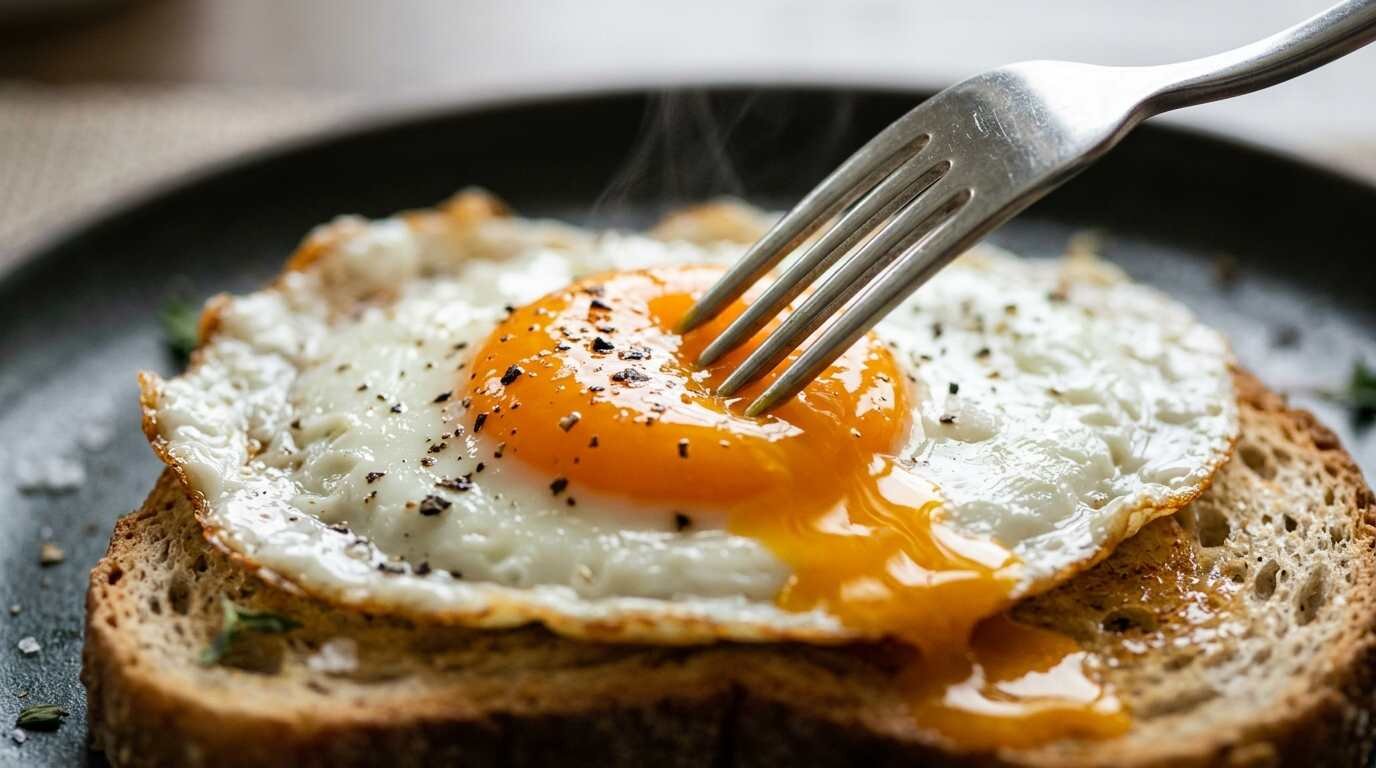
A home pan on low cannot copy a griddle, and it does not need to. Butter plays the insulating part here, a layer of fat between hot metal and tender protein, which fits the way Brown and Zakarian pair low heat with a generous tablespoon of real butter. The comparison is an analogy, not a claim either chef makes.
The payoff shows up in the second half of the cook. Low heat lets the white set before the bottom colors, and it buys a few seconds of grace around the turn, the exact moment a hotter pan would turn a small slip into a rubbery white.
Reading the Pan: Doneness and Fixes
Over easy is one stop on a ladder. The names describe how long the second side stays on the heat and what that does to the yolk.
| Name | White | Yolk | Second side |
|---|---|---|---|
| Over easy | Fully set | Liquid | A few seconds; Brown counts slowly to ten |
| Over medium | Fully set | Soft and partly set | A little longer than over easy |
| Over hard | Fully set | Cooked through | Long enough for the yolk to firm up |
When a plate goes wrong, the pan usually tells you why.
| Symptom | Likely cause | Fix |
|---|---|---|
| Brown bottom, rubbery white | Pan too hot | Drop to low; Zakarian and Brown both keep the heat down |
| Egg clings to the pan | Too little butter, or no loosening jiggle | Use the full tablespoon and shake the pan before the turn |
| White spreads thin and ragged | Eggs sliding across a level pan | Lift the handle about an inch so they pool, as Brown does |
| Yolk bursts on the turn | Rough landing | Crack into a cup first, and lower the pan with the egg as it lands |
| Slick, raw white on top after the turn | Turned too early | Wait until the white has turned opaque before flipping |
Questions People Ask
Is an over-easy egg safe to eat? The FDA’s consumer guidance says to cook eggs until both the yolk and the white are firm, and to keep them refrigerated at 40°F or below. A liquid yolk sits outside that guidance by design. The agency also notes that fresh eggs can carry Salmonella even when the shell is clean and uncracked, and it suggests pasteurized eggs for dishes where eggs stay raw or undercooked. Anyone who wants to follow the guidance to the letter should take the egg to over hard, and a doctor can advise on higher-risk situations.
Can I use a cast iron or carbon steel pan? Every recipe cited here specifies a non-stick pan, so that is the tested path. For a seasoned pan, the skillet comparison and the cast iron seasoning guide cover what each surface asks of you.
Why crack the eggs into a cup at all? Two reasons come up in the sources. Brown says it lets him pour the eggs exactly where he wants them in the pan, and Flay says a yolk that is going to break should break in the cup. As a bonus, any stray shell is easy to fish out before it reaches the butter.
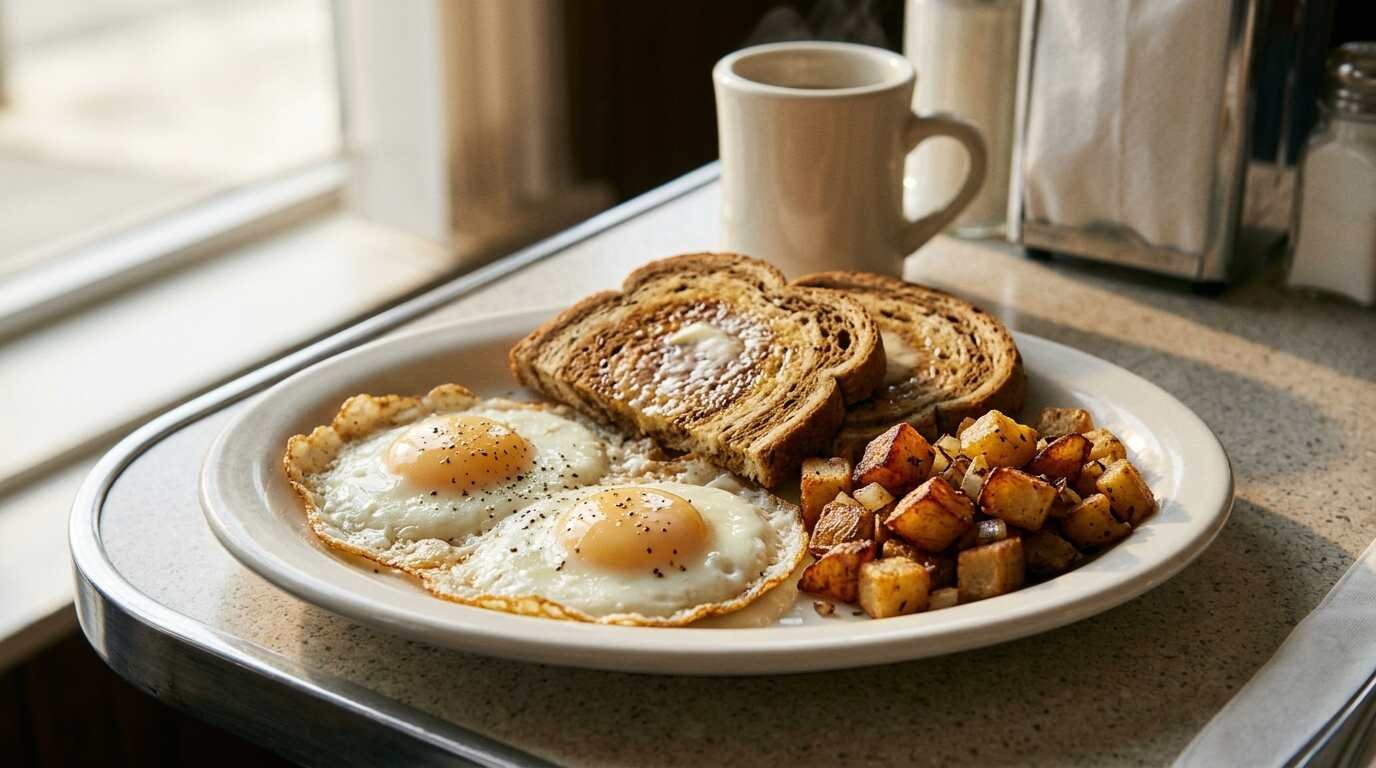
What goes on the plate beside it? Brown’s own recipe serves the eggs with toast, and the full diner build, from home fries to the order everything lands in, is mapped in the breakfast platter assembly guide. Over-easy yolks make their own sauce, so a slice of toast earns its place.
How fresh should the eggs be? Brown’s recipe says the fresher, the better. A fresh egg holds its shape, which is the point of the tilted-pan trick in step four.
Sources
- World Egg Day, World Egg Organisation
- World Egg Day 2026 Theme and Key Messages, World Egg Organisation
- @WorldEggOrg on X
- @worldeggorg on Instagram
- Eggs Over Easy, Alton Brown, Food Network
- Eggs Over Easy, AltonBrown.com
- Alton Brown’s Tip For Evenly Cooked Over-Easy Eggs Every Time, Tasting Table (April 24, 2024)
- How to Make Eggs Over Easy the Geoffrey Zakarian Way, Food Network
- Bobby Flay’s Pro Tip For Fried Egg Yolks That Never Break, The Takeout (April 10, 2026)
- Egg Safety: What You Need to Know, U.S. Food and Drug Administration
- How to Fry an Over Easy Egg & Flip It Without a Spatula, MOMables, YouTube
- How To Flip an Egg Without Breaking the Yolk, What Am I Cooking Tonight, YouTube
As an Amazon Associate I earn from qualifying purchases. A commission may be earned if you buy through this link, at no extra cost to you.