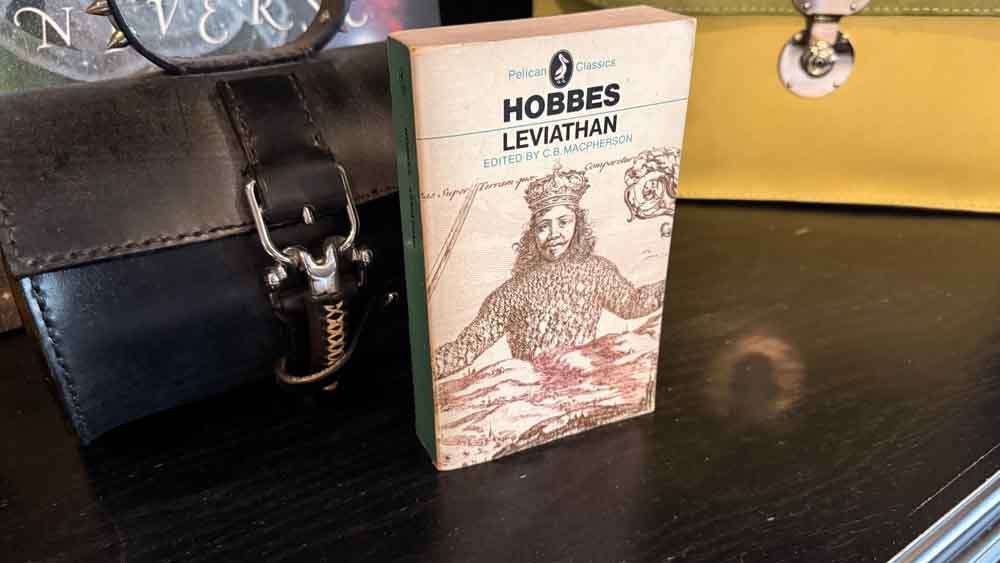
Most philosophers dress up power. They give it noble clothes — natural law, divine right, the common good. They write around it, above it, and through it, always careful not to say the plain thing. Thomas Hobbes said the plain thing. That’s what makes Leviathan the most uncomfortable book in the Western canon, and one of the most important.
Published in 1651 — right in the middle of the English Civil War, when the question of who gets to rule whom was being settled with actual bodies in actual fields — Leviathan didn’t arrive as an abstraction. It arrived as a detonation. Hobbes had watched a king get his head removed by his own subjects, and instead of mourning the old order or celebrating the new one, he sat down and asked the only question that mattered: why does anyone obey anyone at all?
His answer was not pretty. But it was honest.
Life Without Order Is a War You Can’t Win
Hobbes begins with his famous premise — that in the state of nature, meaning before governments and laws, human life is “solitary, poor, nasty, brutish, and short.” People love quoting that line, usually to argue with it. What they miss is the architecture underneath it. Hobbes isn’t making a moral claim about human nature. He’s making a logical one. In the absence of any authority to settle disputes, every man is an equal threat to every other man. It doesn’t matter if most people are decent. One bad actor with a club is enough to make everyone else live in fear. And fear changes behavior. Fear makes you strike first. It makes you hoard. It makes you form alliances that only last until the alliance is no longer advantageous.
This is not pessimism. This is game theory before game theory had a name.
I’ve thought about this more than most people have a reason to. Running a place for twenty-plus years, you learn fast that civilization is thinner than it looks. The diner at two in the morning when a table won’t pay. The contractor who pockets your deposit and vanishes. The partnership that holds as long as the money is good and dissolves the second it isn’t. Strip away the social infrastructure — the courts, the contracts, the shared understanding that there are consequences — and you’re looking at Hobbes’s state of nature wearing a sport coat. Most people behave because the system makes it rational to behave. Not because they’re saints.
The Contract That Nobody Signed
Here is where Hobbes gets genuinely radical. His social contract is not a romantic agreement between free people who choose to live together. It’s a surrender. We give up our natural right to do whatever it takes to survive, and we hand that right to a sovereign — a king, a parliament, a government — not because we trust them, but because we fear each other more than we fear them. The Leviathan of the title, that great artificial man-monster that Hobbes describes on his famous frontispiece, is made of thousands of individual human bodies pressed together into one enormous figure. The state isn’t above us. It is us. A collective fear transformed into a collective power.
What’s brilliant — and what political philosophers have been wrestling with ever since — is that Hobbes doesn’t ask the sovereign to be good. He asks the sovereign to be effective. The whole point is to end the war of all against all. Justice isn’t a natural feature of the universe. It’s whatever the sovereign says it is, because without a sovereign, the word means nothing. There is no “just” or “unjust” when every man is both judge and executioner.
This is the part that offends people. It offended them in 1651 and it offends them now. We want to believe that rights are real things — that they exist somewhere above human law, in God or nature or reason. Hobbes says: they’re constructs. Useful, necessary constructs, but constructs. Built and maintained by the same social machinery that builds roads and collects taxes.
Thomas More, writing roughly a century before Hobbes in Utopia, imagined a society organized around virtue and rational cooperation. It’s a beautiful book, genuinely. But Hobbes would have read it and asked: who enforces it? More’s utopians are good because the system makes them good. Take the system away and you’ve got the same clay Hobbes is working with.
What the Civil War Taught Him
You can’t read Leviathan without reading it as a document of trauma. Hobbes was sixty-three years old when he published it. He had lived through the execution of Charles I. He had watched the Church of England fracture, Puritans and Catholics and Presbyterians all convinced God was on their side, each willing to kill to prove it. The thirty years of European religious war that had killed something close to eight million people. He had seen, up close, what happens when the question of authority becomes genuinely open. The answer was not enlightenment. The answer was corpses.
This is why his insistence on sovereign authority — even an imperfect, potentially tyrannical sovereign — reads differently once you understand the context. He’s not celebrating tyranny. He’s saying: almost any order is better than no order, because no order doesn’t mean freedom. It means the biggest gang wins. Hobbes had seen the biggest gang win. It was not pretty.
Algernon Sidney, writing his Discourses Concerning Government later in the same century, came to opposite conclusions — that absolute sovereignty was precisely the danger, that liberty required limits on power. Both men were right about different parts of the problem. Sidney saw what Hobbes’s Leviathan could become if the sovereign turned predatory. Hobbes saw what Sidney’s liberty could look like without a strong enough hand to hold the peace. They were arguing across the same chasm from opposite sides.
The Church Gets Complicated
The third and fourth books of Leviathan, which most readers skip, are in some ways the most interesting. Hobbes turns his analytical machinery on the Church, and the results are corrosive. He argues that ecclesiastical authority is subordinate to civil authority — that when priests claim power over kings in the name of God, they are doing exactly what any other faction does when it wants power: inventing a justification. The spiritual kingdom of God, Hobbes says, is not of this world and therefore does not come with an army. Any church that pretends otherwise is playing politics under a sacred flag.
This was not a popular argument in 1651. It’s still not entirely popular now. But it follows directly from his first principle. If the whole point of the Leviathan is to end the war of competing authorities, then a church that claims higher authority than the state is a structural threat to peace. It reintroduces exactly the problem the sovereign was supposed to solve.
Augustine, wrestling with related questions nearly twelve hundred years earlier in The City of God, drew the line differently — earthly kingdoms are legitimate but subordinate to divine order. Hobbes essentially inverts this. Earthly order is the precondition for anything else. You can’t philosophize your way to God’s city if someone has burned your city down.
The Honesty Nobody Wanted
What separates Hobbes from almost every political thinker before him is that he refuses comfort. Plato gave us philosopher-kings. Aristotle gave us the natural political animal. Aquinas gave us natural law rooted in divine reason. Every one of those frameworks gives power a moral basis — a reason why the people who have it deserve it, or why the structure that produces it is good. Hobbes gives you none of that. Power is the outcome of fear. Legitimacy is what the sovereign makes it. We obey not because it’s right but because the alternative is worse.
That is not a satisfying conclusion. It’s an accurate one.
I’ve read enough philosophy to know that the thinkers who make you most uncomfortable are usually the ones who got closest to something true. Kierkegaard makes you uncomfortable because he pulls the floor out from under every system you’ve built to avoid choosing. In A Kierkegaard Anthology, he goes after Hegel the same way Hobbes goes after natural law theorists — not by arguing around them but by exposing the self-serving machinery underneath. Hobbes does the same to the entire tradition of political philosophy. He pulls the curtain. The thing behind it is not God or nature. It’s a calculation about survival.
Why It Still Matters
Leviathan was written for a world coming apart. Ours doesn’t look that different. The institutional fabric that Hobbes identified as essential — the shared acknowledgment of authority, the willingness to subordinate personal judgment to a system — is thinner now than it has been in most of our lifetimes. Every faction that decides its cause is righteous enough to exempt itself from the rules is making the Hobbesian state of nature more probable. Every erosion of the idea that there’s a common framework worth defending moves us closer to the war of all against all.
Hobbes didn’t solve that problem. He just described it clearly enough that we have no excuse for not recognizing it when we see it. That’s what the honest man does. He says the thing everyone is thinking and no one wants to say out loud.
That took more courage in 1651 than most people give him credit for. And the argument is more urgent now than most people want to admit.
Sources
- Thomas Hobbes, Leviathan (1651). Standard edition: Penguin Classics
- Noel Malcolm, Aspects of Hobbes (Oxford University Press, 2002): https://global.oup.com/academic/product/aspects-of-hobbes-9780199273690
- Quentin Skinner, Hobbes and Republican Liberty (Cambridge University Press, 2008): https://www.cambridge.org/core/books/hobbes-and-republican-liberty/
- Richard Tuck, Hobbes: A Very Short Introduction (Oxford University Press, 2002): https://global.oup.com/academic/product/hobbes-a-very-short-introduction-9780192802552
- Stanford Encyclopedia of Philosophy, “Hobbes’s Moral and Political Philosophy”: https://plato.stanford.edu/entries/hobbes-moral/