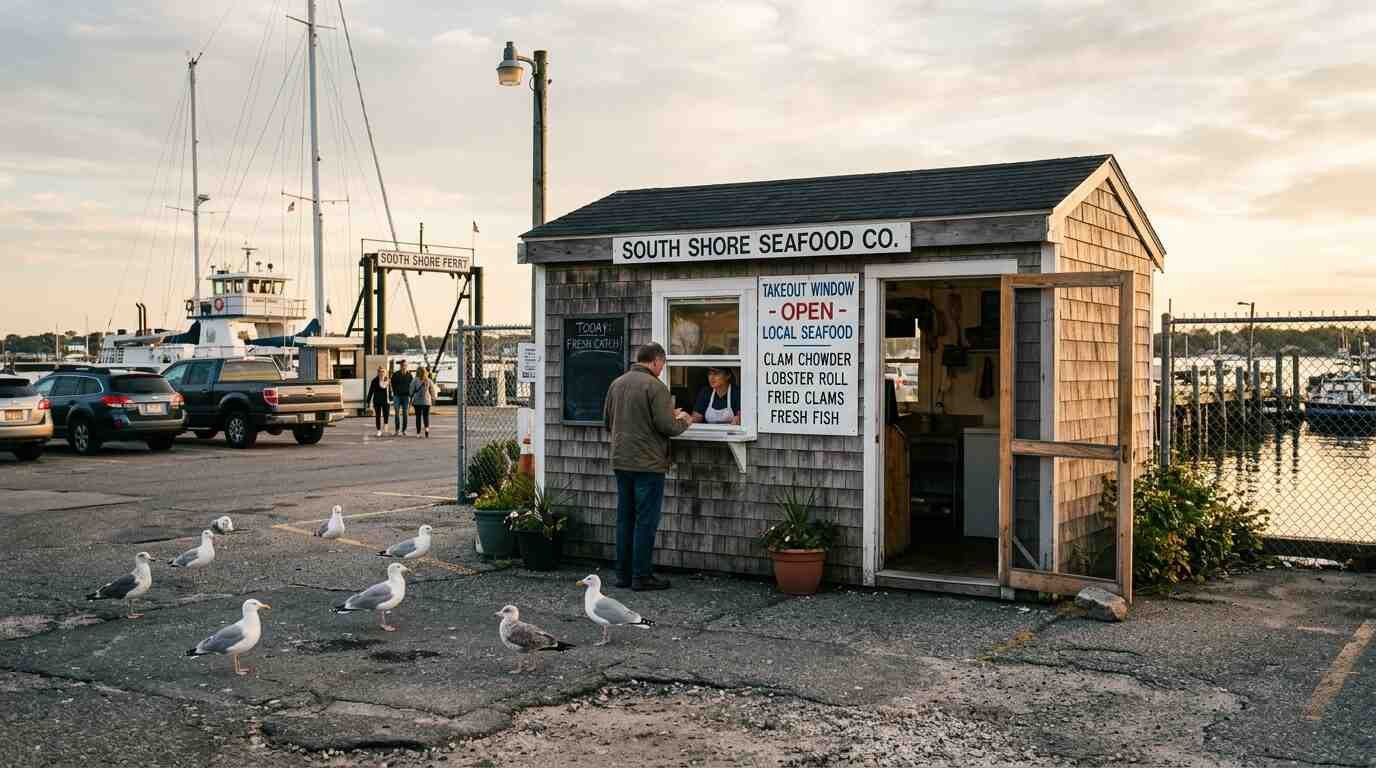
Behind the Fire Island ferry slips at 99 Maple Avenue in Bay Shore, in a parking lot that thousands of people cross every summer weekend while checking departure times on their phones, there is a clam bar that has been in the same family since 1990. Nicky’s seats about thirty. It runs a takeout window aimed at passengers who are already late. Nobody drives to Bay Shore for it, which is roughly the point — the restaurant exists because the ferry exists, and it has spent thirty-five seasons collecting the fraction of a captive crowd that looks sideways instead of straight ahead.
That relationship, between a seafood counter and a piece of maritime infrastructure, is the actual organizing principle behind which Long Island clam bars survived. It has very little to do with scenery.
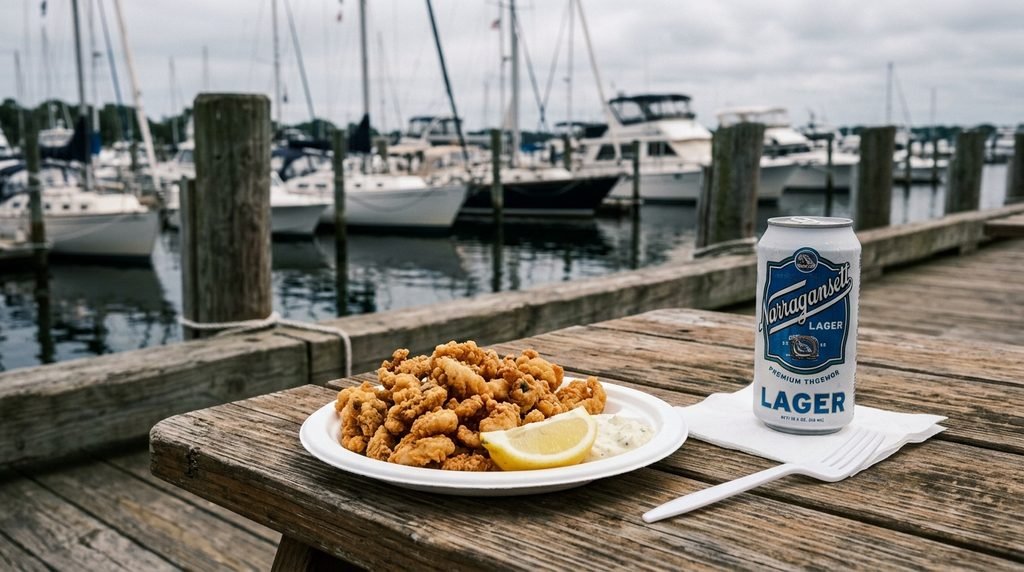
What the Bay Used to Push Through Those Doors
The scale of what has been lost is difficult to hold in your head. In the mid-1970s, by the National Park Service’s accounting, roughly half of all hard clams eaten in the United States came out of the Great South Bay — a body of water covering about 151 square miles. Roger Tollefsen of the New York Seafood Council put the 1975 harvest above 675,000 bushels, worked by more than 8,000 licensed baymen.
Then it fell apart, fast. Between 1976 and 1984, clam landings in the bay dropped by roughly 80%. Brown tides, driven largely by septic seepage and fertilizer runoff off a heavily developed South Shore, became a recurring event through the 1980s. By 1986 the harvest was down to something like 104,000 bushels worth $4.2 million, taken by around 1,200 full- and part-time baymen. Measured against the 1976 peak, the annual hard clam harvest has since fallen by more than 99%.
Bluepoints Company, which had shipped Great South Bay oysters and clams across the country and into Europe, kept going until the 1985 brown tide and finally closed the business in 1999. The Nature Conservancy now holds a large portion of the underwater land in the central bay as a sanctuary — around 13,500 acres — and restoration work continues under the Suffolk County hard clam framework.
Here is the part that reframes everything: the clam bars outlived the clams. Whatever is on the paper plate at a South Shore counter today arrived on a truck. The institution survived the collapse of the supply chain that created it, which means its survival was never really about proximity to the resource. It was about proximity to people who had a reason to be standing there anyway.
Infrastructure, Not Waterfront
Sort the survivors by what they sit next to and a pattern shows up immediately.
Peter’s Clam Bar has been at 600 Long Beach Road in Island Park since 1939, positioned on Barnum Inlet where boats can tie up and order from the water. Nicky’s occupies a ferry terminal lot. Bracco’s sits at 319 Woodcleft Avenue on Freeport’s Nautical Mile, which is the same logic wearing a louder shirt — a working canal that turned into a strip of destination restaurants without ever ceasing to be a canal.
None of these are main street addresses. They are attached to a channel, a slip, a bulkhead, or a boat ramp. That is the whole trick. A restaurant on a village main street competes with every other restaurant on that main street and depends on people choosing to come. A restaurant welded to a piece of marine infrastructure inherits traffic that would exist whether or not it was hungry. Ferry schedules, tide charts, and fishing seasons are more reliable than food trends, and they do not care what got reviewed last month.
The corollary is unglamorous and worth saying directly: many of these buildings are not attractive. Low roofs, vinyl, a screen door, an ice machine humming against an exterior wall. They look like what they are, which is a structure sited for utility on land that was cheap because it flooded.
Recreational Water Versus Working Water
The distinction people reach for — tourist spot versus local spot — is less useful than the one underneath it, which is whether a given stretch of shoreline still has commercial activity on it or only leisure activity.
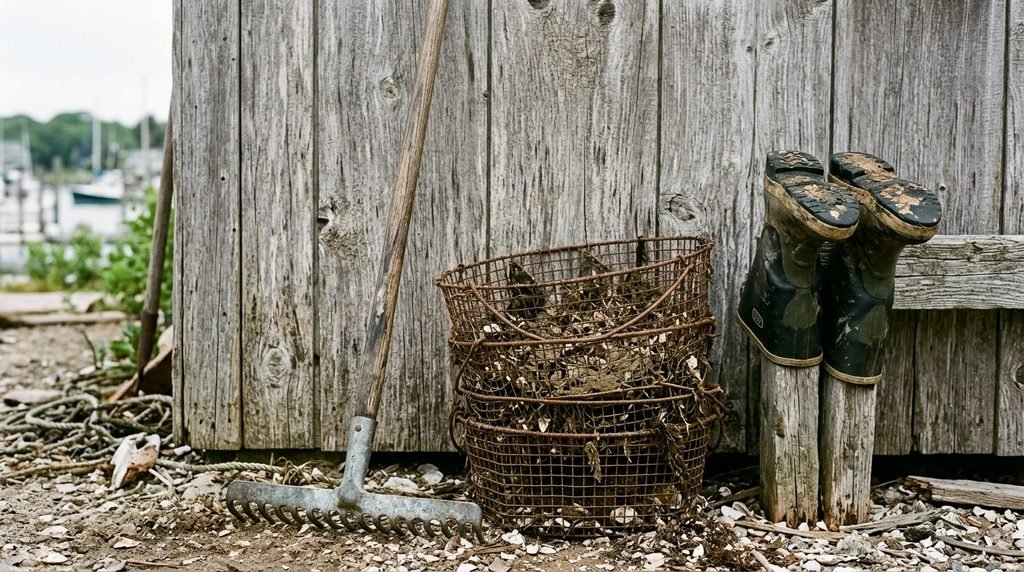
Working waterfronts leave physical evidence. Bait and tackle. A fuel dock. Commercial slips with names painted on the transom. Ice sold by the block. Baymen’s tools have not changed much either — Long Island Traditions documents tongs, treading, and the bull rake, so named because pulling one requires the strength of a bull. Where that apparatus is still present, casual seafood counters tend to persist, because there is a year-round population of people who work outdoors and eat fast.
Where the shoreline converted fully to recreation — private docks, kayak racks, waterfront residential — the casual counters mostly went, replaced by restaurants with linen or by nothing at all.
The politics around all of this have never been simple, and it would be dishonest to render the baymen as pure victims. The Brookhaven Baymen’s Association has held real electoral weight in Brookhaven for generations, its claim rooted in the 1686 Dongan Patent. Environmental groups including Friends of Bellport Bay have argued that commercial raking damages eelgrass beds and bay-bottom habitat that filter nitrogen and shelter juvenile shellfish, and that the industry bears part of the responsibility for the bay’s condition. Baymen counter that management failures and upland pollution did the real damage. Both accounts contain verifiable facts, and the bay’s recovery has been slow enough that neither side can claim vindication.
For the North Shore version of this economics — what it actually costs to work the water in the current decade — see the last of the North Shore baymen and oyster harvesting in 2026. The historical arc that preceded it runs through Cold Spring Harbor’s forgotten shellfish economy, which fed New York City for two centuries.
When the Name Becomes a Theme
The most interesting development on the South Shore right now is a naming decision.
In the spring of 2026, Harbor Crab Co. closed on the Patchogue River after nearly twenty-six years, and the space passed to Jay Varney, who owns Varney’s Restaurant in Brookhaven, and Will Strano of the Dunton Inn in East Patchogue. They reopened it as Baymen’s Clam Bar, rebuilt the main dining room toward a traditional clam-bar look while keeping the outdoor tiki bar, and pointed the menu at South Shore standards — fried whole clams, fried fish, shrimp cocktail. Varney has said the intent was to honor the fishing heritage and working waterfront culture around the river. His father clammed as a bayman.
That is a real lineage and there is no reason to be cynical about it. But it does mark a threshold. When “bayman” becomes available as a restaurant name, the word has completed its move from job description to heritage term. The places that never needed the label are the ones that never put it on the sign, because everyone who mattered already knew.
A Field Guide, Since You’ll Be Driving Past One
The reliable markers are behavioral rather than decorative.
Hours that track something other than dinner service — closing at seven in October, opening early in June, shutting entirely for a stretch of winter — indicate a business built around ferry runs, tides, or the fishing calendar rather than around evening reservations. A menu that does not explain itself is another. If it says “steamers” and “cherrystones” and stops there, the operator assumes you know, and that assumption is only economical when most customers do.
Watch the service format too. Paper plates and plastic forks are not a nostalgia choice; they are what a business does when a meaningful share of orders leave the building or get eaten standing. And check the parking. A lot shared with a marina, a ramp, or a terminal is a stronger signal than any amount of nautical decor, because it means the restaurant was sited to catch people who came for another reason.
What Actually Held
The clam bars that lasted were not the ones with the best clams or the best views. They were the ones attached to something that could not be relocated, run by families who kept the overhead low enough to survive the seasons when nobody came.
That is a less romantic answer than the working-waterfront story usually gets told with. It is also the reason there are any left at all. The bay that made them is a fraction of what it was, the boats are mostly gone from the horizon off the Robert Moses Causeway, and the product comes in refrigerated. What remains is a set of buildings that happened to be standing in the right place when everything around them changed, still selling fried clams to people who were headed somewhere else.
You Might Also Like
- Depression-Era Clam Pie: Foraging the Great South Bay When Meat Was Scarce
- The Invisible Hand That Feeds the North Shore: Greek Immigrant Fishermen and the Seafood Supply Chain Nobody Talks About
- Long Island Weakfish Bake: The Lost South Shore Seafood Staple Before Overfishing
Sources
- Exploring the Woods Under the Water — National Park Service
- Mollusks of Fire Island — National Park Service
- Hard Clams, Hard Lessons: The Shellfish Renaissance — The Solutions Journal
- Great South Bay Hard Clam Working Group Report — New York State Department of State
- Fishing: Baymen, Bluepoints and South Shore Commercial Fisheries — Long Island Traditions
- The Baymen of the Great South Bay, New York: A Preliminary Ecological Profile — MAST
- Not Always as Happy as a Clam: The Cultural Clashes Underpinning Long Island’s Shellfishing Industry — The Cornell Daily Sun
- Harbor Crab closes after 26 years; Baymen’s Clam Bar set to take over — Greater Long Island
- About — Peter’s Clam Bar, Island Park
- Nicky’s Clam Bar, Bay Shore