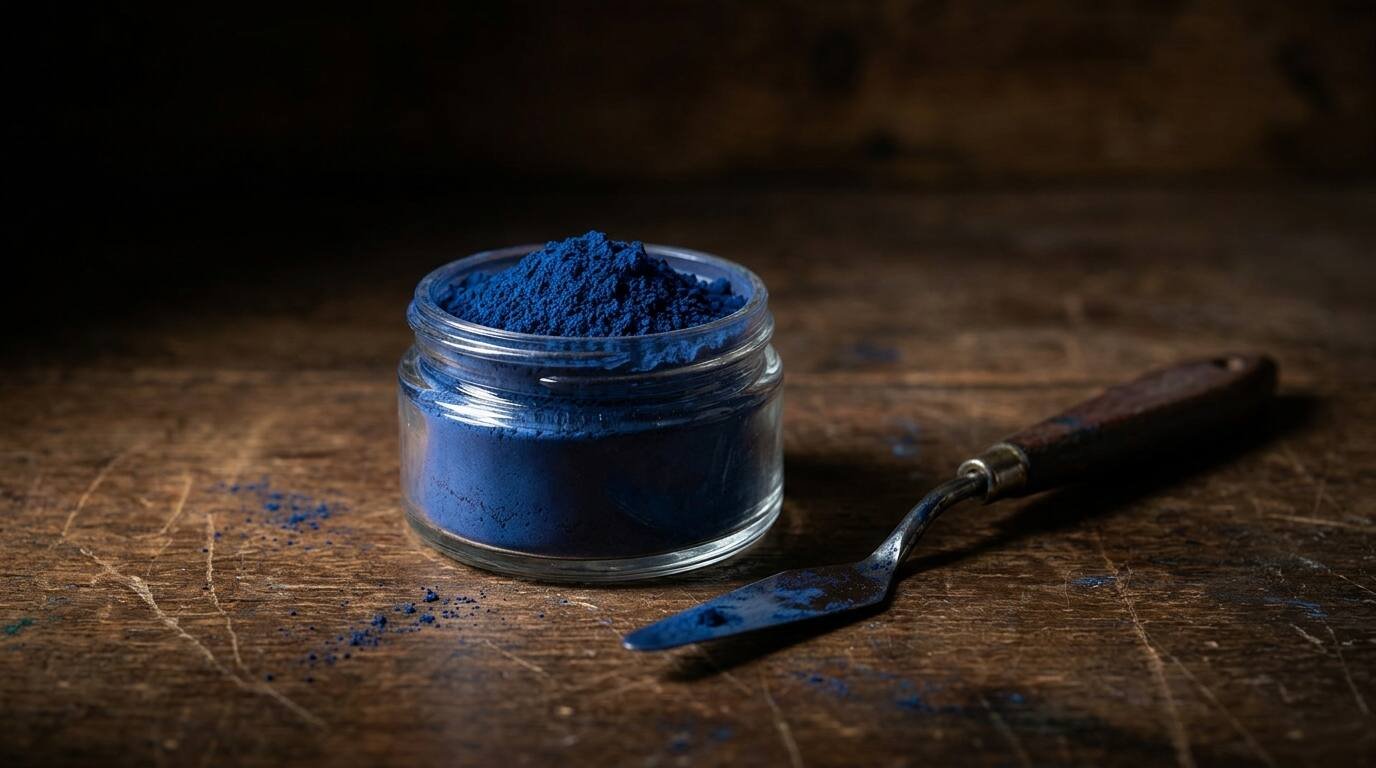
In 1704, a Berlin colormaker named Johann Jacob Diesbach was trying to make a red lake pigment from cochineal when a contaminated potash batch turned his mixture an intense, impossible blue. He had created Prussian blue — the first synthetic pigment in history — without intending to, without understanding the chemistry, and without any concept that corresponded to what he had made. The Platonic Form of blue had just been embarrassed.
This matters philosophically because Diesbach’s accident staged a confrontation between two theories of color that had been circling each other for two thousand years. Plato believed — in the Meno, the Phaedo, in the Allegory of the Cave — that true knowledge is knowledge of Forms: abstract, eternal, perfect prototypes of which worldly things are imperfect instances. On this view, there is a Form of blue, something like the ideal Blueness, of which every particular blue thing partakes to varying degrees. Plato’s blue exists prior to and independent of any perceiver, prior even to any blue thing. Diesbach, stumbling onto his contaminated batch, would merely have been instantiating what was already there.
John Locke, writing his Essay Concerning Human Understanding just fourteen years before Diesbach’s accident, had argued the opposite. Color, for Locke, is a secondary quality: it exists not in objects but in perceivers. The physical world has primary qualities — shape, size, solidity, motion — which it genuinely possesses. But color, sound, smell, and taste are responses produced in us by those primary qualities. There is no blue in the potassium ferrocyanide and iron salt that constitute Prussian blue. There is only the experience of blue in the mind of someone looking at it.
Diesbach’s blue, arriving from nowhere, without precedent, without intention, complicates both positions in interesting ways.
What Plato’s Forms Cannot Handle
The problem for Platonism is the accident. If the Form of Prussian blue exists eternally and independently, waiting to be instantiated, then Diesbach’s contaminated potash batch was simply a fortunate event — reality reaching through chemistry to pull another instance of Form into the world. The blue was always there; Diesbach merely stumbled through the right door.
Philip Ball’s history of pigments, Bright Earth (Farrar Straus Giroux, 2001), reconstructs the episode with precision. The exact synthesis — iron(III) ferrocyanide — was not correctly identified until 1840, by the German chemist Gmelin, a full 136 years after the pigment first appeared. For those 136 years, the blue existed, was used, was reproduced, was traded commercially — introduced to England by the merchants Frend and Woodward in 1724 — and was fully real as a pigment, without anyone knowing what it was chemically. The French chemist Macquer independently re-derived the synthesis in 1752 without knowing Diesbach had preceded him.
This is the detail that troubles Platonism. The Form of Prussian blue, if it exists, is the Form of something no one could fully define for more than a century. The pigment had no conceptual home. It could not be placed in any existing system of chemical knowledge. Artists used it, ground it, mixed it, loved it for the particular translucency it offered (which no natural blue — ultramarine, azurite, smalt — quite replicated), but they could not tell you what it was.
The Platonist might respond: the Form exists whether or not we can articulate it. And that is true. But Plato’s Forms were also supposed to be knowable — accessible to reason, graspable by the intellect once freed from the distortions of sense. A Form that eludes rational comprehension for 136 years, known only through its sensory effects, sounds more Lockean than Platonic.

What Locke’s Secondary Qualities Cannot Handle
Locke’s position is cleaner on the face of it, but Prussian blue exposes its difficulties too. If color is purely a response produced in perceivers — if there is no blue in the pigment, only the experience of blue in whoever looks at it — then what exactly did Diesbach make?
The physical substance is not in dispute: iron(III) ferrocyanide, with the cyanide groups bridging iron centers in a way that creates a particular absorption of light in the red-orange range, which we perceive as blue. The primary qualities — the molecular structure, the crystal lattice, the specific electromagnetic absorption — exist in the material without any perceiver. Locke would say those are real. The blue is our response to them.
But the blue is not arbitrary. Everyone who looks at Prussian blue sees blue, not green or yellow. The connection between the primary qualities and the secondary experience is systematic, reliable, reproducible. Locke acknowledged this — secondary qualities are not random projections; they are responses caused by real physical properties. But this systematicity makes the distinction between primary and secondary qualities wobble. If the blue is always the same blue for every normal perceiver under normal conditions, in what sense is it merely a response rather than something genuinely in the world?
The problem sharpens when you consider the history of pigment use before the color is named. Ball’s research makes clear that painters used and mixed Prussian blue throughout the 18th century — Watteau, Canaletto, Hogarth — without having a stable concept for what they were using. Was the blue in those paintings Lockean (existing only in the minds of viewers) or Platonic (instantiating a Form independent of any mind)? The pigment preceded its own conceptual definition by 136 years. The color was there before anyone knew what to call the thing that produced it.
Chase at Shinnecock and the Difference Between Seeing and Knowing
The Long Island connection to this history is direct and documented. William Merritt Chase established his Shinnecock Hills Summer School of Art from 1891 to 1902 — the Parrish Art Museum in Water Mill, which holds significant Chase holdings, has documented this in its archive, and D. Scott Atkinson and Nicolai Cikovsky Jr. drew on those records in their catalogue William Merritt Chase: Summers at Shinnecock (National Gallery of Art, 1987).
Chase taught plein air painting on the East End, and Prussian blue was a central pigment in his palette — valued specifically for the translucency Ball describes, for the way it behaves in mixtures with white and in glazes over other colors. Chase used the teaching moment of Prussian blue’s mixing behavior to make a philosophical point that he almost certainly would not have identified as philosophical: the difference between seeing and knowing.
A student looking at blue sky over Shinnecock Bay sees blue. That seeing is immediate, prereflective, phenomenologically rich. But the painter has to know something else — has to know what pigment will behave on the canvas the way that blue behaves in the sky, what mixture will retain the translucency of light rather than muddying into opacity. That knowledge is theoretical, acquired, and cannot be reduced to the visual experience. Seeing and knowing diverge.
This is the genuine lesson of Prussian blue’s accidental history. Plato was right that there is a difference between the sensory experience of blue and the knowledge of what blue is. Locke was right that the color exists in relationship to a perceiver, not prior to and independent of all perception. But neither of them quite captured what a working painter at Shinnecock knew: that between seeing and knowing lies a middle territory of craft knowledge — the understanding of how a material behaves, how it interacts with other materials, how it creates effects that exist neither purely in the pigment nor purely in the perceiver but in the ongoing negotiation between them.
Color Without a Concept
There is a brief passage in Wittgenstein’s Remarks on Colour — written in the last years of his life, published posthumously — where he observes that someone could have a completely reliable color vocabulary, identifying every shade correctly, without having any theory of what color is. The practice and the theory come apart. Diesbach had the blue before he had any concept adequate to it. The painters of the 18th century had the practice of using Prussian blue before chemistry could tell them what they were using. The practice was real. The concept caught up later.
This is not the conclusion either Plato or Locke wanted. Plato wanted the concept to be primary — the Form preceding the instance. Locke wanted the perception to be primary — the experience preceding the physical explanation. What Prussian blue’s actual history suggests is that in certain critical moments, especially at the edge of what’s known, neither the Form nor the perceiver’s experience is in the lead. The material is. The accident is. The contaminated potash batch that nobody planned, producing something nobody expected, instantiating a color that nobody could explain — that’s the thing that was primary. The philosophy came later, still trying to catch up.
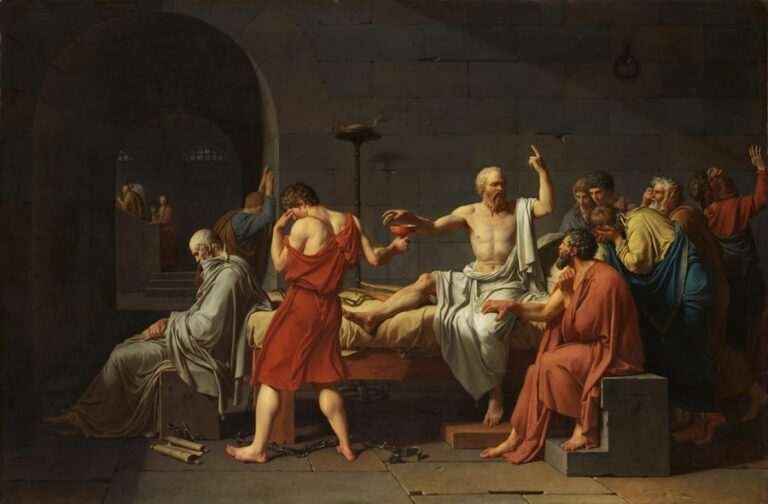
I’ve been thinking about this alongside my piece on Jacques-Louis David’s Death of Socrates, which uses a similarly opaque blue in the robe across Socrates’ knee — possibly Prussian blue, possibly smalt, possibly a mixture, and the uncertainty doesn’t diminish the blue at all. And in my reading of the Demarcation Problem, where Popper grapples with the same question: what counts as real knowledge, and who gets to say so?
Diesbach’s blue doesn’t resolve the dispute between Plato and Locke. It just makes the dispute more interesting, by refusing to sit still inside either framework. That’s what good accidents do.
You Might Also Like
Rembrandt’s Aristotle with a Bust of Homer — A Portrait of the Mind in Conflict
Goya’s Third of May: Assembly Line of State Murder
The Demarcation Problem: Karl Popper, Falsifiability, and the Boundary Between Science and Pseudoscience
Sources
Philip Ball, Bright Earth: Art and the Invention of Color. Farrar Straus Giroux, 2001. macmillan.com
John Locke, Essay Concerning Human Understanding, Book II, Chapter 8. 1690. Project Gutenberg
D. Scott Atkinson and Nicolai Cikovsky Jr., William Merritt Chase: Summers at Shinnecock, 1891–1902. National Gallery of Art, 1987.
Parrish Art Museum collection records, Water Mill, NY. parrishart.org
Ludwig Wittgenstein, Remarks on Colour, ed. G.E.M. Anscombe. University of California Press, 1978.