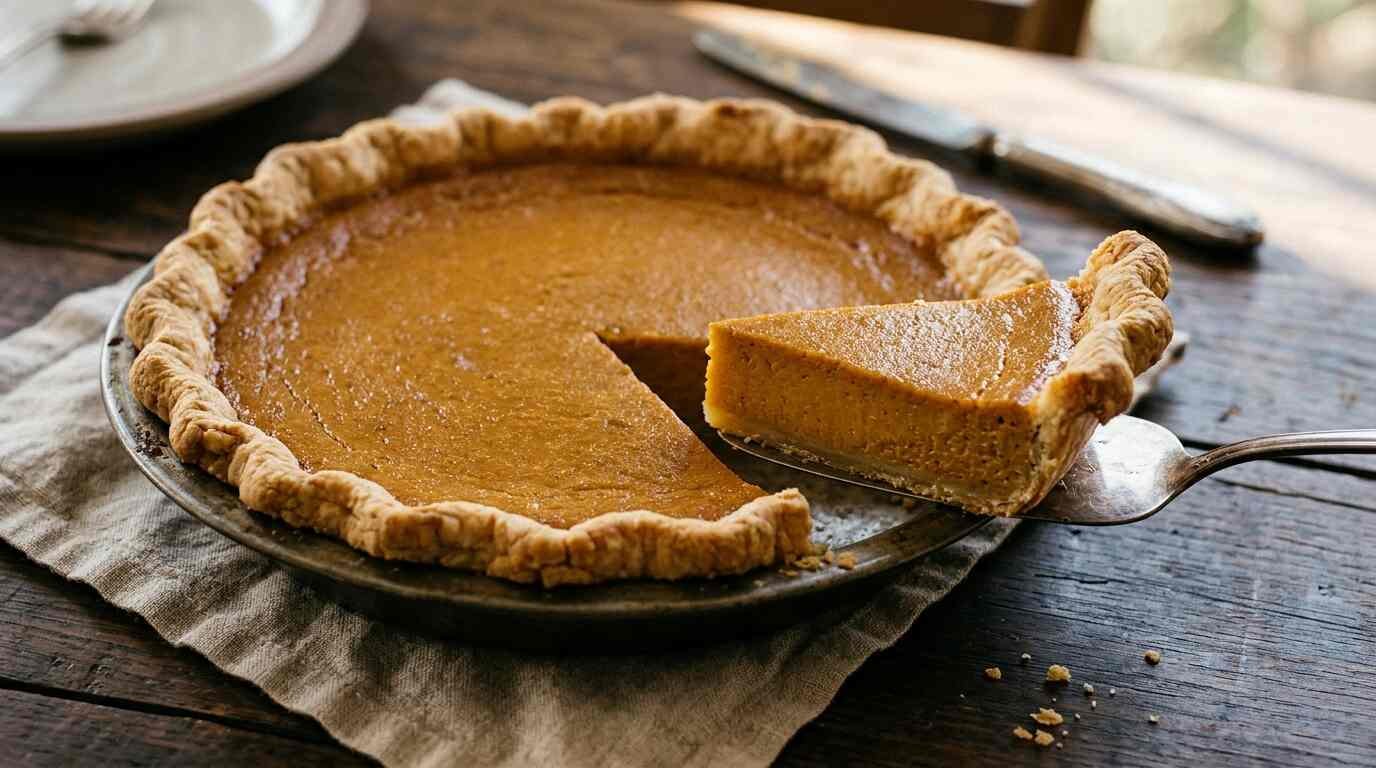
A pumpkin pie is a baked custard in a pastry shell, and nearly every failure traces to one of two things: a crust that stayed pale and damp underneath, or eggs cooked past the point where they hold water. The recipe below is assembled from published instructions by King Arthur Baking, with the crust, puree, doneness and storage details checked against separate sources, each linked where it is used.
The pie fits the Thanksgiving table the site has already been tracking, from the cost forecast for the dinner to the restaurants taking reservations on the North Shore. It is also one of the few holiday desserts that can be finished two days ahead, which is the main reason it survives the crowding of the oven that day.
Ingredients
Filling for one 9-inch pie
- 1/2 cup (99 g) granulated sugar
- 1/2 cup (106 g) light or dark brown sugar, packed
- 1 tablespoon all-purpose flour
- 1/2 teaspoon table salt
- 1 teaspoon ground ginger
- 1 teaspoon ground cinnamon
- 1/2 teaspoon ground nutmeg
- 1/8 teaspoon ground cloves
- 3 large eggs, beaten
- 2 scant cups (425 g), or one 15-ounce can, pumpkin puree
- 1 1/4 cups (283 g) light cream or evaporated milk
Crust
- One single pie crust, either the site’s flaky all-butter pie crust or King Arthur’s Classic Single Pie Crust: 1 1/2 cups (180 g) all-purpose flour, 1/2 teaspoon salt, 4 tablespoons (46 g) vegetable shortening, 5 tablespoons (71 g) cold unsalted butter, and 3 to 5 tablespoons (43 g to 71 g) ice water
Quantities for the filling come from the King Arthur pumpkin pie recipe, which also allows a generous 2 1/2 teaspoons of pumpkin pie spice in place of the four individual spices.
Method
Make the crust and chill it. Whisk the flour and salt, work in the shortening until the mixture is evenly crumbly, then cut in the butter and leave uneven chunks. Add water a little at a time until the dough barely holds together when squeezed, shape it into a disk, and chill at least 30 minutes (King Arthur). Roll to a 13-inch circle for a 9-inch pan at least 1 1/2 inches deep, and crimp the edge above the rim to leave room for the filling to expand (King Arthur).
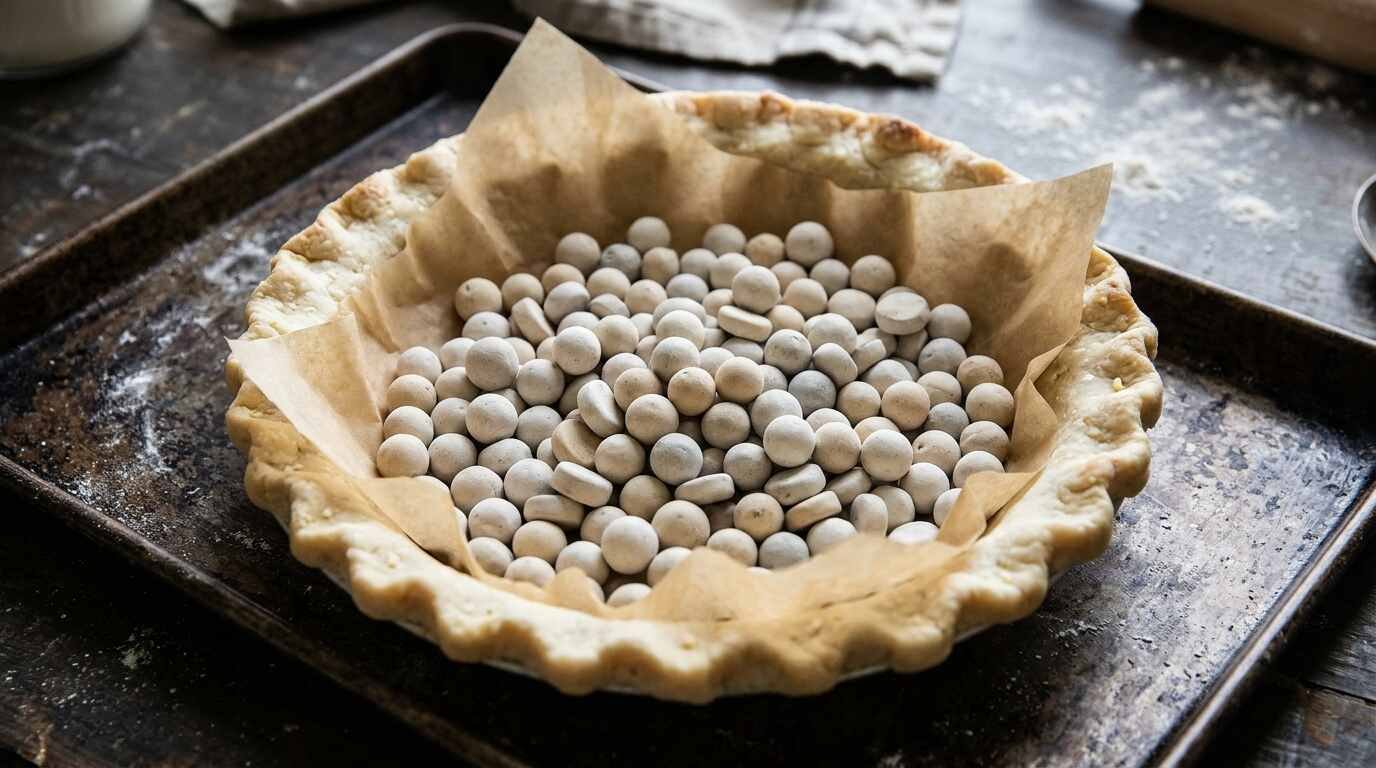
Blind-bake the shell partway. Chill the lined crust for 30 minutes, line it with foil or parchment, fill the liner about two-thirds full with pie weights, dried beans, rice or sugar, and bake in a preheated 375°F oven for 20 minutes. Lift out the liner and weights. That stage is the partial prebake King Arthur recommends for fillings that still need oven time, pumpkin among them (King Arthur).
Mix the filling. Combine both sugars, flour, salt and spices, then beat in the eggs, the puree and the cream. The mixture can be refrigerated, covered, a day ahead so the spices blend (King Arthur).
Bake. Raise the oven to 400°F, pour the filling into the warm shell, and bake 45 to 50 minutes, starting to check about ten minutes early. The filling should be set about 2 inches in from the edge while the center still wobbles (King Arthur).
Cool and chill. Cool the pie on a rack until completely cold before slicing, then refrigerate. The center finishes cooking on its own heat while the pie sits (King Arthur).
Canned pumpkin or fresh
The can is not a shortcut with a flavor penalty so much as a different product. Snopes, reporting on the long-running claim that canned pumpkin is really butternut squash, found that Libby’s says it uses a proprietary variety called the Dickinson pumpkin, a Cucurbita moschata, and that the squash-blend claim is false. The same article notes that botanists draw no strict line between pumpkins and squash, and that the FDA has said it would not take action solely over sweet squash products sold under the pumpkin label. The word on the can is looser than it sounds, but it is also not a disguise.
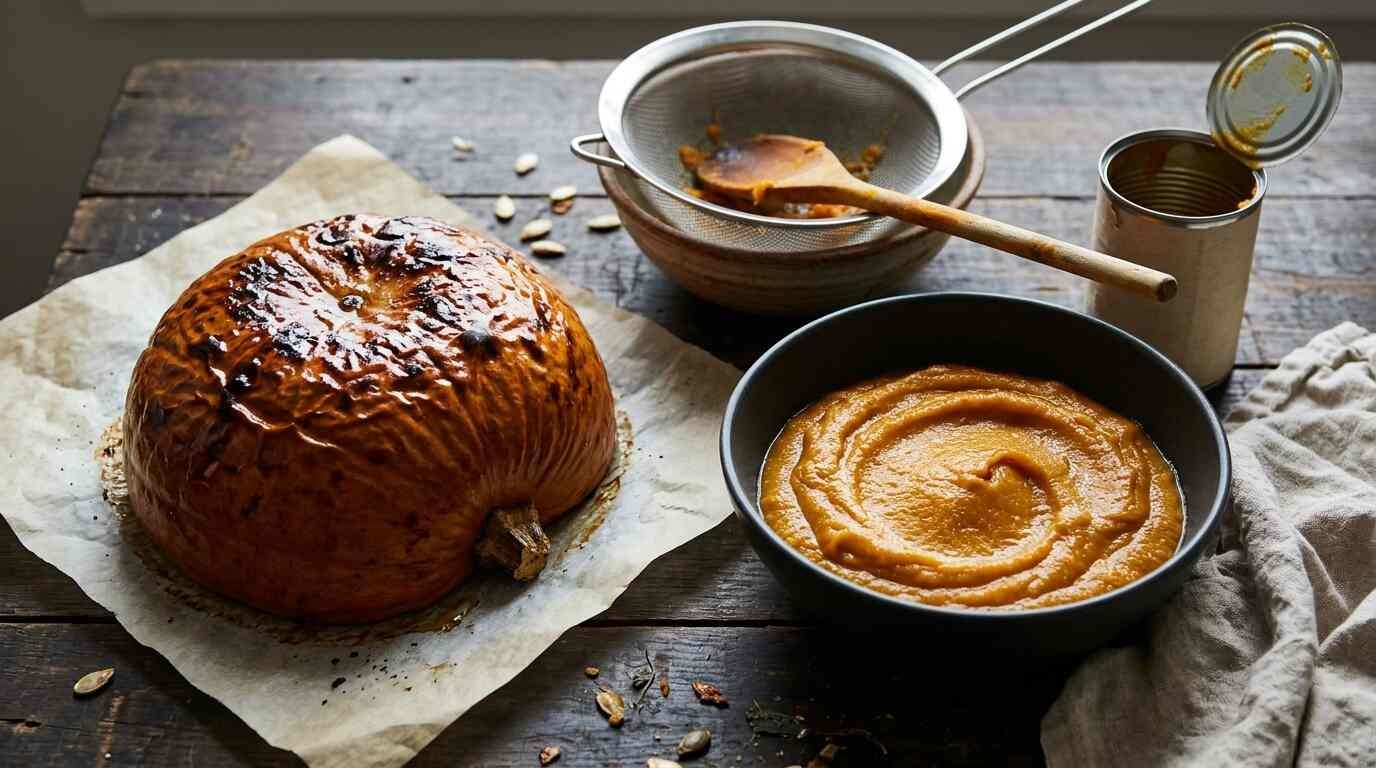
Fresh puree is a matter of choosing the right pumpkin and removing water. America’s Test Kitchen directs cooks to a sugar pumpkin or another eating variety rather than a carving pumpkin, about 8 to 10 inches across, denser and drier than the jack-o’-lantern type. The halves roast cut side down at 375°F for 45 to 60 minutes until a skewer slides in, then turn over for roughly 30 more minutes. Roasting, in the article’s words, “helps dry out the pumpkin and concentrate its sweetness.”
Even then the flesh stays wet. The puree goes through a fine-mesh strainer for at least an hour, until a spoonful turned out of a small glass slumps slightly but holds its shape. At that point it substitutes measure for measure for canned. Homemade tastes fresher, according to the test kitchen, though the aim of the whole exercise is a texture matching the can. Refrigerated, it keeps up to four days, and frozen, up to two months (America’s Test Kitchen).
That leaves a practical split. Canned puree arrives at a consistent thickness, which matters because a custard recipe is tuned to it. Fresh puree rewards the extra hours only when it has been drained to that same thickness; skipped, the draining turns the filling loose and the crust soggy.
Where the custard sets, and why it cracks
An egg custard does not thicken gradually. The proteins tighten across a narrow band, and once past it they squeeze out moisture and the texture turns from silk to curd. The surface, being driest, splits first as the pie cools and contracts.
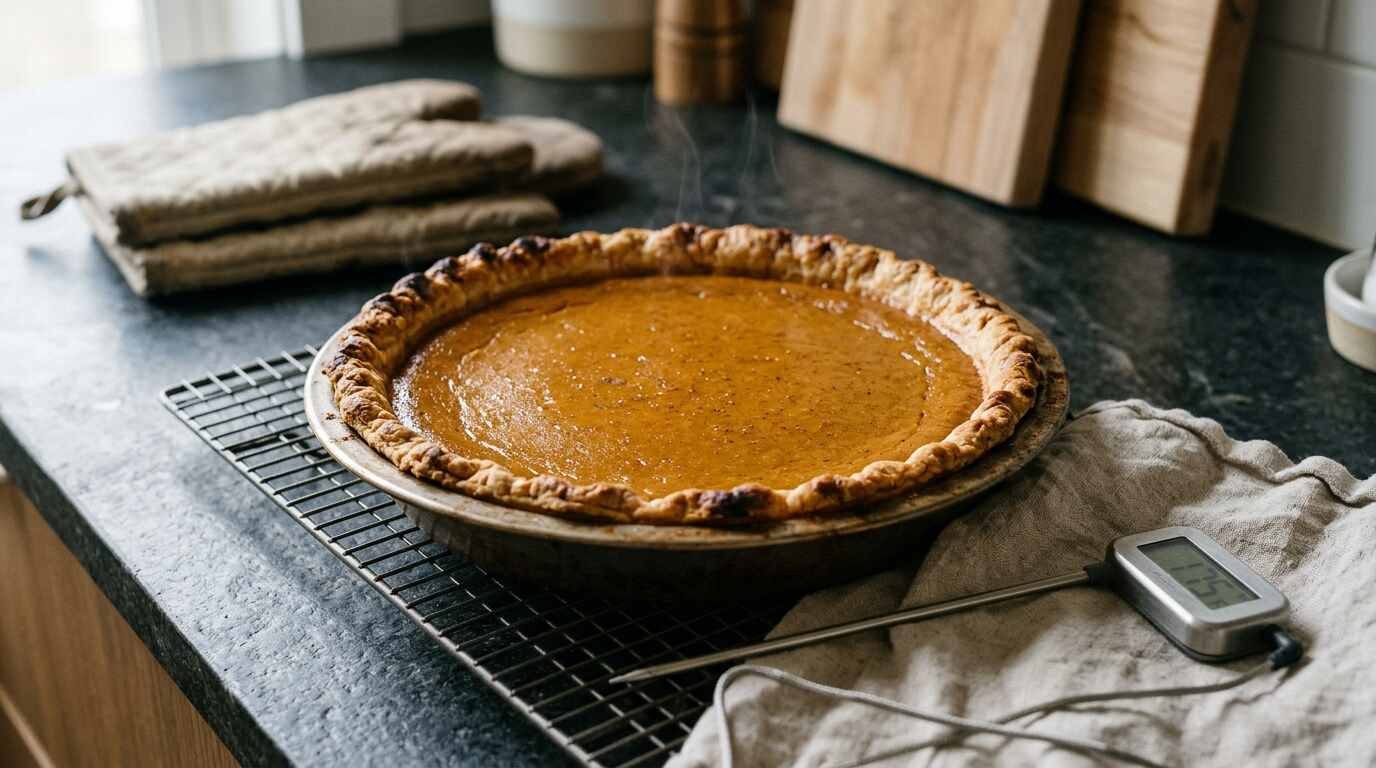
King Arthur ties cracking directly to overbaking: the eggs “over-coagulate (tighten), cracking the surface and creating a curdled mouthfeel.” Its guide to judging doneness gives a target center reading of 160°F to 170°F, notes that above 175°F the edges can dry and the center can crack on cooling, and describes pulling the pie while roughly a 4-inch circle in a 9-inch pie still jiggles like gelatin. It also points out that a thermometer leaves a hole that can itself encourage cracking, which is why the wobble test comes first.
Sources do not agree on the number. ThermoWorks, a maker of kitchen thermometers, advises pulling the custard at 175°F, a figure that King Arthur treats as the upper edge of safe. The two positions can be reconciled by the carryover heat both describe: a pie that leaves the oven at 165°F to 170°F keeps climbing as it sits on the rack. Anyone choosing the higher figure is working with less margin.
ThermoWorks also describes a different oven schedule, attributed there to America’s Test Kitchen: an initial 400°F for 10 minutes, then a drop to 300°F. The gentler second stage lengthens the window in which the center sets without the edges overshooting. The King Arthur single-temperature method is simpler; the two-stage method suits an oven known to run hot.
Safety sets the lower bound. Michigan State University Extension states that a pumpkin pie must first be baked to a safe minimum internal temperature of 160°F because it contains eggs and milk, and must be refrigerated after baking. Both the wobble and the 160°F floor are satisfied by the same window, which is the one worth aiming for.
Cooling slowly finishes the job. ThermoWorks recommends cooling completely and then refrigerating overnight before slicing, and the overnight rest also firms the cut edge.
Blind-baking the crust
A custard filling is wet, and a raw bottom crust sits under it for most of the bake. Prebaking sets the pastry first. ThermoWorks puts it flatly: bake the empty shell on high before it meets the filling so it cooks through and stays crisp.
King Arthur separates two versions. A partial prebake is the first 20 minutes at 375°F with weights, enough for fillings that finish baking in the shell. A full prebake adds a fork-pricked bottom and another 20 to 25 minutes until golden, reserved for no-bake fillings like banana cream. Pumpkin belongs to the first group, and the shell goes into the oven again under the filling.
The 30-minute chill before baking is not a formality. King Arthur says it relaxes the gluten and firms the fat, which limits shrinkage. For shells that slump on the sides, the same article describes baking the crust upside down between two identical pans for the first 20 minutes. For a metal pan, King Arthur’s pumpkin recipe adds a baking stone or steel underneath to help avoid a soggy bottom.
A pie shell that is already hot when the filling goes in has a head start on setting, and the crimped edge standing above the rim holds the pour when the filling rises.
Storing the pie
A baked pumpkin pie is a custard, and custards are treated like any egg dish: bake to temperature, cool, refrigerate. Michigan State’s extension article gives no hour count for how long the pie may stand out, only that it must be refrigerated after baking. Holding temperatures it cites are 140°F or warmer for hot food and 40°F or colder for cold food. Slices can be warmed in a microwave for 10 to 30 seconds right before serving, one slice at a time, rather than reheating the whole pie (MSU Extension).
Sources
- King Arthur Baking, Pumpkin Pie: https://www.kingarthurbaking.com/recipes/pumpkin-pie-recipe
- King Arthur Baking, Classic Single Pie Crust: https://www.kingarthurbaking.com/recipes/classic-single-pie-crust-recipe
- King Arthur Baking, How to prebake pie crust: https://www.kingarthurbaking.com/blog/2015/11/23/blind-bake-pie-crust
- King Arthur Baking, How to tell when pumpkin pie is done: https://www.kingarthurbaking.com/blog/2024/09/25/how-to-tell-when-pumpkin-pie-is-done
- America’s Test Kitchen, Fresh Pumpkin Puree: https://www.americastestkitchen.com/articles/6525-fresh-pumpkin-puree-recipe
- Snopes, Canned Pumpkin Isn’t Actually Pumpkin: https://www.snopes.com/canned-pumpkin-isnt-actually-pumpkin/
- ThermoWorks, Secrets to Silky Pumpkin Pie: https://thermoworks.com/blogs/thermoblog/secrets-silky-pumpkin-pie
- Michigan State University Extension, To refrigerate pumpkin pie or not: https://www.canr.msu.edu/news/to_refrigerate_pumpkin_pie_or_not