Two words name one pan of seasoned bread, and the argument over which word is correct returns every November with the reliability of a turkey. Dictionaries treat the terms as overlapping, linguists describe a rough north-south line, and the people who insist on a rule usually tie it to a single question: where the mixture cooked. None of the three accounts fully agrees with the others, which is most of the reason the argument survives.
Video: “Stuffing vs. dressing: Is there really a difference?” from the Atlanta Journal-Constitution channel on YouTube.
Where the Word “Stuffing” Comes From
A fifteenth-century noun, a sixteenth-century dish
Merriam-Webster defines the culinary sense of stuffing as a seasoned mixture, often made with bread crumbs, vegetables and butter, placed inside a turkey, pepper or similar item and cooked. The same entry gives the 15th century as the first known use of the noun, in the broader sense of material that fills a space. A New England writer, Leslie Land, reported in a Yankee magazine piece republished by New England Today that the Oxford English Dictionary cites 1538 as the earliest written use of “stuffing” for the kitchen mixture. Dictionary.com says the noun has described such fillings since at least the 1500s, and Wikipedia lists “farce” (around 1390) and “forcemeat” (1688) as older and later English names for the same family of mixtures.
Forcemeat points back to French. Land notes that the 1961 edition of the Larousse Gastronomique lists neither word and files these preparations under “forcemeats,” from farcir, the French verb meaning “to stuff.”
Older than the English word
The practice predates every English term. A Tasting Table history points to the Roman cookbook attributed to Apicius, whose recipes call for spelt, spices, vegetables and herbs packed into pigs, chickens, rabbits and even dormice. Wikipedia describes that cookbook as the earliest documentary evidence of stuffing, while flagging that some of its own supporting sources are weak. Nobody knows when the first cook filled the first bird.

Where the Word “Dressing” Comes From
A verb for preparing a bird
“Dress” has meant preparing food for cooking, especially birds, since at least the 1300s, according to Dictionary.com. The same verb gave English the salad dressing, a seasoning applied to finished food. Under that logic, a dressed bird is a cleaned and prepared one, and the mixture served with it picked up the name by association.
The dating is where the sources split. Land’s article reports that the Oxford English Dictionary gives 1504 for “dressing” in the sense of a seasoning substance used in cooking. Wikipedia, citing the same dictionary, places the word in its current stuffing sense at 1850 and calls it mainly American. Those two dates describe different senses of one word, and the sources do not reconcile them. What can be said is that “dressing” for the bread mixture is the younger term in print.
The Victorian-squeamishness theory
The popular explanation holds that nineteenth-century delicacy pushed “stuffing” out of polite use. CulinaryLore says “dressing” seems to have originated in Victorian England but offers no citation for the claim, and its author calls cookbooks unreliable evidence for this kind of question. Linguist Karen Stollznow writes in Psychology Today that “stuffing” was widely used in the United States until the Victorian era, when some objected to it as vulgar. Mental Floss, citing HuffPost, floats a related idea that Southerners may have found “stuffing” impolite and never adopted it, and presents it as a possibility only.
The cookbook record complicates the neat story. Land lists Mrs. Hill’s Southern Practical Cookery (1872), which uses “stuffing” and warns that it “should never be crammed,” and Housekeeping in Old Virginia (1879), which uses “dressing.” Both are Southern books from the same decade. A single region was already using both words.
How Usage Splits Across the Country
The map people describe
Mental Floss reports that “dressing” is favored in Mississippi, Tennessee, South Carolina and Georgia, while “stuffing” is preferred in Maine, New York and other northern areas. Stollznow gives a wider sketch: “stuffing” seems to be the preferred term in the Northeast and Pacific Northwest, “dressing” in the South and Midwest. Pennsylvania is the outlier, where some households say “filling.”
None of these sources cites survey figures. The strongest quantitative hint comes secondhand: the Atlanta Journal-Constitution reports that Southern Living analyzed search data and found Southern states searching for dressing recipes and Northern states searching for stuffing recipes, with no overlap between the two.
The map that does not hold
Land’s 1996 reader poll, run for Yankee, found “stuffing” the more common term by roughly three to one but no clear regional pattern; fans of “dressing” wrote in from Florida, Ontario, Iowa, West Virginia, Connecticut, Rhode Island, Massachusetts, California and Vermont. The poll covered readers of a New England magazine, so it says little about the country at large, but it does show how quickly a tidy boundary frays. Dictionary.com adds that not everyone in the South uses “dressing,” and that usage often follows family habit more than geography.
What does track geography more reliably is the base. Cornbread dressing belongs to Southern tables, Stollznow notes, and sourdough to San Francisco ones. Land’s poll found most respondents building on bread, with bread-and-potato mixtures second, crackers third and cornbread rare. Pecans and chestnuts turned up mostly in recipes from New York State and points south and west, while Vermont and New Hampshire cooks often added apples.
The Rule That Separates Them: Bird or Pan
What the purists say
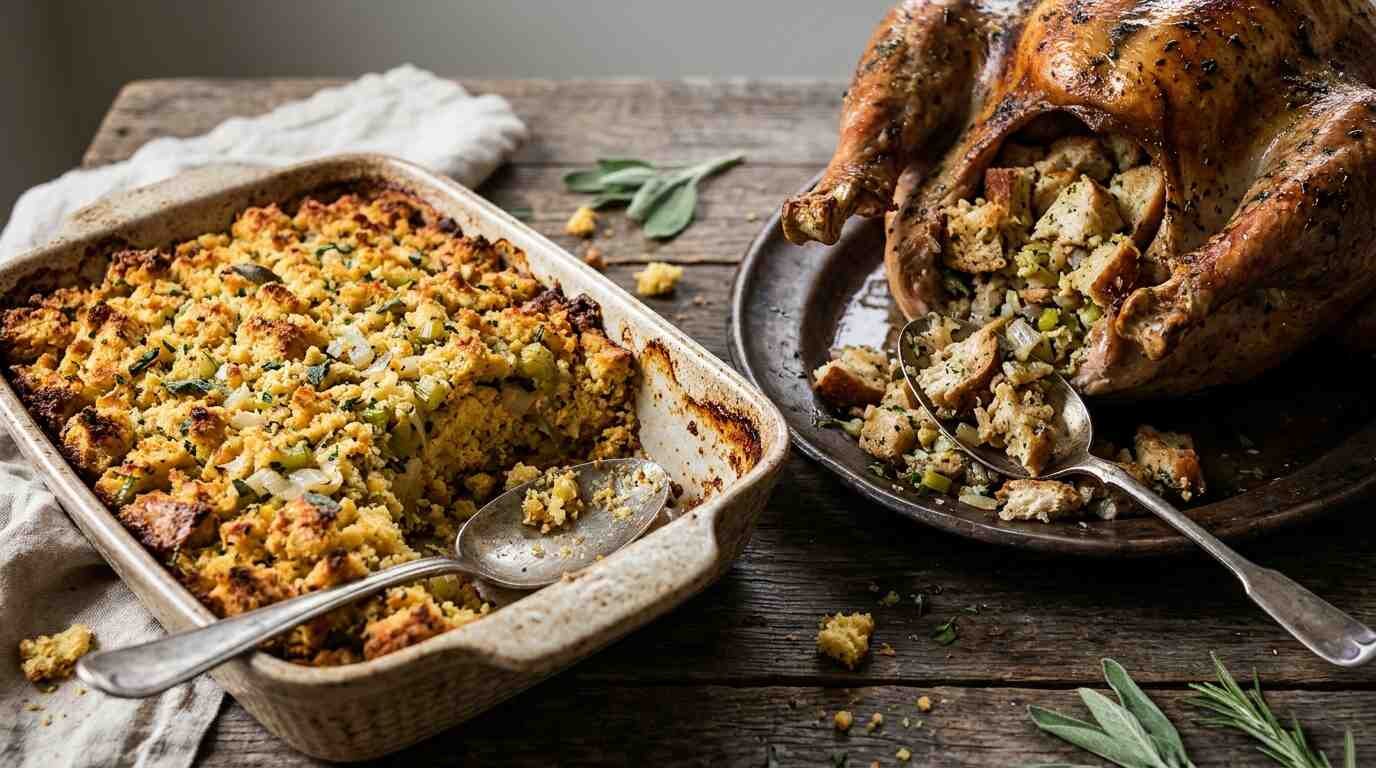
The distinction most often offered is mechanical. Dictionary.com notes that some people insist on “dressing” for the version cooked separately and reserve “stuffing” for the one cooked inside the bird. The AJC states the purist view in the same terms. Stollznow describes the idea as common, though people do not always follow it.
What the evidence says
The rule fails against the people who might be expected to enforce it. Martha Stewart is quoted in the AJC as saying, “there’s no real difference between stuffing and dressing,” and the same article cites the National Turkey Federation, via Reader’s Digest, as calling the terms interchangeable. Mental Floss points out that dressing can be stuffed inside a turkey and stuffing can be baked in a casserole dish. A Michigan food writer quoted in the AJC says her family served several dishes called stuffing, none of them cooked in the bird.
Reference books follow the same loose line. Land quotes Theodora Fitzgibbon’s The Food of the Western World as saying that in the United States, stuffing is also called dressing.
What Changes When the Mixture Bakes in the Bird
Texture and flavor
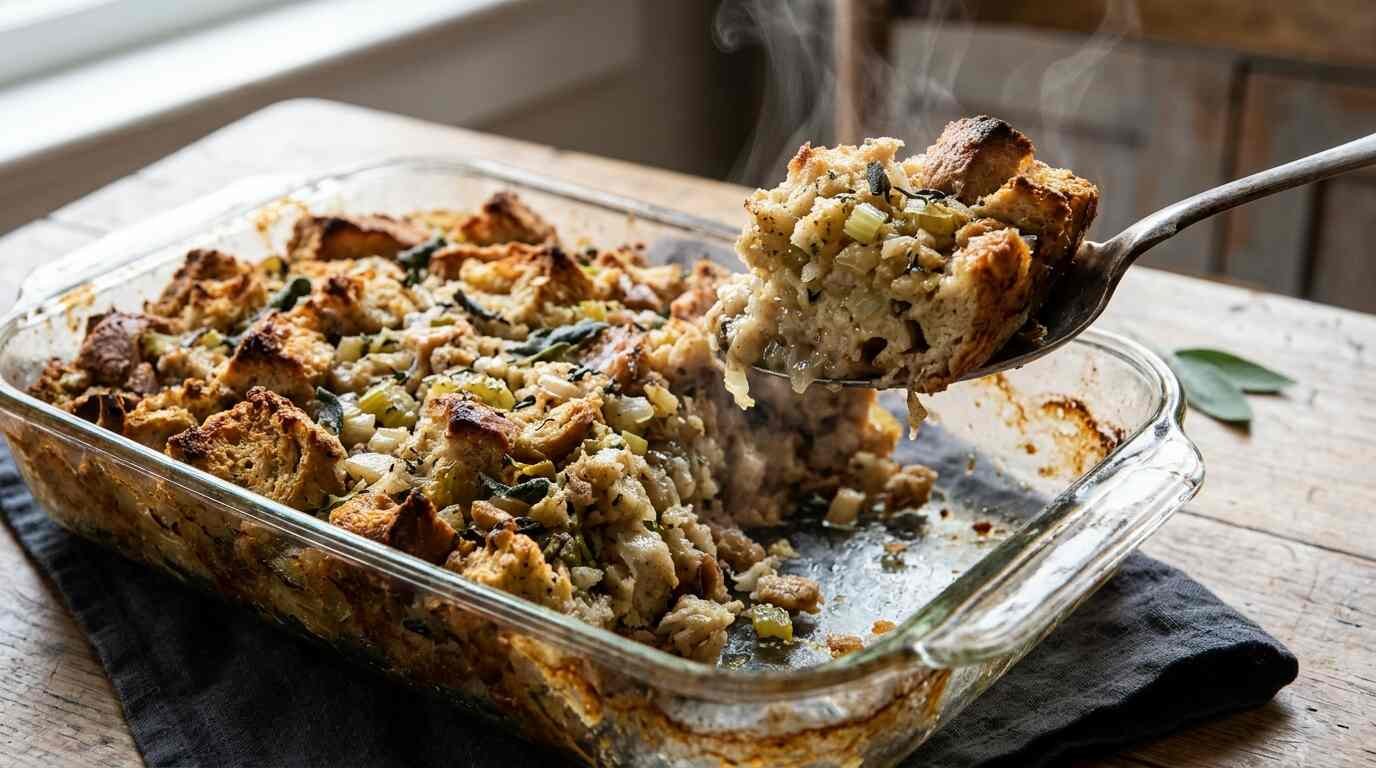
CulinaryLore observes that fewer cooks stuff the bird than once did, and that the mixture is now often baked in a separate dish such as a casserole. The ingredients rarely change with the method. The AJC’s cornbread dressing, baked in a 9-by-11-inch dish at 375°F for about 30 minutes, and its turkey stuffing, packed loosely into the cavity before roasting, differ in where they cook and in the bread they start with, and the newspaper treats them as the same family of dish.
Food safety
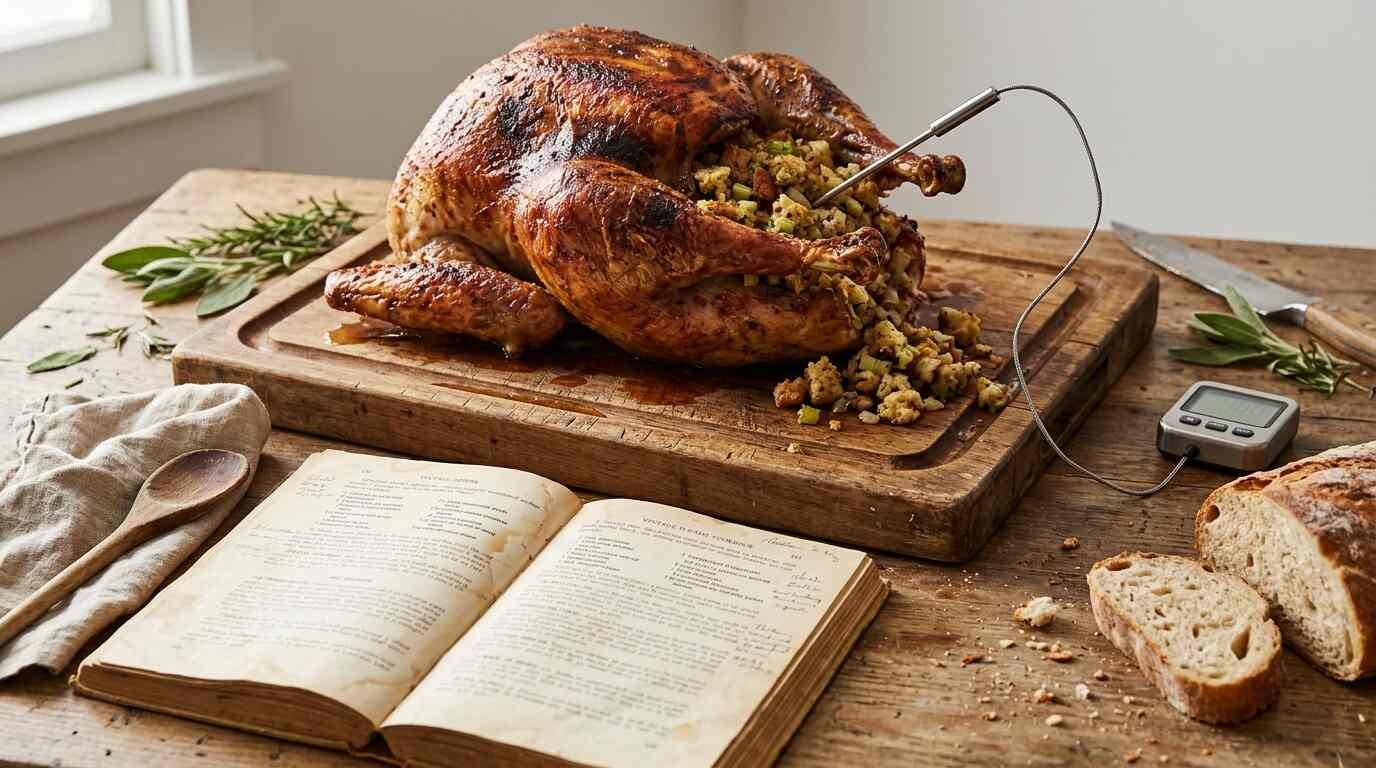
The sharpest difference between the two methods is the one with an official source behind it. The U.S. Department of Agriculture’s Food Safety and Inspection Service guidance on stuffing says stuffing must reach a safe minimum internal temperature of 165°F as measured with a food thermometer, and that the center can stay cold even when the meat is done. Its recommendation is plain: “For optimal safety and uniform doneness, cook stuffing separately.”
For cooks who stuff the bird anyway, the agency advises spooning the mixture in loosely, at about three-quarters of a cup per pound, and letting the bird stand 20 minutes before removing it. It says stuffed poultry is “somewhat riskier” than unstuffed, and that birds destined for deep-frying should not be stuffed at all. It also advises against preparing stuffing ahead of time and against mixing wet and dry ingredients until just before they go in the oven or the bird. A reliable instant-read thermometer settles the temperature question; Heritage Diner’s ThermoPop 2 review covers one such model.
The practical result follows from the guidance. A pan of stuffing, whatever it is called, is the easier one to cook to a safe temperature, because its center can be probed directly and it does not hold the turkey hostage while it catches up.
Choosing a Word at the Table
A matter of whose table it is
Mental Floss concludes that either word is acceptable and that visiting relatives may prefer to hear their own. That is about as close to etiquette as the subject gets. Words for food tend to change shape as they travel, and the same slow drift turned a late-morning meal into brunch, a coinage with its own disputed origins. Stuffing and dressing are two stations on a single line of bread, fat and herbs that runs back through French forcemeat to Roman kitchens.
For cooks planning the November meal itself, the rising cost of the bird is covered in the PwC Thanksgiving forecast on this site. Either word works on the menu card.
Sources
- Merriam-Webster, “stuffing”: https://www.merriam-webster.com/dictionary/stuffing
- Dictionary.com, “stuffing or dressing”: https://www.dictionary.com/e/stuffing-or-dressing/
- Wikipedia, “Stuffing”: https://en.wikipedia.org/wiki/Stuffing
- New England Today, “Dressing vs. Stuffing” (Leslie Land, originally in Yankee, 1996): https://newengland.com/food/dressing-vs-stuffing
- CulinaryLore, “Dressing Versus Stuffing in Your Turkey”: https://culinarylore.com/food-history:stuffing-versus-dressing/
- Psychology Today, Karen Stollznow, “Stuffing vs. Dressing”: https://www.psychologytoday.com/ca/blog/speaking-in-tongues/202011/stuffing-vs-dressing
- Mental Floss, “What’s the Difference Between Stuffing and Dressing?”: https://www.mentalfloss.com/food/whats-difference-between-stuffing-and-dressing
- Atlanta Journal-Constitution, “Stuffing vs. dressing: Is there really a difference?”: https://www.ajc.com/lifestyles/food–cooking/stuffing-dressing-there-really-difference/ZJ0YyAjkOemdiwI3S2x6eP/
- Tasting Table, “The Ancient Roman Origins of Stuffing”: https://www.tastingtable.com/1097922/the-ancient-roman-origins-of-stuffing
- USDA Food Safety and Inspection Service, stuffing guidance: https://www.fsis.usda.gov/es/node/3758
- YouTube, Atlanta Journal-Constitution: https://www.youtube.com/watch?v=oizQ1NK0RNU