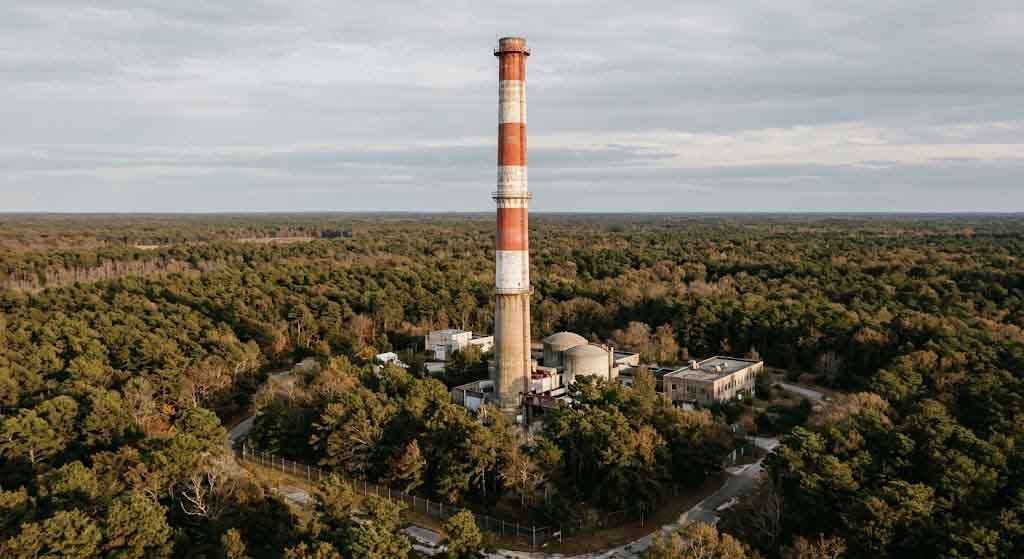
From 1965 to 1996, fifteen miles from Stony Brook’s campus, a nuclear research reactor operated in the pine barrens of Long Island. The building’s still there. The contamination required a decade of cleanup and hundreds of millions of dollars. And the university that now manages the entire site rarely mentions any of it in the brochure.
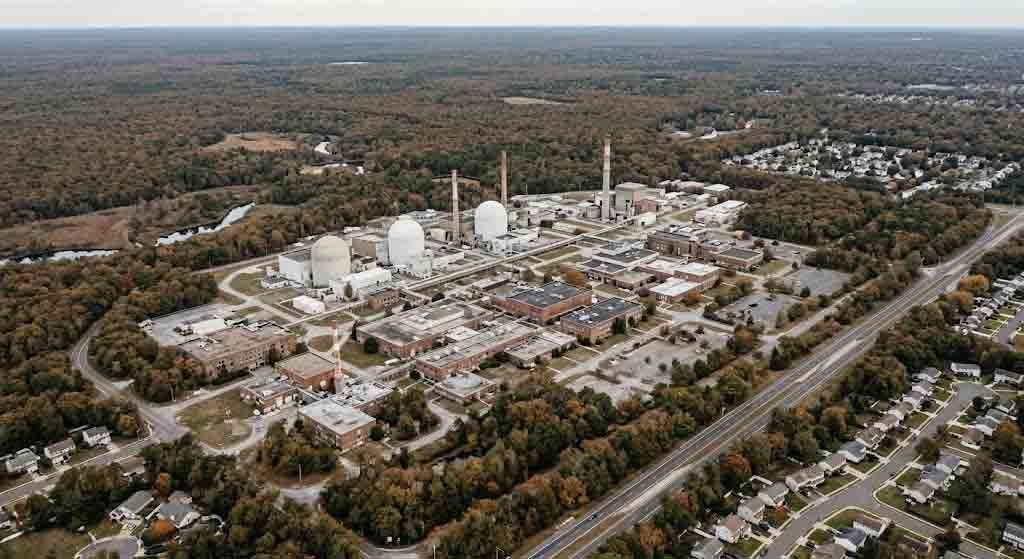
Stony Brook University and Brookhaven National Laboratory are functionally inseparable. The university co-manages BNL through a partnership with Battelle Memorial Institute on behalf of the U.S. Department of Energy. Graduate students and faculty move between the two institutions regularly. The facilities share research infrastructure, resources, and scientific culture. Whatever happened at Brookhaven is, in any meaningful sense, part of Stony Brook’s institutional history — even if it sits in a hamlet technically named Upton and not on the main campus in Stony Brook.
What happened there is one of Long Island’s most instructive Cold War stories. It involves nuclear reactors, a tritium leak, political firestorm, the permanent closure of a working scientific facility, and a lesson about what happens when a research institution stops communicating with the community it’s embedded in.
The High Flux Beam Reactor
Brookhaven National Laboratory was formally established in 1947 on the site of Camp Upton, a former U.S. Army base on Long Island. In 1950, the Brookhaven Graphite Research Reactor opened — the first reactor built in the United States after World War II. In 1959, Brookhaven built a reactor specifically for medical research, the first in the nation constructed for that purpose.
Then came the High Flux Beam Reactor.
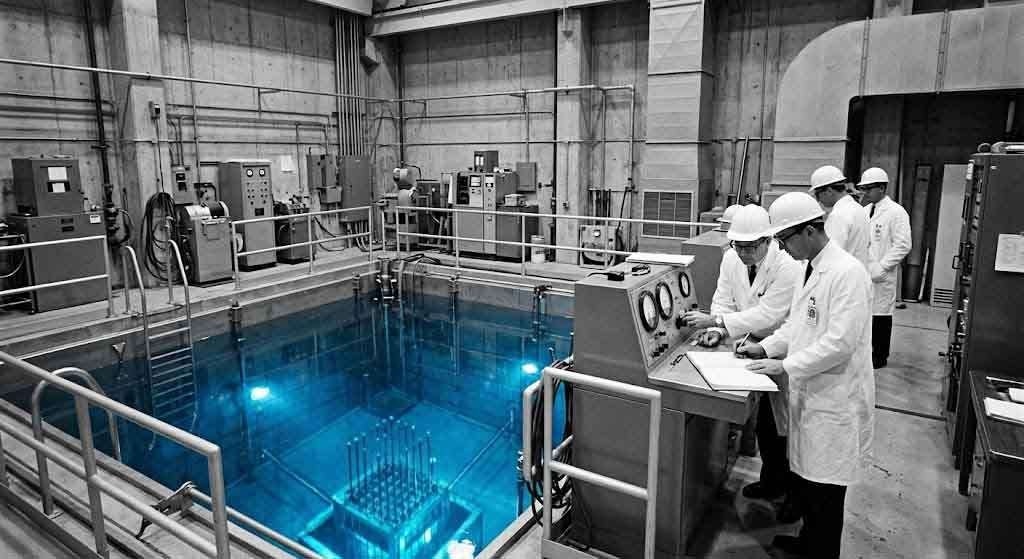
The HFBR operated from 1965 to 1996. It was used solely for scientific research, providing neutrons for experiments in materials science, chemistry, biology, and physics. Scientists using the HFBR determined the structures of the 23 amino acids that make up every protein in every living cell. This was serious science — neutron scattering work that had broad implications across medicine and materials research. It was not a power reactor. It didn’t generate electricity for homes. It was an instrument, like a very large microscope pointed at the structure of matter.
The HFBR complex consisted of a domed reactor confinement building, several smaller ancillary buildings, and a 100-meter-tall red-and-white striped exhaust stack still visible on the BNL site today.
The Leak
During a routine maintenance shutdown in the fall of 1996, tritium was found in groundwater monitoring wells immediately south of the reactor. Tritium is a radioactive form of hydrogen and a by-product of reactor operations. The investigation revealed a small leak in the pool where spent reactor fuel was stored. BNL subsequently determined that tritiated water had been leaking from the spent-fuel pool in the reactor basement for more than a decade — at roughly eight gallons per day.
The leak did not reach drinking water sources. Federal, state, and local officials all declared that the leak posed no health hazard. The tritium contamination extended approximately 2,200 feet south of the reactor — well within BNL’s own site boundaries. The concentrations would have decayed far below drinking water standards before the groundwater could have carried them to the lab’s perimeter.
None of that mattered politically.
The Firestorm
What followed was a case study in institutional failure, media amplification, and the erosion of public trust. Anti-nuclear activists bypassed established safety procedures and expert advice, making comparisons to Chernobyl that had no scientific basis. A celebrity-driven, well-funded group — whose members included actor Alec Baldwin and model Christie Brinkley — lobbied the then-Secretary of Energy Bill Richardson to permanently close the reactor.
Brookhaven’s scientists found themselves outgunned. They wrote careful, technical letters that were too long for newspapers. Their explanations at public meetings were too measured to counter incendiary accusations. The lab had operated for decades with little outreach to the surrounding community. When the crisis hit, there was no reservoir of trust to draw from.
In November 1999, Secretary Richardson decided to permanently close the HFBR — not because the science demanded it, but because the politics required it. A productive research facility that had operated safely for thirty years, that had never posed a documented public health risk, was shut down.
The managing contractor, Associated Universities Inc. — a partnership of nine major research universities including Harvard, Yale, MIT, Princeton, Columbia, Cornell, Johns Hopkins, Penn, and Rochester — was terminated by DOE in May 1997. Stony Brook University and Battelle Memorial Institute took over management of BNL in 1998.
What It Cost to Clean Up
The remediation was expensive and thorough. In cooperation with the EPA and the Suffolk County Department of Health Services, BNL installed 140 groundwater monitoring wells and analyzed over 1,000 samples. A pump-and-recharge system was installed to contain the tritium plume. As of the EPA Superfund record, the groundwater extraction and reinjection system has managed more than 334 million gallons of tritium-contaminated groundwater.
The Brookhaven Graphite Research Reactor — the original 1950 reactor — required a parallel decommissioning effort. It contained over 8,000 curies of radioactive contaminants from past operations, primarily nuclear activation products and fission products like cesium-137 and strontium-90. Dismantling it took 13 years and cost $148 million. Some 23.9 million pounds of radioactive waste were removed and sent to disposal sites in Nevada and Utah. Dismantling finished in June 2012.
Since 1993, DOE has spent more than $580 million on remediating soil and groundwater contamination at the BNL site — including cleanup of the Peconic River, which runs through the property, and the installation and operation of 16 on- and off-site groundwater treatment systems.
What’s Still There
The HFBR confinement building still stands. Following a 65-year safe storage period, during which high radiation levels inside the vessel naturally decay, the remaining reactor components — including the reactor vessel, thermal shielding, and biological shields — will be dismantled. That timeline puts final decommissioning well into the 2060s and 2070s.
The 100-meter exhaust stack is a visible landmark on the BNL site. The site itself remains an active federal research laboratory, currently operating the Relativistic Heavy Ion Collider and the National Synchrotron Light Source II. Seven Nobel Prizes have been awarded for work conducted at Brookhaven Lab.
Stony Brook’s Nuclear Present
The story does not end with the HFBR. Stony Brook University is currently an active participant in nuclear research through its College of Engineering and Applied Sciences. In 2022, the DOE awarded a Stony Brook research team $3.4 million under its ARPA-E ONWARDS program — focused on reducing waste from advanced nuclear reactors through improved fuel utilization and reduced uranium loading. The university’s researchers work at both the BNL Center for Functional Nanomaterials and the National Synchrotron Light Source II.
In late 2024, Stony Brook’s Collaborative for the Earth hosted a public forum on nuclear energy — framed around the growing push to use nuclear power to fuel artificial intelligence data centers and address climate change. “The conversation around nuclear extends right across Stony Brook’s research enterprise,” said the program director.
In other words, the reactor nobody talks about is part of the origin story of a university that is now one of the leading nuclear research institutions on the East Coast. The contamination was real and has been addressed. The science that produced it was also real and produced genuine knowledge. The political failure that closed the HFBR prematurely is a lesson about communication, community, and the cost of institutional arrogance — useful knowledge for anyone navigating how science and public trust intersect.
For related reading on Long Island’s Cold War-era infrastructure and the science embedded in this region’s landscape, see The Wreck of the HMS Culloden: How a 74-Gun British Warship Met Its End on the Rocks of Montauk and The 1699 Stony Brook Grist Mill: Where Water, Grain, and Commerce Built Long Island’s North Shore.
The Lesson BNL Keeps Relearning
Robert P. Crease, a philosophy professor at Stony Brook who later wrote the definitive account of the HFBR closure, identified the core failure in a single observation: Brookhaven had been “operating unwittingly in a region of imbalance with its society.” The lab had produced world-class science for decades without cultivating the relationships that would have allowed its community to trust it when something went wrong.
The Shoreham Nuclear Power Plant — visible from the Bridgeport-Port Jefferson ferry, built between 1973 and 1985 at a cost of $6 billion, never commercially operated, sold to the state for $1 in 1992 — is the larger Long Island nuclear story that most people know. What happened at Brookhaven is the subtler one. A functioning research reactor, no public health danger, a political miscalculation, and a permanent loss.
The building’s still there. The stack’s still there. The research continues.
You Might Also Like:
The Wreck of the Lexington: The 1840 Steamship Fire That Changed American Maritime Law Forever
The 1699 Stony Brook Grist Mill: Where Water, Grain, and Commerce Built Long Island’s North Shore
The Boltzmann Brain Paradox: When Statistical Physics Predicts You Shouldn’t Exist
Sources:
Brookhaven National Laboratory — Wikipedia
BNL High Flux Beam Reactor Decommissioning
BNL Graphite Research Reactor Decommissioning
BNL Environmental Restoration — Reactor Decommissioning Projects
EPA Superfund — Brookhaven National Laboratory
American Physical Society — The 1997 Leak at Brookhaven National Laboratory
Physics World — Life After the Leak
Stony Brook University — Nuclear 101 Conversation (2025)
Stony Brook Nuclear Waste Research — $3.4M DOE Award (2022)
LongIsland.com — Crazy Facts About Brookhaven National Lab