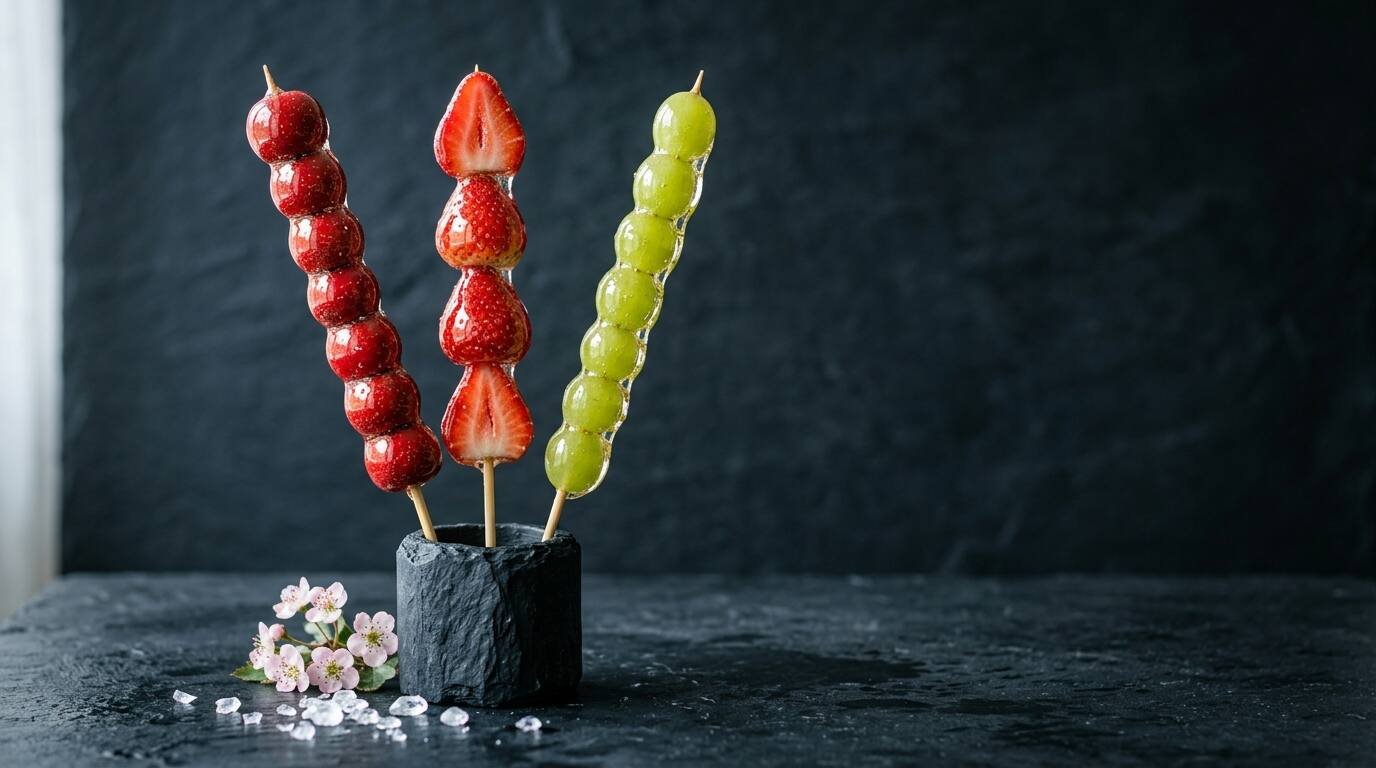
Crunch sells the video before the color does. A skewer of glossy fruit gets dipped, lifted, and bitten, and the shell around it breaks with a sound that phone microphones love. For a few months in 2024, plenty of home cooks tried to reproduce that sound with a pot of sugar and whatever fruit was in the bowl.
Doctors noticed first. By mid-August, a children’s hospital in Boston had issued a public warning, and clinicians in the United States and Australia were comparing notes on the same injury. The snack at the center of it is centuries older than the app, and the sugar science behind it is older than that.
The Clip That Carried the Warning
NBC South Florida posted the video above in mid-August 2024, within days of that Boston warning. Its caption describes tanghulu as “a traditional Chinese snack” that “can be a challenge to find,” and says doctors consider making it at home, as viral videos demonstrate, dangerous. It is a “colorful, crunchy, and sweet treat,” the caption continues, “but what makes tanghulu stunning can also make it hazardous.”
That sentence holds the whole story. The same glassy shell that photographs so well is sugar heated to temperatures well above the boiling point of water.

Hawthorn, a Physician, and a Concubine Who Recovered
Wikipedia describes tanghulu as several fruits coated in sugar on a bamboo skewer, traditionally Chinese hawthorn (Crataegus pinnatifida), with modern versions using cherry tomatoes, strawberries, blueberries, and other fruit. Regional names vary: tangdun’er in Tianjin, tangqiu in Fengyang, Anhui, and tangzhan’er in Shandong.
The origin story begins in the Southern Song dynasty. According to the legend, as Kim Hyunjung recounted from Beijing for the Asia Business Daily in 2023, a physician prescribed hawthorn boiled in rock sugar to an ailing concubine of Emperor Guangzong, who was said to have recovered within two weeks. The remedy then spread among ordinary people and turned into a street snack. Hawthorn does have a long reputation as a digestive aid, which gives the tale its internal logic.
Caution applies. The same article admits that “no authoritative documents confirming it as fact have been found,” and that many Chinese accounts describe the original physician as a quack. Treat the concubine as folklore, and the snack as a long-standing tradition.
212 Degrees: Where Water Gives Out
Every piece of candy sugar starts as a syrup, which means it starts as sugar dissolved in water. Heat does two jobs at once. It raises the temperature, and it drives off water, so the sugar concentration climbs.
CulinaryLore’s Eric Troy puts it plainly: as the solution gets hotter, “the concentration of sugar becomes greater, so not only does the temperature increase, but the viscosity.” The familiar candy stages follow from that. Soft ball sits at 225 to 240°F, firm ball at 245 to 250, hard ball at 250 to 268, and soft crack at 270 to 290.
A hospital source frames the same physics from the other side. Becker’s Hospital Review, reporting on the Shriners Children’s Boston warning, notes that sugar’s boiling point reaches about 350°F, against water’s 212. At 212, the pot is still mostly water. By the time the syrup becomes candy, it has stopped behaving like a liquid anyone is used to handling.
300 Degrees: Where Syrup Turns Brittle
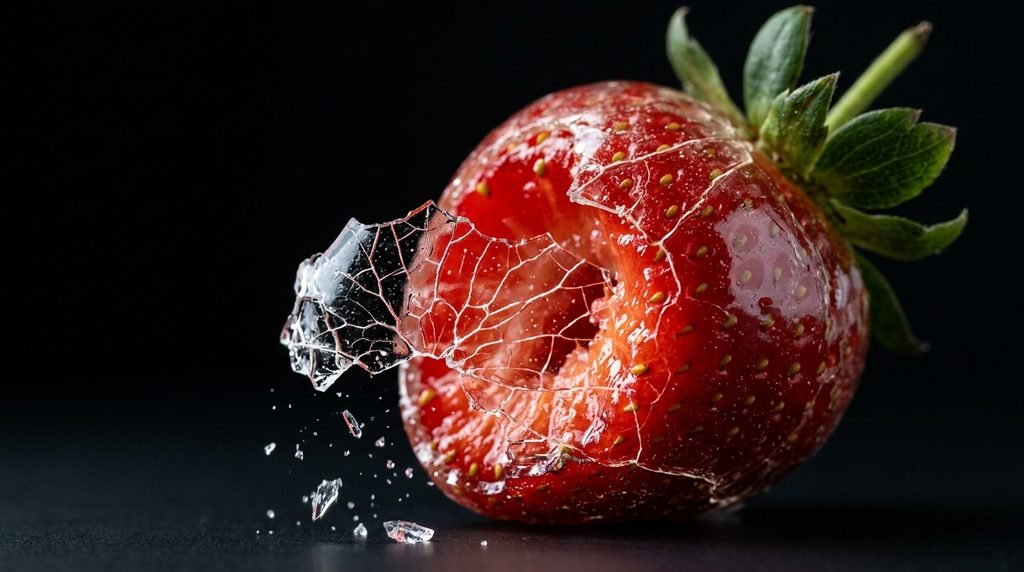
The stage that gives tanghulu its snap is called hard crack. CulinaryLore places it at 298 to 310°F, where “the sugar will form long threads” that “will be hard and brittle, and will snap apart very easily.” CooksInfo gives 300 to 310°F, notes that sugar at this point is about 99 percent solids, and says that heated further it turns amber, and eventually to rock.
Wikipedia notes that the coating needs roughly 300°F and that the syrup “hardens in the cold.” Dip cool fruit into the pot and the shell sets as it cools, thin enough to shatter between the teeth. That is the appeal. It is also the trap, because, as CooksInfo points out, sugar turns amber if heated further.
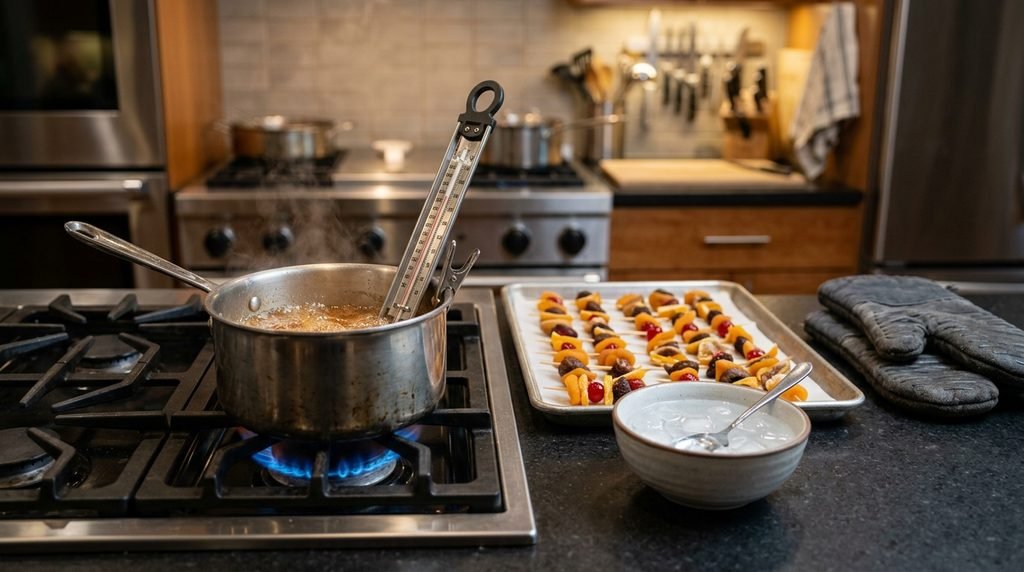
A cold-water test exists to tell the stages apart. CooksInfo’s version is to drizzle a little syrup into cold water, and if it forms threads, the stage has been reached.
350 Degrees: Where the Emergency Room Begins
On August 14, 2024, Shriners Children’s Boston issued a public warning about an “uptick in children with severe burns.” Surgeon Dr. Colleen Ryan told reporters the hospital had seen 10 burn cases attributed to preparing tanghulu over the previous couple of months, mostly to the hands and face. She also reached out to colleagues, and heard back about similar cases in Iowa, Virginia, North Carolina, California, and Australia.
Why does sugar injure so badly? “Molten sugar has a very high heat capacity, and it holds a lot of energy,” Ryan explained to NBC Boston, and the sticky, syrupy texture compounds the danger. The report’s description of the aftermath was blunt: “These scars are deep and uncomfortable. They can cause problems with mobility and appearance.”
The Boston Globe, reporting a few days later, added reports from elsewhere: West Penn Hospital in Pennsylvania treated four patients in three weeks, two of them adults and two children, including a 9-year-old boy, and it cited Queensland Children’s Hospital in Brisbane while putting the toll at no fewer than 15 children across Australia and New Zealand. NBC Boston, for its part, reported 15 Australian cases in three months, five of which needed skin grafts. Microwave methods drew special mention. Becker’s reported that melted sugar can stick to paper containers and splatter when a child removes them.
| Temperature | What the sources say |
|---|---|
| 212°F | Boiling point of water, the baseline hospitals compare against (Becker’s) |
| 225–290°F | Soft ball through soft crack, as sugar concentrates (CulinaryLore) |
| 298–310°F | Hard crack, the brittle stage used for tanghulu shells (CulinaryLore, CooksInfo) |
| About 350°F | Temperature cited for molten sugar in hospital warnings (Becker’s, Boston Globe) |
The numbers come from two kinds of source, candy references for the stage that forms the shell and hospitals for the molten sugar behind the injuries, so they should not be read as one continuous scale.
If Hot Sugar Lands on Skin
NBC Boston’s report passed along a short list of first-aid steps from doctors.
- Remove the hot substance quickly and carefully.
- Separate clothing from the injury.
- Cool the burn with water for 20 minutes.
- Skip the ice, because of the risk of frostbite.
- Get professional care for deep or critical burns.
- Take toddlers and babies to a healthcare provider immediately.
The Boston Globe likewise recommends 20 minutes of cool water and no ice or frozen packs.
What Became of the Trend
Wikipedia notes that demand fell off in 2024 over health concerns and shifting trends, after a boom in South Korea. That fits the pattern of most viral kitchen projects: a burst of imitation, a wave of warnings, then a quieter life as a street food again. For anyone curious about the history of sweets that moved from one tradition into another, the long run of candy corn and Long Island’s wartime potato candy make good companions.
A vendor selling a finished skewer on a northern Chinese street is performing an old craft with a practiced hand. A first-time cook with a hot pot, a phone, and an audience is doing something else entirely. The fruit is the same. The margin for error is not.
This article is general information, not medical advice. For any burn, follow the guidance of a qualified healthcare provider.
Sources
- Tanghulu TikTok Trend Sparks Burn Warning From Doctors, Anika Hope, NBC Boston, August 13, 2024
- Hospital Warns of Severe Burns Tied to TikTok Trend, Mariah Taylor, Becker’s Hospital Review, August 16, 2024
- Hospital Warns About Burns From Viral TikTok Candied-Fruit Recipe, The Boston Globe, August 2024
- TikTok video by NBC South Florida on tanghulu burn warnings
- Tanghulu, Wikipedia
- Where Did Tanghulu Come From?, Kim Hyunjung, Asia Business Daily, October 8, 2023
- Candy Making Sugar Stages, Eric Troy, CulinaryLore
- Hard-Crack Stage, CooksInfo