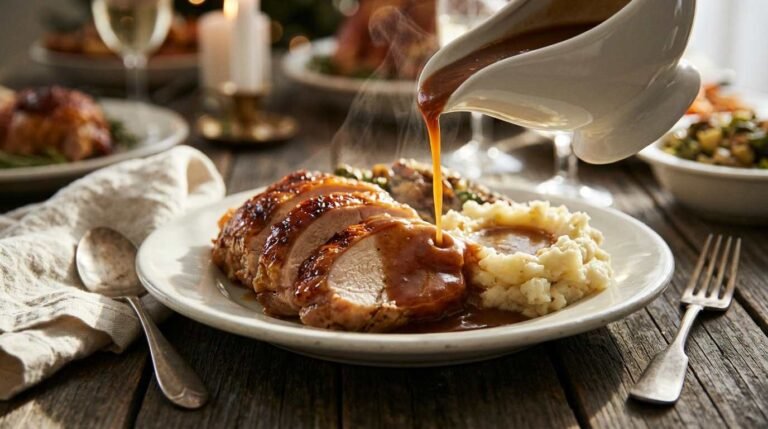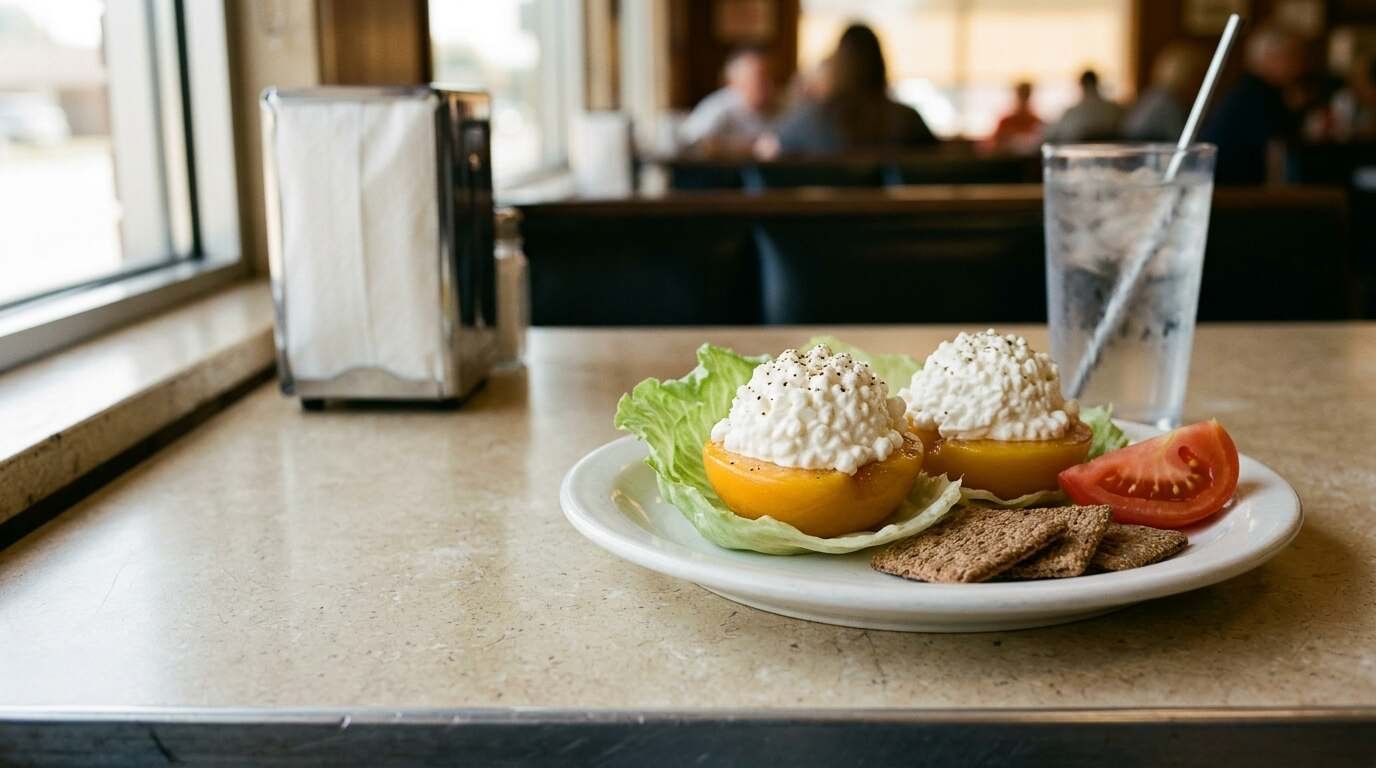
Two peach halves, a scoop of cottage cheese, a lettuce leaf, a few rye wafers. A 1975 Denny’s menu tallied that plate at 227 calories, and for a generation of American diners it counted as a virtuous lunch. Nobody ordered it out of joy. They ordered it the way a person pays a fine.
Half a century later, the same cheese has dairy executives describing orders that outrun their plants. A deal has valued one brand above $500 million. A food once shorthand for deprivation now turns up in tacos, pancakes, ice cream, and pasta sauce, each with a phone video to prove it. How the diet plate’s leftover became a supply problem is a story about menus, milk chemistry, and the strange arithmetic of going viral.
A Taco Built on a Tub of Curds
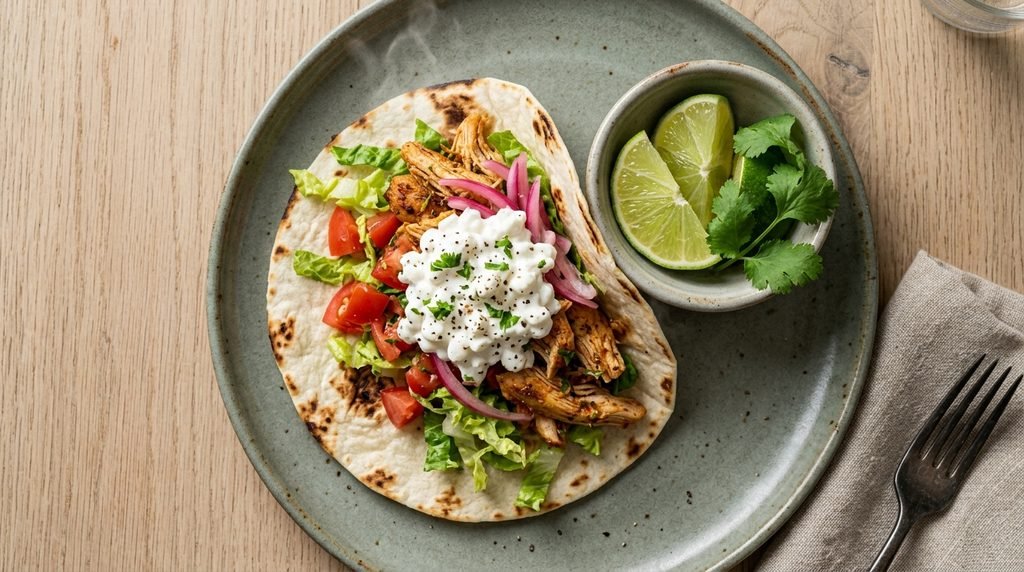
Canadian Grocer’s May 2026 roundup of the year’s most viral food trends gave cottage cheese a slot of its own and pointed readers to creator @sameenmaali’s cottage cheese taco recipe, which is the clip above. Writer Jillian Morgan was blunt about the trend’s staying power: “No, the cottage cheese craze isn’t over.” She added that it keeps finding new forms, from baked goods to dips to pasta sauce.
Nothing about a taco shell lined with curds sounds like diner food. That is the point. The product has been detached from the plate it was trapped on for decades, and the people posting these videos mostly never saw that plate.
From a Wisconsin Cheese Factory to a Wartime Pitch
Grub Americana, a food-history site that lists no author, credits German, Norwegian, and Swiss immigrants with making the first cottage cheese in America, in Wisconsin during the 1830s. It names Anne Pickett as the founder of the first “cottage industry” cheese factory, near Lake Mills in 1841, and says Wisconsin counted more than 1,500 such factories by 1899.
The cheese picked up a patriotic job during World War I, when it was promoted as a way to stretch the meat supply. Marketing of the day claimed it held more protein than lamb, pork, beef, or chicken, pound for pound. Its share of U.S. cheese production climbed from 7.4 percent in 1919 to nearly 21 percent by 1928, according to the same account. Thrift came first, then. The dieting came later.
The Diet Plate Nobody Ordered Twice
Jan Whitaker, who writes the blog Restaurant-ing through History, described the classic version as a hamburger patty “accompanied by cottage cheese topped with canned peach and a limp lettuce leaf on which reposed a wan slice of tomato.” Variations followed the chain. Gelatin sometimes stood in for the canned fruit, steak houses added toast, and Woolworth advertised its diet plates in 1971 with saltines on the side.
Tasting Table’s A.J. Forget traces the heyday to the 1950s through the 1970s, when dieting turned into a national hobby and cottage cheese became the low-calorie protein of choice. The 1975 Denny’s menu offered a “Slender Steak” with cottage cheese, tomato wedges, and egg slices, plus the peach plate with its 227 calories. Then the fad moved on. In Forget’s words, attention turned to yogurt.
The same site puts consumption at roughly 4.6 pounds per American during the 1970s peak, falling below 2 pounds after the 1980s. Treat those figures as indicative rather than official, since the page cites no table behind them. Whitaker’s post adds an irony worth keeping: the average American of the diet-plate era was slimmer, even though the plate itself drew complaints as unappetizing and unbalanced.
Milk Coming Apart on Purpose
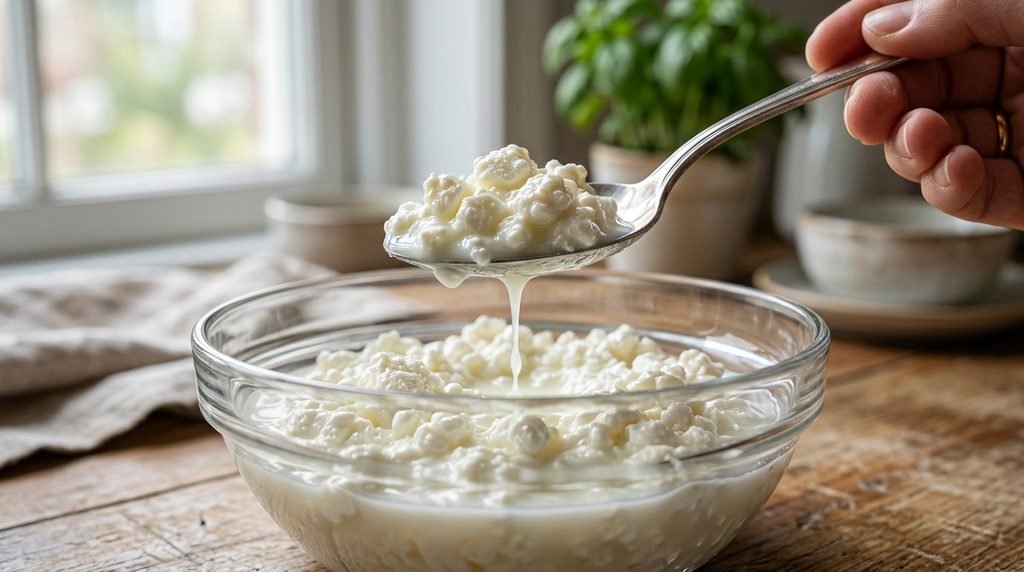
Cheese is milk made to separate. The Science Learning Hub at the University of Waikato lays out the mechanism: casein micelles float in milk, kept apart because the kappa casein around each one repels its neighbors. Starter bacteria turn lactose into lactic acid, which lowers the pH, and rennet brings in an enzyme called chymosin that strips that protective character from the micelles’ surfaces. Once that happens, they “aggregate together, trapping fat and water molecules in the developing curd.”
Draining the liquid leaves curds on one side and whey on the other. A tub of cottage cheese is, in essence, curds sold before anyone has pressed them into a block, often still dressed in a little cream.
Protein comes with the territory. USDA FoodData Central lists 2 percent cottage cheese at 12 grams of protein, 2.5 grams of fat, 90 calories, and 350 milligrams of sodium in a four-ounce (113-gram) serving. That ratio explains both eras of popularity. Dieters in 1975 wanted protein with few calories. Gym-minded shoppers now want the same thing and call it a macro.
Five Hundred Million Views and a Waiting List
Modern Retail reported in June 2024 that #cottagecheese had passed 500 million views on TikTok, after a cottage cheese ice cream recipe took off in spring 2023. U.S. sales that May reached $1.33 billion, up 13.5 percent from the year before.
The numbers kept climbing. A CNN report carried by KSL in July 2025 put retail sales growth at 20 percent for the 52 weeks ending June 15, on top of 17 percent growth in each of 2024 and 2023 and 11 percent in 2022. Organic Valley’s sales rose more than 30 percent in the first half of 2025, and Andrew Westrich of the company told CNN the product was “selling faster than we can make it.” Westby Cooperative, which produces about 14.5 million pounds a year, said orders exceeded that by at least 30 percent.
| Figure | What it measures | Source |
|---|---|---|
| 500 million+ | TikTok views on #cottagecheese, mid-2024 | Modern Retail, June 2024 |
| $1.33 billion | U.S. cottage cheese sales, May 2024 (up 13.5%) | Modern Retail, June 2024 |
| 20% | U.S. retail sales growth, 52 weeks through June 15, 2025 | CNN via KSL, July 2025 |
| 17%, 17%, 11% | Annual growth in 2024, 2023, and 2022 | CNN via KSL, July 2025 |
| 30%+ | Organic Valley sales growth, first half of 2025 | CNN via KSL, July 2025 |
| $500 million+ | Good Culture valuation in a deal with L Catterton | Entrepreneur, January 2026 |
Entrepreneur’s January 2026 piece said Good Culture’s sales had grown nearly 300 percent over three years, against about 60 percent for the industry, and described the dairy staple as “long viewed as diet food for old people.” CEO Jesse Merrill told CNN of “insane demand for our products and our struggle to keep up.”
This is for informational purposes only — consult a licensed attorney or financial advisor for your specific situation.

Why This Round Looks Different From the Last
A fad announces itself by spiking and vanishing. Circana’s John Crawford, quoted in the CNN report, drew that line himself: “It is not a fad when you are seeing double-digit growth” for two years running. He also admitted he would once have said no to the idea of a comeback.
The first wave of cottage cheese fame was a story of permission. Diners ate it because dieting required it, and the plate came pre-assembled by a menu. The second wave runs the other direction. Young cooks blend it into pancake batter and ice cream bases, which hides the curd texture that had put people off. Nobody is being told what to eat; they are copying a clip because the result looks good.
Whether the diner itself gets the credit is another matter. Tasting Table judges it unlikely to reappear on traditional diner menus, and the viral recipes live in home kitchens, far from any griddle. Still, the product that long sat at the center of the diner’s diet plate is the same tub in the fridge. Related TikTok moments that have already touched diner culture include the cucumber water craze and the diner booth aesthetic. For readers curious about why protein shapes appetite in the first place, there is a longer look at the protein leverage hypothesis.
Peaches, lettuce, and rye wafers were never going to hold up against a taco. The cheese, evidently, had been waiting for a better delivery system all along.
Sources
- Most Viral TikTok Food Trends of 2026 (So Far), Jillian Morgan, Canadian Grocer, May 28, 2026
- TikTok video by @sameenmaali (cottage cheese taco), as linked by Canadian Grocer
- The Protein-Packed Food That Disappeared From Diner Menus, A.J. Forget, Tasting Table, May 25, 2026
- Diet Plates, Jan Whitaker, Restaurant-ing through History, March 19, 2017
- Once a Dairy Darling, Cottage Cheese Makes a Comeback, Grub Americana
- The Science of Cheese, Science Learning Hub, University of Waikato
- Cheese, cottage, lowfat, 2% milkfat (USDA FoodData Central SR Legacy FDC 172182), via GetFoodFacts
- TikTok Has Ignited a Cottage Cheese Renaissance, Gabriela Barkho, Modern Retail, June 12, 2024
- TikTok Made Cottage Cheese So Popular, Producers Are Struggling to Keep Up, Danielle Wiener-Bronner, CNN, via KSL, July 27, 2025
- Cottage Cheese Company Lands $500 Million Valuation as Sales Surge 300%, Jonathan Small, Entrepreneur, January 8, 2026