Lamb on a vertical spit is one of the oldest cooking methods in human memory — fire, salt, time, and patience spinning slowly against heat until the outer layer goes golden and the fat renders into something close to revelation. The gyro, at its core, is not a sandwich. It’s a philosophy of accumulation: thin shavings of marinated meat built up in layers, each slice exposing the next to the heat, the whole greater than the sum of its parts.
In Greece, this is street food as cultural institution. In American diners and Greek-owned restaurants, it became something beloved and slightly altered — often a processed lamb-and-beef cone, still delicious, but a departure from the original. Understanding the difference matters if you want to get it right at home.
The Meat: What Tradition Actually Demands
Traditional gyro consists of thin shavings of meat stacked vertically on a rotating spit and roasted to crispy perfection. While pork and chicken are the most common single-meat versions in Greece, the international icon is more often the lamb and beef combination — finely ground, seasoned with dried oregano, garlic, onion powder, and black pepper, compressed into a cone that bastes in its own juices as it spins.
For home cooks without a vertical rotisserie, the most practical and flavorful approach is bone-in lamb shoulder. It’s a fatty, forgiving cut that becomes extraordinarily tender when slow-roasted. Don’t reach for leg of lamb — it’s too lean and will dry out before it develops the depth you need. Lamb shoulder is built for this. The bone conducts heat and adds flavor throughout the long cook.
The Marinade: Building the Layers Before the Fire
This is where the work actually happens. A proper lamb gyro marinade isn’t subtle — it’s assertive, fragrant, and designed to penetrate. Combine:
- 10 garlic cloves, roughly chopped
- 3 tablespoons fresh oregano, chopped
- 2 tablespoons fresh rosemary, chopped
- 3 tablespoons red wine vinegar
- Generous kosher salt and cracked black pepper
- A good pour of olive oil
Score the lamb shoulder deep enough to push the garlic and herbs into the flesh itself. Don’t just coat the surface — you want the marinade working through the meat. Wrap it tight and let it rest overnight in the refrigerator. The vinegar does the real work here, breaking down the proteins and carrying the aromatics inward.
The Roast: Low, Slow, and Unavoidable
Pull the lamb from the refrigerator an hour before cooking. Preheat your oven to 325°F. Roast the shoulder in a heavy pan, fat side up, for roughly 3 to 4 hours depending on size — until the internal temperature reaches around 165°F and the meat pulls easily from the bone. Rest it for at least 30 minutes before touching it with a knife.
The resting period is non-negotiable. Cut too early and the juices run out onto the board instead of redistributing through the meat. What looks like impatience costs you everything.
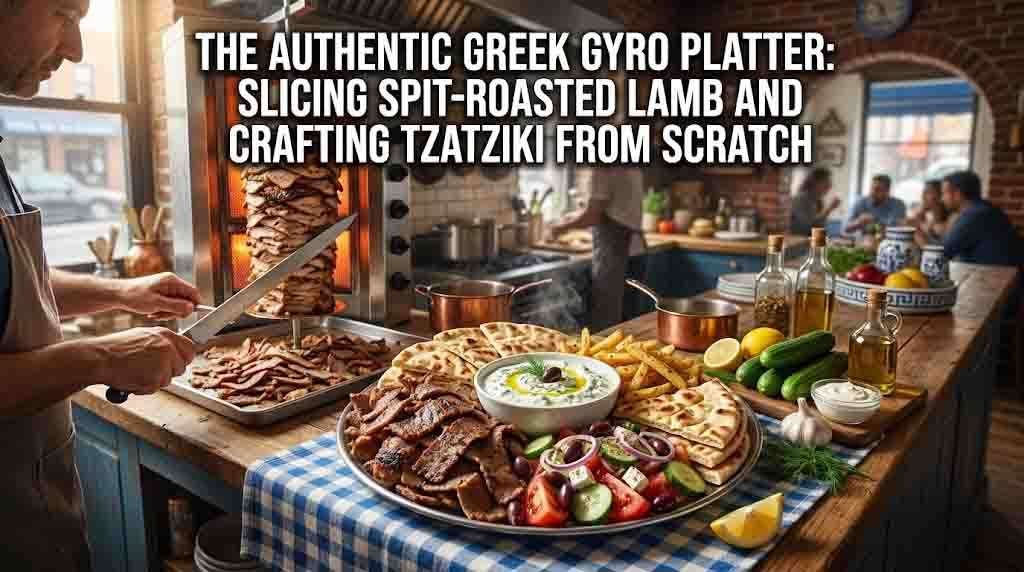
When you’re ready to slice, use a sharp carving knife and cut thin — no more than ¼ inch. Then lay the slices on a foil-lined baking sheet and run them under the broiler for 2 to 4 minutes. This is the step that changes everything. The broiler crisps the edges and gives the meat that characteristic charred exterior you’d get from a commercial rotisserie, without any special equipment. Watch it closely — the broiler moves fast.
Tzatziki from Scratch: No Shortcuts
Tzatziki is three things: full-fat Greek yogurt, cucumber, and garlic. Everything else is refinement. Low-fat yogurt produces a thin, watery sauce that pools in the pita and defeats the purpose. Use full-fat. This is not the place to negotiate.
The process:
- Grate one English cucumber on the large holes of a box grater. Wrap it in a clean kitchen towel and wring out as much moisture as you can — aggressively. Wet cucumber ruins the texture.
- In a bowl, combine: 2 cups full-fat Greek yogurt, the wrung cucumber, 2 to 3 cloves of grated garlic, juice of half a lemon, a tablespoon of good olive oil, fresh dill, salt to taste.
- Stir well. Cover and refrigerate for at least an hour before serving.
The resting time isn’t optional. An hour in the refrigerator lets the garlic bloom into the yogurt and the dill settle into the sauce. What comes out is cooler, sharper, and more cohesive than what went in.
Assembly: The Platter as Composition
Warm your pita on a dry cast-iron griddle until soft and slightly blistered — 60 seconds per side. Use the thick Greek-style pita, not the thin pocket variety. It needs to hold everything without tearing.
Spread tzatziki generously across the surface. Layer the lamb. Add sliced tomato, thinly shaved red onion, and if you’re being honest with yourself, a small pile of crispy fries tucked in alongside the meat. In Greece, it’s traditional to tuck french fries directly into the wrap — this is not an indulgence, it’s the authentic way. Crumbled feta over the top is optional but earns its place.
The Heritage Angle
My parents ran Greek diners in Brooklyn long before I opened The Heritage Diner in Mount Sinai, and the gyro was always present — on menus, at family tables, at celebrations. What I’ve learned from 25 years in a kitchen is that the dishes people return to most reliably are the ones built on restraint and good sourcing, not complexity. The gyro is proof of that: a handful of ingredients, properly handled, that has outlasted nearly every food trend of the last half-century.
At The Heritage Diner, we’ve always believed the quality of the animal matters as much as the technique. Source your lamb from a reputable butcher who can speak to the provenance. A grass-fed lamb shoulder from a local farm will cook differently and taste demonstrably better than commodity product.
This is a dish that demands nothing exotic and forgives very little carelessness. Treat the lamb with patience. Make the tzatziki from scratch. Warm the pita properly. The rest takes care of itself.