Some links in this post are Amazon affiliate links. As an Amazon Associate, Heritage Diner earns from qualifying purchases at no extra cost to you.
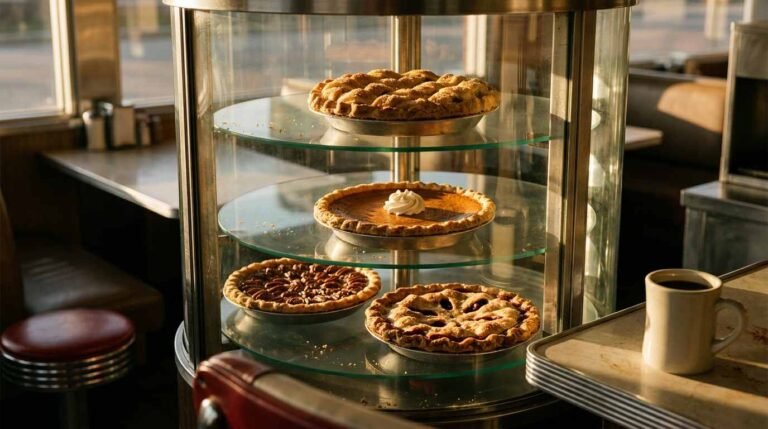
You sat down for eggs. You did not plan on pie. Then the glass case turned, the light caught a slice of lemon meringue as tall as a hat, and the check came back with something extra on it.
That is not an accident. The dessert case is one of the most deliberate pieces of furniture in a restaurant.
Why it turns
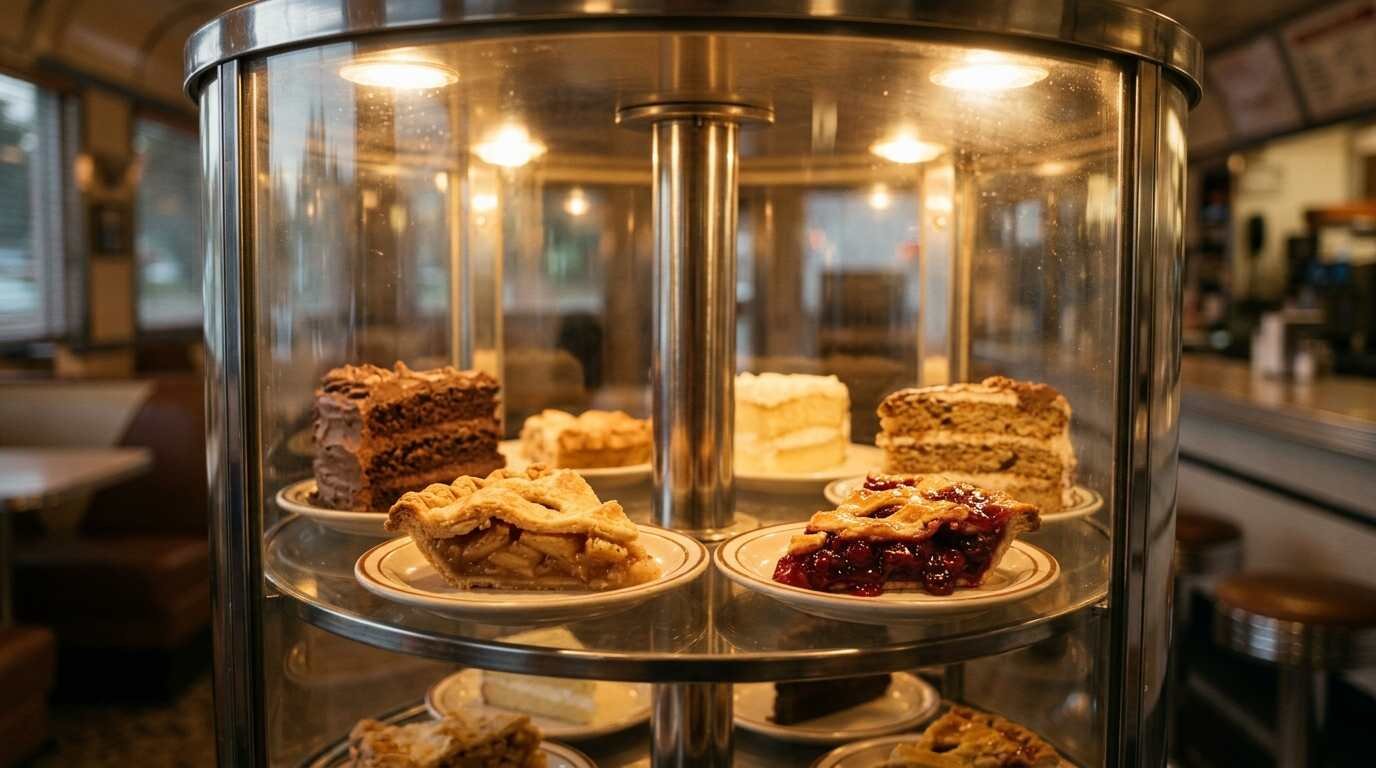
A rotating case shows every pie to every seat. A fixed case favors the stools nearest to it, while a slowly turning one puts the whole lineup in front of the counter and the booths in rotation. The movement itself draws the eye, and the lights inside make the food glow.
Display is sales. A dessert that people can see is a dessert people order. Many customers decide on pie only after the sight of it, which makes the case a silent salesperson that works every shift.
The economics, in plain terms
Opinion, reasoned from how kitchens work: desserts are often a good business for a restaurant because the ingredients cost little compared with the price of a slice, and the labor can be done in advance. Flour, sugar, fruit and butter go a long way. A single pie yields several portions, and each slice is a clean, countable unit.
A dessert also adds to the check without taking up table time. The customer is already seated, already paying for coffee, and a slice of pie lengthens the visit only slightly. I am describing the logic here, not citing a number, and margins differ widely from place to place.
Waste is the other half. A pie that goes unsold loses money. So the case is managed: fresh pies go to the back, older ones come to the front, and the slices nearest the end of their best days are the ones featured in the special.
Cake under glass
Layer cakes hold up in a case better than most desserts, which is part of why they are there. A frosted cake seals its own crumb, so it stays moist for a day or two. Buttercream and ganache are stable at room temperature for a limited time, but frostings made with cream cheese or whipped cream need cold storage.
A cake also has a presence. A tall one in the middle of the case, with a few slices already cut to show the layers, does the same selling as a pie. The cut face is the advertisement.
Many diners buy cakes and pies from a baker, and others bake their own. Either way, the case is a showroom, and everything in it is expected to look its best at any moment.
Rotation of stock
The word rotate has a second meaning in kitchens. First in, first out is the rule for everything, and the case is no exception. When a new pie comes out, it is placed behind the older one, and the older one sells first. A good manager checks the case every day.
Fruit pies tolerate a day or so on the counter. Cream, custard and meringue pies are different.
What has to stay cold. Pies made with eggs and dairy, such as cream, custard, pumpkin and chiffon pies, belong in the refrigerator. Food safety guidance says that perishable foods should not sit at room temperature for more than two hours, and pumpkin and custard pies fall into that category. Many cases are refrigerated for this reason, and you may notice a cool window.
Fruit pies, such as apple and cherry, are commonly kept at room temperature for a short period, but longer storage belongs in the refrigerator. Check current food safety guidance for details.
At home, the same rules apply. Cover leftover pie, refrigerate perishable fillings within two hours, and eat them within a few days.
What the case teaches the home baker
A pie sells itself when it looks good. A tall meringue, a lattice with even gaps, a golden crust brushed with egg wash. The case rewards attention to presentation, and so does your own table.
It also teaches restraint. A diner does not stock fifteen pies. It carries a handful of favorites and rotates seasonal ones in. Pick two good pies and make them well.
The last slice. There is an old habit among regulars of asking, “What is good today?” The server looks at the case, thinks, and says one name. That is the real economics of the dessert counter: a small recommendation, a fork and a cup of coffee, and a stranger turned into a regular.
Slicing and portion control
A pie is cut into a set number of slices, usually six or eight, and that decision is made before the first one is sold. Portion size affects the plate, the price and the margin. A cook cuts with a thin, sharp knife dipped in hot water for clean edges, and uses a pie server to lift each wedge without breaking the crust.
At home, the same trick works. Run the knife under hot water and wipe it between cuts. Let the pie cool completely before slicing, or the filling will run. A pie server makes the first slice, which is the hardest, much easier.
The first slice out of any pie is always a bit ragged. Serve it to yourself.
Case etiquette for the home table. If you are serving pie to guests, borrow the habit: cut the first slice before dinner so the pie looks inviting, keep it on a plate or stand where everyone can see it, and put cream-based pies back in the refrigerator the moment dessert ends.