If you’ve spent any time online in the last decade, you’ve probably heard the term “open source” thrown around like confetti at a tech conference. Maybe you’ve nodded along, pretending to understand, while secretly wondering: Is this just another buzzword, or does this actually matter?
Here’s the truth: open source isn’t just some philosophical debate happening in basement server rooms. It’s quietly reshaping the entire technology landscape — and it directly affects your privacy, your wallet, and the tools you use every day. By 2026, the open source software market has reached $66.24 billion and is growing at 16.4% annually. Meanwhile, 96% of organizations report increasing or maintaining their use of open source software.
But what exactly is open source? How does it differ from the polished, professionally marketed software from companies like Microsoft, Apple, and Adobe? And most importantly — why should you, as a regular person just trying to get work done, care about any of this?
Let’s break it down in plain English.
The Restaurant Analogy: Understanding Open vs. Closed
Imagine two restaurants. The first one — let’s call it “Proprietary Palace” — has a secret recipe for their signature dish. You can order it, pay for it, eat it, and even subscribe to a monthly meal plan. But you’ll never know what’s in it, you can’t modify it, and if you don’t like one ingredient, tough luck. The chef says “trust me, it’s perfect as-is.”
The second restaurant — “Open Source Kitchen” — gives you the complete recipe. Not just that, they encourage you to tweak it, share your improvements with other diners, and even open your own restaurant using their recipe (with proper credit, of course). Sometimes the food is free, sometimes you pay for the fancy service or premium ingredients, but the recipe itself is always transparent.
That’s essentially the difference between proprietary (closed-source) and open source software.
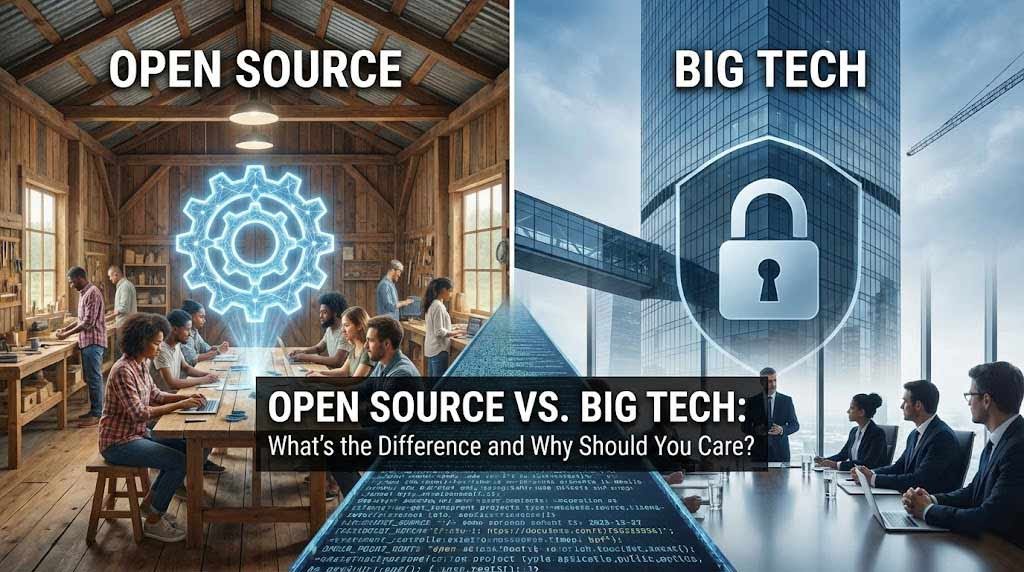
Proprietary software is owned and controlled by a single company. The source code — the underlying instructions that make the software work — is kept secret. You pay for a license to use it, but you don’t own it, can’t modify it, and must accept whatever terms the company dictates. Think Microsoft Windows, Adobe Photoshop, or Apple’s macOS.
Open source software makes its source code publicly available. Anyone can inspect it, modify it, and redistribute it (within the terms of its license). The code is developed collaboratively, often by communities of developers worldwide. Think Linux, Firefox, or LibreOffice.
The Numbers Tell a Story: Open Source Is Winning
Here’s what might surprise you: open source has already won in many areas you interact with daily, even if you’ve never heard of it.
The Internet Runs on Open Source: 95% of all websites use open source software. If you’ve ever used Google, watched Netflix, or scrolled through Instagram, you’ve benefited from open source infrastructure. Linux, the open source operating system, powers the world’s top 500 supercomputers and 82% of smartphones globally (through Android).
Businesses Are All In: 96% of organizations use open source in some capacity. Companies aren’t adopting it because it’s trendy — they’re doing it because open source software saves businesses approximately $60 billion annually in development costs. That’s not pocket change; that’s the entire GDP of a small country.
Developers Love It: 55% of developers contribute to open source projects, and 61% say they’re more likely to work for a company that contributes to open source. The developer community has created over 200 million open source repositories on GitHub alone, representing software valued at over $400 billion.
As one engineering lead at a Fortune 500 company told TechCrunch in late 2025: “Ten years ago, choosing open source was seen as risky. Today, not choosing it is what’s risky. The innovation happens there first.”
The Real-World Differences: What This Means for You
Let’s get practical. What are the actual differences between these two approaches, and how do they affect your life?
Cost: It’s Not What You Think
The common perception is that open source = free, proprietary = expensive. That’s partially true but misleading.
Many open source solutions are indeed free to download and use. Linux, LibreOffice, GIMP, and thousands of other tools cost $0. But “free” isn’t the full story. For enterprises, open source can involve costs for support, training, customization, and maintenance. A company might spend $100,000 on open source support contracts — but that’s often still cheaper than $500,000 in proprietary licenses plus support.
Proprietary software has clear upfront costs. Microsoft Office 365 costs $6-$22 per user per month. Adobe Creative Cloud is $60/month. These prices are predictable, which companies like, but they add up fast. A 100-person company pays $72,000-$264,000 annually just for basic productivity software.
The hidden cost difference is vendor lock-in. Once you’ve built your entire infrastructure around proprietary software, switching is expensive and painful. You’re at the vendor’s mercy for pricing. As one CTO put it in a 2025 interview: “We spent two years and $3 million migrating off Oracle. If we’d used open source from the start, we’d never have been trapped.”
Flexibility and Control: Who’s Really in Charge?
With proprietary software, you get what they give you. Don’t like a feature? Too bad. Need a specific integration? Hope the vendor adds it. Want to fix a bug? Wait for the next patch (maybe).
Open source flips this dynamic. If you need something changed, you can change it yourself (or hire someone to do it). You’re not waiting for a vendor’s product roadmap to align with your needs.
This matters more than it sounds. Consider a real example from 2024: A healthcare startup needed their medical records system to integrate with a specific lab’s equipment. The proprietary vendor quoted them $250,000 and a 14-month timeline. They switched to an open source alternative, hired a contractor for $30,000, and had it working in 6 weeks.
Security and Privacy: The Transparency Paradox
Here’s where things get interesting. Critics of open source argue: “If everyone can see the code, doesn’t that make it easier to hack?”
The reality is exactly the opposite. Open source operates on the principle of “many eyes make all bugs shallow.” When thousands of developers can review code, security vulnerabilities get found and fixed faster. Proprietary software relies on a small internal team — and if they miss something, nobody outside the company can help.
The numbers back this up: According to the 2025 State of Open Source Report, organizations using open source experience 30% fewer security incidents than those relying solely on proprietary software. Why? Transparency forces better security practices.
There’s also the privacy angle. With proprietary software, you have no idea what data it’s collecting or where it’s sending that data. Open source is transparent — you can verify exactly what it’s doing. This matters in an era where every company wants to monetize your data.
Support: The Trade-Off
Proprietary software wins on the convenience of support. You have a vendor to yell at when things break. Call their support line, open a ticket, escalate to management. It’s clear who’s responsible.
Open source support is more varied. Popular projects like Linux have excellent commercial support options (Red Hat, Canonical, etc.). Smaller projects might rely on community forums, documentation, and Stack Overflow. The quality ranges from “better than any proprietary vendor” to “good luck figuring it out yourself.”
However, this picture has changed dramatically. The open source services market reached $50 billion in 2026. Commercial support for open source is now big business, with companies offering enterprise-grade SLAs that rival or exceed proprietary vendors.
The Hidden Third Category: Open Core and Hybrid Models
Here’s where it gets messy: the line between open and closed is blurring.
Many modern companies use an “open core” model: the basic software is open source, but premium features, enterprise support, or hosted services cost money. MongoDB, GitLab, and Elastic all follow this approach.
Is that open source? Technically yes for the core product. Is it free? Not if you want the good stuff.
Then there’s the question of big tech “embracing” open source. Microsoft — once open source’s biggest enemy — now owns GitHub, open sources many tools, and contributes extensively to Linux. Google releases open source projects constantly (TensorFlow, Kubernetes, Chromium). But they also control the direction of these projects and extract massive value from the ecosystem.
As one open source maintainer told Wired in 2025: “Microsoft contributes code to Linux, then uses that Linux to run Azure cloud services that compete with other Linux vendors. They’re not heroes or villains — they’re playing a complex game.”
The Long Island Connection: Why Local Tech Ecosystems Matter
You might be wondering: what does any of this have to do with Long Island?
More than you’d think. New York City has become the world’s second-largest tech hub, with over 25,000 startups valued at $189 billion. That growth radiates outward — Long Island increasingly attracts tech companies and remote workers who want NYC’s opportunities without Manhattan’s prices.
Many of these companies rely heavily on open source. The startups in Brooklyn’s Tech Triangle, the fintech firms in Manhattan, and the emerging AI companies in Queens all build on open source foundations. They use open source because it allows rapid innovation at lower cost.
For Long Island residents working in tech or considering entering the field, understanding open source versus proprietary software is essential. The job market reflects this: 92% of executives plan to hire AI talent in the next three years, and most AI development happens in open source environments (PyTorch, TensorFlow, Hugging Face).
Making the Choice: What Should You Actually Use?
For individuals, the answer depends on your priorities:
Choose Proprietary If You Want:
- Polished, user-friendly interfaces with minimal learning curve
- Guaranteed customer support with clear accountability
- Seamless integration between products (Apple ecosystem, Microsoft Office suite)
- No need for technical tinkering
Choose Open Source If You Want:
- Complete control over your data and privacy
- Freedom to modify and customize
- No vendor lock-in or recurring subscription fees
- Support for older hardware (open source often runs on less powerful machines)
For businesses, the calculation is more complex. The 2025 State of Open Source Report found that 96% of organizations now use both open source and proprietary software in a hybrid approach. Few companies go 100% either way.
The trend is clear, though: open source adoption is accelerating, especially in cloud infrastructure, AI/ML, data analytics, and developer tools. Proprietary software still dominates in areas requiring heavy specialization or certification (CAD software, certain medical applications, highly specialized industry tools).
The Future: Open Source and AI
The biggest shift happening right now is AI — and open source is at the center of it.
In January 2026, Meta released Llama 4, the latest in their series of open source AI models. Google’s Gemini and OpenAI’s GPT are proprietary, but Meta’s decision to open source their AI has sparked massive innovation. Smaller companies and researchers can now build on Llama’s foundation rather than starting from scratch.
This pattern is repeating across AI: open source models like Mistral, Falcon, and DeepSeek are challenging proprietary giants. The open source AI ecosystem raised over $6 billion in 2022 alone, and that number has only grown.
Why does this matter? Because AI is going to reshape nearly every job and industry in the coming decade. Whether that AI is controlled by a handful of corporate giants or distributed across open, inspectable systems will determine a lot about our technological future.
As one AI researcher at NYU told The Verge: “Proprietary AI is like giving one company control over electricity. Open source AI distributes that power. The stakes couldn’t be higher.”
The Bottom Line: It’s About Control
Strip away all the technical jargon, and this debate comes down to one question: Who controls the software that runs your life?
With proprietary software, the vendor controls it. They decide features, pricing, terms of service, and what data they collect. You’re renting access to tools that someone else owns.
With open source, control is distributed. Users collectively have power through transparent code, the ability to fork projects, and community governance. No single entity can unilaterally make changes.
Neither is perfect. Proprietary software can offer better user experience and support. Open source can suffer from fragmentation and inconsistent quality. But as we move into an era where software mediates nearly every aspect of our lives — our health records, financial transactions, communications, and now our artificial intelligence — the question of control becomes existential.
The good news? You don’t have to pick a side completely. Most people and organizations use both, choosing the best tool for each job. But being informed about the difference gives you power — the power to make intentional choices about the technology you depend on.
So the next time someone mentions open source, you’ll know it’s not just another tech buzzword. It’s a fundamental philosophy about who owns technology, who benefits from it, and what kind of digital future we’re building together.
Related Articles
- How Long Island Tech Workers Are Leveraging Open Source Skills
- The Hidden Infrastructure That Powers Your Favorite Apps
- Why Major Companies Are Moving Away From Vendor Lock-in
- Building Your First Open Source Project: A Beginner’s Guide
Sources
- Open Source Initiative – 2026 State of Open Source Survey
- ZipDo Education – Open Source Software Statistics 2024-2026
- OpenLogic – Open Source Trends and Predictions for 2026
- The Linux Foundation – Census III of Free and Open Source Software
- Nebius – Open-source vs Proprietary Software Comparison
- Heavybit – Open-Source vs. Proprietary Software Analysis
Watch: Open Source Explained in 5 Minutes https://www.youtube.com/watch?v=PVD1LNDxOnc