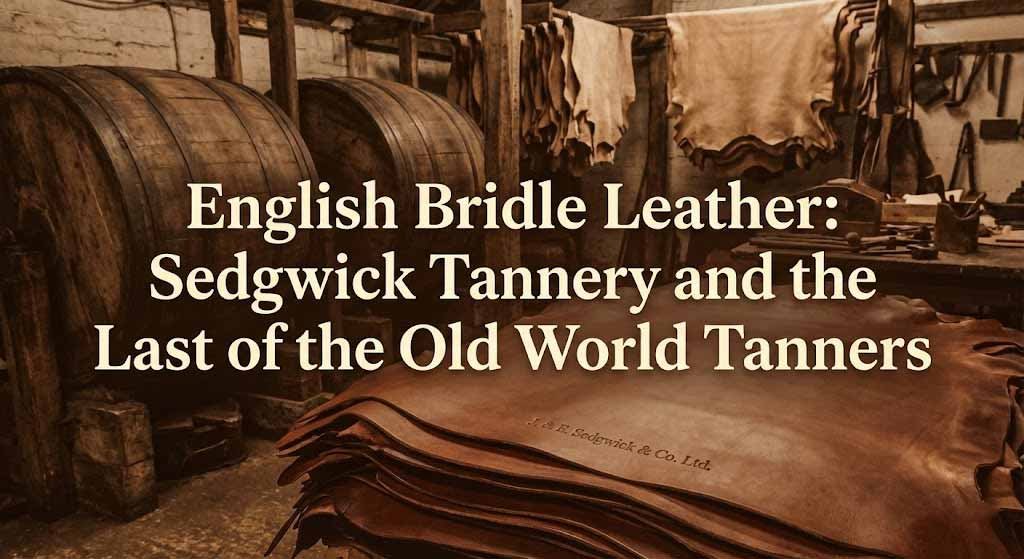
There is a moment, early in the morning at our workshop, when the light catches a freshly unpacked side of Sedgwick English bridle and the entire room changes. The wax bloom sits on the surface like frost on a January field—white, spectral, ancient in its chemistry. You run a thumb across it and the leather beneath reveals itself: tight-grained, dense as a closed fist, radiating that unmistakable scent of tallow and tannin that no synthetic process on earth has ever replicated. That single side of leather, stamped with the mark of J & E Sedgwick & Co. of Walsall, England, represents the culmination of a craft tradition stretching back centuries—and one that, by nearly every honest metric, is approaching extinction. In an era when ninety percent of the world’s leather is chrome-tanned in hours using chromium salts and industrial drums, the surviving vegetable tanneries of England and America stand as defiant monuments to a different understanding of time, material, and what it means to make something that will outlast the person who made it. This is the story of those tanneries—specifically of Sedgwick and its counterpart across the Atlantic, Wickett & Craig—and of the leather they produce for makers like us at Marcellino NY who refuse to accept anything less than the absolute standard.
The Weight of Walsall: A Town Built on Hide and Iron
To understand Sedgwick, you must first understand Walsall. Situated in the West Midlands—the industrial corridor the British call the Black Country—this unassuming town once contained the highest concentration of saddlers, curriers, leather merchants, and brass foundries in all of northern Europe (The Field, 2016). By 1900, more than a hundred companies were exporting equestrian goods from within a square mile of Walsall’s center to every outpost of the British Empire: saddles to India, bridles to Australia, harness leather to the cavalry regiments that would, within fifteen years, ride into the mechanized slaughter of the Western Front. A single Walsall saddlery firm supplied one hundred thousand saddles to the British Army in a single year during the First World War (Tim Hardy, “History of the Walsall Leather Industry,” 2023). Rows of Victorian terraced houses bore signs proclaiming the nature of the leather business carried on behind their doors—curriers alongside bit-makers alongside buckle foundries, an entire ecosystem of interrelated trades that had evolved organically over centuries.
J & E Sedgwick & Co. was established in 1900, in the final years of this golden age, as leather curriers and finishers. It is a distinction worth pausing on: Sedgwick did not simply tan hides. They received already-tanned leather and put it through the dressing process—the dyeing, waxing, stuffing, and hand-finishing that transforms a rigid, tanned hide into the supple, luminous, waxy material the trade calls English bridle. Richard Farrow, who runs the company and started his apprenticeship there in 1963, represents the third generation of his family in the business. As he told The Field in a widely cited interview, “I can remember a time when there were six tanneries and nineteen curriers in the town, but today we’re pretty much the only ones left” (The Field, 2016). The company moved into their current Walsall site in 1954, and while the surrounding streets have lost their Victorian leather trades to time and globalization, Sedgwick’s curriers still hand-wax and hand-color every piece of leather that leaves the shop.
That phrase—”hand-finished”—is not marketing language. It is an operational reality that separates Sedgwick from virtually every other leather producer on the planet, and it is the reason that when I source hides for a Marcellino NY briefcase destined for a Manhattan law office or a surgeon’s private study, Sedgwick remains the gold standard.
The Alchemy of English Bridle: What the Process Actually Entails
The term “English bridle leather” refers not to a single material but to a specific finishing tradition with roots in the equestrian trades. Originally developed for horse tack—the bridles, reins, and harnesses that needed to withstand English rain, sweat, and decades of daily use—bridle leather is distinguished by a multi-stage process that goes well beyond basic vegetable tanning (Glenroyal Journal, 2024).
The process begins with hide selection. Sedgwick sources only the highest-quality cattle hides from the United Kingdom and Ireland, with a well-known preference for animals raised in Devon and Dorset, where cleaner farming practices produce hides with fewer barbed-wire scars, tick marks, and growth blemishes. As Farrow explained, “You never quite know what you’re dealing with until all the hair comes off. We want forty-kilogram-plus hides from beef cattle, but not those fattened too quickly, as they have growth marks” (The Field, 2016). This selectivity mirrors what we practice at the Heritage Diner when sourcing proteins—the invisible upstream decisions that determine whether the final product is merely adequate or truly exceptional.
Once selected, the hides undergo vegetable tanning in pits—not drums. Pit tanning is the ancient method, the one that demands patience measured in weeks rather than hours. The hides are submerged in vats containing vegetable tannins and slowly, over approximately twenty-eight days, the tannins penetrate the collagen structure of the skin, transforming it from a perishable biological material into stable, enduring leather (Atlas Leathercraft, 2024). This is the inverse of chrome tanning, which achieves the same chemical stabilization in a single day using chromium salts—a process that produces roughly ninety percent of the world’s leather and, not coincidentally, produces a material that will never develop the patina, structural integrity, or tensile strength of properly vegetable-tanned bridle.
After tanning comes the currying—the stage where Sedgwick’s artisans truly earn their reputation. The leather is aniline-dyed in deep, traditional shades: London Tan, Conker, Hazel, Navy, Black, Red. Then comes hot stuffing, the defining step: the hides are impregnated with a proprietary mixture of tallow, fish oils, and beeswax, each tannery guarding its specific recipe like a family heirloom (Filly & Fox, 2025). This is what gives bridle leather its weather resistance, its flexibility, and its characteristic “bloom”—the ghostly white wax that rises to the surface in dry conditions and can be buffed out to reveal a deep, luminous sheen. Finally, both the grain side and the flesh side are polished with glass or steel slickers under heavy pressure, producing the dual-finished surface that is the hallmark of genuine bridle leather.
This dual finishing is rare and almost never found outside the English tradition. When both sides of the leather are sealed, waxed, and polished, the result is a material of extraordinary density and resilience—the kind of leather that, when you pick up a Marcellino briefcase made from Sedgwick hide, gives you the physical sensation that you are holding something that was built to survive you.
Across the Atlantic: Wickett & Craig and the American Tradition
If Sedgwick represents the old-world apex of English bridle leather, then Wickett & Craig of Curwensville, Pennsylvania represents its most formidable American counterpart. Founded in 1867—thirty-three years before Sedgwick—Wickett & Craig spent its first 123 years in Toronto, Canada, before the city expropriated their property in 1989 in anticipation of an Olympic bid that never materialized (Stitchdown, 2020). The company relocated to an abandoned cheese factory in rural Pennsylvania, rebuilt their operation from the ground up inside a 180,000-square-foot shell, and resumed production in 1991. Today, their sixteen-acre facility produces approximately 4.5 million square feet of leather annually, making them one of only two remaining vegetable tanneries in the entire United States (Filson Journal, 2020).
The Wickett & Craig process shares DNA with Sedgwick’s but diverges in critical ways. Their hides—jumbo heavy native steers, sourced from North American cattle of European stock, specifically breeds like Charolais, Simmental, and Limousine chosen for their light-colored hair follicles—spend two weeks soaking in seventy-two vats filled with a proprietary blend of Mimosa and Quebracho bark tannins (Wickett & Craig, 2024). The hides are then drum-dyed, fat-liquored with conditioning oils and waxes, and hot-stuffed with tallows for enhanced durability. The total process takes approximately six weeks from raw hide to finished leather.
The practical differences between Sedgwick and Wickett & Craig are subtle but, for the craftsman, profound. We describe it this way on the Marcellino NY leather page, and it remains the most honest assessment I can offer: the UK bridle leather is stiffer, waxier, and has a greasy top coat that, as it softens and dries with use, eventually approaches the temper of the American bridle leather as you would receive it new. Sedgwick’s leather arrives with that dramatic wax bloom, a tighter grain reminiscent of shell cordovan, and a firm temper that demands patience from the maker—you must earn the leather’s cooperation through careful handling, precise cutting, and the steady accumulation of hand-stitched miles. Wickett & Craig’s bridle arrives smoother, more immediately workable, with a mid-temper and a drum-dyed evenness that makes it exceptionally consistent across large production runs.
Neither is superior in any absolute sense. They are, rather, expressions of different philosophies forged by different landscapes—one shaped by the damp, equestrian traditions of the English Midlands, the other by the American pragmatism of making a material that works hard from the first day it leaves the tannery.
The Decline That Should Frighten Every Maker
The numbers tell a story that no amount of artisanal romanticism can obscure. In the past seventy years, the United Kingdom has lost more than four hundred tanneries. Only twenty-three remain, and of those, a mere four practice traditional bark tanning (Warriner Leather, 2025). Eighty percent of British cattle hides are now shipped abroad for processing, ten percent are simply discarded, and the remaining ten percent are tanned domestically. Traditional oak bark tanning—the method that predates Sedgwick’s vegetable tanning by centuries—has been classified as “critically endangered” on the Heritage Crafts Red List, the same designation given to skills on the verge of complete disappearance from British culture (Cotmarsh Farm, 2025).
J & FJ Baker & Co. in Colyton, Devon, stands as Britain’s last remaining traditional oak bark tannery, operating on a site that has been used for leather production since Roman times. Their process takes fourteen months per hide, using bark from sustainably coppiced English oaks, water from the River Coly, and a 400-year-old water wheel mechanism to agitate the tanning pits (J & FJ Baker, 2024). Baker’s represents the most extreme end of the temporal spectrum—a year-long commitment to a single piece of leather, in an age when chrome tanning achieves a passable result before lunch.
In America, the picture is similarly grim. Wickett & Craig is one of only two vegetable tanneries left in the entire country. The demand for handmade saddles, holsters, and leather goods that once sustained dozens of domestic tanneries has been supplanted by the global appetite for cheap, chrome-tanned material produced in developing nations at a fraction of the cost. As Matt Bressler, Wickett & Craig’s Vice President, noted in a candid interview with Stitchdown, the company nearly vanished entirely when its parent corporation went bankrupt in 2004—only to be rescued by its own hide supplier, Bank Bros of Toronto, who recognized the tannery’s irreplaceable expertise (Stitchdown, 2020).
This is the context in which every Marcellino briefcase is made. Each piece of Sedgwick or Wickett & Craig leather that arrives at our bench carries the weight of a tradition that the market, left to its own devices, would have already killed.
Why the Difference Matters: The Patina Argument
There is a concept I return to constantly in this work, whether I am talking about the seasoning of a cast-iron skillet at the Heritage Diner, the maturation of a neighborhood like Mount Sinai into something worth investing in alongside Paola, or the aging of a leather briefcase: the Patina of Time. Patina is not wear. Patina is the visible record of a material’s dialogue with the life of its owner—the darkening of the grain where hands grip a handle, the softening of a panel where documents press against it daily, the deepening of color that comes from years of exposure to sunlight and air and the natural oils of human skin.
Vegetable-tanned English bridle leather develops patina because its open, tannin-rich fiber structure is chemically receptive to these inputs in ways that chrome-tanned leather simply is not. The waxes and tallows stuffed into the hide during currying migrate and redistribute over time, creating shifts in luster and tone that make each piece genuinely unique after a year of use. The tannins themselves continue to oxidize slowly, deepening the color palette in ways that are impossible to predict or replicate artificially. A Sedgwick London Tan briefcase that begins its life as a warm, honey-gold will, over five or ten years, evolve into a deep amber with undertones that no dye house could manufacture. This is the material equivalent of what happens to a good neighborhood—or a good restaurant—given enough time and authentic use.
Chrome-tanned leather, by contrast, maintains a more static appearance. It resists patina because its chromium-stabilized fiber structure is less absorbent, less reactive, less alive. It is leather designed to look the same on day one thousand as it did on day one. For some applications, that stability is a virtue. For a bespoke briefcase intended to become an heirloom, it is a disqualification.
The Marcellino Standard: Why We Source from Both Traditions
At Marcellino NY, we use Grade A full-grain vegetable-tanned English bridle leather from both American tanneries and imported UK sources, depending on availability and the specific requirements of each commission. This is not indecisiveness—it is connoisseurship. A client requesting a structured attaché for daily courtroom use may be better served by the firmer temper and dramatic bloom of Sedgwick. A client seeking a weekend briefcase with an immediately supple hand may find Wickett & Craig’s mid-temper bridle more appropriate from the first day of use.
The common thread is the refusal to compromise on grade. Both tanneries produce leather with extraordinary tensile strength, superb edge-burnishing characteristics, and the capacity to accept hand-stitching without tearing or delaminating under stress. Both produce leather that, when cut, reveals a cross-section of saturated color extending deep into the fiber—proof of proper drum-dyeing and hot-stuffing rather than the surface-only pigmentation found in inferior materials. Both produce leather that smells like something made by human hands from natural materials, not like something extruded from a chemical plant.
These are the details that remain invisible to anyone who has never held the material, and they are precisely the details that define a Marcellino piece the way twenty-five years of six-AM openings define the Heritage Diner—not through advertising, but through the accumulated evidence of showing up and refusing to cut corners.
The Obligation of the Bespoke Maker in a Disposable Age
The closing of nearly every traditional tannery in the Western world is not merely an industrial statistic. It is a civilizational failure—the logical endpoint of a consumer culture that has systematically devalued duration in favor of convenience. When a society loses its tanneries, it does not simply lose the ability to produce a specific material. It loses the curriers who know how to read a hide’s grain structure by touch. It loses the recipes for hot-stuffing mixtures that have been refined over generations. It loses the understanding that some things cannot be accelerated without being destroyed, that the twenty-eight days a Sedgwick hide spends in the tanning pit are not a manufacturing inefficiency but a non-negotiable requirement of the chemistry involved.
This is why the bespoke maker’s role—whether the craft is leather, food, or the careful curation of a real estate portfolio on the North Shore—has never been more critical. Every Marcellino briefcase that enters circulation carrying Sedgwick or Wickett & Craig leather is a small, tangible argument against the disposable. Every meal served at the Heritage Diner from a kitchen that has been running for a quarter century is the same argument in a different register. And every property that Paola and I identify and develop in Mount Sinai is built on the same conviction: that communities, like materials, require time, care, and the unseen details to achieve their full expression.
The last of the old-world tanners are not relics. They are the standard. The question is whether enough makers, enough consumers, and enough communities remain willing to pay the price—measured not only in dollars but in patience and attention—that the standard demands. At Marcellino NY, at the Heritage Diner, and in every venture that bears our name, the answer has never been in doubt.
Sources Cited:
- The Field, “Walsall Leather: Where to Buy the Best,” 2016
- Tim Hardy, “The History of the Walsall Leather Industry,” 2023
- Stitchdown, “Veg-Tanner Wickett & Craig’s History, Process, and Push Into Footwear,” 2020
- Filson Journal, “Wickett & Craig x Filson: American Made Leather,” 2020
- Warriner Leather, “The Art and Science of Leather Tanning,” 2025
- Cotmarsh Farm / Great Cotmarsh Farm, “Cotmarsh Tannery,” 2025
- Glenroyal Journal, “5 Things to Know About Bridle Leather,” 2024
- Filly & Fox, “What is Traditional English Bridle Leather,” 2025
- Atlas Leathercraft, “The Leather,” 2024
- J & FJ Baker & Co., Official Tannery Documentation, 2024
- Wickett & Craig, “Vegetable Tanning Process,” 2024
- Stitchdown, “A Chat with Andrew Parr of J&FJ Baker,” 2023
Related Viewing:
- Wickett & Craig Vegetable Tanning Process: https://wickett-craig.com/vegetable-tanning/
- J & FJ Baker Oak Bark Tanning Process: https://www.jfjbaker.co.uk/the-process
- Marcellino NY Leather Choices: https://marcellinony.com/leather-choice/