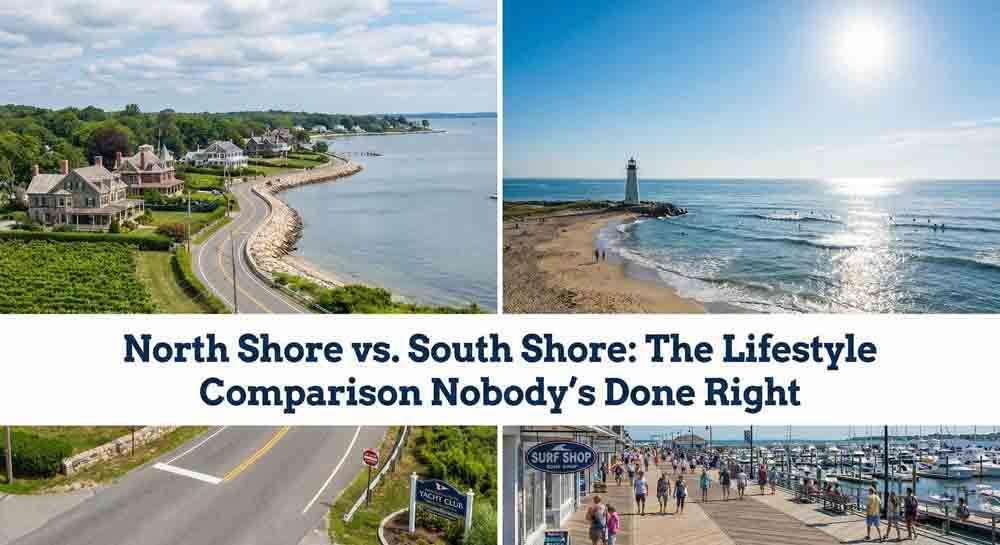
There is a question that has fractured Long Island dinner tables for generations, a question as loaded as a Thanksgiving turkey and twice as divisive: Which shore? It is the question that real estate agents dance around with practiced diplomacy, that LIRR commuters answer with the fervor of theological conviction, and that newcomers from the city naively assume they can resolve with a weekend of open houses and a Zillow subscription. They cannot. The North Shore versus South Shore debate is not a real estate question. It is a philosophical one — a referendum on what you believe a life well-lived actually looks like. And after twenty-five years of operating The Heritage Diner on Route 25A in Mount Sinai, after building a bespoke leather atelier that ships Marcellino NY briefcases to clients from Midtown to Milan, and after watching my wife Paola navigate the North Shore luxury market with the precision of a Swiss horologist, I can tell you with absolute certainty: nobody has done this comparison right. Until now.
Every listicle you have ever read on this topic commits the same sin. They reduce two profoundly different ways of living to a spreadsheet of median home prices and school rankings, as though choosing between the North Shore and the South Shore were no different than choosing between two dishwashers at Home Depot. The data matters — and I will give you more of it, more rigorously sourced, than any comparison you have encountered — but data without context is noise. What follows is the comparison Long Island deserves: grounded in numbers, enriched by history, and filtered through the hard-won perspective of someone who has staked three careers on the belief that the North Shore is not merely a place to live, but a philosophy of living.
The Geology of Identity: How Two Glaciers Created Two Cultures
Before a single Gold Coast mansion was erected, before Robert Moses bulldozed his way to Jones Beach, the fundamental character of each shore was already determined — roughly 21,000 years ago, when the Wisconsin glacier ground to a halt across what would become Long Island. The Harbor Hill Moraine, the glacier’s terminal debris field, created the North Shore’s defining topography: rolling hills, bluffs reaching heights of over a hundred feet, rocky beaches punctuated by glacial erratics the size of automobiles, and a coastline so jagged with peninsulas and harbors that it resembles the New England coast more than anything else in the New York metropolitan area (U.S. Geological Survey, Long Island Coastal Geology). The South Shore, by contrast, is the outwash plain — the glacial runoff that spread south in a gentle, sandy slope toward the Atlantic, creating the flat terrain, barrier islands, and wide white beaches that define everything from Long Beach to Montauk.
This is not mere geological trivia. It is the origin story of two fundamentally different relationships with the landscape. The North Shore’s terrain demands a certain deference. You build into the hills, not over them. Properties are oriented toward harbors and the Long Island Sound, toward sheltered water and wooded privacy. The South Shore’s flat expanse invites the opposite impulse: openness, accessibility, communal beach culture, the democratic sprawl of Jones Beach welcoming six million visitors annually since Robert Moses opened it in 1929 as what he called a “park built for kings” — intended for the common citizen (New York State Parks, 2024). Two glaciers. Two philosophies. One island.
The Money: A Data-Driven Look at Home Prices, Taxes, and True Cost of Living
Let us dispense with vague generalizations and examine the numbers with the precision they deserve. As of late 2025, the Long Island housing market remains one of the most competitive in the nation. The regional median sale price for single-family homes reached $750,000, representing a 6.3% year-over-year increase (EXIT Realty Premier Market Report, November 2025). But the aggregate obscures the divergence between shores, and between the counties that roughly (though imperfectly) map onto them.
Nassau County, which encompasses the western half of the island and contains the most iconic North Shore Gold Coast communities, posted a median single-family home price of $840,000 in late 2025. Suffolk County, stretching east and containing both North Shore communities like Mount Sinai, Port Jefferson, and Northport as well as South Shore towns like Bay Shore, Babylon, and Patchogue, recorded a median of $725,000 — lower in absolute terms but appreciating faster, with month-over-month price growth of 3.42% compared to Nassau’s 0.36% (EXIT Realty Premier, November 2025).
But the North Shore–South Shore divide does not align neatly with county borders. Within Nassau, the Gold Coast communities of the North Shore — Manhasset, Great Neck, Port Washington, Cold Spring Harbor, Oyster Bay — command medians that routinely exceed $1.5 million, with waterfront properties in Huntington and Glen Cove carrying premiums of 50% or more above non-waterfront comparables (PropertyShark, December 2025). South Shore Nassau communities like Rockville Centre, Massapequa, and Merrick offer relative value, with median prices typically ranging from $600,000 to $850,000 — substantial, but meaningfully below their North Shore counterparts.
Property taxes add another layer. Nassau County’s effective property tax rate averages approximately 2.24%, with the median annual tax bill among the highest in the nation (Heller & Consultants, 2025). Suffolk County averages roughly 2.3%. But these averages mask enormous variation by school district. Elite North Shore districts like Syosset, Cold Spring Harbor, and Jericho levy school taxes that can push total annual property tax bills above $25,000 on homes assessed near their median values — a premium that parents pay willingly for districts that consistently rank among the top in the nation. This is not speculation; it is the price of provenance.
For buyers in 2025 and 2026, the critical dynamic is what market analysts are calling the “Great Normalization” — a return to seasonal patterns and predictable appreciation after the volatility of the post-pandemic era. First-time buyers face qualifying income requirements that have skyrocketed alongside Nassau’s median prices, while cash buyers and equity rollers continue to drive the upper-middle and luxury segments, particularly on the North Shore (EXIT Realty Premier, November 2025). Paola and I see this daily in our work: the North Shore luxury market is less rate-sensitive than any other segment on the island, because the buyers who choose it are making a lifestyle decision that transcends mortgage arithmetic.
Schools: The Numbers Behind the Reputation
If there is one category where the North Shore’s dominance is quantifiable and unambiguous, it is education. In Niche’s 2026 Best Schools and Districts rankings, twelve Long Island districts earned spots among the nation’s top 100 — and the concentration on the North Shore is staggering. Syosset claimed the number two ranking nationally. Roslyn surged to number three. Half Hollow Hills reached number nine, and Jericho rounded out the top ten. Eighteen of the top fifty districts in New York State are located in Nassau County; Suffolk contributed eight, giving Long Island twenty-six of the state’s top fifty (Greater Long Island, September 2025).
The specifics are instructive. Syosset’s graduation rate stands at 99%, with an average SAT score of 1400 and per-pupil spending of $33,187 — numbers that rival elite private institutions. The North Shore School District (Glen Cove–Sea Cliff) and Manhasset Secondary School consistently appear among the highest-ranked individual schools in Nassau County according to U.S. News & World Report’s 2026 analysis, with math proficiency scores averaging 69% in Nassau — seventeen points above the state average — and reading proficiency at 62%, thirteen points above the state benchmark (Public School Review, 2025).
The South Shore is not without strong districts. Garden City, Rockville Centre, and Sayville all earn high marks. But the sheer density of nationally ranked districts along the North Shore corridor from Great Neck through Cold Spring Harbor creates a gravitational pull for families who view education as the primary investment in their children’s futures. It is the same logic that drives a client to commission a bespoke Marcellino briefcase rather than purchase something off the shelf: you are paying for the certainty that every detail has been attended to, that the craftsmanship will endure, and that the investment will compound over a lifetime.
The Commute: Anatomy of a Long Island Morning
Every Long Islander’s relationship with Manhattan is mediated by the Long Island Rail Road, the busiest commuter railroad in North America, carrying approximately 325,000 passengers daily across more than 700 miles of track and 126 stations (MTA, 2025). And here, the two shores offer genuinely different experiences.
The North Shore’s crown jewel is the Port Washington Branch — the only LIRR branch that operates entirely on electrified track and runs directly to Penn Station and Grand Central Madison without requiring a transfer at Jamaica. Commuters from Port Washington, Manhasset, and Great Neck reach Midtown Manhattan in as little as 33 to 40 minutes. This is the gold standard of Long Island commuting: a single-seat ride, frequent service, and minimal variability.
Further east on the North Shore, the calculus changes. The Port Jefferson Branch runs diesel service east of Huntington, which means longer travel times — 90 minutes or more from Port Jefferson — and no direct service through the East River tunnels to Grand Central Madison. Communities like Stony Brook, Setauket, and Mount Sinai must contend with this reality, though the trade-off is precisely what drew many of us here: more space, lower density, and the kind of quiet that money alone cannot buy in western Nassau.
The South Shore’s Babylon Branch is the workhorse of the system — high frequency, multiple express options, and direct service to Penn Station. Rockville Centre clocks express trains at roughly 35 minutes. Babylon itself runs about 55 to 60 minutes. The Long Beach Branch offers direct beach-to-city service. For commuters whose offices are near Penn Station, the South Shore’s rail infrastructure is genuinely excellent and, in many corridors, more frequent than North Shore alternatives.
The honest assessment: if your sole criterion is minimizing door-to-desk time, the western North Shore (Port Washington, Manhasset, Great Neck) and the western South Shore (Rockville Centre, Lynbrook, Valley Stream) are roughly equivalent. As you move east, the South Shore generally maintains better LIRR frequency and speed. But commute time is only one variable in a much larger equation — and as anyone who has spent twenty-five years making the same drive from Mount Sinai to a diner kitchen at 5:00 a.m. can attest, what awaits you at either end of the journey matters far more than the journey itself.
The Table: Dining Culture as a Mirror of Community
I have spent a quarter-century feeding the North Shore — literally. The Heritage Diner at 275 Route 25A in Mount Sinai has been a daily gathering place since 2000, and if there is one thing I understand with the certainty of a man who has cracked approximately two million eggs, it is that a community’s dining culture reveals its soul.
The North Shore dining scene is defined by two qualities: intimacy and provenance. From the upscale waterfront tables at Nino’s Beach in Port Washington’s Safe Harbor to the candlelit Italian rooms scattered through Huntington Village, from Branzinos’ new Northport location with its charred octopus and wood-fired pizza to the quiet farm-to-table ethos of Cold Spring Harbor’s restaurants, the North Shore gravitates toward dining as an experience of place. Restaurants here tend to source locally, to maintain relationships with specific purveyors, and to operate with the understanding that a meal is not merely fuel but an act of community. This is the same philosophy that drives our kitchen at The Heritage Diner: we know our suppliers by name, we understand the provenance of what we serve, and we believe the unseen details — the quality of the oil, the freshness of the bread, the temperature of the griddle — define the experience.
The South Shore’s dining culture is different in character, though not in quality. It is more democratic, more boisterous, more oriented toward the communal experience. Patchogue’s revitalized downtown has become a craft brewery and restaurant destination that rivals any waterfront district on the island. The Nautical Mile in Freeport offers dockside seafood with the energy of a perpetual summer party. Long Beach’s boardwalk restaurants capture the surf-town vibe that defines the South Shore’s relationship with food: fresh, casual, unpretentious, and best enjoyed with sand still between your toes.
Long Island’s restaurant scene grew by an estimated 15% in new openings during 2024-2025, driven by what industry analysts describe as an appetite for “experience-driven dining” — and both shores are reaping the benefits (Beacon Team Market Analysis, 2025). But the character of the experience differs. The North Shore dines; the South Shore eats out. Both are wonderful. Only one is a philosophy.
The Waterfront: Ocean Surf vs. Sound and Harbor
The beaches settle the matter for some families before any other variable is even considered. The South Shore’s Atlantic Ocean coastline is, by any objective measure, one of the finest stretches of public beach on the Eastern Seaboard. Jones Beach State Park alone encompasses six and a half miles of oceanfront, a two-mile boardwalk, multiple bathing fields, and the infrastructure of a world-class public amenity — all conceived by Robert Moses and opened in 1929. Cooper’s Beach in Southampton was named America’s best beach in 2025 by Dr. Beach’s annual survey (FIU Coastal Research, 2025). Long Beach offers the rare combination of ocean surf and LIRR accessibility. The waves, the breadth, the sheer sensory power of the Atlantic — the South Shore owns this, unambiguously.
The North Shore’s relationship with water is quieter, more sheltered, and arguably more livable on a year-round basis. The Long Island Sound offers calm waters for kayaking, paddle-boarding, and sailing. The rocky beaches of Caumsett State Park and Crab Meadow in Northport are framed by coastal bluffs and maritime forests. The marinas that dot every harbor from Port Washington to Port Jefferson support a boating culture that is more about weekend sailing than jet-ski adrenaline. North Shore beaches are typically smaller, often requiring town or village permits, and their appeal is precisely in their exclusivity and natural setting — wooded cliffs behind you, the Sound stretching toward Connecticut ahead, the kind of quiet that the Atlantic’s roar makes impossible.
This is a genuine lifestyle fork. If your ideal Saturday involves bodysurfing with your children in the Atlantic, grilling on the beach, and walking a two-mile boardwalk as the sun sets behind the Jones Beach water tower, the South Shore is your home. If it involves launching a kayak into a sheltered harbor at dawn, hiking glacial bluffs through Caumsett’s 1,500 acres, and eating lunch at a harborside restaurant where the chef knows your name, you belong on the North Shore. Neither is superior. Both are irreplaceable. But they are not the same experience, and pretending otherwise is the fundamental dishonesty of every comparison that has come before this one.
The Gold Coast Legacy and the Future of North Shore Living
The North Shore’s identity cannot be understood without the Gold Coast — the roughly forty-year period from the 1890s through the 1930s when more than 1,200 mansions were erected along the Sound by families whose names defined American capitalism: the Vanderbilts, Astors, Guggenheims, Morgans, Whitneys, Woolworths, and Pratts (WNET/Thirteen, Treasures of New York, 2014). Otto Hermann Kahn built Oheka Castle — the second-largest private residence in America — on the highest point of Long Island in Cold Spring Harbor for the equivalent of $200 million in today’s dollars. F. Scott Fitzgerald immortalized the peninsula communities of Kings Point and Sands Point as West Egg and East Egg in The Great Gatsby, creating a literary mythology that persists a century later (Fitzgerald, 1925).
Of those original mansions, fewer than a third survive. But the cultural DNA persists in ways that transcend architecture. The North Shore’s emphasis on privacy, on landscaped grounds and setback properties, on institutions like the Piping Rock Club (founded 1912) and the Seawanhaka Corinthian Yacht Club (founded 1871), on a certain understated formality — all of this descends directly from the Gold Coast ethos. It is the same sensibility that I bring to every Marcellino NY briefcase: the belief that quality speaks quietly, that craftsmanship reveals itself over time, and that the finest things are not the most ostentatious but the most considered.
The South Shore carries a different but equally legitimate inheritance. Its working waterfront towns — Freeport, Bay Shore, Patchogue — grew from colonial-era fishing and boatbuilding communities into the democratic suburban heartland of postwar Long Island. Its culture is more communal, more accessible, more oriented toward shared public space. The revitalization of downtown Patchogue, with its restored theater, waterfront park, and craft brewery scene, represents the best of what the South Shore can be: a community that honors its maritime roots while embracing contemporary energy.
As Paola and I prepare to launch Maison Pawli, our boutique real estate venture, in 2026, we are doing so with the conviction that the North Shore’s future belongs to those who understand its past. The communities that will thrive are those that invest in the bespoke over the mass-produced, in the local over the algorithmic, in the kind of patient, relationship-driven craftsmanship that has sustained The Heritage Diner for twenty-five years and Marcellino NY for every year of its existence. The North Shore is not merely a geographic designation. It is a commitment to a particular way of living — one that values provenance, quality, and the quiet confidence that comes from knowing exactly who you are and where you stand.
The South Shore is magnificent in its own right. Its beaches are unmatched. Its communities are vibrant. Its accessibility is unparalleled. But the question was never which shore is better. The question is which shore is yours. And for those of us who have built our lives along the hilly, harbor-carved, glacier-sculpted northern edge of this extraordinary island, the answer was never really in doubt.
Sources Cited:
- EXIT Realty Premier, Long Island Housing Market Report, November 2025
- PropertyShark, Long Island Flood-Zone Home Price Analysis, December 2025
- Niche.com, 2026 Best Schools and Districts Rankings, September 2025
- Greater Long Island, “12 Long Island School Districts Among America’s Best 100,” September 2025
- U.S. News & World Report, 2026 Best Elementary and Middle Schools Rankings
- Public School Review, Nassau County Rankings, 2025
- MTA Long Island Rail Road, Ridership and Service Data, 2025
- Heller & Consultants, Definitive Guide to Property Taxes, 2025
- FIU Coastal Research / Dr. Beach, America’s Best Beaches, 2025
- New York State Parks, Jones Beach State Park Visitor Data
- WNET/Thirteen, Treasures of New York: Gold Coast Mansions, 2014
- Fitzgerald, F. Scott, The Great Gatsby, Charles Scribner’s Sons, 1925
Recommended Viewing:
- PBS Treasures of New York: Gold Coast Mansions — Stream free at pbs.org, a stunning documentary tour of surviving North Shore estates including Oheka Castle, Old Westbury Gardens, and the Vanderbilt Museum
- The Bowery Boys: Long Island’s Gold Coast — An outstanding podcast episode exploring the Gatsby-era mansions and the families who built them, available at boweryboyshistory.com
- Jones Beach: An American Riviera — Emmy-nominated documentary narrated by Eli Wallach chronicling Robert Moses’ creation of the South Shore’s most iconic public space, available on DVD and select streaming platforms
Peter has operated The Heritage Diner at 275 Route 25A, Mount Sinai, NY since 2000. He is the founder of Marcellino NY, a bespoke English bridle leather atelier, and is preparing to launch Maison Pawli, a boutique North Shore real estate venture, with his wife Paola in 2026. Read more at heritagediner.com/blog.