Somewhere over the American interior — over its cattle ranches, its mountain corridors, its coastal dead zones and forgotten rural highways — a constellation of satellites is quietly rewriting the terms of human connectivity. Not from geostationary orbit, distant and slow, the way the old world did it. But from low Earth orbit, a mere 340 miles up, moving fast, handshaking with your phone as naturally as a tower on the corner of a city block.
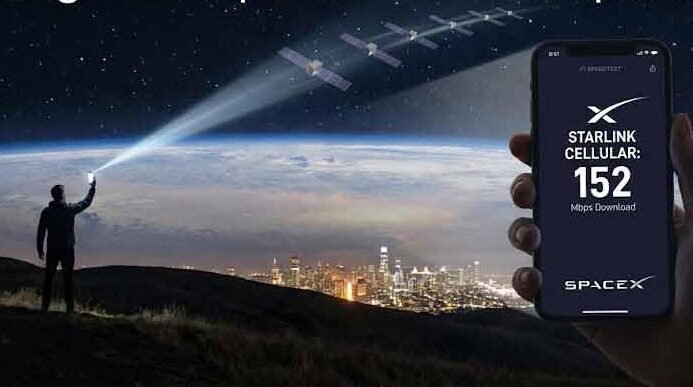
This is Starlink’s Direct to Cell initiative. And what SpaceX has accomplished in the span of eighteen months — from emergency SMS texts during hurricanes to a commercially launched broadband satellite service capable of pushing north of 150 megabits per second to a standard, unmodified LTE handset — is not a feature update. It is a civilizational shift in how we define the right to be connected.
From Dead Zones to Dead Letters
For decades, the cellular dead zone was treated as a nuisance to be tolerated rather than a problem to be solved. About 500,000 square miles in the United States are not covered by any cellular network Space.com, a figure that seems almost impossible in the age of instant everything. Remote regions, interstate stretches, coastal waters, national parks — they all existed inside a kind of digital silence, the modern equivalent of being beyond the edge of the map.
The traditional telco response was to build towers. More towers, taller towers, denser towers. But towers are anchored in earth and economics. They require permits, power lines, backhoes, and capital expenditures that simply don’t pencil out when the coverage area contains more elk than people. For communities on the rural margins — farmers tracking weather, hikers navigating wilderness, emergency responders in disaster corridors — the gap between connectivity and isolation was not an abstraction. It was, occasionally, a matter of life and death.
In New Zealand, a woman who came upon a car crash in a cellular dead zone was able to text her partner the location of the accident through a Starlink Direct to Cell connection, and first responders were on the scene within minutes. Starlink During the catastrophic hurricane seasons of 2024 and 2025, more than 1.5 million people were able to send and receive millions of SMS messages and hundreds of Wireless Emergency Alerts that otherwise would not have been received. Starlink These are not benchmark statistics from a lab. They are the real-world proof of concept that accelerated Direct to Cell from experiment to commercial product.
How a Cell Tower Ends Up in Orbit
The engineering logic behind Starlink Direct to Cell is, at its core, elegantly simple — even if its execution represents one of the more remarkable achievements in modern aerospace and telecommunications.
Starlink satellites with Direct to Cell capability carry an eNodeB modem onboard that acts like a cellphone tower in space. Starlink The eNodeB is the same base station architecture used in every terrestrial 4G LTE network on the planet. By embedding it in a satellite, SpaceX effectively placed a cell tower into low Earth orbit — one that orbits the globe every 90 minutes and covers vast swaths of territory that no physical tower ever could.
Critically, this doesn’t require a new phone or a specialized satellite handset. Direct to Cell works with every LTE phone wherever you can see the sky, enabling off-the-grid connectivity on land, lakes, or coastal waters, with no changes to existing hardware, firmware, or special apps required. Starlink As of early 2026, roughly 60 phone models are compatible, covering most current iPhone and Samsung flagship lines, with the list expanding steadily.
SMS texting via Starlink became publicly available in the U.S. and New Zealand in July 2025, reaching T-Mobile, AT&T, Verizon, and One NZ customers. Wikipedia The service uses T-Mobile’s midband PCS spectrum, meaning the satellite borrows the same frequencies your phone already knows how to speak. Bandwidth in the current texting phase is constrained — the shared cell coverage area is designed to handle thousands of simultaneous voice calls or millions of texts — but the roadmap ahead changes the equation dramatically.
The Speed Question: Where Are We Now and Where Is This Going
The 150Mbps figure in the headline is not a marketing projection. It’s a real-world throughput being observed on Starlink’s residential terminals today, and a benchmark that frames what the Direct to Cell ecosystem is building toward. Starlink residential customers in the U.S. can currently expect download speeds between 100 and 300Mbps, depending on their location. SatelliteInternet As of the most recent quarter, Starlink users saw a median download speed of 104.71 Mbps RCR Wireless News in Ookla Speedtest data — a figure that has been trending steadily upward since 2022.
The Direct to Cell service, however, operates under different physics than a residential dish. The satellite must serve a cell area measured in hundreds of square miles rather than a single household terminal. In its current texting phase, that architecture makes raw speed less relevant than universal reach. But the next phase — full voice and data connectivity, slated for the latter half of 2025 and now pushing into 2026 — will require substantially more per-device bandwidth as the constellation densifies.
In 2026, SpaceX plans to begin using Starship to deploy the next generation Starlink V3 satellites — expected to deliver 10 times the downlink capacity and 24 times the uplink capacity of current V2 Mini satellites. DISHYtech Each Starship mission is projected to add roughly 60 terabits per second of new network capacity, approximately 20 times more than a typical Falcon 9 Starlink launch. V3 Direct to Cell satellites are expected to deliver full 5G cellular connectivity from space, with a comparable experience to terrestrial 5G. DISHYtech
This is not incremental improvement. This is the satellite internet industry undergoing the same compression of generations that the smartphone industry experienced between 2007 and 2015.
The Carrier Ecosystem and the Competitive Landscape
SpaceX did not attempt to build this infrastructure alone. The carrier partnership model — pairing Starlink’s orbital assets with terrestrial spectrum licenses already held by established telcos — was the strategic masterstroke that allowed Direct to Cell to sidestep the regulatory and commercial friction of building a competing mobile network from scratch.
In addition to T-Mobile, SpaceX has announced cellular partnerships with Rogers in Canada, One NZ in New Zealand, KDDI in Japan, Optus in Australia, and Salt in Switzerland. SpaceNews The FCC’s conditional approval framework established that Direct to Cell operates as a Supplemental Coverage from Space service — designed to complement, not replace, terrestrial networks. That positioning was smart. It transformed potential adversaries into distribution partners.
But the competitor landscape is not standing still. AST SpaceMobile has placed live cellular calls over satellites with partners like AT&T and Vodafone and is pursuing full broadband links. Lynk Global offers satellite texting in select markets. Apple’s Emergency SOS relies on Globalstar for targeted satellite messaging. FindArticles The race is no longer about whether satellite-to-phone connectivity is technically possible. It is about who delivers it at scale, at speed, and at a price point that normalizes it as a standard feature rather than an emergency fallback.
SpaceX filed trademark protection for “Starlink Mobile” in October Technology Org of 2025, a move that analysts read as a signal of intent to eventually operate an independent mobile service — one that would put SpaceX directly in the carrier business rather than merely the wholesale infrastructure business. Elon Musk acknowledged the idea of a potential Starlink-branded phone, writing that it is “not out of the question at some point.” TESLARATI
The Physics of the Problem — and the Elegance of the Solution
Any journalist covering this space owes the reader an honest accounting of what remains technically difficult. The laws of physics do not observe press releases.
The core challenge in Direct to Cell is the inverse square law: signal strength degrades proportionally to the square of the distance between transmitter and receiver. A satellite 340 miles overhead is transmitting into an enormous cell footprint. The power budget required to make a standard LTE phone’s antenna — designed for a tower a few miles away — communicate reliably with an object traveling at 17,000 miles per hour is formidable.
SpaceX addresses this through constellation density and advanced phased array technology. The Starlink Direct to Cell satellites carry the most advanced phased array antenna in the industry Starlink, capable of forming and steering narrow beams with precision that earlier generations of satellite hardware could not achieve. As the constellation grows toward the FCC-approved ceiling of 15,000+ satellites, the overlap between adjacent coverage footprints increases, effectively lowering the load on any single satellite and improving per-device bandwidth allocation.
Latency, too, deserves honest treatment. Starlink’s median latency currently ranges from 38–39 ms in well-served states and above 100 ms in Alaska and Hawaii, RCR Wireless News with the Direct to Cell service operating at the higher end of that range due to coverage area geometry. For voice calls and real-time applications, the next generation of lower-altitude V3 satellites is the answer — shorter orbital radius means shorter signal travel time, and latency that approaches terrestrial network performance.
What This Means for Rural America — and for North Shore Long Island
The infrastructure conversation has a local dimension that rarely gets the attention it deserves. Long Island’s North Shore — the waterfront communities, the preserved estates, the pockets of preserved rural character from Port Jefferson through Cold Spring Harbor — sits in a curious connectivity purgatory. Dense enough to have terrestrial service, but with enough topographic variation and coastal geography to produce reliable dead zones on the water, in the deeper suburban lots, and along stretches of the LIE and the North Country Road.
Those dead zones have been invisible to the infrastructure investment conversation because they are surrounded by nominally served areas. They don’t appear on the FCC’s coverage gap maps. But ask anyone who has tried to take a call from a boat in the Sound, or lost signal mid-navigation on a country road east of Stony Brook, and the gap is very real.
Starlink’s Direct to Cell approach — working through existing T-Mobile, AT&T, and Verizon partnerships, requiring no new hardware from the end user — is precisely the kind of solution that fills those invisible gaps. The future V3 constellation, with its 5G-equivalent throughput and seamless handoff between satellite and terrestrial coverage, will make the distinction between “covered” and “not covered” a relic of the old network architecture.
For small business owners and property markets along the North Shore — a segment I watch closely through the lens of Maison Pawli, our boutique real estate venture launching in 2026 — connectivity parity between waterfront and terrestrial addresses is not a minor amenity. It is a value driver. Properties that once carried an implicit cellular asterisk in their listings will become genuinely competitive in a market that increasingly treats broadband access as a non-negotiable baseline, equivalent to running water and reliable power.
The Starlink Phone — Speculation or Roadmap?
The most speculative, and perhaps most consequential, dimension of this story is the device question. What happens when SpaceX stops licensing its orbital infrastructure to carrier partners and starts selling the access directly through its own hardware?
Native Starlink capability in a handset implies more than emergency texting. It suggests a handset engineered to talk to low Earth orbit satellites as a first-class network, likely alongside standard terrestrial 4G and 5G. FindArticles The engineering trade-offs are significant — phased array antennas at smartphone scale require either a redesign of the RF front-end or a reliance on the lower-frequency cellular spectrum already supported by the Direct to Cell program. Neither path is trivial.
SpaceX generated approximately $8 billion profit on $15–16 billion revenue last year, with Starlink contributing 50–80% of total income. Technology Org That financial foundation funds a level of R&D ambition that no traditional handset manufacturer can easily match on the satellite side. Whether the Starlink phone arrives as a premium rugged device for professionals and adventurers, or as a mainstream consumer product optimized for orbital-first connectivity, the market logic is clear: vertical integration from rocket to satellite to spectrum to device is the most defensible moat in the history of telecommunications infrastructure.
The craft analogy is not accidental. In the same way that the finest English bridle leather briefcase isn’t assembled from the outside in — from a price point down to a material compromise — but built from the material outward, from the hide to the thread to the form, the most durable technology architecture is the one where every layer was designed with the others in mind. SpaceX is building that architecture. The question is not whether it arrives. It is whether the rest of the industry is positioned to respond when it does.
The Network as Infrastructure — The Signal as a Right
The broadest frame for this story is not about Starlink or SpaceX or any particular technology. It is about what we have decided, as a society, to treat as essential infrastructure — and how long it takes for that consensus to catch up with both technological capability and human need.
The U.S. government’s $42.5 billion Broadband Equity, Access and Deployment program represents the political acknowledgment that high-speed internet access is not a luxury. The revamped BEAD program has recently loosened rules to open the field more broadly to Fixed Wireless Access and satellite providers RCR Wireless News — a direct validation of what Starlink and its competitors have built. The regulatory environment, historically slow to adapt, is finally moving at something approximating the speed of the technology.
What Direct to Cell represents, at its most fundamental level, is the extension of that infrastructure logic into the cellular domain — the argument that a reliable signal, like clean water or a paved road, should not be contingent on geography or the economics of tower construction. Whether the signal travels 340 miles from orbit or 3 miles from a rooftop antenna is an implementation detail. The entitlement to connectivity is what matters.
That argument is winning. The satellites are already up. The partnerships are already signed. The phones already know how to listen.
The sky, it turns out, was always the answer.