
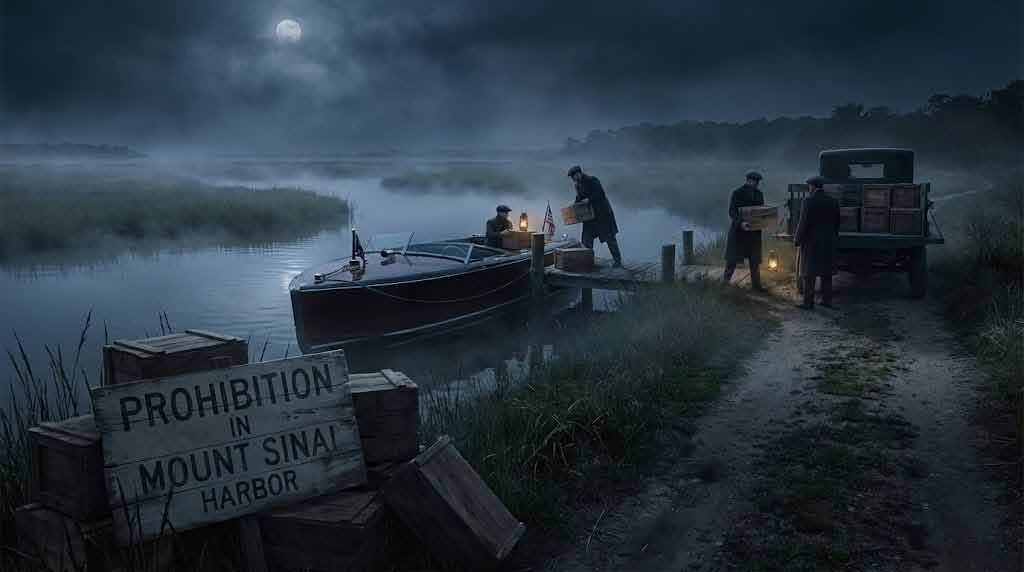
Fog settles differently over Mount Sinai Harbor than it does anywhere else on the North Shore. It rolls in low and quiet off Long Island Sound, pooling first in the marsh grass, then spreading across the shallow tidal flats until the inlet disappears entirely — until the water and the sky become one gray silence. Walk Cedar Beach on a raw November morning and you can feel it: the sense that this place has always known how to keep secrets.
Between 1920 and 1933, it did exactly that.
When the 18th Amendment imposed federal Prohibition on January 17, 1920, it did not stop Americans from drinking. It simply forced them to become more creative — and in doing so, it transformed the quiet fishing harbors, shallow coves, and glacier-carved embayments of Long Island’s North Shore into one of the most sophisticated illicit supply chains in the nation’s history. Mount Sinai Harbor, tucked three miles west of Port Jefferson along a stretch of Sound coastline that the Coast Guard found notoriously difficult to patrol, was perfectly suited for what was coming.
The baymen and fishermen who worked these waters were not criminals by disposition. They were men who knew every sandbar, every tidal shift, every unmarked channel that navigational charts failed to capture. And when the syndicates arrived with cash money and midnight propositions, many of them said yes — not out of moral ambivalence, but because the Sound had always provided, and this was simply the Sound providing again.
The Geography of Concealment: Why the North Shore Was a Smuggler’s Dream
Long Island’s role in Prohibition rum running was not accidental. Extending 118 miles from New York Harbor to Montauk, Long Island contained more than 1,600 miles of shoreline that its baymen and other locals knew better than anyone. That intimate knowledge — passed father to son over generations of clamming, fishing, and oystering — became enormously valuable when the syndicates needed guides who could move contraband from offshore ships to shore without being intercepted.
Local baymen, with their knowledge of the waterways, became an important part of the network of rum runners. This was not a distant, romantic history happening in Nassau County or the Hamptons. It was happening in the same waters visible from Route 25A — from the bluffs above Cedar Beach, from the docks that fishermen used every morning before the law woke up.
Mount Sinai Harbor’s geography made it particularly useful. The Harbor is accessible from the Sound via an inlet stabilized by a rock jetty, with two sandy barrier bars of unequal length on either side that protect the embayment from the strong physical activity of the Sound. That natural protection — the same barrier beach configuration that makes Cedar Beach so pleasant for summer swimming today — created a sheltered interior harbor that was invisible from open water, difficult to enter for anyone who didn’t know the shoals, and deep enough in its northern basin to accommodate the shallow-draft contact boats that the rumrunners favored.
The shallows themselves were a form of protection. The Coast Guard’s pursuit vessels, particularly in the early years of Prohibition, drew more water than a flat-bottomed fisherman’s skiff. A local bayman running a load of Scotch from an offshore mother ship could thread the inner channels of Mount Sinai Harbor in complete darkness while a patrol boat sat helplessly outside the inlet, unable to follow. Shores could sometimes be found littered with bottles from a rum-runner who sank after hitting a sandbar or a reef in the dark at high speed — which meant the men who survived were the ones who knew the water before the night required them to.
The broader North Shore operated as a single, loosely coordinated corridor. The land that extends from the Hell Gate Bridge in Queens out east to Orient and Montauk was a 100-mile long dock with coves and harbors where rumrunners could hide after venturing outside U.S. territorial waters to pick up alcohol from the ships of European producers. Within that corridor, Mount Sinai sat at a strategically useful midpoint — close enough to New York City that trucks could reach the boroughs before dawn, remote enough that federal Prohibition agents rarely maintained a sustained presence in the hamlet.
Rum Row and the Supply Chain That Began at Sea
Before a single bottle reached Cedar Beach or the back roads of Mount Sinai, it had traveled an extraordinary distance. Captain Bill McCoy pioneered rum running in the first years of Prohibition when he loaded a former fishing schooner with foreign liquor and anchored three miles off Long Island in May 1921. Small boats running from the South Shore quickly purchased his cargo. McCoy was soon joined by a motley assortment of converted yachts, old sailing vessels, trawlers, tramp steamers, and fishing schooners loaded with every type of alcohol. Most, including McCoy’s Tomoka, were registered in foreign countries to avoid seizure by the Coast Guard. This floating liquor market became known as Rum Row.
Rum Row was not a fixed location. It moved with the law. Initially the mother ships anchored three miles offshore — just outside the limit of U.S. territorial waters. At first the “Rows” were 3 miles from shore, but the patrolled area was moved to 12 miles in 1924. New York’s Rum Row, the largest on either coast, was southeast of Nantucket Island and east of Long Island. As enforcement tightened, the supply ships moved farther out to sea, which meant faster contact boats were needed — and the men building them were sometimes the same men the Coast Guard hired to chase them.
The supply chain that followed was precisely engineered. Captains of boats loaded with liquor bottles in false bottoms beneath fish bins anchored offshore at designated areas and waited for “contact boats,” small high-speed crafts with buyers who tossed aboard a bundle of large-denomination bills bound by elastic bands, loaded their liquor orders onto their boats and sped to shore to load it onto trucks headed for New York, Boston and other cities.
The economics were staggering. To give you an idea of how big a business this was, the gang on average paid $200 a week to one hundred employees when the average store clerk took home $25 a week, and they paid $100,000 a week in graft to police, federal agents and city and court officials. Despite these expenses, the gang still took in an estimated net profit of $12 million a year from the business. Along the North Shore, that money flowed into the local economy in unpredictable ways — into the pockets of fishermen, boatyard owners, dock workers, and the occasional garage owner who was offered a modest sum to simply not ask questions about what appeared overnight in his storage space.
The syndicates attached to these operations were not abstractions. They were names that would define American organized crime for a generation. The industry marks the start of organized crime in the U.S., birthing groups that would eventually become versions of the mafia. Smugglers netted millions, at a time when a pound of coffee cost around 35 cents. Dutch Schultz, Lucky Luciano, Waxey Gordon — these were the figures whose money funded the contact boats, the payoffs, and the sophisticated shortwave radio networks that coordinated landings from Orient Point to Oyster Bay.
The Men on the Water: Fishermen, Baymen, and the Moral Economy of the Shore
What historians sometimes flatten into “organized crime” was, from the perspective of a North Shore bayman in 1922, something considerably more complicated. When the 18th Amendment took effect on Jan. 17, 1920, baymen in the middle of scallop season found they could make big money moving mysterious, compact and very heavy cargo from boats waiting offshore, usually by night.
The decision many of them made was not primarily ideological. Prohibition enjoyed something close to contempt along the working waterfront — it was a law written by people who had never depended on the sea, imposed on communities where alcohol had always been part of the social fabric of hard physical labor. A fisherman who helped land a crate of Scotch on a dark stretch of Cedar Beach or off one of the smaller coves east of the Mount Sinai inlet was not, in his own moral accounting, doing something fundamentally different from what his grandfather had done when he sold fish to whomever would buy them.
The coercion, however, was real. Although some locals did not willingly participate in the smuggling trade, many were “more or less forced into it,” while others wanted to be part of it or were willing to ignore it. “A lot of times, if you had a shoreline house and somebody came around and said, ‘I need to borrow your garage for tonight, don’t go in it,’ a lot of people would just say, ‘OK, go do whatever you’re going to do,’ because they know they’re sort of a violent group of people.”
That violence was never far from the surface. Hijackings of boats, people held prisoner, low-level criminals turned informants winding up with bullets in their foreheads — all composed elements of the time. The North Shore was not the romantic underworld that Hollywood later constructed. It was a place where ordinary people found themselves enmeshed in something far larger and more dangerous than they had anticipated, where the line between participant and victim was often thin.
The radio networks that coordinated these operations were sophisticated enough to alarm federal authorities. Coded communication crisscrossed the county on short wave radios arranging sales and logistics. In one documented case, a local law enforcement officer in nearby Southold was found to have a hidden trapdoor in his home leading to a storage pit — and an illegal radio transmitter used to communicate with ships on Rum Row. He was a police officer who single-handedly covered 400 square miles of territory. He returned to work after a temporary suspension and went on to a long career. The community, broadly speaking, absorbed these revelations with a certain pragmatic equanimity.
The Artemis and the Battle of Orient Point: Violence on North Shore Waters
No single episode captures the texture of North Shore rum running more completely than the story of the Artemis — a 52-foot speedboat that became the most notorious vessel in the Sound’s Prohibition history, a craft that haunted the waters between Orient Point and Port Jefferson like something out of a crime novel.
On Thursday evening, Aug. 20, 1931, CG-808 was patrolling Long Island Sound, searching for suspected rumrunners. The cutter had sighted the 53-foot Artemis about two miles east of the Cornfield Point Lightship and commanded her to stop. Although loaded down with illicit liquor, the speedy rumrunner answered by racing off into the darkness, propelled by her powerful Liberty aircraft engines that had been converted for marine use.
What followed was one of the most dramatic maritime chases in the history of Long Island Sound. The Coast Guard gave chase, fired hundreds of rounds at the fleeing vessel, many hitting their mark — and then the Artemis did something unexpected. It turned around and rammed the patrol boat, forcing the damaged cutter to limp back to port. The Artemis escaped after being shot at by authorities. The boat reportedly was equipped with three 12-cylinder Liberty motors and achieved a speed of 45 MPH. Nine machine gun bullets through the windshield were counted.
The crew made it ashore. Two badly wounded men were taken to a hospital in Greenport, where a quick-thinking doctor told investigators they were hunting accident victims who had been there for some time. The Artemis itself disappeared — stopping in Mattituck Harbor for patchwork repairs before making its way directly into Port Jefferson, where it was quietly hauled out of the water at the Long Island Shipyard at the foot of Main Street, barely three miles from the mouth of Mount Sinai Harbor. While in Port Jefferson for repairs at Long Island Shipyard, nine machine gun bullets through the windshield were counted.
The Artemis was eventually seized — but even then, the machinery of the law moved slowly. It was not uncommon for rum-runners’ ships to be sold at auction shortly after a trial — ships were often sold back to the original owners. Some ships were captured three or four times before they were finally sunk or retired. After Prohibition’s repeal, the Artemis was renamed the South Bay Courier and put into service as a ferry to Fire Island, carrying summer passengers across the same waters where it had once outrun machine-gun fire.
That detail — the rum runner reborn as a commuter ferry — is either deeply ironic or simply a straightforward expression of how the North Shore has always worked. The water doesn’t care about the laws that govern it. It simply carries what you put on it.
The Corruption Architecture: How the Machine Stayed Oiled
The rum-running enterprise did not survive thirteen years through seamanship alone. It survived because it was extraordinarily good at purchasing the cooperation of the institutions theoretically tasked with stopping it.
A ship from the Bahamas working for the Kinder syndicate was seized with liquor aboard as well as a memorandum book containing payoffs to Prohibition agents, Customs agents, and local police and public officials. That memorandum book was not an anomaly — it was the operational ledger of a system that functioned precisely because it had built payoff infrastructure into its cost accounting from the beginning.
One of the problems of enforcing Prohibition was the revolving door of justice. The rumrunners and bootleggers had the money and the ability to easily make bail and walk away from the charges against them. Sometimes, they would move their cargo when agents were testifying in court. The head of the industrial alcohol inspection section of the Prohibition office in New York, Major E.C. Schroeder, went to jail for blackmail.
The corruption extended far enough that it distorted even the basic intelligence functions of enforcement. Smugglers also became more sophisticated and used radio direction-finding equipment to locate Coast Guard units. They were not merely evading the law — they were actively monitoring it, using the same technology the Coast Guard used to track them, scanning for patrol boat positions before making a run. The game was played on both sides with considerable technical sophistication.
Freeport’s shipyard built Coast Guard patrol boats and rum-runner vessels at the same time — sometimes side by side. The economics of the enterprise had penetrated so deeply into the local industrial base that the legal and illegal economies could no longer be cleanly separated. During Prohibition, Freeport Point Shipyard built patrol boats for the Coast Guard side-by-side with vessels for the rum runners they were chasing down.
After Repeal: What the Harbor Remembered
The 21st Amendment ended Prohibition on December 5, 1933. The rum-running economy collapsed overnight, the syndicates pivoted to other enterprises, and the baymen of the North Shore went back to clamming and fishing — officially, at least. The underground economy never entirely vanished. The smuggling of alcohol did not end with the repeal of prohibition. In the Appalachian United States, for example, the demand for moonshine was at an all-time high in the 1920s, but an era of rampant bootlegging in dry areas continued into the 1970s.
On the North Shore, what endured was subtler. It was the knowledge — passed laterally through communities rather than vertically through institutions — of how to use the water to move things that didn’t want to be seen. It was the understanding, embedded in families that had been part of the operation, that the geography of concealment was also the geography of daily life. The same coves where contraband landed were the coves where children learned to swim. The same marshes that hid skiffs carrying Scotch whisky were the marshes that yielded blue-claw crabs on summer mornings.
Mount Sinai Harbor today is tranquil in a way that has nothing to do with forgetting and everything to do with the particular quietness of places that have seen things. A number of commercial fishermen work out of the harbor and fish in Long Island Sound. Cedar Beach draws families from across the Town of Brookhaven on summer weekends. The yacht club sits where it has always sat, on the western spit. On a clear day you can see across to Connecticut.
But walk the barrier beach at dusk, when the light goes horizontal and the marsh grass bends the same way it always has, and the harbor reveals something about the character of this coastline — about a community that has always known how to maintain the distinction between what it shows and what it keeps. That quality, that deeply ingrained coastal discretion, was not created by Prohibition. It was merely confirmed by it.
There’s a reason this stretch of the North Shore has always attracted people who build things meant to last — who understand that permanence requires a certain patience with darkness, a willingness to wait out the fog. Twenty-five years operating a diner a mile south of this harbor, I have served three generations of Mount Sinai families across the same counter. The harbor is part of every conversation about this town, whether those conversations mention it or not. It’s in the way people here understand time — not as something to be spent, but as something to be worked with, the way a bayman works a tide.
The Legacy Hidden in Plain Sight
The rum-running era of Long Island’s North Shore left no monuments. There are no historical markers along Cedar Beach explaining that this inlet was a Prohibition-era contraband corridor. No plaques on the Route 25A corridor noting that trucks loaded with Scotch and Canadian rye rolled through here in the small hours, bound for speakeasies in Midtown Manhattan.
What the era left instead was something less visible and more durable: a demonstrated capacity for collective organization outside official channels, a sophisticated understanding of how geography and timing could protect commercial activity from government interference, and a body of navigational knowledge that kept the North Shore’s working waterfront viable through an economic disruption that devastated less resourceful communities.
The word “scofflaw,” which means someone who takes advantage of hard-to-enforce laws, came into wide use during Prohibition to describe those who continued to traffic in alcohol, despite the law. On the North Shore, scofflawry was so widespread as to constitute community policy. Suffolk County District Attorney Alexander Blue observed at the time that liquor smuggling along its shores had become critical to keeping New York City supplied — that the North Shore, in effect, was doing more to maintain urban quality of life than the law was doing to curtail it.
That history is part of what makes Mount Sinai Harbor worth understanding as more than a recreational destination. The harbor is a place that has been genuinely used — for commerce, for survival, for community solidarity against external authority — in ways that the polished marina and the summer beach crowd don’t immediately suggest. Its depth is not only physical. It is historical: layers of use and knowledge and selective silence deposited like sediment over four hundred years of human occupation of this glacially carved embayment.
The fog still rolls in low off the Sound. The marsh grass still bends. The inlet that once swallowed contact boats loaded with illicit Scotch now admits kayakers and sailboats and the occasional commercial fishing vessel. The water keeps its counsel.
It always has.