Drowned. That was the original name — Drowned Meadow — and it was not metaphor. Twice daily, the tidal surge consumed the lower village, submerging the mudflats and salt marsh that stood where Main Street now runs. It was, by most 18th-century accounts, a forgettable hamlet of five homes, its harbor deep and promising but its ambitions modest. Then the shipwrights arrived. And in the span of a single generation, that drowned meadow rose from the water to become one of the most productive shipbuilding centers on the Eastern Seaboard — a place where Long Island white oak was transformed into vessels that carried the commerce of a young republic from port to port, and where one family, above all others, left a mark that endures not just in history books but in the living institution of a hospital that still serves this community today.
The story of Port Jefferson’s maritime ascent is inseparable from the story of the Mather family. Across four generations and more than a century, the Mathers did not merely participate in the shipbuilding industry — they were its spine. Their arc, from a sea captain’s daughter marrying a young builder in 1813 to a bachelor philanthropist dying in Havana in 1928 and willing his fortune into a community hospital, is the kind of American story that never loses its power to instruct.
Drowned Meadow: The Deep-Water Harbor That Started Everything
Long before any ship was ever laid down here, Port Jefferson Harbor was exceptional. A natural deepwater bay cut into the North Shore of Long Island, sheltered by a generous headland and fed by the cool, clean waters of Long Island Sound, it was precisely the kind of geographic gift that shipbuilders required. In 1797, when the settlement still barely qualified as a village, its first shipyard was established — a modest operation, almost certainly opportunistic, seizing what the land had provided. (Historical Society of Greater Port Jefferson)
By 1825, several shipbuilding firms had taken root along the harbor, drawn by the same deep water, the regional abundance of timber, and the growing coastal trade demanding vessels of increasing size and durability. The transformation of the physical landscape followed quickly. In 1836, a sea captain named William L. Jones undertook one of the most consequential civil engineering feats in local history: he built a causeway across a 22-acre salt marsh, effectively creating what is now Main Street and unlocking the lower harbor for expanded commercial activity. The village, recognizing that the name Drowned Meadow was a poor advertisement for a shipbuilding economy, rechristened itself Port Jefferson that same year — honoring President Thomas Jefferson, whose federal investment had helped address the town’s persistent flooding. (Port Jefferson Historical Society)
The harbor’s character shaped the character of the community. Homes built during this period were owned by shipbuilders and sea captains. The village’s social hierarchy ran along the waterfront, with the most prosperous yards commanding the best positions, and the families that ran them occupying the hillside homes that still define Port Jefferson’s architectural identity. At the height of the industry, four out of every ten ships built in all of Suffolk County were constructed in Port Jefferson — a statistic that speaks less to luck than to the combination of natural advantage, skilled labor, and generational expertise concentrated in this one small bay. (Historical Society of Greater Port Jefferson)
The Mather Line: A Family Built Around a Boat
The Mather shipbuilding lineage traces its origin to a man named Captain John Wilsie, who purchased land in Drowned Meadow in 1797 and established one of the harbor’s first major shipyards on its eastern shore. Wilsie was not merely a builder — he was a trainer, educating early local craftsmen in the trade that would define the village’s next century. His daughter Irena married Richard Conklin Mather in 1813, a young man whose own father was a Mount Sinai sea captain, and the Mather name entered the shipbuilding ledger. Richard proved a capable builder, constructing 23 vessels before his death in 1816 — killed in a work accident aboard the sloop Catherine Rogers at age 30, leaving behind a two-year-old son named John R. Mather who would carry the trade forward. (Grokipedia, citing primary sources)
John R. Mather, born in 1814 and orphaned young, learned his craft from relatives in Bridgeport, Connecticut, before returning to Port Jefferson to apprentice under his stepfather, William R. Jones. By 1844, he had established his own independent operation. What followed was a sustained period of production that made the Mather yard one of the anchor enterprises of Port Jefferson’s golden shipbuilding age. By the mid-19th century, John R. had built named vessels including the schooner Alfred E. Thorn (1839), the Excelsior (1840), the Lady Suffolk (1849), a schooner he named after himself, John R. Mather (1851), and the Millard Fillmore (1856). These were not ornamental crafts — they were working schooners and brigs designed for the punishing demands of coastal freighting, built to carry loads between New York, New England, and the mid-Atlantic ports in any season. (Grokipedia, citing census records and ship logs)
The Mather operation diversified strategically over the decades, adding a general store partnership in the 1860s and a lumber operation with William Jones — recognizing, as any durable enterprise must, that raw material supply and retail adjacency created resilience that pure production could not. By 1860, the 37-year-old John R. Mather held real estate valued at $3,000 and personal property at $1,500 — modest figures by later standards, but emblematic of a man building carefully and for the long term. He married Sarah Jane Wells, the daughter of a Stony Brook shipbuilder, in 1848, forging one of the North Shore’s characteristic alliances between maritime trades families.
John R. retired in 1885 after more than four decades of active building. His obituary, when it came in 1899, described him as a “warm admirer of Grover Cleveland” and a “staunch Democrat” — but more to the point, it called him “Boss” Mather, a term that captured not just authority but affection, the kind of nickname that accumulates only around men who have earned the respect of the people who work alongside them.
The Apex: Port Jefferson at Its Industrial Peak
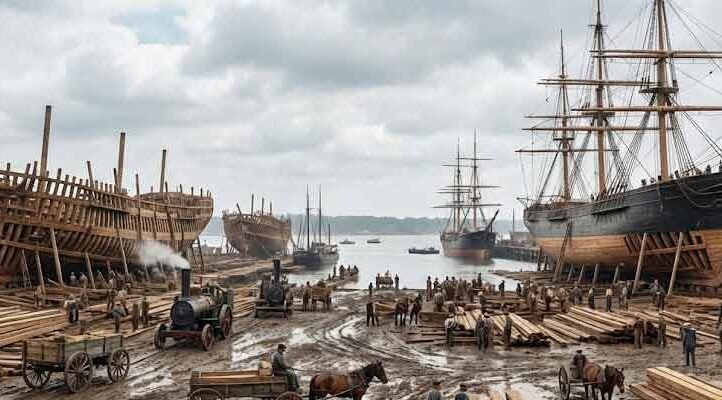
The 1870s represented the zenith of Port Jefferson’s shipbuilding output, and the Mather yard was far from alone in driving it. The Bayles Shipyard, established in 1835 by Charles and James Bayles and later operated into remarkable industrial scale by James M. Bayles, eventually documented production of 135 vessels under James’s direction alone — one of the most complete 19th-century shipbuilding records in the Northeast. (Naval Marine Archive) The Hawkins, Darling, and Mather yards rounded out a cluster of operations that together made Port Jefferson’s harbor a continuous theater of production: keels being laid, timbers being bent, sails being cut and stitched in the sail loft, the air carrying the smell of pine tar and fresh-cut oak.
In 1877, two whaling vessels were built here for New Bedford — the ship Horatio and the bark Fleetwing — evidence that Port Jefferson’s capabilities extended beyond coastal freighting into the more demanding construction requirements of deep-water whaling vessels. A Port Jefferson-built schooner, La Ninfa, was later converted into a whaling vessel operating out of San Francisco. The harbor’s reputation had traveled. Every contract for every vessel built here carried a phrase that functioned almost as a philosophical statement: “Delivered Afloat in the Harbor.” Not in a warehouse. Not on a drawing. In the water, where the work would be tested. (Historical Marker, Harborfront Park, Port Jefferson)
The economic ripple effects were profound. Shipbuilding was not a solitary industry — it required sawyers, blacksmiths, riggers, sailmakers, painters, caulkers, and chandlers, each trade sustaining a web of ancillary commerce. The village’s Hotel Square, at the intersection of what are now Upper and Lower Main Street, became a lively center of hospitality, with multiple hotels serving the captains, merchants, and buyers drawn by the yards. The post office arrived in 1855. The Long Island Rail Road extended its Port Jefferson branch line in 1873, connecting the village to Manhattan and accelerating both the movement of materials and the flow of commerce. P.T. Barnum, the celebrated showman, bought land here with ambitions to establish the village as a circus hub — ambitions the townspeople firmly rejected, though Barnum’s name now marks a street through what was once his property.
John Titus Mather: The Last Builder and His Enduring Gift
John R. Mather’s only son, John Titus Mather, was born on June 27, 1854, into a family and a village that knew what it was doing. He entered the shipbuilding trade as a matter of inheritance, carrying the operation into the early 20th century and eventually building the Martha E. Wallace, the last large sailing vessel constructed in Port Jefferson — a closing chapter written in the same wood and salt air that had defined the first. He expanded into shipping operations and related ventures, building one of the region’s more prosperous maritime businesses before retiring in 1909 when he sold his holdings to the Andrew Radel Oyster Company. (Wikipedia, John T. Mather)
John T. Mather never married. He spent his post-career years at the family home on Prospect Street — the house built by his father between 1840 and 1860, the same address that now anchors the Mather House Museum Complex — living quietly, accumulating his observations about what a community requires to sustain itself. When he died suddenly in Havana, Cuba, on March 30, 1928, his will delivered one of the most consequential philanthropic acts in Suffolk County history. He directed his executor to “incorporate under the laws of the State of New York a non-sectarian charitable hospital, to be located in said village of Port Jefferson…so designed and constructed as to permit future enlargement, assuming that future needs may justify such action.” He added: “It is my sincere hope that the citizens of Port Jefferson and vicinity will give their liberal and devoted support to said institution.” (Mather Hospital, official history)
On December 29, 1929 — one year and nine months after his death — John T. Mather Memorial Hospital opened its doors with 54 beds, equipped with what was then considered the finest X-ray, laboratory, and surgical technology available. It was the first general hospital in the entire Town of Brookhaven. Today, as Mather Hospital / Northwell Health, it operates as a full teaching hospital with Magnet designation for nursing excellence, cardiac catheterization labs, and residency programs — a living institution that has grown from a shipbuilder’s dying wish into one of the North Shore’s most essential civic anchors.
The arc is almost biblical in its completeness: a family that began by building vessels designed to carry life across water ends by building an institution designed to sustain life itself.
The Industry’s Close and the Landscape It Left Behind
The shipbuilding era did not end gradually — it ended with the transactional finality of a corporate acquisition. In 1923, the Bayles Shipyard, the last significant operational yard, was sold to the Standard Oil Company. Most of its structures were demolished. The economic ripple reversed: hotels closed, the tourism that had grown alongside industry contracted, and Port Jefferson Harbor became, for a time, a depot for oil transport and gravel operations, and later the site of a Long Island Lighting Company coal-fired power plant. The Mather & Jones Shipyard site was eventually redeveloped in 1976 into Chandler Square, a shop-lined promenade. The former Bayles Shipyard property, after passing through several hands, was purchased by the Village of Port Jefferson in 1997 and transformed into Jeanne Garant Harborfront Park, completed in 2004, featuring a promenade, seasonal ice skating rink, and a public sculpture depicting four seamen carrying the bones of a ship — a tribute to the builders by the community they built. (Harborfront Park Historical Marker, 2008)
What remained, beyond the physical landscape, was architecture. The Port Jefferson Village Historic District, listed on the National Register of Historic Places in 2005, encompasses nearly 100 buildings, the majority constructed between 1840 and 1870 in Greek Revival, Italianate, and Victorian styles. These are the homes of the shipbuilders and captains, preserved by time and community care, still standing on the same hills from which their original owners once watched vessels launched into the harbor below. The Mather House at 115 Prospect Street — headquarters of the Historical Society of Greater Port Jefferson — anchors a museum complex that includes a Marine Barn and Sail Loft with a full-sized harbor diorama from circa 1900, a collection of half-hull ship models, shipbuilding tools, sail-making implements, period furnishings, and paintings by the village’s own 19th-century landscape painters, William Moore Davis and Leon Foster Jones, whose canvases captured the harbor at its industrial peak.
The Bayles Shipyard, separately listed on the National Register of Historic Places in 2000, retains the 1897 Bayles Chandlery, the 1917 Machine Shop and Mould Loft, and the 1917 Compressor House — industrial archaeology preserved within a contemporary public space. Bayles Boat Shop, operating today within this historic context, continues the restoration of historic wooden boats, maintaining a living continuity with the craft that built the village.
What Provenance Does to Property: The Real Estate Dimension
One of the more instructive economic phenomena of the contemporary North Shore is the degree to which historical identity has been transmuted into property value. Port Jefferson is not a wealthy enclave in the conventional sense — it is not the Hamptons, nor is it Old Westbury. But its character is distinctive in ways that resist generic comparison, and that distinctiveness commands a genuine premium.
Home values in Port Jefferson currently range from $600,000 to well over $1 million, depending on size, location, and proximity to the waterfront, with luxury properties featuring harbor views or beach access especially sought after. The enclave of Belle Terre, bordering Port Jefferson Harbor, hosts estates of 8-plus acres with private shoreline commanding prices well into the multi-millions. The average home price across Port Jefferson currently sits at approximately $1.1 million, with 94 homes transacted over the last twelve months — figures that reflect a community where demand consistently outpaces available inventory.
The reasons are layered, and the Mather legacy is not incidental to them. The historic district creates a de facto architectural conservation mechanism — you cannot easily demolish what the National Register has designated significant, and the result is a built environment that retains the proportional integrity of 19th-century construction while housing contemporary life. The harbor, which once launched schooners and brigs, now anchors Danfords Hotel and Marina, the Bridgeport & Port Jefferson Ferry — in continuous operation since 1883 — and a waterfront that draws visitors and residents who specifically seek character rather than calculation. North Shore markets are expected to remain strong, with the luxury segment in particular rising as investors shift capital from volatile equity markets into stable tangible assets.
The architecture of the 19th-century shipbuilder’s village — steep hillside lots, harbor vistas, Greek Revival cornices, wide-board floors — carries the kind of provenance that cannot be manufactured. It accrued over two centuries of human habitation, industry, and community investment. That provenance is now part of the assessed value of every historic property within the Port Jefferson Village Historic District, whether its owners recognize the connection or not.
The Craftsman’s Standard and the Long View of Quality
What the Mather family built was not simply ships. They built a culture of craft accountability — one in which the quality of construction was a direct expression of professional identity and community reputation. John R. Mather’s yard produced vessels that sailed coastal routes for decades because the standards under which they were built did not permit shortcuts. The timber selection, the joinery, the caulking, the rigging specifications — each was an argument against obsolescence.
It is worth pausing on what that kind of commitment requires. Every contract contained the clause “Delivered Afloat in the Harbor” — not a guarantee, but a philosophy. The harbor was the ultimate proving ground, the one judge whose verdict was irrevocable. You could not argue with water. A vessel either floated or it did not. A seam either held or it failed. The standard was absolute, and the Mather family built to that standard for more than a century.
That same philosophy — building things designed to outlast their makers, refusing the expedient in favor of the enduring — is what separates the North Shore’s most valuable properties from its merely expensive ones. The homes that command premiums today are, disproportionately, the homes built by people who thought in decades rather than quarters. The shipbuilder’s sensibility did not stay in the yard. It moved uphill into the houses, into the community institutions, into the hospital that still operates under a dead man’s vision of what his village deserved.
A few years ago, an acquaintance asked me what distinguished a piece of English bridle leather from everything else that calls itself a briefcase. The answer I gave then is the same answer the Mather family practiced across four generations of shipbuilding: material integrity, construction method, and the willingness to let time pass before declaring the work finished. The standards that define Marcellino NY’s bespoke briefcases — hand-saddle stitched, vegetable-tanned, built for decades of use — are the same standards that once governed the laying down of a keel in Port Jefferson Harbor. Different scale. Identical philosophy.
The Village Today: Where Industry Became Identity
Port Jefferson in 2026 is a village that has absorbed its history without being paralyzed by it. The harbor that launched the Martha E. Wallace now receives the Bridgeport ferry multiple times daily. The Hotel Square that once served ship captains is now a constellation of restaurants, boutiques, galleries, and Theatre Three — a non-profit regional theater housed in historic Athena Hall, dating to 1874, which produces six productions annually including its acclaimed staging of A Christmas Carol during the December Dickens Festival, when the streets fill with 19th-century costumed characters in a scene that would be precious if it weren’t so genuinely rooted.
Mather Hospital operates at 75 North Country Road, its campus having expanded dramatically from the original 54-bed structure, now encompassing surgical pavilions, cardiac catheterization labs, a Graduate Medical Education program, and Magnet-designated nursing excellence — having joined the Northwell Health system in January 2018 while retaining the name its founder gave it from a Havana deathbed in 1928. The endowment of a shipbuilder still keeps people alive on the North Shore.
The Mather House at 115 Prospect Street operates Wednesday through Sunday, noon to four, from May through October, with docent-guided tours of the main house and the surrounding complex. The Marine Barn’s full-sized harbor diorama from circa 1900 remains one of the more quietly extraordinary artifacts on Long Island — a miniature of a harbor in full industrial operation, built to preserve the memory of a world that had already passed by the time it was constructed. Call (631) 473-2665 or visit portjeffhistorical.org for hours and visiting information.
The Bayles Chandlery, the Machine Shop, the Mould Loft — these structures survive within Harborfront Park, in the care of a village that understands that the value of its past is not nostalgia but foundation. Every luxury property within the Port Jefferson Village Historic District carries that foundation in its listing price, whether the buyer comprehends the connection or simply feels the weight of a place that knows what it is.
The Mathers built their ships to be delivered afloat. More than a century after the last keel was laid in Port Jefferson Harbor, the village they helped build remains afloat — which is, perhaps, the most honest measure of craft that any culture can offer.
Visit: Historical Society of Greater Port Jefferson / Mather House Museum | 115 Prospect Street, Port Jefferson, NY 11777 | (631) 473-2665 | Open May–October, Wednesday–Sunday, 12–4 PM
Mather Hospital / Northwell Health: matherhospital.org | 75 North Country Road, Port Jefferson, NY 11777