A Universe That Refuses to Behave
Sixty years ago, a Harvard-trained physicist named Thomas Kuhn published a slim volume that would quietly detonate inside every corner of scientific culture. The Structure of Scientific Revolutions (1962) argued, with devastating clarity, that science does not advance through the steady accumulation of facts. It advances through crisis — through the slow, uncomfortable recognition that an accepted map of reality can no longer account for the territory.
Kuhn called these maps paradigms. And he argued that when a paradigm begins to fracture under the weight of what he called anomalies — observations that the reigning framework simply cannot absorb — a field does not immediately abandon its model. It strains. It patches. It adds epicycles. It resists. Only when the resistance becomes untenable, and a viable alternative emerges to explain both the old data and the new, does the paradigm finally break and a revolution begin.
We are living through exactly that moment in modern astrophysics.
The contested terrain is dark matter — the invisible, undetected substance that, according to the reigning cosmological framework called Lambda-CDM, constitutes roughly 27 percent of the universe’s total energy content and nearly 85 percent of all matter (NASA Science, 2023). It has never been directly observed. It has never been captured, measured, or detected in a laboratory. Its existence is inferred entirely from its gravitational effects on the things we can see — the rotation of galaxies, the bending of light, the large-scale structure of the cosmos. And now, telescope by telescope, observation by observation, that inference is beginning to strain at its seams in ways that would have made Kuhn nod slowly and reach for his pen.
The Kuhninan Framework: A Brief Cartography of Collapse
To understand why the dark matter debate is so philosophically rich, it is worth spending a moment with Kuhn’s actual argument rather than the pop-science caricature of it.
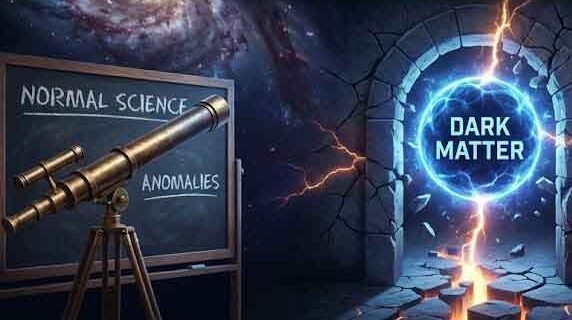
Kuhn identified four stages in the life cycle of a scientific field. The first is pre-science — a period of competing schools and no shared framework. The second is normal science, in which a dominant paradigm governs the questions scientists ask, the instruments they build, and the anomalies they permit themselves to notice. Normal science is, in Kuhn’s telling, a form of disciplined puzzle-solving. It is extraordinarily productive, but it is not designed to challenge its own foundations.
The third stage is crisis — triggered when anomalies accumulate beyond the paradigm’s absorptive capacity. And the fourth is revolution, in which a new framework displaces the old not through incremental persuasion but through a gestalt shift, what Kuhn famously described as seeing the same duck-rabbit drawing and suddenly recognizing a rabbit where you had always seen a duck.
Crucially, Kuhn emphasized that paradigm shifts are never purely rational events. They are sociological ones as well. Senior scientists tend to defend established frameworks with the same devotion they brought to building them. New paradigms often gain traction not by converting the old guard but by outliving them — a point that the physicist Max Planck captured with characteristic sharpness when he observed that science advances one funeral at a time.
What makes the dark matter case particularly interesting in Kuhnian terms is that after Kuhn’s book was published, astrophysicists realized that the pursuit and discovery of anomalies and revolutions could yield fame, history, and Nobel Prizes — thereby changing the sociology of science away from Kuhn’s original structure. The field became, paradoxically, more aggressive in seeking anomalies even as the dominant institutions remained committed to defending the paradigm. This creates an unusual dynamic: a scientific community simultaneously hunting for the revolution and resisting it.
The Anomaly That Started It All: Zwicky, Rubin, and the First Cracks
The dark matter story begins not in a crisis but in an ignored anomaly — a perfect Kuhninan case study in the resistance of normal science to uncomfortable data.
In 1933, the Swiss astronomer Fritz Zwicky was studying the Coma Cluster, a dense collection of approximately a thousand galaxies. Applying the virial theorem to estimate the cluster’s mass based on the velocities of its member galaxies, he postulated it was hundreds of times more dense than it appeared based on visible, glowing matter alone — meaning some kind of invisible “dunkle Materie,” or dark matter, must bind it together. The concept did not catch on. “It was too outrageous to believe for almost four decades,” as Princeton astrophysicist Neta Bahcall has put it.
The anomaly sat in plain sight for nearly half a century, classified as an oddity and shelved by the community’s consensus-building machinery.
Then came Vera Rubin.
Working at the Carnegie Institution of Washington in the late 1960s and 1970s with a sensitive new spectrograph developed by her colleague Kent Ford, Rubin measured how fast stars orbit their galactic centers. What she found surprised everyone. Instead of slowing down the farther they were from the center — as planets do in our solar system — stars on the outskirts of galaxies moved just as fast as those near the core. The rotation curves were flat. According to the laws of gravity and visible mass, those outer stars should have been flung into space. But they weren’t.
Rubin’s calculations showed that galaxies must contain about ten times as much “dark” mass as can be accounted for by the visible stars. In short, at least ninety percent of the mass in the observable universe appeared to be invisible and unidentified.
Unlike Zwicky’s anomaly, Rubin’s could not be ignored. She systematically observed dozens more spiral galaxies, each time measuring their rotation curves. Over the next decade, she and her collaborators compiled detailed velocity profiles for more than 75 galaxies, confirming again and again that stars in the outer regions rotated just as fast as those near the center. The effect was not a glitch. It was a universal feature of galactic structure.
The scientific community absorbed this anomaly not by questioning Newtonian gravity or Einstein’s general relativity, but by proposing an invisible scaffolding — a halo of non-luminous, non-interacting matter surrounding every galaxy. Dark matter became not a crisis but a patch. Normal science had swallowed its anomaly whole and kept moving.
Lambda-CDM: The Paradigm Enthroned
By the late 1980s and early 1990s, dark matter had been formally incorporated into the reigning cosmological framework. Lambda-CDM — where Lambda refers to the cosmological constant (a proxy for dark energy) and CDM stands for Cold Dark Matter — became the standard model of cosmology. It is, in its domain, extraordinarily successful.
Lambda-CDM accurately predicts the large-scale structure of the universe — the web of filaments, voids, and clusters that define cosmic architecture on the grandest scales. It provides a coherent account of the cosmic microwave background radiation, the faint afterglow of the Big Bang whose temperature fluctuations map the seeds of all subsequent structure. It successfully models the formation of galaxy clusters and superclusters. For several decades, it represented astrophysics functioning at its most productive — a paradigm generating fruitful puzzle-solving across multiple subfields simultaneously.
The dark matter particle itself remained elusive. WIMPs — Weakly Interacting Massive Particles — were the leading candidate for decades, predicted by supersymmetric extensions of the standard model of particle physics. Axions were another serious contender, along with primordial black holes and sterile neutrinos. While WIMPs, axions, and primordial black holes remain the primary candidates for dark matter, numerous other theories have been proposed to address specific observational anomalies or theoretical motivations. But the particle, if it exists, has never been detected. Decade after decade of increasingly sensitive underground detectors — LUX, XENON1T, LZ — have returned null results. Not a whisper. Not a single confirmed event.
This silence is itself an anomaly. In Kuhn’s terms, a paradigm can absorb a certain number of null results — they become “instrumentation problems” or “parameter adjustment” issues. But as the instrumentation improves and the silence deepens, the null result itself becomes harder to dismiss.
The New Anomalies: MOND and the Modified Gravity Challenge
The first serious theoretical alternative to the dark matter paradigm arrived in 1983, precisely as Lambda-CDM was consolidating its dominance. Israeli physicist Mordehai Milgrom proposed Modified Newtonian Dynamics, or MOND — a framework in which Newton’s law of gravity is not universal but breaks down below a critical acceleration threshold of approximately 1.2 × 10⁻¹⁰ meters per second squared.
MOND suggests that Newton’s laws of gravity break down at extremely low accelerations, such as those found in the outer regions of galaxies. Instead of dark matter, MOND introduces a new fundamental acceleration scale below which gravitational force declines more slowly with distance. This adjustment naturally explains the observed flat rotation curves of spiral galaxies without requiring unseen mass.
MOND was largely dismissed by the mainstream. It was a non-relativistic theory with no deeper theoretical foundation, and it struggled with galaxy cluster data and the cosmic microwave background. But it made something dark matter frameworks did not: precise, predictive successes at the galactic scale that dark matter models could only reproduce after extensive parameter tuning.
Case Western Reserve astronomer Stacy McGaugh has argued that either dark matter halos are much bigger than expected, “or the whole paradigm is wrong.” His 2024 research using gravitational lensing data showed that the flat rotation curves MOND predicts extend to scales of a million light-years — a result MOND had anticipated and that dark matter models find deeply uncomfortable.
This is the hallmark of an emerging counter-paradigm in Kuhn’s framework: it explains known anomalies and makes successful predictions that the dominant model did not anticipate.
The James Webb Crisis: When the Anomalies Become Undeniable
If MOND represented the gathering pressure of a pre-crisis state, the James Webb Space Telescope (JWST) may represent the moment the pressure becomes structural.
Lambda-CDM makes a clear prediction about the early universe. In the dark matter model, galaxies formed gradually. Bit by bit, small structures would merge to become larger ones. By that logic, JWST should have spotted faint traces of these early building blocks. The model predicted dim, primitive, slowly assembling structures in the cosmos’s first billion years.
That is not what JWST found.
The standard model for how galaxies formed in the early universe predicted that the James Webb Space Telescope would see dim signals from small, primitive galaxies. But data are not confirming the popular hypothesis that invisible dark matter helped the earliest stars and galaxies clump together. Instead, the oldest galaxies are large and bright. They appear massive, well-formed, and structurally complex at redshifts that place them within the universe’s first few hundred million years — earlier and larger than Lambda-CDM can comfortably accommodate.
Analysis of JWST infrared photometric images has revealed large galaxies that do not match the predictions of the ΛCDM model. More than ten ultra-far and anomalously bright galaxies have been spotted in JWST photometric images, and their abundance far exceeds the predictions of the standard cosmological model.
McGaugh and his collaborators at Case Western Reserve pointed out that MOND had in fact predicted this outcome in 1998 — that structure formation in the early universe would occur far more rapidly under a modified gravity framework than under cold dark matter. That 25-year-old prediction is now, observation by observation, coming true. McGaugh said: “What the theory of dark matter predicted is not what we see.”
This is not merely an anomaly. This is what Kuhn described as a crisis — the accumulation of contradictions that the reigning paradigm can no longer absorb without fundamental modification.
The Sociology of Resistance: Why Paradigms Don’t Fall Quietly
Here the Kuhninan analysis becomes most illuminating — and most sobering.
Kuhn was clear that paradigms do not yield to anomalies alone. They yield to anomalies plus an available alternative that can account for both the old successes and the new failures. And they yield on a sociological timeline as much as an empirical one. The established framework — with its funding structures, its textbooks, its career ladders, its institutional affiliations — possesses an enormous inertial force.
The clash between dark matter and MOND can get heated. On one side is the vast majority of astronomers who vigorously support the concept of dark matter and its foundational place in cosmology’s standard model. On the other is the minority — a group of rebels convinced that tweaking the laws of gravity rather than introducing a new particle is the answer.
The resistance is not irrational. Lambda-CDM has genuine successes that any challenger must match. The Bullet Cluster — a landmark observation where two galaxy clusters merged — revealed that mass inferred from gravitational lensing is spatially distinct from visible matter. This separation is naturally explained by dark matter particles passing through each other, but modified gravity models must account for such discrepancies through complex field interactions. MOND also struggles with the cosmic microwave background and large-scale structure in ways that dark matter handles with relative elegance.
But a paradigm that requires elaborate epicycles — adjusted star formation histories, exotic feedback mechanisms, fine-tuned parameters — to accommodate every new anomaly begins to look less like a description of reality and more like a machinery for avoiding it. Kuhn recognized this pattern acutely.
After Kuhn, scientists realized that to gain recognition for a revolution, the prior paradigm must be demonstrated to be wrong, even with no alternative paradigm in hand. Dark matter, dark energy, and quantum gravity are now widely accepted as being wrong or at least incomplete, even though there is no useful evidence to point to any single alternative from among the many speculations. We are, by that measure, in precisely the liminal state Kuhn described: a paradigm widely felt to be inadequate, but not yet replaced.
The Road to Revolution: What Comes Next
Where does this leave cosmology?
Several candidates compete to become the successor paradigm. MOND — or its relativistic extension, TeVeS, and more recent frameworks like RMOND — remains the most empirically developed alternative at galactic scales. Proposed modifications of gravity include Modified Newtonian Dynamics, tensor–vector–scalar gravity, and entropic gravity, though so far none can describe every piece of observational evidence simultaneously. Dark matter itself may simply require a different particle candidate — ultralight axions, sterile neutrinos, primordial black holes — rather than the abandonment of the paradigm’s core structure.
A third possibility, increasingly discussed in cosmological literature, is that Lambda-CDM is correct in its broad architecture but wrong in its accounting. Perhaps dark matter exists as a particle but behaves differently than WIMPs at small scales — “warm” or “fuzzy” rather than “cold” — in ways that could reconcile the JWST anomalies without abandoning the standard model’s large-scale successes.
What seems increasingly untenable is the position that nothing needs to change. The JWST data, the persistent null results from particle detectors, the Hubble tension (a separate but related anomaly in which different measurement methods yield conflicting values for the universe’s expansion rate), and the galactic-scale successes of MOND together constitute what Kuhn would recognize as a pre-revolutionary state: the paradigm is under siege from multiple directions simultaneously.
Kuhn also understood something that transcends astrophysics: the deepest revolutions in science are not just technical corrections. They are shifts in what questions are permitted, what observations are considered meaningful, and what kind of universe we believe ourselves to inhabit. If gravity itself is more complex than Einstein described — if the inverse-square law breaks down at cosmic scales of acceleration — then the implications reach far beyond galaxy rotation curves. They touch the foundations of our understanding of space, time, matter, and the forces that shape everything.
The anomalies are piling up. The silence from the detectors deepens. The early universe refuses to look the way it was supposed to look.
Somewhere in the machinery of modern cosmology, the epicycles are multiplying. Kuhn recognized that sound. It is the sound a paradigm makes just before it breaks.
The Weight of What We Cannot See
There is a kind of philosophical vertigo in contemplating dark matter — the idea that everything we have ever seen, measured, touched, or built represents less than five percent of the universe’s total content. The rest is darkness: dark matter we cannot detect and dark energy we cannot explain.
Kuhn would remind us that this vertigo is not unique. Every major scientific revolution has confronted its practitioners with the same unsettling recognition: the map we trusted most completely was the one that needed to be redrawn. The Ptolemaic astronomer who accepted the Copernican revolution did not merely update a calculation. He woke up in a different cosmos. The Newtonian physicist who absorbed Einstein did not merely add a correction term. He discovered that absolute space and absolute time had never existed.
What waits on the other side of the dark matter revolution — if that is what is coming — we cannot yet know. Perhaps a universe governed by modified gravity at cosmic scales, where the inverse-square law is an approximation rather than a law. Perhaps a universe in which the particle that constitutes dark matter is something so exotic it has slipped past every detector we have yet designed. Perhaps something none of us has yet imagined.
Kuhn’s deepest insight was not that science changes. It is that the change, when it comes, is never merely technical. It is a reorganization of the world itself — the universe seen suddenly whole in a configuration it has always had, but that we had simply lacked the paradigm to perceive.
The anomalies are accumulating. The revolution, when it comes, will not arrive quietly.
Sources
- Kuhn, T. S. (1962). The Structure of Scientific Revolutions. University of Chicago Press. https://press.uchicago.edu/ucp/books/book/chicago/S/bo13179781.html
- NASA Science. “Dark Matter.” Roman Space Telescope Mission. https://science.nasa.gov/mission/roman-space-telescope/dark-matter/
- American Physical Society. “Vera Rubin Publishes Paper Hinting at Dark Matter.” (2023). https://www.aps.org/apsnews/2023/05/vera-rubin-paper-dark-matter
- Bertie, CCSU. “Thomas Kuhn’s Theory of Scientific Revolutions.” https://bertie.ccsu.edu/naturesci/philsci/kuhn.html
- McGaugh, S. S., Lelli, F., Schombert, J., & Franck, J. (2024). “Accelerated Structure Formation: the Early Emergence of Massive Galaxies and Clusters of Galaxies.” The Astrophysical Journal. DOI: 10.3847/1538-4357/ad834d. https://phys.org/news/2024-11-dark-theory-galaxy-formation.html
- Mistele, T., McGaugh, S., Lelli, F., Schombert, J., & Li, P. (2024). “Indefinitely Flat Circular Velocities and the Baryonic Tully-Fisher Relation from Weak Lensing.” Astrophysical Journal Letters. https://www.sciencedaily.com/releases/2024/06/240617173533.htm
- Haslbauer, M. et al. (2022). “Has JWST already falsified dark-matter-driven galaxy formation?” arXiv:2210.14915. https://arxiv.org/abs/2210.14915
- Scientific Reports. “Possible nonstellar explanation for the unexpected brightness of the earliest galaxies observed by the James Webb Space Telescope.” (2025). https://www.nature.com/articles/s41598-025-04418-1
- Nature Astronomy. “Stress testing ΛCDM with high-redshift galaxy candidates.” https://www.nature.com/articles/s41550-023-01937-7
- Cooper, K. (2025). “MOND versus dark matter: the clash for cosmology’s soul.” Physics World. https://physicsworld.com/a/mond-versus-dark-matter-the-clash-for-cosmologys-soul/
- Quantum Zeitgeist. “Dark Matter Might Not Exist. Here’s What Could Replace It.” (2024). https://quantumzeitgeist.com/dark-matter-might-not-exist-heres-what-could-replace-it/
- Smithsonian American Women’s History Museum. “New Quarter Honors Vera Rubin, Astronomer Who Revealed the Universe’s Hidden Mass.” https://womenshistory.si.edu/blog/new-quarter-honors-vera-rubin-astronomer-who-revealed-universes-hidden-mass
- Harvard ADS. “Kuhn’s Structure of Scientific Revolutions Has Changed Because Scientists Are Now Aware of Kuhn’s Paradigm.” (2020). https://ui.adsabs.harvard.edu/abs/2020AAS…23513907S/abstract
- Wikipedia. “Dark Matter.” https://en.wikipedia.org/wiki/Dark_matter