Pull up a chair at any table in the Springs section of East Hampton — the working-class stretch of land that runs north along the Accabonac Creek toward the bay — and ask about clam pie. You’ll get a recipe, an opinion, a family story, and probably an argument. No two are exactly alike. That’s the whole point.
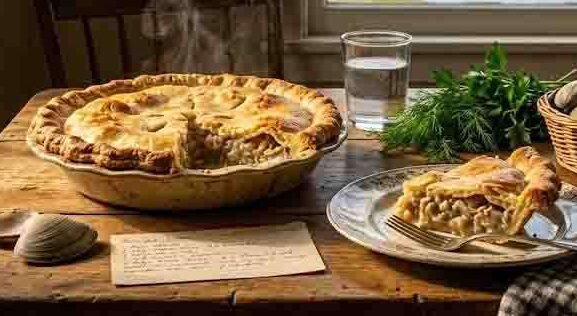
Bonac clam pie is Long Island’s most hyper-local dish: a savory, cream-filled pastry born not from a restaurant kitchen or a culinary school but from centuries of baymen pulling quahogs out of the cold floor of Gardiners Bay. It is, at its core, a dish of resourcefulness and place. And for reasons that have everything to do with pride and very little to do with marketing, it has stayed stubbornly regional — largely unknown outside the East End — even as the Hamptons have become one of the most photographed zip codes in America.
This is the dish that deserves to be better known. Here’s its full story.
Who Were the Bonackers — and Why Does It Matter?
The name comes from the harbor. Accabonac Harbor sits in the Springs area of East Hampton, its name derived from an Algonquin word meaning “root place.” (Slow Food USA, 2004.) The English settlers who built their homes along its shores in the mid-1600s eventually became known as “Bonackers” — working-class fishermen, farmers, and baymen whose families remained on that same stretch of land for generations, some for over three centuries.
These were not the wealthy summer residents who would eventually transform the Hamptons into a luxury resort. The Bonackers — the Lesters, the Bennetts, the Rattray family, among others — made their living off the water. They farmed the bay floor the way a farmer works a field: methodically, seasonally, with a rake and a basket and a deep knowledge of tidal patterns. Clams were not a special occasion ingredient. They were currency. They were dinner. They were survival.
The center of clam pie diversity remains the Bonacker culture of East Hampton, composed of those pioneer families of British heritage whose ancestors worked the water for centuries. That British lineage matters too. English medieval cooking had a deep affinity for pies — everything got into pies, so certainly clams and oysters were made into pies. When the first East End settlers arrived from Kent and Dorchester in the 17th century, they brought that pastry tradition with them and slipped local ingredients — quahogs, New World potatoes — straight into the crust.
The Oldest Recorded Recipe and What It Tells Us
The Bonac clam pie, in its documented form, dates back to at least 1896, when the recipe was first recorded by the Ladies’ Village Improvement Society of East Hampton. That original entry — attributed to a Mrs. Ann Parsons — is a study in brevity: chopped clams or oysters, one beaten egg, a scant cup of milk, a little broth, butter, pepper, and salt. Bake like any pie with two rich crusts for an hour. That’s it. Mrs. Parsons simply writes of the crust: “rich.” No temperature. No method. No mention of what kind of clams. She assumed you already knew.
That assumption is the entire philosophy of the dish. Bonac clam pie was never written down with precision because it was never meant to be taught from a page. It was taught hand to hand, in real kitchens, by people who had made it fifty times and could read the filling by sight. Recipes have often been passed down from one family member to the next, so specific ingredients and methods tend to vary across surnames and generations.
The L.V.I.S. 300th Anniversary Cook Book, published in 1948 to commemorate East Hampton Town’s 300th year, notes plainly: “There are different schools of thought on Long Island Clam Pie, which is unknown in the Big City.” That sentence, written nearly 80 years ago, still holds. Walk into any diner in midtown Manhattan and ask for Bonac clam pie. You’ll get a blank stare. Drive out to Amagansett and it’s a different conversation entirely.
By the late 1930s there were already multiple distinct iterations recorded — recipes from the Rattray family using both soft and hard clams with fresh parsley; a version from Mrs. William Conrad featuring minute tapioca and crumbled milk crackers for texture; and a pie served with a cream sauce on the side, Depression-era circumstances notwithstanding. Every family left its fingerprints in the filling.
What Goes Inside — The Anatomy of a Clam Pie
Strip away the mythology and the dish is architectural in its simplicity. The base of nearly every version involves three things: clams, potatoes, and onion. Beyond that, the variations multiply.
Almost all recipes feature a filling of chopped, ground, or whole clams — often quahogs or a combination of hard and soft-shell clams — along with a mix of potatoes, onions, celery, and heavy cream or milk. Some versions add bacon rendered in the pan, its fat used to sweat the aromatics. Others call for parsley, thyme, or mustard seed. A few incorporate tomatoes from a backyard garden — a detail that traces directly to a specific grandfather’s prolific summer patch.
The crust carries as much debate as the filling. Lard produces the most traditional result: flaky, savory, with just enough structural integrity to hold the soupy interior together. Shortening is more forgiving. Butter is richer. Food historians who have researched the pie extensively believe a lard-based crust remains the ideal — the first thing you eat is still the crust, and it has to be right.
The finished product has been described repeatedly as “clam chowder in a pie crust” — but that description, while useful, undersells it. A classic preparation calls for potatoes boiled in clam juice until soft, bacon sautéed until crisp, onions caramelized in the rendered fat, then everything combined with clams, flour, parsley, and thyme and baked at 400 degrees until golden, 50 to 55 minutes. The clam liquor — the briny liquid released as the clams steam open — is the soul of the filling. It does what a stock does in a French braise: concentrates, deepens, and connects every element into a single coherent flavor.
James Beard Award-nominated chef Jeremy Blutstein, executive chef at Gurney’s Star Island Resort & Marina in Montauk, has been eating clam pie since childhood. “It was a meal that was supposed to be filling,” he said. “If you’re working outside all day long, you need something with a high-calorie intake. Clams were cheap because they were free.”
That last line says everything about why this dish exists and why it endures.
A Dish of Access, Not Aspiration
There’s a meaningful distinction between food that becomes a regional classic because of its refinement and food that becomes a classic because of its utility. Bonac clam pie is the latter, and that’s precisely what makes it interesting.
The history of savory dinner pies stretches back to medieval times in Europe. But, according to historians, the clam pie rarely appears in regional American cookbooks throughout the 18th century — except on Long Island. Elsewhere, there was often a stigma surrounding clam-eating, with some claiming the bivalve was food fit for the poor. The East End rejected that stigma entirely. Where other coastal communities turned their noses up at the quahog, the Bonackers built a culinary identity around it.
Unlike many other colonial seaside settlements from Virginia to Maine who made pies filled with all types of seafood, it’s only at the tip of Long Island where you find the clam pie specifically. Clams were often thought of as peasant food, or something only “Indians” ate. Thankfully the Bonackers disagreed — making this shellfish dish exclusively their own.
The connection between economic necessity and culinary excellence is one that repeats across food cultures all over the world. The great working-class dishes — French cassoulet, Italian ribollita, Southern gumbo — all share this origin story. You make do with what the land and water give you, and if you do it long enough, with enough care and enough family pride, it becomes art. Bonac clam pie is no different.
After 25 years behind the line at The Heritage Diner, this pattern is deeply familiar — the dishes that stick, that become traditions, that customers still request decades later, are never the expensive ones. They’re the ones that taste like someone’s kitchen, someone’s grandmother, someone’s Sunday afternoon.
Where to Find It Today — and Where the Tradition Lives
For years, the go-to source for clam pies on the East End was the Crystal Room on Pantigo Road in East Hampton — a weathered roadside spot with a hand-painted sign nailed to a tree that simply read “Clam Pies.” It’s gone now. So is the Sea Spray Inn, which reportedly sent 135 pies to the 1950 L.V.I.S. summer fair before being lost to fire.
Today, the most reliable keeper of the tradition is Stuart’s Seafood Market at 41 Oak Lane in Amagansett, where the Sasso family has maintained the clam pie as part of their prepared foods program. Originally established by Amagansett bayman Stuart Vorpahl in the 1950s, the market is one of the oldest seafood operations on the East End and continues to freeze pies for enthusiasts year-round. Their phone number is (631) 267-6700.
The Bonac Eats community on Facebook has become the modern repository of recipes, stories, and debates — a digital version of the L.V.I.S. cookbook, crowdsourced across generations of East End families who still make the pie at home, still argue about the crust, and still consider it a mark of belonging.
Bennett Shellfish, operated by Clint Bennett Jr. — a 14th-generation Bennett whose family worked the bay alongside local Indigenous people centuries ago — supplies the kind of locally-raked quahogs that make the difference between a good clam pie and a great one.
The Recipe: A Working Template for the Home Cook
No single recipe is “correct.” What follows is a solid foundational version, informed by the documented historical variants and adapted for a home kitchen. Consider it a starting point. The adjustments you make over time — a handful of thyme from the garden, a splash more clam juice, your grandmother’s pie crust — are what make it yours.
Ingredients (serves 6 to 8):
- 3 cups shucked quahogs (or a mix of hard and soft-shell clams), chopped and liquid reserved
- 3 to 4 medium potatoes, cubed
- 1 medium onion, diced
- 2 stalks celery, diced
- 4 strips bacon
- 1/4 cup heavy cream
- 2 tablespoons flour
- Fresh parsley and thyme
- Salt, black pepper
- Pie crust for a 9-inch deep-dish pie (top and bottom), lard-based if possible
Method:
Steam clams open and reserve all liquid. Boil cubed potatoes in the reserved clam juice until just tender — about 20 minutes — then drain. Render bacon in a heavy skillet until crisp, remove and crumble. In the same fat, sauté onion and celery over medium-low heat until soft and golden, 12 to 15 minutes. Combine potatoes, clams, bacon, onion, celery, parsley, thyme, flour, and cream in a bowl. Season with salt and pepper. The mixture should be thick but not dry — the clam liquor keeps it cohesive.
Fit one crust into a 9-inch deep-dish pie pan. Add filling, mounding toward the center. Dot with butter. Cover with the second crust, trim to one inch, fold and crimp. Cut a small steam vent in the center. Bake at 400°F for 50 to 55 minutes until deeply golden. Rest for 10 minutes before slicing.
Saveur’s East End Clam Pie recipe offers a well-documented version worth consulting alongside this one.
Why This Dish Deserves More Than Local Fame
Food culture has a short memory. Dishes that sustained entire communities for generations can vanish within a single generation if no one makes a point of preserving them. While few residents make clam pie anymore, it continues to be produced by a handful of holdouts on the East End — some markets sell as many as 10 to 15 pies a week during fall and winter months.
That’s not nothing. But it’s also not enough for a dish with this much history behind it.
As one historian tracking the pie’s evolution put it: “This isn’t anywhere else. This is only out here. It’s a silly little item to try and save, but I think it’s an important thing.”
He’s right. The Bonac clam pie is not just a recipe. It’s a record of how one community on the eastern edge of Long Island lived, ate, and survived across four centuries — how the families who raked the bay for a living turned a free, abundant ingredient into something worth passing down. In an era when every regional food tradition faces pressure from mass-market homogeneity, that kind of specificity is worth protecting.
Make the pie. Adjust the recipe. Argue about the crust. That’s how it’s supposed to work.
Sources:
- Gastro Obscura / Atlas Obscura — Bonac Clam Pie
- Heated / Medium — Hannah Selinger, “You’ve Likely Never Heard of This Super Regional Dish” (2019)
- The East Hampton Star — “Deep-Dish Bonac: A Social History of Clam Pie” (2020)
- Slow Food USA — “The Pleasures and Past of the Bonac Clam Pie” (2004)
- Saveur — East End Clam Pie Recipe (2007)
- Foodigenous — “West End Girls, But It’s East End Clam Pie” (2022)
- Wikipedia — Clam Pie
- Stuart’s Seafood Market, Amagansett NY — stuartsseafood.com