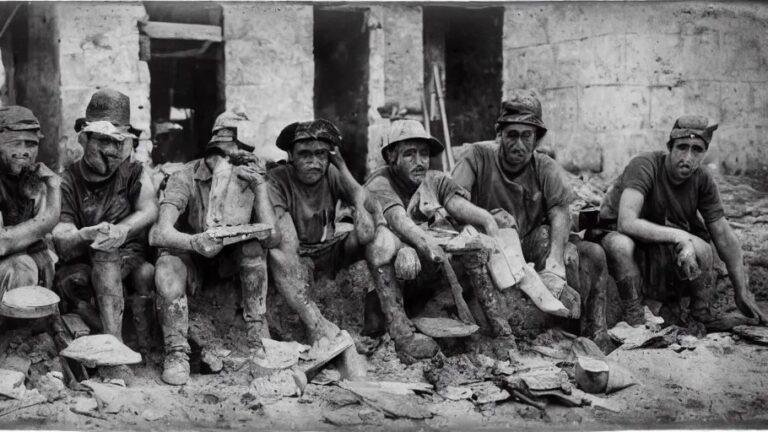
Eighty years ago, the North Shore of Long Island looked different. Not in geography, not in the salt-and-pine character that still defines Route 25A on a November morning — but in what was growing in the yards. Behind cottages in Port Jefferson and Mount Sinai, alongside the modest homes of Setauket and Stony Brook, something was happening in American soil that this country had never seen before and has not seen since at such scale. Families were feeding the war. Not with bullets or boots, but with parsnips, turnips, carrots, and potatoes.
The Victory Garden. It was a national act of collective discipline, and for the communities of Long Island’s North Shore — then still largely rural and agricultural — it carried a particular weight.
A Nation That Grew Its Own Meal
When Japan attacked Pearl Harbor on December 7, 1941, the reverberations moved through the American food system almost immediately. By May 1942, the U.S. government’s Office of Price Administration (OPA) had begun rationing sugar. By November of that year, coffee was limited to one pound every five weeks. And by March 1943, the ration books that every American family carried expanded to cover meats, fats, canned fish, cheese, and canned milk. (National WWII Museum, 2024.)
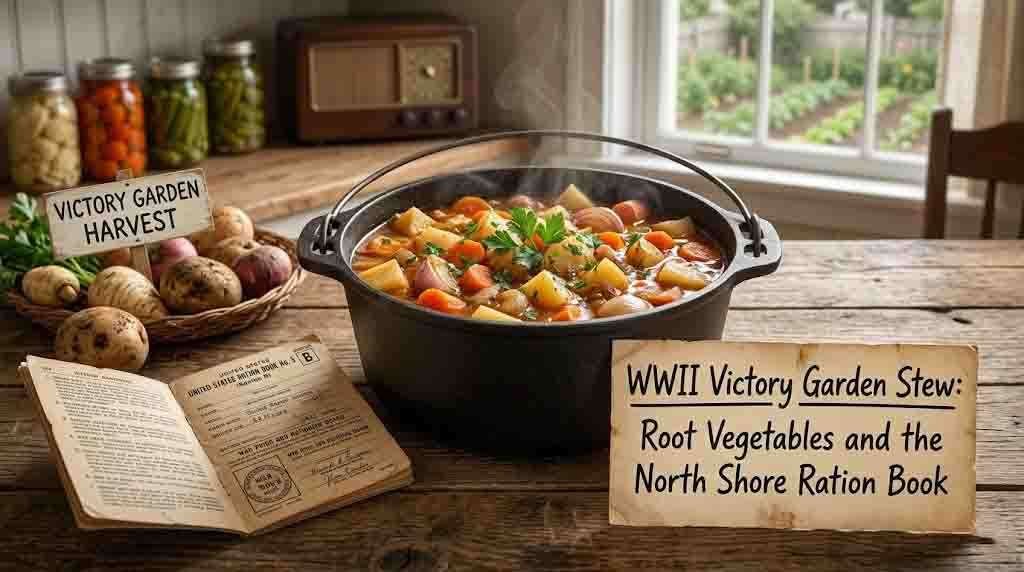
Every American — even newborns — received ration books filled with red and blue stamps. Red stamps governed meat, butter, and fats. Blue stamps covered canned and processed foods. Each person received 48 blue and 64 red points per month, an allowance carefully calculated to keep civilian bellies fed while ensuring enough calories reached the sixteen million men and women in uniform overseas. (National Museum of the Pacific War, 2024.)
The math was unforgiving. Families with three or four children did the arithmetic every week at the kitchen table. A pound of bacon cost around 30 cents in 1943 — but it also cost seven red ration points, points that couldn’t be spent on anything else. (National WWII Museum, Rationing, 2024.) The solution, urged by the Department of Agriculture and amplified by every newspaper, radio program, and propaganda poster the federal government could produce, was to grow your own.
Victory Gardens — also called war gardens or food gardens for defense — had existed since World War I, but their second iteration was something of an entirely different order. Between 1942 and 1944, approximately 20 million Victory Gardens took root on both public and private spaces, supplying nearly half the produce Americans ate. By 1944, a survey conducted by the Department of Agriculture determined over 18.5 million gardens had been established, with home and community gardens producing roughly 40% of the available fresh vegetables in the United States that year.
These were not hobby plots. They were survival infrastructure with a patriotic seal of approval.
Long Island’s Home Front Garden
Long Island in the early 1940s straddled two worlds. Nassau County had begun suburbanizing, but much of Suffolk — including the towns along the North Shore — remained defined by farms, fishing hamlets, and modest working communities. That agricultural character made the Victory Garden campaign land differently here than it did in, say, Manhattan.
In New York City proper, the effort was extraordinary: at the peak of the effort, there were more than 400,000 Victory Gardens in the city cultivating more than 200 million pounds of produce on more than 6,000 acres — the equivalent of seven Central Parks. Mayor Fiorello LaGuardia was instrumental, working through both the municipal government and the Brooklyn Botanic Garden to coordinate planting programs. (NYC Department of Records and Information Services, 2021.)
Out on the North Shore, the effort was quieter but arguably more organic. Families who had always kept kitchen gardens simply expanded them. Those who hadn’t were handed government pamphlets detailing soil preparation, planting schedules, and canning techniques. Seed companies moved quickly: W. Attlee Burpee & Co. developed and marketed seeds selected specifically for victory gardens, with tomatoes among the company’s best sellers, followed by wax beans.
But the North Shore’s real garden currency wasn’t tomatoes. It was the root cellar staples — the vegetables that could be pulled from the ground in October and still sustain a family through February. Turnips. Parsnips. Carrots. Potatoes. Rutabagas.
Long Island was also deeply connected to the war effort in other ways. According to historian Dr. Christopher Verga, author of World War II Long Island: The Homefront in Nassau and Suffolk (Arcadia Publishing, 2022), Long Island was transformed from a primarily rural, agricultural region to a hub of modernity during the war, hosting defense industry workers, POW camps, and civilian defense volunteer networks. In Rockville Centre alone, residents raised 700,000 pounds of scrap metal — enough to build 35 tanks. The war was not abstract out here.
The Root Vegetable as Wartime Currency
Of all the crops a Long Island family could grow or store through a Suffolk County winter, root vegetables were the most valuable. They asked little of the gardener in terms of ongoing attention. They stored without electricity. They could be pulled and cooked in stages. And they yielded something that the ration book could not: protein-adjacent satiety — that deep, slow warmth of starch and fiber that kept a family upright through a cold morning and a long shift.
Turnips, rutabagas and parsnips were as much staples a hundred years ago as carrots and potatoes are today. The wartime kitchen rediscovered this truth from necessity. Parsnips sweetened naturally after the first frost, their starches partially converting to sugars. Turnips added bitter depth to a broth that was otherwise just water and bay leaf. Carrots, abundant and easy to store in damp sand, provided color and sweetness. Potatoes were the anchor — the carbohydrate backbone of a stew that otherwise had no meat.
The Victory Garden stew was not a recipe so much as a philosophy: use what is growing, waste nothing, season with intention, and feed the people in front of you.
Government pamphlets provided planting guidance, but wartime cookbooks filled in the gap between garden and pot. Marguerite Patten’s Victory Cookbook — produced during the war and still referenced by culinary historians — detailed how to build satisfying meals from root vegetables alone, using bones for stock, herbs from the garden window, and thickened broth in place of the fat that was being rationed away. Citizens were encouraged to embrace “Victory Meat Extenders” like soy and breadcrumbs, and learned to bake with alternative sweeteners like honey and molasses.
The stew pot was the democratic center of the wartime kitchen.
What Went Into the Pot
Victory Garden stew had no canonical recipe — it had a logic. Root vegetables that stored well formed the foundation. Aromatics that could be grown easily, such as onions and leeks, provided the base layer of flavor. Stock — made from bones if available, vegetable water if not — was the medium. And thickening came from flour, corn starch, or simply from the starch released by the potatoes themselves over a long, slow simmer.
A representative North Shore stew from the early 1940s might have included the following, drawn from a late-autumn root cellar and a small garden plot:
Turnip and rutabaga — The coarsest in texture and most assertive in flavor, these went into the pot first, cut smaller than the other vegetables to compensate for their density. They needed the most time and rewarded the wait with a savory depth that softened as the broth developed.
Carrots and parsnips — The parsnip, often overlooked today, was a standard wartime crop. Its nutty sweetness — most pronounced after cold exposure — contributed complexity without using any rationed ingredient. Carrots followed, cut to similar size, adding color and natural sugar.
Potatoes — Added later in the cook to prevent complete dissolution, potatoes provided the body and starch that made the stew genuinely sustaining.
Onion and bay leaf — The aromatics. An onion, even a small one, transformed a pot of boiled root vegetables into something resembling dinner. Bay leaves, dried and stored, cost no ration points.
Thin broth thickened with corn starch — Meat stock was ideal but not always possible. A corn starch slurry stirred in during the final ten minutes of cooking turned the thin vegetable liquid into something that clung to the spoon and coated the bowl.
The cooking method echoed what food historians would later identify as the governing principle of wartime cuisine: the hardest vegetables cut smallest, the softest added last, nothing wasted, everything stretched. As documented in archives from period cookbooks, stew was likely commonplace in most wartime kitchens, with people throwing in all sorts — porridge, bacon rinds, dripping, even leftovers. None were right or wrong; a stew was just throwing things together to create a thick and textured soup and often a very economical dish.
The Morale Function of Food
What historians have come to understand about the Victory Garden movement — and what contemporary accounts often understate — is that the stew pot was doing two things simultaneously. It was feeding the body. And it was maintaining the morale architecture of American civilian life.
Regardless of the challenges and shortcomings, the Victory Garden and Food for Freedom campaigns were two of the most successful undertakings of the federal government and American society during the war.
Food, even humble food — especially humble food — was an act of participation. The North Shore family that pulled their turnips in October, stored them in the root cellar, and ladled them into a stew in January was not simply eating. They were exercising a form of agency in a situation designed to make the individual feel powerless. The meal said: we can do this. We are still feeding our own.
Jennifer Steinhauer, writing in the New York Times Magazine in 2020, observed that Victory Gardens were more about solidarity than survival — that the act of growing and cooking together knit communities in ways that the war effort demanded. (Steinhauer, 2020.) On the North Shore, where neighbors had long shared fence lines and fishing grounds, this communal instinct was already part of the culture. The garden was a natural extension of it.
A poll in January 1944 found that 75 percent of housewives canned, and those women canned an average of 165 jars per year — meeting the family’s needs and preserving ration points for foods they couldn’t grow. These were not weekend hobbyists. These were household managers operating under extraordinary logistical constraints, and they rose to meet them with a discipline the country has rarely asked of its civilians since.
Making the Stew Today
The Victory Garden stew translates remarkably well to a modern kitchen — and makes an argument for the way seasonal, local, and storable produce can anchor a week of eating without elaborate preparation. The root vegetables remain the same. The slow simmer remains the same. What has changed is that the cook is no longer working around a ration book.
A contemporary version worthy of the original:
Begin by sweating a diced onion in a small amount of butter or olive oil until translucent. Add two cloves of garlic and a sprig of fresh thyme. To the pot, add diced rutabaga and turnip first — the densest vegetables — cut to half-inch pieces. Cover with four to five cups of good vegetable or chicken stock and bring to a simmer.
After fifteen minutes, add diced carrots, parsnips, and celery root in equal proportion. Twenty minutes later, add diced Yukon Gold potatoes. Season generously with salt, black pepper, and a bay leaf. Simmer uncovered until all vegetables are fork-tender and the broth has reduced by a third.
If thickening is desired, stir two tablespoons of corn starch into a quarter cup of cold water and stream it into the pot while stirring. Simmer for an additional five minutes until the broth has taken on a glossy, coating consistency. Finish with a handful of flat-leaf parsley. Serve with crusty bread — sourdough, ideally, its tangy fermented crumb built for tearing and dipping.
The flavor is deep, earthy, and genuinely warming — the kind of dish that improves by the next day, when the starches have had time to absorb the broth and the vegetable flavors have fully merged.
What the Ration Book Left Behind
Most Victory Gardens disappeared after the war. People became uninterested; they wanted to distance themselves from the food hardships of the Great Depression and the War, and there was a shift to post-war processed foods. The Levittown development that reshaped Nassau County’s potato fields into subdivisions represented the postwar American appetite for newness, convenience, and the erasure of wartime memory.
But what the ration book era left behind was more durable than it looked. It left behind a generation of cooks who knew how to use what was in front of them. Who understood that a turnip and a parsnip and a bay leaf, given sufficient time and attention, could become a meal worth sitting down for. Who knew that food grown close to home required no supply chain, no refrigerated truck, and no ration stamps.
That knowledge, like the root vegetables themselves, kept well underground. It returns, reliably, whenever the circumstances require it — or whenever someone decides, for reasons of pleasure rather than necessity, to pull a turnip from the November earth and find out what it tastes like when it has been given the time and heat it deserves.
On the North Shore, that particular patience has never entirely gone out of season.
Sources
- National WWII Museum. “Victory Gardens: Food for the Fight.” https://www.nationalww2museum.org/war/articles/victory-gardens-world-war-ii
- National WWII Museum. “Rationing During WWII.” https://www.nationalww2museum.org/war/articles/rationing-during-wwii
- National WWII Museum. “Ration Books.” https://www.nationalww2museum.org/students-teachers/student-resources/research-starters/take-closer-look-ration-books
- National Museum of the Pacific War. “Rationing on the Homefront.” https://www.pacificwarmuseum.org/learn/articles/rationing-on-the-homefront
- U.S. National Park Service. “Victory Gardens on the World War II Home Front.” https://www.nps.gov/articles/000/victory-gardens-on-the-world-war-ii-home-front.htm
- U.S. National Park Service. “Food Rationing on the World War II Home Front.” https://www.nps.gov/articles/000/food-rationing-on-the-world-war-ii-home-front.htm
- NYC Department of Records and Information Services. “Victory Gardens.” https://www.archives.nyc/blog/2021/4/2/victory-gardens
- Edible Manhattan. “World War II Brought 400,000 Victory Gardens to Manhattan.” https://www.ediblemanhattan.com/foodshed-2/producers/farms-foodshed/manhattans-victory-gardens/
- Norfolk Botanical Garden. “Vital to Victory — Victory Gardens.” https://norfolkbotanicalgarden.org/vital-to-victory-victory-gardens/
- Sundin, Sarah. “Victory Gardens in World War II.” https://www.sarahsundin.com/victory-gardens-in-world-war-ii/
- Verga, Christopher. World War II Long Island: The Homefront in Nassau and Suffolk. Arcadia Publishing, 2022.
- Long Island Advocate. “From Nazi Spy Rings to POW Camps: Long Island’s Role in WWII.” https://longislandadvocate.com/from-nazi-spy-rings-to-pow-camps-long-islands-role-in-wwii/
- Eats History. “WW2 Ration Cooking: 10 Recipes for Wartime.” https://eatshistory.com/ww2-ration-cooking-10-recipes-for-wartime/
- Steinhauer, Jennifer. “Victory Gardens Were More About Solidarity Than Survival.” New York Times Magazine, July 15, 2020.
- The 1940s Experiment. “Wartime Stew.” https://the1940sexperiment.com/tag/wartime-stew/