
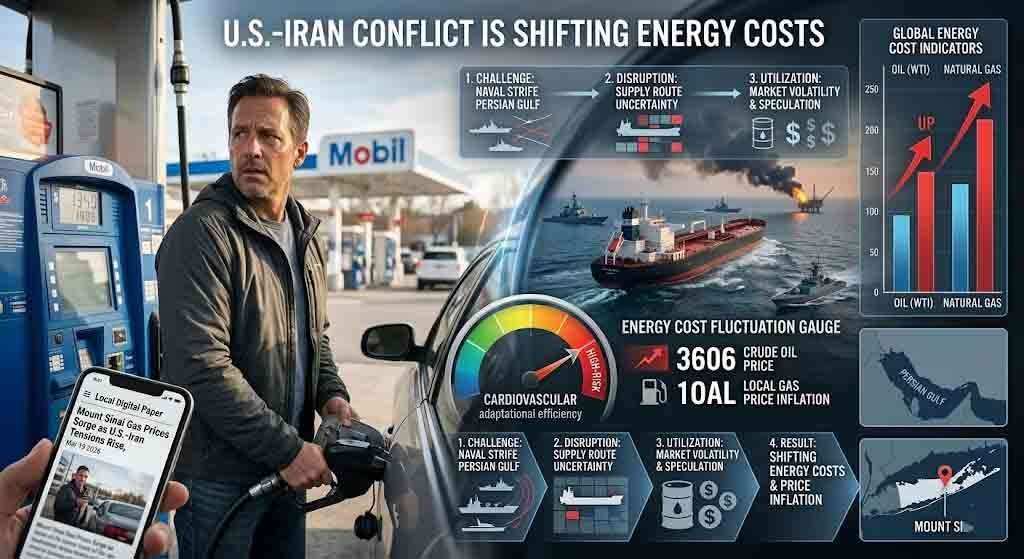
War doesn’t announce itself on your heating oil bill the day after the first missile flies. It works more slowly — a tremor across the Strait of Hormuz, a spike on the crude futures screen, a quiet revision from your fuel delivery service three weeks later. But make no mistake: what began on the night of February 28, 2026, when the United States and Israel launched coordinated military strikes against Iran, has set off a chain of consequences that will be felt not just in global financial markets, but on the driveways and in the oil tanks of Long Island’s North Shore estates.
For those of us who live and work here — who understand this community not as a abstraction on a real estate map but as a living ecosystem of homes, families, and property values — the events unfolding thousands of miles away in the Persian Gulf are not distant news. They are a direct variable in the cost of keeping a home warm, the trajectory of a mortgage decision, and the calculus of whether a buyer pulls the trigger on a $2 million listing this spring.
The Strait of Hormuz: A Chokepoint the World Cannot Ignore
Geography is destiny in energy markets. The Strait of Hormuz — that narrow corridor between Iran and Oman at the mouth of the Persian Gulf — is, without exaggeration, the most consequential 21 miles of water on the planet when crude oil is the subject. According to the U.S. Energy Information Administration, roughly 20 million barrels of oil pass through that waterway every single day, representing approximately 20% of global oil demand. When traffic slows, the world feels it.
It has already slowed. In the days following the initial U.S. and Israeli strikes that killed Iran’s Supreme Leader Ali Khamenei, shipping companies and their insurers began withdrawing from the strait with remarkable speed. Within 48 hours, more than 200 vessels — tankers carrying crude oil and liquefied natural gas — were anchored in the waters near the passage, unwilling to risk transit. Leading marine insurers canceled war-risk coverage, effectively halting tanker movement and driving shipping rates higher across the board.
The result was immediate. Brent crude, the international benchmark, surged more than 8.5% on Monday following the strikes, pushing past $79 a barrel. U.S. West Texas Intermediate climbed above $71, its highest in nearly nine months. And analysts at Citi projected Brent could trade between $80 and $90 a barrel in the days ahead — with Fidelity’s Capital Markets Strategy group warning that, if the stoppage extends further, oil could surge past $100 to $120 per barrel. Tail-risk scenarios, they noted soberly, could push prices toward $200.
Oil prices had already been rising before the first strike. Even before the weekend’s escalation, U.S. crude had climbed 17% year-to-date, pushed higher by months of rhetorical pressure from the Trump administration and escalating sanctions on Iranian exports. This was not a sudden shock arriving from nowhere. The market had been pricing in risk for weeks. The strikes turned that probability into a reality.
Long Island’s Hidden Vulnerability: The Oil-Heated Home
Here is a fact that does not appear in many conversations about geopolitical risk and real estate: according to U.S. Census data, nearly 44% of Suffolk County households heat their homes with fuel oil. That is not a rounding error. That is nearly half of a county of 1.5 million people — including the waterfront colonials of Huntington, the historic properties of Cold Spring Harbor, the stone-and-cedar estates dotting the bluffs above Long Island Sound from Miller Place to Centerport — directly tied to the global crude market every time the temperature drops.
North Shore homes are, by their nature, among the highest consumers. Older architecture, sprawling square footage, and the microclimate peculiarities of the Sound shoreline — where temperatures tend to run several degrees colder than the south shore — combine to produce annual fuel oil consumption that can run between 700 and 1,000 gallons for a typical home, and considerably more for larger estates. At the baseline Long Island residential heating oil price of roughly $4.03 per gallon as of early 2025, a 1,000-gallon household was already managing a heating season that cost over $4,000. Every $10 increase in the price of a barrel of crude oil translates, with some lag, to roughly 25 cents more per gallon at the residential level — a number that compounds quickly across a single heating season.
If Brent crude stabilizes near $90, which many analysts now consider a conservative floor for a conflict of this duration and scope, a North Shore homeowner consuming 1,000 gallons annually could be looking at an additional $500 to $800 in heating costs before spring arrives. For larger estates running 2,000 gallons or more, that number doubles. This is not catastrophic — the luxury market has survived oil shocks before — but it changes the conversation around operating costs, and over time it changes what buyers ask about before they sign.
Natural Gas, LNG, and the European Ripple Effect
The Strait of Hormuz is not merely an oil chokepoint. It is a liquefied natural gas corridor as well, and the disruption to LNG has sent its own shock through energy markets. QatarEnergy — operator of the world’s largest LNG export facility — halted production after Iranian drone strikes targeted its facilities in the opening days of the conflict. European natural gas futures rocketed higher by 45% on the news. In the United States, natural gas prices jumped roughly 5% — a smaller move, but notable given that natural gas prices in Long Island directly influence utility costs for those homes that have converted from oil.
The irony is not lost on those tracking the broader energy picture: homeowners who made the switch from heating oil to natural gas over the past decade — often sold on the proposition of price stability and infrastructure independence — find that LNG market shocks now ripple into their utility bills as well, though with a delay and a degree of insulation that direct oil consumers do not enjoy.
For Long Island estates, where many properties remain entirely dependent on oil delivery, there is no buffer. The market price, the geopolitical event, and the invoice from the fuel company exist in nearly direct relationship.
The Real Estate Equation: Inflation, Rates, and the North Shore Buyer
The connection between oil shocks and real estate is not merely anecdotal. Research published in the Journal of Financial Economics has documented that supply-driven oil price spikes function as a contractionary force in net oil-importing economies — which the United States, despite its domestic production, effectively remains at the residential consumer level. When energy costs rise persistently, household budgets tighten, discretionary spending contracts, and consumer confidence — that reliable lagging indicator of market behavior — softens.
The transmission mechanism to real estate is more indirect but no less real. A sustained oil shock above $80 to $90 per barrel would push core inflation higher, potentially forcing the Federal Reserve to pause or even reverse any plans for interest rate reductions. If inflation expectations climb, Treasury yields follow, and 30-year fixed mortgage rates — currently sitting near 5.98% according to Freddie Mac — could inch higher at exactly the moment buyers need relief. Construction costs for energy-intensive materials rise alongside crude: asphalt, insulation, transport of lumber and stone — all components of the renovation and new construction budgets that define the North Shore’s premium housing stock.
The live South Florida Realty analysis on the conflict’s real estate impact put it cleanly: the real threat is not the first week’s spike but the sustained “war premium” embedded in oil prices if Iran retaliates in ways that disrupt Gulf infrastructure at scale. That scenario — analysts placing it in the $90 to $100-plus range for Brent — would be decidedly negative for the broader housing market, particularly in supply-constrained markets like ours where limited inventory has kept prices elevated even as buyers have grown more cautious.
What Smart North Shore Buyers and Sellers Should Be Watching
The situation is dynamic enough that no one — not the market analysts, not the oil traders, not the geopolitical strategists — knows whether this conflict will resolve in weeks or stretch into a prolonged campaign. President Trump has publicly suggested the engagement could last four to five weeks, or longer. That uncertainty is itself a market variable.
For buyers currently considering North Shore estates, a few considerations have moved to the front of the due diligence checklist. First: the heating system. A property running on a high-efficiency oil furnace with an AFUE rating above 85% will weather this shock materially better than an older, inefficient system burning the same volume at higher cost. Second: contract structures with local oil delivery companies. Long Island’s competitive oil delivery market — with over 260 companies serving Nassau and Suffolk — still offers fixed-price and ceiling contracts that allow homeowners to cap their exposure before summer ends and prices climb further. Locking in now, before the full Iran premium filters to the retail level, is a move worth considering.
For sellers, energy efficiency certifications and recently serviced heating systems have become differentiating assets in a way they weren’t two years ago. The buyer asking “what does this place cost to run?” is no longer the exception. That question is now part of every serious conversation.
As for the broader North Shore market: the luxury segment has historically demonstrated resilience to geopolitical oil shocks precisely because high-net-worth buyers are less sensitive to financing costs and more driven by lifestyle, privacy, and long-term asset strategy. A significant share of luxury transactions remain cash-based, insulating the segment from rate movements. This is not a moment of collapse — it is a moment of recalibration.
Energy Transition as a Long-Term Hedge
It would be incomplete to discuss this moment without noting what savvy North Shore homeowners and estate buyers have been quietly doing for the past several years: reducing oil dependency. The number of Long Island homes incorporating active solar arrays has grown dramatically over the past decade — from fewer than 200 in 2012 to nearly 2,850 today, representing an increase of over 1,800%. Ground-source heat pumps and cold-climate air-source systems have moved from engineering curiosity to legitimate heating alternatives, with New York State’s Clean Heat program offering incentives that can meaningfully offset installation costs.
The 2026 global luxury property outlook, as tracked by PropertyWire, confirms what is being seen in transactions across premium markets: from sustainability having been “desirable,” it has become “expected.” Energy management systems, solar integration, and reduced dependence on fossil fuel delivery are increasingly listed as value drivers — not just in environmental terms, but in hard operational cost terms that buyers are now modeling explicitly.
The estate that runs on a hybrid heat pump system with solar offset arrives at every conversation about energy costs with structural advantage. In a year when oil prices have climbed 17% before March, and the Strait of Hormuz remains in active conflict, that advantage is quantifiable.
A Moment That Asks for Clarity
Twenty-five years of watching the restaurant industry taught me something about operating costs in volatile commodity environments: the businesses that survive downturns are rarely the ones who got lucky with timing. They are the ones who understood their cost structure deeply enough to make deliberate choices before the pressure arrived. The same principle applies to real estate ownership.
The clients Paola and I work with on Long Island’s North Shore are not unsophisticated. They understand that a $2 million home is not a static asset — it is an operating system with ongoing costs, energy dependencies, and exposure to global market variables that they cannot fully control. What they can control is preparation: the heating contract signed in June, the insulation assessment scheduled before fall, the solar consultation that transforms a liability into a hedge.
The conflict in the Persian Gulf is real, its duration uncertain, its consequences still unfolding. But the question it poses to every North Shore property owner is ultimately local: do you know exactly what your home costs to run — and have you done everything within reach to keep that number stable regardless of what happens in the Strait of Hormuz?
That clarity, in any market, is the beginning of sound strategy.
Sources:
- CNN Business, Oil surges and stock futures sink as war in Iran threatens crude supply (March 1, 2026): https://www.cnn.com/2026/03/01/business/oil-prices-us-attack-iran-vis
- NBC News, Higher gas prices are likely coming to the pump after oil prices jump in wake of U.S. strikes in Iran (March 2, 2026): https://www.nbcnews.com/business/business-news/oil-prices-iran-strikes-rcna261209
- NPR, Oil prices surge, but no panic yet, as Iran war continues (March 2, 2026): https://www.npr.org/2026/03/02/nx-s1-5732287/iran-war-oil-gasoline-prices
- NPR, How could the U.S. strikes in Iran affect global oil supply? (February 28, 2026): https://www.npr.org/2026/02/28/nx-s1-5678603/iran-strikes-oil-energy-markets
- Fox Business, Oil prices surge after strikes kill Iran’s supreme leader, tankers hit near Strait of Hormuz (March 2, 2026): https://www.foxbusiness.com/markets/oil-prices-jump-iran-supreme-leader-killed-hormuz-tanker-strikes
- CNBC, Markets brace for impact following U.S. military strikes against Iran (February 28, 2026): https://www.cnbc.com/2026/02/28/markets-brace-for-impact-following-us-military-strikes-against-iran.html
- Fidelity, Oil prices surge after Iran conflict (March 2, 2026): https://www.fidelity.com/learning-center/trading-investing/us-iran-oil-prices
- Bloomberg, Iran War: How Oil Prices Are Surging as Hormuz Shipping, Production Disrupted (March 5, 2026): https://www.bloomberg.com/news/articles/2026-03-05/iran-war-how-oil-prices-are-surging-as-hormuz-shipping-production-disrupted
- OK Petroleum, Fuel Oil Prices on Long Island (October 2025): https://www.okpetroleum.com/understanding-fuel-oil-prices-what-long-island-homeowners-need-to-know/
- CheapestOil.com, Compare cash heating oil prices for Suffolk County, New York: https://www.cheapestoil.com/NewYork/Suffolk-County
- COD Oil Long Island, Suffolk County Heating Oil Delivery: Complete Town Guide: https://codoillongisland.com/suffolk-county-heating-oil-delivery-town-guide/
- Heat Fleet, Long Island Heating Oil: https://heatfleet.com/heating_oil_prices/LI-Long_Island.html
- Live South Florida Realty, The Impact Of Striking Iran On The Real Estate Market In The U.S. (February 2026): https://livesouthfloridarealty.com/the-impact-of-striking-iran-on-the-real-estate-market-in-the-u-s/
- PropertyWire, 2026 Global Luxury Property Outlook (December 2025): https://www.propertywire.com/analysis/2026-global-luxury-property-outlook/
- JLL, Global Real Estate Outlook 2026 (December 2025): https://www.jll.com/en-de/insights/market-outlook/global-real-estate
- ScienceDirect, Energy commodities and U.S. housing: Long-run Price and volatility integration (October 2025): https://www.sciencedirect.com/science/article/pii/S0140988325008370