Keats was drunk when he said it. December 1817, at the painter Benjamin Haydon’s London studio, surrounded by Wordsworth and Lamb and enough wine to loosen convictions into declarations. Newton, Keats insisted, had destroyed the poetry of the rainbow by reducing it to prismatic colors. They raised their glasses — to Newton’s health, and confusion to mathematics. Three years later, sober and tubercular, Keats distilled that barroom grievance into verse. In Lamia, he mourned the rainbow consigned to the “dull catalogue of common things,” beauty annihilated by the cold touch of philosophy. It is one of the most famous accusations in English literature: that science murders wonder.
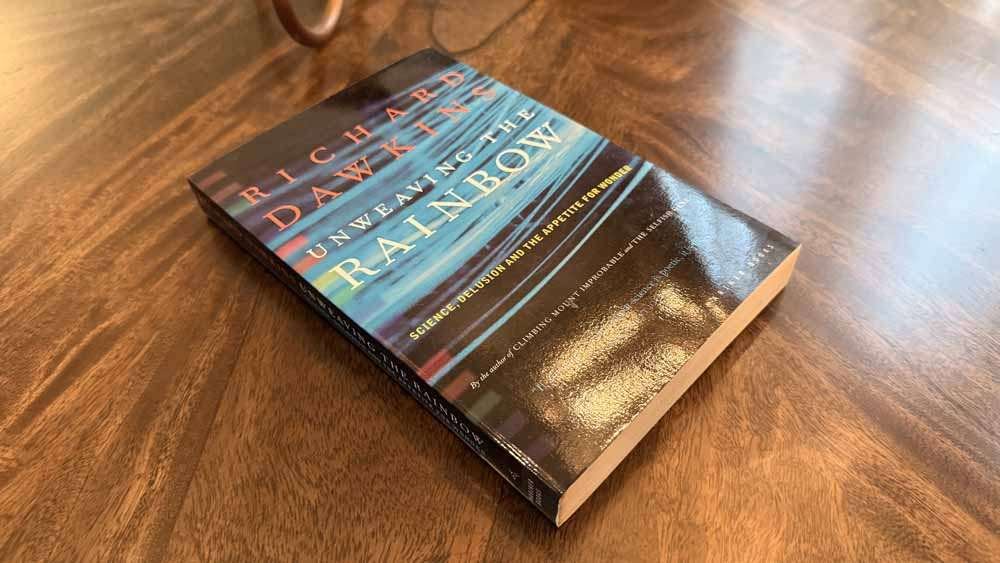
Richard Dawkins wrote Unweaving the Rainbow (1998) as a direct rebuttal, and it may be the most important book in his catalog that nobody talks about.
The Accusation That Launched a Book
Dawkins did not set out to answer Keats on a whim. The provocation came from his own readers. After The Selfish Gene and The Blind Watchmaker, he received letters — not from creationists or theologians, but from ordinary people who found his naturalistic worldview bleak. If we are gene machines stumbling through a universe indifferent to our hopes, why bother getting out of bed? The question stung him, and Unweaving the Rainbow is his attempt to flip the charge entirely. Science, he argues, does not drain the color from the world. It reveals colors we never knew were there.
The title itself is a reclamation. Where Keats saw Newton’s prism as an instrument of disenchantment, Dawkins sees the opposite: an instrument that cracked open the visible spectrum and eventually gave us spectroscopy, the technique that lets astronomers read the chemical signatures of stars billions of light-years away. Newton’s unweaving did not end at a slab of glass in a Cambridge study. It led to the discovery that the same hydrogen burning in our sun burns in galaxies we will never visit, that the element helium was detected in the solar spectrum before anyone found it on Earth. The unweaving, in other words, did not shrink the rainbow. It extended it across the entire observable universe.
Barcodes Everywhere
The middle chapters are where Dawkins hits his stride as a science writer, and they are genuinely dazzling. He introduces the concept of “barcodes” — not the kind you scan at the grocery store, though he starts there — as a unifying metaphor for how nature encodes information. Light from distant stars carries spectral barcodes that reveal composition, temperature, velocity. Sound waves carry barcodes that our ears decompose through a biological version of Fourier analysis, separating a symphony into individual instruments the way a prism separates white light into colors. DNA carries barcodes that can identify a criminal, confirm paternity, or trace the migration routes of ancient human populations.
This is Dawkins at his best: finding the structural rhyme between seemingly unrelated phenomena and making you feel the elegance of it. The same mathematical principle — decomposing a complex signal into its component frequencies — operates whether you are listening to a cello, analyzing starlight, or reading a genetic fingerprint. That kind of deep pattern recognition is exactly what good poetry does, and Dawkins knows it. He is not arguing that science replaces poetry. He is arguing that science is a form of poetry, one that happens to be testable.
The Anaesthetic of Familiarity
The book’s opening chapter introduces a phrase worth carrying around permanently: “the anaesthetic of familiarity.” Dawkins argues that the real enemy of wonder is not knowledge but habituation. We stop marveling at the fact that we exist — that we are, as he puts it, cities of cells, each cell a town of bacteria, the whole arrangement powered by molecular cogwheels spinning a hundred times per second. The sheer statistical improbability of any one of us being born, given the astronomical number of potential genetic combinations that never made it past conception, should be enough to make every morning feel like a lottery win. But familiarity dulls us. We walk past miracles because we see them every day.
This is where Unweaving the Rainbow lands its most persuasive blow. The Romantic complaint — that explanation kills mystery — assumes a fixed quantity of wonder in the universe, as if understanding how a rainbow forms necessarily subtracts from the experience of seeing one. Dawkins rejects that zero-sum framing. Every answered question, he insists, opens onto deeper and stranger questions. Newton’s optics led to Maxwell’s electromagnetism, which led to Einstein’s special relativity, which led to a picture of the cosmos so bizarre and so beautiful that Keats, had he lived to see it, might have written very different poetry.
Good Poetry, Bad Poetry, and Gaia
Not every chapter sustains the same altitude. Dawkins spends significant time distinguishing what he calls “good poetic science” from “bad poetic science,” and here the book gets uneven. Good poetic science, in his framework, uses metaphor to illuminate genuine mechanisms — the way “selfish gene” captures the logic of natural selection without implying conscious intent. Bad poetic science uses metaphor to obscure or romanticize, dressing up wishful thinking in scientific language. His primary target is Gaia theory, the idea that Earth functions as a single self-regulating organism. Dawkins considers this seductive but misleading, a metaphor that has escaped its leash and started behaving like an explanation.
He is probably right on the merits, but the prosecution can feel heavy-handed. The chapters on bad poetic science read less like celebration and more like score-settling, and they interrupt the book’s larger argument about wonder. The same could be said for his extended treatment of astrology and superstition, which, while entertaining, sometimes drifts toward targets too easy to be interesting. Dawkins is at his weakest when he is debunking downward and at his strongest when he is building upward, and Unweaving the Rainbow contains both modes in roughly equal measure.
Reweaving the World
The book’s final movement is its most ambitious. Having spent ten chapters unweaving — showing how science decomposes phenomena into their constituent parts — Dawkins reverses direction and asks how the mind reweaves reality into coherent experience. How does a brain reassemble the barrage of sensory data into the unified world we perceive? How did language evolve, and what role did metaphor play in the development of human cognition? He floats the idea that our capacity for analogy — for seeing one thing as another — may have been the cognitive mutation that launched the human mind into its peculiar orbit.
This is where the book connects back to its title most powerfully. The mind is itself a weaver. It takes the raw threads of perception and spins them into meaning, narrative, and — yes — poetry. Science, in Dawkins’s telling, is not the opposite of this process but its most disciplined expression. Where the poet weaves intuitively, the scientist weaves with controls and measurements, but both are engaged in the same fundamental human activity: making sense of a world that does not come pre-labeled.
Where It Sits in the Shelf
Readers familiar with The Selfish Gene know Dawkins as a rigorous biologist who can write like a novelist. Readers who came to him through The God Delusion know him as a polemicist. Unweaving the Rainbow sits between those two identities, and it may be the truest expression of what actually drives him — not the urge to argue, but the urge to marvel. The combative Dawkins is here, certainly, in the chapters on pseudoscience and sloppy metaphors. But the dominant note is something closer to rapture. The Wall Street Journal called it the most poetic science writing of its era, and that assessment holds up nearly three decades later.
The book also serves as a quiet companion to The Extended Phenotype, which expanded the gene’s-eye view beyond the body, and to Andrew Brown’s The Darwin Wars, which chronicles the intellectual battles Dawkins fought along the way. But where those books argue within the framework of evolutionary biology, Unweaving the Rainbow steps outside the frame entirely to ask a more fundamental question: what is the relationship between knowing and feeling?
Dawkins answers that they are not enemies. They never were. Keats was wrong at that dinner table in 1817, wrong in Lamia, wrong in ways that a young man dying of tuberculosis at twenty-five might be forgiven for. The rainbow is not diminished by Newton’s prism. It is deepened, extended, and made stranger than any myth could manage. And in an era when anti-intellectualism has metastasized from a dinner-party provocation into a political force, the argument that understanding enriches rather than impoverishes experience is no longer a philosophical luxury. It is a survival skill.
Unweaving the Rainbow: Science, Delusion and the Appetite for Wonder is available from Amazon, Barnes & Noble, and wherever books are sold.
You Might Also Like:
- The Extended Phenotype: How Your Genes Build Structures Beyond Your Body
- An Introduction to Logic and Scientific Method by Morris R. Cohen & Ernest Nagel — A Review
- The Boltzmann Brain Paradox: When Statistical Physics Predicts You Shouldn’t Exist
Sources:
- Dawkins, Richard. Unweaving the Rainbow: Science, Delusion and the Appetite for Wonder. Houghton Mifflin, 1998.
- Keats, John. “Lamia.” Lamia, Isabella, the Eve of St Agnes and Other Poems. 1820. Wikipedia: Lamia (poem)
- Unweaving the Rainbow — Wikipedia
- Raman, V.V. “Review of Richard Dawkins’ Unweaving the Rainbow.” Metanexus
- We Need to Talk About Books — Unweaving the Rainbow Review
- “Does Science Diminish Wonder or Augment It?” Nautilus