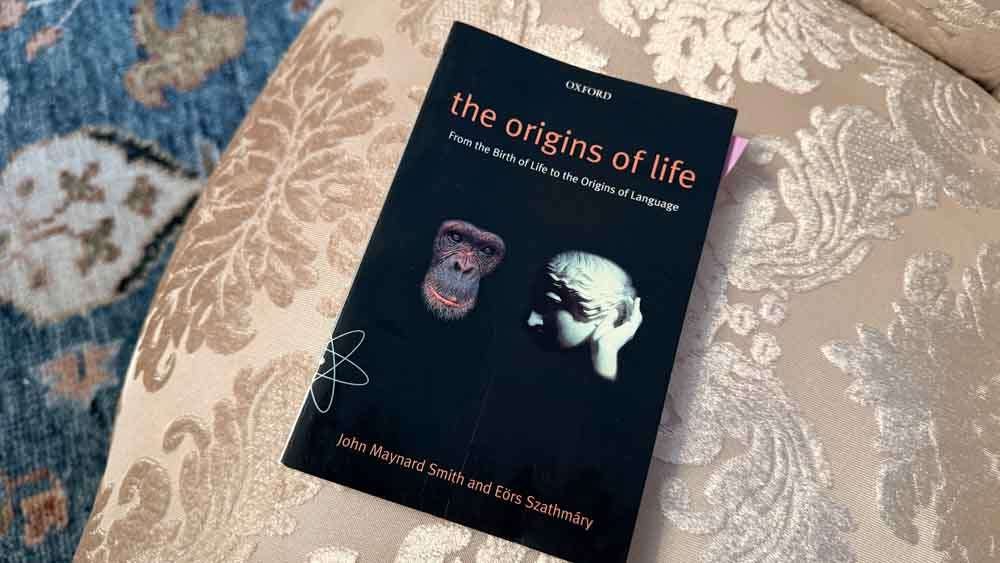
Every serious inquiry into biology eventually arrives at the same wall. You can trace the lineage of any living thing backward through time — through genus, through phylum, through kingdom — and the chain holds. Species give rise to species. Populations diverge. Mutations accumulate. Darwin explained all of that with a clarity that still feels like cold water on a hot day. But push far enough back and the chain simply ends. Not in some earlier, simpler organism, but in chemistry. Raw, indifferent, purposeless chemistry. The question of how life crossed that threshold — how replication, metabolism, and heredity emerged from molecules that had no interest in emerging at all — is one of the most difficult problems in all of science, and John Maynard Smith and Eörs Szathmáry attack it with the kind of rigor and intellectual courage that the question demands.
The Origins of Life: From the Birth of Life to the Origin of Language, published in 1999, is the accessible companion to their earlier and more technical work The Major Transitions in Evolution. Smith was one of the towering figures of twentieth-century evolutionary biology, the man who applied game theory to natural selection and gave us the concept of the evolutionarily stable strategy. Szathmáry, a Hungarian theoretical biologist, brought a complementary depth in chemistry and information theory. Together they argued that the history of life is not a smooth gradient of gradual change but a series of discrete, transformative transitions — moments when information was stored, copied, and transmitted in radically new ways. The origin of life itself was the first and most radical of these transitions.
The Problem with Chemistry
The central puzzle the book confronts is deceptively simple to state and extraordinarily hard to answer: how did molecules that replicate themselves first appear? For Darwinian selection to operate, you need variation, heredity, and differential reproduction. But heredity requires a copying mechanism, and a copying mechanism requires molecules of sufficient complexity. Those molecules, in turn, require biosynthetic pathways that are themselves encoded in hereditary molecules. The whole thing is circular in a way that makes your head swim. The chicken-and-egg problem of biology isn’t a metaphor — it is the literal problem of how life began.
Smith and Szathmáry’s treatment of this is patient and honest. They do not pretend we have a definitive answer, because we don’t. What they do instead is map the terrain of possible solutions with remarkable clarity. The RNA World hypothesis — the idea that RNA, unlike DNA, can both carry information and catalyze chemical reactions, and therefore might have served as the original self-replicating molecule — gets careful, measured treatment. They explain why it is compelling, where it runs into trouble, and what would need to be true for it to hold. This is what good science writing looks like: not breathless certainty, but structured uncertainty that helps you understand the shape of what we don’t yet know.
Hypercycles and the Replication Paradox
One of the book’s most intellectually bracing sections concerns the work of Manfred Eigen and the concept of the hypercycle. Here the authors engage with a genuine paradox: for a molecule to replicate with enough fidelity to preserve useful information, it needs to be long enough to encode a decent copying enzyme. But the longer the molecule, the more copying errors accumulate per replication, and above a certain length — Eigen’s error threshold — useful information is swamped by noise. You cannot have a long, complex replicator without a good copying enzyme. You cannot have a good copying enzyme without a long, complex replicator.
Eigen’s proposed solution was the hypercycle: a loop of cooperating RNA molecules, each helping to replicate the next, collectively encoding more information than any single molecule could manage alone. Smith and Szathmáry engage with this idea seriously but also critique it. Hypercycles are vulnerable to exploitation by selfish parasitic molecules that take the cooperative benefit without contributing to it — a problem that will feel familiar to anyone who has thought about the evolution of cooperation at any scale. The book works through the proposed solutions, including spatial compartmentalization (primitive membranes that would group cooperating molecules together), with the kind of rigor that makes you feel the difficulty rather than simply be told about it.
What Is a Major Transition?
The organizing framework of the book — and of Smith and Szathmáry’s broader intellectual project — is the concept of major evolutionary transitions. They identify eight of them: the origin of life itself, the emergence of chromosomes, the invention of the genetic code, the appearance of eukaryotic cells (cells with a nucleus), sexual reproduction, the evolution of multicellular organisms, the emergence of animal societies, and finally the origin of human language. What unites these apparently disparate events is a single underlying pattern: in each case, entities that previously replicated independently began to replicate only as part of a larger whole. Genes were gathered into chromosomes. Chromosomes were enclosed in cells. Cells merged to form multicellular bodies. The unit of selection shifted, and new levels of complexity became possible.
This framework is one of the genuinely important ideas in modern biology, and the book makes a strong case for it. It also raises profound questions about the stability of cooperation. At every level of this hierarchy, there is a tension between the interests of the larger collective and the selfish interests of the components. Cancer is what happens when that tension breaks down in a multicellular body — cells that defect from the collective and revert to individual replication. Understanding the major transitions means understanding how cooperation at each level was made stable, how defection was suppressed, and how new levels of organization became possible. These are not just evolutionary questions. They run straight through economics, political philosophy, and the theory of institutions.
The Origin of the Genetic Code
Among the most arresting chapters in the book is the one dealing with the origin of the genetic code — the specific mapping between RNA codons and amino acids that is, with minor variations, universal to all life on Earth. This universality is deeply strange. There is no obvious chemical reason why, say, the codon UUU should code for phenylalanine rather than something else. The code looks arbitrary. And yet it is shared by every bacterium, every plant, every animal, every fungus. The most parsimonious explanation is that every living thing on Earth is descended from a single ancestral population in which this code became fixed — the Last Universal Common Ancestor, or LUCA.
Smith and Szathmáry work through the competing hypotheses for why the code has the specific structure it does, including the stereochemical hypothesis (that certain codons have a physical affinity for certain amino acids) and the frozen accident hypothesis (that the code was essentially arbitrary but became impossible to change once the whole cellular machinery was built around it). They are clear about which arguments are stronger and which are speculative, and they resist the temptation to oversell any particular explanation. This epistemic honesty is one of the book’s consistent virtues.
Language as the Final Transition
The book’s final section turns to human language, and it is here that the argument becomes most ambitious — and, necessarily, most speculative. Smith and Szathmáry argue that the emergence of language represents a genuine major transition in the same sense as the earlier biological ones: a new system for storing and transmitting information, operating at a new level of organization, enabling new kinds of complexity. The analogy between genetic information and linguistic information is developed carefully. Both involve a symbolic code. Both require a machinery for transmission. Both are subject to copying errors and to selection.
What distinguishes language from genetic heredity, and what makes its origin so philosophically loaded, is that language allows the transmission of acquired information. A genetic mutation that arises in one generation can be passed on, but what an individual learns in a lifetime cannot be written into the genome. Language breaks that barrier. It allows one individual’s experience to become another’s knowledge without biological inheritance. It is, in the authors’ framing, the beginning of what we might call cultural evolution — the domain Dawkins had earlier sketched with the concept of the meme, and which readers of The Selfish Gene will find deeply familiar territory.
Does the Answer Change How We Live?
The question that hangs over a book like this — the question that separates it from a narrowly technical treatise — is whether the answer to “where did life come from?” changes anything about how we experience being alive. I think it does, though not in the way that provokes anxiety.
What Smith and Szathmáry describe is a universe in which the emergence of life was not guaranteed, not planned, and not directed toward any outcome — and yet was also not random in the pejorative sense of the word. Each step was constrained by physics and chemistry. Each transition happened because it was, under the right conditions, selectively advantageous or thermodynamically favorable. Life did not appear because it was supposed to. It appeared because, given enough chemistry and enough time, certain kinds of order are what physics tends toward in open, energy-consuming systems. That is either humbling or awe-inspiring depending on your temperament, and I suspect it is both.
The book pairs powerfully with On the Origin of Species — Darwin handles what happened after life was already underway; Smith and Szathmáry reach back before Darwin’s starting line. It also rewards reading alongside The Extended Phenotype, which explores how the logic of the gene extends outward into the world. Together these three books form something close to a complete account of life as a physical and informational phenomenon.
The Origins of Life is not light reading. It asks you to hold chemistry, thermodynamics, information theory, and evolutionary biology in your mind simultaneously, and it does not apologize for that. But it is written with genuine care for the non-specialist reader, and the rewards are proportionate to the effort. After reading it, you will look at a blade of grass, a jar of sourdough starter, a drop of seawater — anything alive — and see something different. Not something mysterious in the vague, hand-waving sense. Something genuinely strange, and genuinely understood, in all its irreducible complexity.
That combination — strangeness fully illuminated — is what the best science writing achieves, and this book achieves it.
Sources
- Smith, John Maynard, and Eörs Szathmáry. The Origins of Life: From the Birth of Life to the Origin of Language. Oxford University Press, 1999. https://global.oup.com/academic/product/the-origins-of-life-9780198504931
- Smith, John Maynard, and Eörs Szathmáry. The Major Transitions in Evolution. W. H. Freeman/Spektrum, 1995. https://www.amazon.com/Major-Transitions-Evolution-John-Maynard/dp/019850294X
- Eigen, Manfred. “Selforganization of Matter and the Evolution of Biological Macromolecules.” Die Naturwissenschaften, 1971. https://link.springer.com/article/10.1007/BF00623322
- Gilbert, Walter. “The RNA World.” Nature, vol. 319, 1986. https://www.nature.com/articles/319618a0
- Woese, Carl R. “The Universal Ancestor.” Proceedings of the National Academy of Sciences, 1998. https://www.pnas.org/doi/10.1073/pnas.95.12.6854