
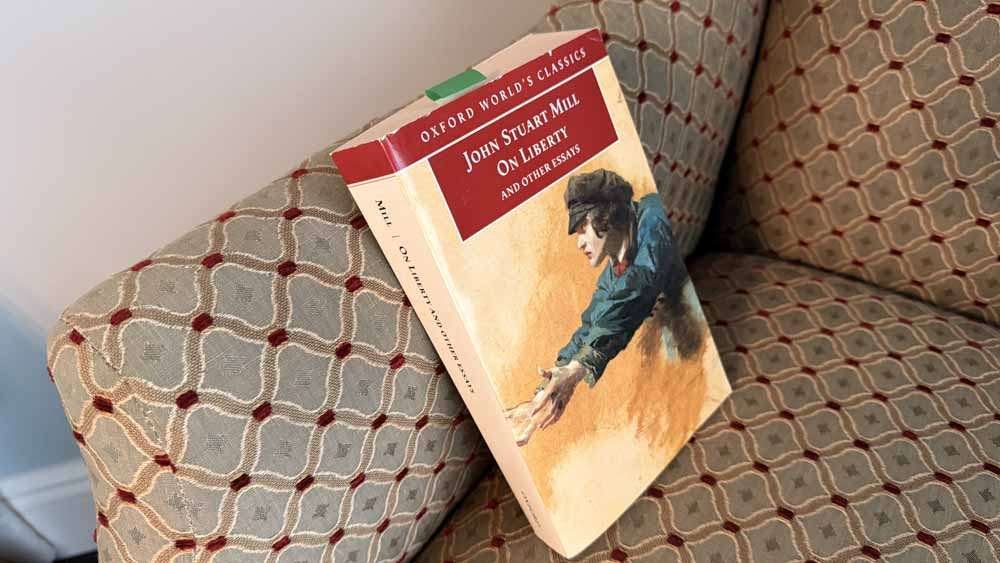
Published in 1859 — the same year Darwin dropped On the Origin of Species and lit a fuse under everything humanity thought it knew about itself — John Stuart Mill released On Liberty, and lit a different kind of fuse. One aimed not at biology but at government. Not at God but at social conformity. Not at the past but at the permanent human instinct to tell other people how to live.
The book is short. Barely a hundred pages in most editions. Mill himself called it a small book. What he didn’t say is that it contains one of the most consequential single sentences in the history of political thought:
The only purpose for which power can be rightfully exercised over any member of a civilised community, against his will, is to prevent harm to others.
That’s it. That’s the Harm Principle. Everything else in the book is either argument in its defense or application of it to specific cases. And yet here we are, a hundred and sixty-five years later, still arguing about what it means.
The Argument Mill Actually Makes
Most people who reference the Harm Principle have never read Mill. They quote it as though it’s a slogan — leave me alone unless I’m hurting someone — without understanding the philosophical architecture that holds it up.
Mill was a Utilitarian. He believed the test of any moral or political position was whether it maximized human happiness. What makes On Liberty unusual, even within his own tradition, is that he doesn’t justify individual freedom primarily because it feels good or because it’s a natural right. He justifies it because, over time, free individuals and free societies produce better outcomes than controlled ones. Liberty, in Mill’s framework, is instrumentally valuable — not just intrinsically sacred.
This is a harder argument to dismiss than “you can’t tell me what to do.” It forces the paternalist to prove their case empirically: that restricting this person’s freedom actually produces more good than leaving them free. Mill’s bet — and it’s a bet rooted in deep skepticism of authority — is that the state almost never wins that case.
The Three Domains Mill Defends
Mill isn’t vague about what freedom means. He identifies three specific zones of liberty that government has no right to enter.
The first is the domain of consciousness — thought, feeling, opinion, and conscience. No authority, religious or secular, has the right to dictate what you believe. The second is the liberty to pursue your own purposes, to live your own life as you choose, so long as you bear the consequences yourself. The third is the freedom to associate — to unite with others around whatever common cause you choose, provided it harms no one outside that association.
These three domains, Mill argues, are where the individual is sovereign. Not the state. Not the church. Not the majority.
That last point — the majority — is where the book gets genuinely interesting, and where Mill shows he’s thinking past his own century into ours. He feared what he called the tyranny of prevailing feeling almost as much as he feared government overreach. A democracy can be as oppressive as a monarchy if its majority decides that nonconformity is unacceptable. You don’t need a law against thinking differently — you just need a culture that treats difference as a problem. Mill saw this and called it by name. The social pressure to conform, to not stand out, to not say the uncomfortable thing — that too is a form of tyranny. Quieter. Harder to fight. In some ways more effective.
He was describing 2026 as clearly as he was describing 1859.
Why the Harm Principle Is Harder Than It Sounds
Here’s where the book earns its longevity: the Harm Principle is not a simple rule. It’s a framework that immediately generates hard questions.
What counts as harm? Does it have to be direct and physical, or can it be economic, psychological, cultural? Does your right to swing your fist end at my nose, or somewhere before that? What about harms you do to yourself — does the state have an obligation to intervene in what Mill calls “self-regarding” actions? He says no. But then he spends considerable time on exceptions and edge cases, which suggests he knows the line isn’t always clean.
The tension is this: Mill wants to protect individual freedom from collective interference, but he also wants a society that functions, that produces flourishing human lives, that doesn’t atomize into pure selfishness. Those two things are in permanent, productive friction with each other. Every generation has to negotiate them fresh.
What I find most honest in Mill is that he doesn’t pretend otherwise. He doesn’t offer a formula. He offers a principle and then shows you how to think with it. That’s rarer in political philosophy than it should be.
The Chapters That Still Sting
The essay on the liberty of thought and discussion — Chapter 2 — is the one that tends to stop readers cold, because Mill does something few political thinkers are willing to do: he defends the right of the wrong to speak.
His argument is not that all opinions are equally valid. It’s that suppressing any opinion, even a false one, damages the process by which truth is found and kept alive. If your belief is never challenged, you don’t actually hold it — you merely possess it the way you possess a piece of furniture. You can’t articulate why it’s true, you can’t defend it under pressure, you have no idea what would count as evidence against it. Mill thought a society of unchallenged beliefs was a society of sleepwalkers. And he thought the instinct to silence disagreement — however well-intentioned — was one of the most corrosive forces in public life.
He’s not entirely comfortable reading on this point. He’s asking you to protect speech you find dangerous, offensive, or simply wrong. Not because it might be right. Because the act of engaging with it keeps your own thinking honest.
That’s a demanding ask. It was demanding in 1859. It doesn’t get easier.
The chapter on individuality — Chapter 3 — is where Mill comes closest to sounding like Nietzsche, though he gets there by a different road. He argues that human nature is not a machine to be adjusted but a tree to be grown, and that the conditions for that growth require freedom. Conformity produces mediocrity. Not because mediocre people are bad — they’re not — but because a society organized around conformity loses the capacity to generate the kind of original thinking that moves civilization forward. The eccentric, the dissenter, the person who refuses to simply absorb the values handed to them — these are not dangers to society. They’re how society renews itself.
I’ve spent time with Thus Spoke Zarathustra and found Nietzsche making a related argument from a harsher angle. Mill’s version is kinder. More democratic. He’s not interested in supermen — he’s interested in conditions under which ordinary people can become more fully themselves.
What the Critics Get Wrong
There is a standard critique of the Harm Principle that reduces it to naive libertarianism — the idea that Mill is just saying “anything goes.” He isn’t. He’s making a narrower, more specific argument: that the coercive power of the state and of social pressure should not be used to enforce majoritarian preferences about how to live. That’s not the same as saying there are no obligations to others, no community, no common good.
A more serious critique is that Mill’s framework assumes a kind of individual who is already self-possessed, educated, and capable of rational self-governance. His own views on colonial rule — which aged badly, to put it charitably — suggest he had a narrower conception of who qualified for full liberty than the Harm Principle implies. This is a real tension in his thought, and honest readers don’t paper over it.
Civilization and Its Discontents took a darker view of what happens when you give individuals free rein — Freud thought the instincts always eventually collide with the requirements of civilization. Mill would not have been surprised by the objection. He would have said the question is who decides when to intervene, by what authority, and with what safeguards against abuse. The answer to human complexity is not a more powerful state. It’s a more thoughtful one.
Why It Endures
The reason On Liberty stays in the conversation is not that it solved the problem of freedom. It’s that it gave us the clearest terms in which to argue about it.
Every time a government bans something “for your own good,” someone is implicitly invoking Mill — or would be, if they’d read him. Every time a platform removes content on the grounds that it causes harm, the argument being made is a direct descendant of the questions Mill raised. Every time someone is pressured into silence not by law but by social consensus, Mill’s warning about the tyranny of prevailing feeling is the most relevant text available.
He wrote a thin book in 1859 and put a question into circulation that has not been answered yet: at what point does the community’s right to protect itself end and the individual’s right to be left alone begin?
Governments have been getting that line wrong in both directions ever since.
Brave New World imagined what it looks like when conformity wins completely — not through force but through engineered comfort. No Exit showed the existential price of a life defined by others’ judgments. Mill was working the same territory from a different direction: not fiction, not drama, but argument. Clear, patient, relentless argument.
That’s what makes On Liberty one of the most influential political works ever written. Not because it’s easy. Because it refuses to be anything other than honest about how hard the question actually is.
You Might Also Like
- Civilization and Its Discontents by Sigmund Freud — The Book That Saw the Twentieth Century Coming
- Thus Spoke Zarathustra by Friedrich Nietzsche — The Book That Rewired My Understanding of Everything
- The Writings of William James: A Useful Mind in an Impatient World
Sources
- Mill, John Stuart. On Liberty. John W. Parker and Son, 1859. Available via Project Gutenberg
- Skorupski, John. Why Read Mill Today? Routledge, 2006.
- Riley, Jonathan. Mill’s Radical Liberalism. Routledge, 2015.
- Gray, John. Mill on Liberty: A Defence. Routledge, 1983.
- Stanford Encyclopedia of Philosophy — John Stuart Mill
- Internet Encyclopedia of Philosophy — John Stuart Mill: Ethics