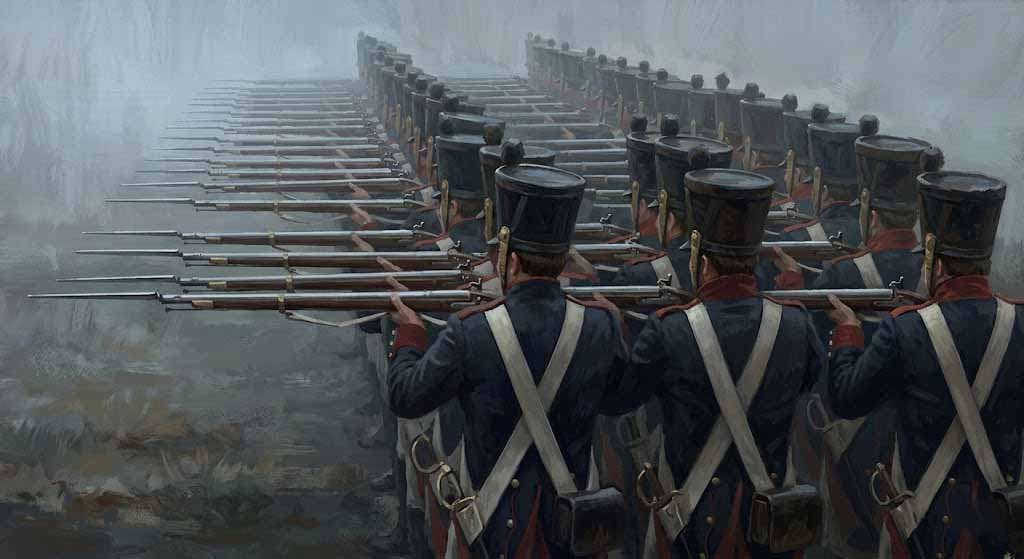
Look at the firing squad. No faces. Just uniforms and gun barrels. Goya figured out the modern world before the rest of us: the machine kills you, and the machine doesn’t care.
He painted The Third of May 1808 in 1814, six years after the event it depicts — Napoleon’s troops executing Spanish civilians and resistance fighters the morning after the Madrid uprising. He didn’t paint it from witness accounts alone. Goya was deaf by then, had been for nearly twenty years, living in a silence that perhaps sharpened what his eyes took in. He’d watched his country occupied, watched neighbors disappear, watched the French army operate with the mechanical efficiency of an institution that had long since disconnected killing from conscience.
What he put on that canvas is not what the world expected from a war painting in 1814. It’s what the world would spend the next two centuries slowly learning to see.
The Tradition He Dismantled
To understand what Goya did, you need to know what he was painting against.
War painting before the nineteenth century was a genre built on glorification. Mounted generals in the foreground, banners flying, the defeated lying with a kind of sculptural dignity at the victors’ feet. Think of Velázquez’s Surrender of Breda — even the vanquished have posture, have dignity. The whole tradition assumes that war is a theater of human virtue: courage, honor, sacrifice, the triumph of the righteous. Death, in this tradition, is meaningful. It means something to die in battle. The painter’s job was to record what it meant.
Goya tore that apart.
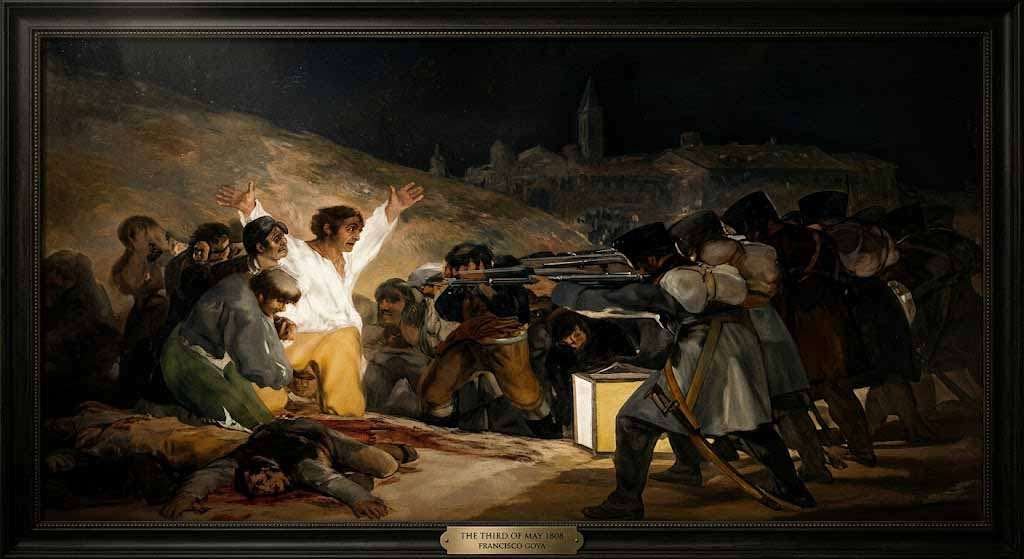
There is no glory in The Third of May. There is no dignity in the postures of the men about to die. The white-shirted figure — the most lit, the most central, arms flung wide in a gesture that critics have compared to a crucifixion — is not a hero striking a pose. He’s terrified. His mouth is open. His eyes are wide. The man to his left covers his face with his hands. The man behind him has already collapsed. These are not soldiers. They are caught men — farmers, laborers, anyone unfortunate enough to have been in Madrid when the order came down.
The Faces That Aren’t There
The French soldiers have no faces.
This is the painting’s most deliberate and devastating formal choice. The soldiers form a unified mass — dark uniforms, identical shakos, rifles leveled at the same angle, boots planted at the same stance. They are a mechanism, not men. You cannot appeal to them. You cannot reason with them. There is no individual conscience present to which any of the condemned might make a human plea.
The art historian Kenneth Clark wrote that The Third of May is “the first great picture which can be called revolutionary in every sense of the word, and is the first modern picture.” What he meant, in part, is that Goya was the first major painter to show the machinery of organized state violence without romanticizing it — to show it as a process rather than a drama.
A process doesn’t have protagonists. A process just runs.
The facelessness of the soldiers is not a compositional accident or a technical limitation. It is the point. When states kill at scale — and Goya had seen the French military operate at scale across Spain during the Peninsular War — they do it through the instrument of the anonymous soldier who follows orders and does not look his victim in the eye. The soldier doesn’t need to. The institutional structure removes the need for personal moral engagement. Someone higher up decided. The soldier executes.
What the Light Does
The large square lantern on the ground — the only artificial light source in the painting — illuminates the condemned men and almost nothing else. The soldiers are lit from the side, enough to read their forms but not their expressions. The hill in the background is dark. The city beyond is dark. All the light in this painting is concentrated on the dying.
This is not accidental. It is a moral spotlight. Goya is forcing your eyes to stay with the victims. He won’t let you rest your gaze on the soldiers long enough to find them interesting. He won’t let you look at the landscape. There is nowhere to look but at the white shirt, at the flung arms, at the horror on the faces of the men who are watching their comrades die and waiting their turn.
The lantern itself is crude. It’s a working-class light source — the kind of thing you bring to a job site or a stable, not the kind of thing that belongs in any formal ceremony. Goya even makes the instrument of illumination humble. Nothing about this execution is elevated. It is a job being done in the dark by men with a light they brought from somewhere practical.
The Morning After
Napoleon’s armies entered Spain in 1808 under the pretense of alliance, then turned on the population. On May 2nd, Madrileños rose up in revolt — the famous Dos de Mayo. The French response was immediate and systematic: mass arrests, and the following morning, summary executions. Thousands died across Spain in the weeks that followed.
What made it different from previous military violence wasn’t the scale alone. It was the administrative character of it. The French forces operated with bureaucratic efficiency — lists, orders, designated shooting sites, mass graves. The execution Goya depicts wasn’t a battlefield event. It was a procedure. The men were brought to a hill outside the city, stood up, and shot by a unit that then moved on to the next group.
Goya understood what that meant. His Disasters of War — the series of etchings he produced between 1810 and 1820, unpublished in his lifetime — documents atrocity with the same unsparing clarity. The caption on one of the most famous simply reads: Esto es lo peor — “This is the worst of it.”
The Third of May is the large-scale, full-color version of that etching series. Same refusal to look away. Same refusal to frame the dead as anything but dead.
The Class Dimension
Look at who’s dying.
The condemned in the painting are not in military uniforms. They are in workers’ clothes — coats, simple shirts, rough trousers. The white-shirted man, the painting’s central figure, has hands that art historians have noted are rough and callused, the hands of someone who works with them. These are not aristocrats. These are not officers or politicians or the people whose decisions actually caused the conflict between France and Spain. Those people were somewhere else, negotiating, surviving, accommodating.
The men on the hill at dawn are the people who always end up on the hill at dawn. The ones with no leverage, no connections, no way out. They picked up whatever weapons they had during the Dos de Mayo because that’s what people do when an occupying army is killing people in their streets. Then the army found them, or found people who looked like them, or simply rounded up enough to make a point.
Francisco José de Goya y Lucientes was the son of a master gilder. He was not an aristocrat by birth. He knew what class meant in Spain, had painted both the royal family and the people of the streets with the same unblinking directness. He did not romanticize peasants any more than he romanticized kings. But he recognized a pattern: when empires fight each other, it is the working man who bleeds.
He didn’t say that as an ideology. He said it as an observation. The painting is the observation.
What Came After
Goya’s influence on war art runs deep and largely unacknowledged. Édouard Manet’s The Execution of Emperor Maximilian (1867–1868) is in direct conversation with The Third of May — the same faceless firing squad, the same ordinary-man victim, the same flat refusal to heroize. Picasso’s Guernica (1937), responding to the aerial bombing of a Basque civilian town by Franco’s forces and Nazi Germany, carries the same DNA: not a painting of war’s glory but a record of what war does to a town, to bodies, to horses and children and women screaming at the sky.
The lineage is clear. Goya established that great war painting was not about bravery or victory. It was about consequence.
That realization — that the painter’s job is to show you what was done rather than to make you feel good about it — is the pivot point of modern art’s engagement with violence. Before Goya, war painting was largely propaganda for whoever commissioned it. After Goya, the honest painter has to choose: serve the state’s narrative, or serve the truth of what the state does.
Goya, once the king’s favorite court painter, chose the truth.
1814 and Now
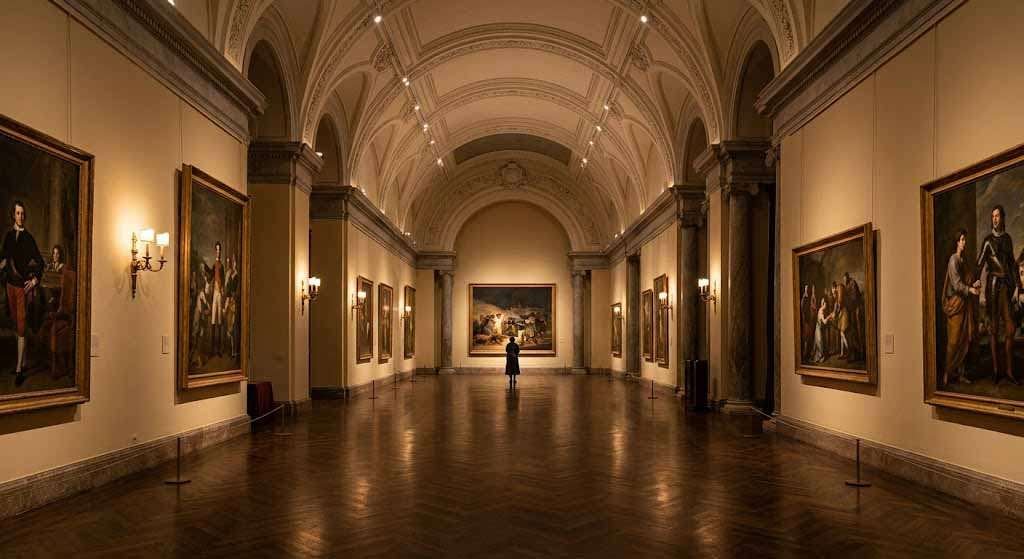
The Third of May 1808 hangs in the Museo del Prado in Madrid. It was painted as a petition to the restored Spanish monarchy — Goya requested royal funding to paint “the most notable and heroic actions or scenes of our glorious insurrection against the tyrant of Europe.” What he delivered was the opposite of heroic, in the conventional sense. He delivered the dead.
The monarchy accepted it anyway, which says something about either their obtuseness or their understanding. Perhaps they recognized that the painting would endure longer than any celebration of their own restoration, and they were right.
Stand in front of it long enough and you stop seeing 1808. You start seeing the structure — the faceless apparatus on one side, the terrified ordinary people on the other, the lantern that illuminates only the ones being killed. That structure is not historical. It keeps recurring. The victims change. The uniforms change. The rifles update. The posture of the firing squad stays exactly the same.
Goya knew that. He was painting something that had already happened many times and would happen many times more. The specific date is in the title. The general truth is in the composition.
He gave us both. The least we can do is look.
You Might Also Like
- Jacques-Louis David’s The Death of Socrates — Conviction, Hemlock, and the Price of the Examined Life
- Rembrandt’s Aristotle with a Bust of Homer — A Portrait of the Mind in Conflict
- Civilization and Its Discontents by Sigmund Freud — The Book That Saw the Twentieth Century Coming
Sources
- Museo del Prado, The Third of May 1808: museodelprado.es
- Kenneth Clark, The Romantic Rebellion (Harper & Row, 1973)
- Robert Hughes, Goya (Alfred A. Knopf, 2003)
- Janis Tomlinson, Francisco Goya y Lucientes: 1746–1828 (Phaidon, 1994)
- Nigel Glendinning, Goya and His Critics (Yale University Press, 1977)